You’re staring at your laptop at 2 AM, nine tabs open. Porsche configurator in one window, Lotus specs in another, your bank statement minimized somewhere you’re trying to ignore.
Here’s the weird tension you’re feeling. One is the proven legend that invented this game. The other just walked in acting like it owns the room. You’ve read the reviews. You’ve watched the videos. And somehow you’re more confused than when you started.
This isn’t about 0-60 times or battery sizes. It’s about whether you’re buying a car or buying into an idea about yourself.
Here’s the path we’ll walk together. We’ll face the uncomfortable money truths first. Then we’ll test the performance claims with real-world data. And finally, we’ll figure out which one fits your actual life, not your fantasy garage.
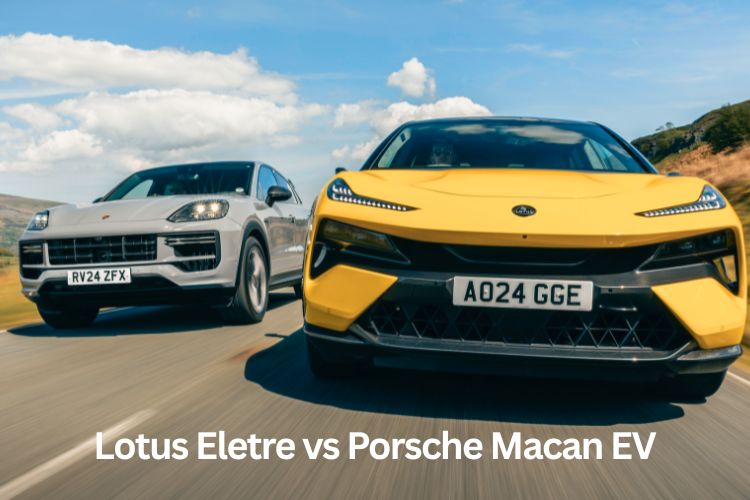
Keynote: Lotus Eletre vs Porsche Macan EV
The luxury electric SUV comparison between Lotus Eletre and Porsche Macan EV reveals two distinct philosophies. Porsche delivers proven driving dynamics with 800-volt charging architecture and refined daily usability. Lotus counters with radical design, 905-hp performance options, and advanced LIDAR technology. Real-world range favors the Macan’s efficiency at 280 plus miles versus the Eletre’s inconsistent 200-mile reality. Pricing dynamics fundamentally shift value calculations, with Chinese manufacturing tariffs pushing the Eletre R to $229,900 versus the Macan Turbo’s $105,300. For most buyers, Porsche’s established dealer network and superior resale value outweigh Lotus’s tech-forward gamble.
The Identity Question: What Your Driveway Says Before You Say Anything
The Porsche Macan EV: When You Want Quiet Confidence
The Macan earns approving nods at every stoplight. It’s the choice your logical brain, your accountant, and your mother-in-law all approve of. German engineering that needs no explanation at dinner parties.
Why does this feel like the “right” choice to everyone except maybe you? Because Porsche spent seven decades teaching the world what driving excellence means. The Macan EV is their best-selling model going electric, and they treated it like reconstructive surgery on a beloved face.
What you actually gain here is the boring trinity that secretly matters: respect, reliability, resale value. These aren’t exciting words. But they’re the words that let you sleep at night when you’ve just spent six figures.
The Lotus Eletre: When You Need Strangers to Stop and Stare
Let’s say it plainly. British badge, Chinese manufacturing, owned by Geely. You’ll spend the first year explaining what a Lotus even is to curious onlookers at Whole Foods.
This isn’t Colin Chapman’s Lotus. The man who said “simplify, then add lightness” would look at the Eletre’s 5,920-pound curb weight and probably weep into his tea. But does that matter to your heart when you see those dramatic air vents breathing like a living thing?
What you gain is conversation, controversy, and a garage that finally feels interesting. The Eletre is Lotus’s radical reinvention, a hyper-SUV built to challenge Bentley Bentaygas and Lamborghini Uruses. It’s a first-generation gamble wearing a storied name.
Reality check: you’re not buying heritage here. You’re buying ambition. And ambition is expensive.
The Money Talk You’ve Been Avoiding
Porsche’s Expected Pain
Macan base: $77,295. Macan 4S: $86,895. Turbo: $105,300 before you even think about options. And you will think about options because Porsche’s configurator is designed to make you feel incomplete without them.
You knew it would be expensive. Porsche’s been training you for this moment your entire adult life. Every time you’ve seen a 911 or Cayenne and thought “someday,” you were preparing your brain to accept these numbers.
The secret superpower here? Strong resale value proven over decades. Porsches hold their worth like few other brands. That $105,000 Turbo won’t feel quite so painful when it’s still worth $70,000 three years later.
Lotus’s Wallet-Crushing Reality Check
Base Eletre: $107,000. Eletre R: $229,900. Read that second number again. Yes, more than a Porsche Taycan Turbo S.
At $230k, the Eletre R costs more than three Mazda CX-50s stacked together. Or two fully-loaded Tesla Model Ys with enough left over for a nice vacation. The reason? A 100% tariff on Chinese-built electric vehicles just landed on this car like a financial anvil.
Here’s the question nobody wants to ask but everyone’s thinking: which one holds value better? The proven Porsche with 192 US dealers and 70 years of brand equity, or the first-generation Chinese-built Lotus with 47 US dealers and a completely unknown depreciation curve?
The Real Cost Breakdown
| Cost Reality | Porsche Macan EV | Lotus Eletre |
|---|---|---|
| Entry Price | $77,295 | $107,000 |
| Top Trim | $105,300 (Turbo) | $229,900 (R) |
| Real Efficiency | 98-108 MPGe | 83-84 MPGe |
| Warranty Coverage | 4 years/50k miles | 5 years/60k miles |
| Likely Resale | Strong Porsche track record | Unknown first-gen experiment |
Insurance will hurt more with the Lotus. Exotic badge means exotic premiums, typically 20-35% higher than Porsche. Your annual cost difference could buy you a nice used Miata.
Performance Reality: Fast vs Violently Fast vs Actually Drivable Daily
Porsche’s Goldilocks Formula
Macan 4: 402 hp, 4.9 seconds to 60 mph. Quick without feeling violent. Macan 4S: 509 hp, 3.6 seconds. The sweet spot that makes passing lanes feel like teleportation. Macan Turbo: 630 hp, 3.1 seconds (Car and Driver clocked 2.9 seconds). Still behaves perfectly in school zones.
The Macan’s steering is a scalpel. Precise and confidence-inspiring on backroads, making you feel like a better driver than you actually are. Porsche engineered these SUVs to handle like the sports cars that built their reputation.
This is performance you can use every single day without drama. No explaining to your spouse why the tires cost $2,000 to replace or why your neck hurts after the morning commute.
Lotus’s Nuclear Option Nobody Actually Needs
Eletre R packs 905 horsepower. Sub-3 second 0-60. MotorTrend described the acceleration as “bordering on unpleasant.” That’s not a compliment when you’re talking about a family SUV.
The base Eletre delivers 603 hp, which is still more power than most people will ever use on public roads. It’s the automotive equivalent of having a flamethrower when you really just needed a lighter.
Does 905 hp feel incredible for exactly three seconds on an empty on-ramp? Absolutely. Does it make sense for the other 99.9% of your driving? Ask yourself honestly.
Weight You’ll Feel in Tight Parking Lots
Macan 4S: 5,110 lbs. Eletre R: 5,920 lbs. That’s an extra 810 pounds you’re lugging around. Every single pound shows up in tight parking lots, narrow driveways, and when you’re trying to avoid the shopping cart someone left in your lane.
Porsche feels refined, collected, makes 5,100 pounds disappear through masterful suspension tuning. The Eletre feels massive and unwieldy at parking speeds, with a noticeable “clunk” over bumps that reminds you exactly how heavy it is.
Range Anxiety: The Uncomfortable Truth About Real-World Miles
Porsche’s Honest Numbers You Can Trust
EPA ratings: 315 miles for the base model, 288 miles for the Turbo. These are conservative numbers you can actually hit with normal driving.
MotorTrend’s real-world testing got 282 miles on the Macan 4, 261 miles on the 4S. That’s the brutal honesty that EPA testing sometimes misses. These are highway miles at 75 mph, the speed you’ll actually drive.
Translation: this is usable for road trips without constant charging panic. You can plan a 250-mile leg, arrive with battery to spare, and not white-knuckle the last 30 miles watching the range estimate drop.
Lotus’s Range Problem Nobody’s Talking About
Official EPA: 373 miles for the base model, 260 miles for the R. Sounds competitive. But real-world reports tell a different story.
Owners are struggling to hit 200 miles in mixed driving. Efficiency hovers around 2.0 miles per kWh, well below what that massive 112 kWh battery should deliver. The Eletre R’s claimed efficiency simply doesn’t math when you put real electrons through real motors moving 5,920 pounds.
What this means: more frequent charging stops, more trip planning, more explaining to passengers why you’re stopping again. The range anxiety you thought you’d escaped by going electric? It’s back.
Charging Speed Where Both Shine
| Charging Reality | Porsche Macan EV | Lotus Eletre |
|---|---|---|
| Architecture | 800-volt | 800-volt |
| Peak Speed | 270 kW | Up to 350 kW |
| 10-80% Time | ~21 minutes | ~20 minutes |
| Real Impact | One coffee stop equals a week of commuting | When you charge more often, does speed advantage matter? |
Both use cutting-edge 800-volt architecture. Both can accept a meaningful charge faster than you can finish a bathroom break and grab coffee. The Porsche’s clever trick: it can split its battery pack to charge at 135 kW on older 400-volt infrastructure, making it more flexible on road trips.
But here’s the gap analysis nobody’s covering: what happens after 80%? The Eletre maintains 50-70 kW from 80-100%, while the Macan tapers to 40-60 kW. For long road trips where you’re chasing that last 20%, the Lotus has a real advantage.
Daily Living: Where Six Figures Meets Your Actual Tuesday
Interior Quality Where Money Meets Materials
Porsche delivers exactly what you’d expect. Understated precision built to last a decade without squeaks or rattles. The twin-screen layout works flawlessly, climate controls respond with satisfying haptic feedback. But walk up from a $50,000 car and you’ll notice hard plastics in places that feel wrong at $100,000.
Lotus delivers surprisingly excellent execution. That 15.1-inch OLED screen is stunning. The 23-speaker KEF audio system makes your Spotify playlists sound like studio recordings. Bronze accents, soft leathers, knurled metal switchgear that feels jewelry-grade.
Top Gear admitted the Eletre’s quality matches BMW and Porsche levels. That’s not faint praise. That’s a first-generation Chinese-built SUV matching German benchmark quality.
Space and Practical Reality
| Daily Use | Porsche Macan EV | Lotus Eletre |
|---|---|---|
| Cargo Space | 47 cubic feet | 54 cubic feet plus 2.9 cu-ft frunk |
| Rear Seat | Adequate but not generous | Properly spacious |
| Overall Size | Perfectly sized daily athlete | Feels like a flagship |
The Lotus gives you more room for actual stuff. The Porsche gives you a more usable frunk that can actually hold groceries instead of just a charging cable and owner’s manual.
Neither will embarrass you when your in-laws visit. But the Eletre’s rear seat is genuinely comfortable for adults on long trips, while the Macan’s rear passengers will notice the compromise.
Ownership Experience Nobody Reviews
Porsche means dealer networks everywhere. Loaner cars when yours needs service. Known service intervals every 10,000 miles. A community of owners who’ve documented every quirk and solution.
Lotus means 47 US dealers versus Porsche’s 192. You’re the beta tester for a brand-new electric platform. Unknown reliability. Depreciation curves that don’t exist yet because nobody’s selling 3-year-old Eletres.
Depreciation reality from the source data: the Eletre could lose 40% in year one versus 30% for the Macan. That’s $43,000 versus $23,000 evaporating on a base model. Math that makes premium German engineering look like the fiscally responsible choice.
Tech Philosophy: Seamless Polish vs Daring Future
Porsche’s It Just Works Ecosystem
The infotainment runs on Android Automotive and it’s lightning fast. The “Hey Porsche” voice assistant actually understands you on the first try. Apple CarPlay integrates so deeply that Apple Maps shows up in your instrument cluster, a feature few brands manage.
The charging planner is genuinely intelligent. Enter a long destination and it automatically routes you through optimal fast chargers, preconditioning your battery pack as you approach so you can grab maximum charging speed. This is the polish that justifies a premium badge.
Occasional software quirks get noted by testers, but nothing that breaks the experience. This is mature technology that won’t blow your mind but will never frustrate you at 6 AM when you’re running late.
Lotus’s Unreal Engine Wow Factor
The UI runs on Unreal Engine, the same software powering video games. Graphics are stunning, fluid, responsive in ways that make other cars feel ancient. Deployable LIDAR sensors rise from the roof like something from a sci-fi film.
Bold aero design that actually breathes. Active vents opening and closing. The interior feels like a lounge meets hypercar, with screens for driver, passenger, and rear occupants creating a shared digital ecosystem.
Honest truth: more wow factor but potentially more first-generation bugs. You’re investing in Lotus’s vision of the future, complete with hardware ready for Level 3 autonomous driving that doesn’t exist yet in software or regulation.
The platform impact on cabin noise, vibration, and harshness: Geely’s Electric Premium Architecture versus Porsche’s PPE platform makes a real difference at highway speeds. The Macan feels vault-quiet. The Eletre, for all its luxury, can’t quite match that German refinement when you’re cruising at 75 mph.
The Final Matchmaking: Which One Fits Your Actual Life?
Choose the Porsche Macan EV If
You value proven reliability over proving a point to strangers. Your daily commute involves tight parking and school runs where size matters. Resale value isn’t just something you pretend to care about when justifying the purchase.
You want 280 plus real-world miles without range anxiety. $80k to $110k feels expensive but defensible to your logical brain and your spouse.
You’d rather drive a scalpel than a sledgehammer. The car makes you look competent instead of compensating.
Choose the Lotus Eletre If
You’re genuinely okay being the guinea pig for Lotus’s electric future. You have home charging and rarely road trip beyond 150 miles, or you enjoy planning charging stops like a strategic game.
The conversation is worth more to you than the inconvenience. You have another car for when the Lotus is figuring itself out at the dealer.
$230k plus is money you can afford to light on fire if this experiment fails. You’re not buying transportation. You’re buying a statement piece that happens to have seats.
The Question That Settles It
Ask yourself this in a quiet moment. Five years from now when the initial thrill has worn off and you’re just living with this machine, which one will still make sense?
When it’s 15 degrees outside and the charging station is occupied and you’re already running late. When the service center is 90 minutes away instead of 15. When your friend asks what it’s worth now and you have to look up the answer on your phone with dread.
Which one becomes a friend instead of a flex?
Conclusion: Your Garage, Your Truth, No Regrets
The Porsche is the choice your logical brain approves. The Lotus is the choice your emotional brain won’t shut up about. Both are extraordinary machines packing 800-volt architecture, dual-motor all-wheel drive, and performance that would make your teenage self weep with joy.
But only one is the right kind of extraordinary for your actual life, not your imagined one. The Macan delivers refined daily-driver capability with legendary Porsche handling dynamics and a dealer network that won’t leave you stranded. The Eletre delivers raw spectacle with a 54 cubic-foot cargo area and tech that feels beamed from 2030.
The first step for today: stop reading reviews. Book same-day back-to-back test drives this weekend. Sit in Saturday traffic in each one. Drive imperfect roads with potholes. Nail a fast on-ramp. Time a real charging session at a 350 kW site. Feel which one fits your hands, your commute, your actual Tuesday.
The best car isn’t the one with the most horsepower or the biggest badge. It’s the one you won’t resent six months in when the novelty fades and you’re just driving. When your luxury electric SUV feels like a friend instead of a flex, you chose right.
Porsche Macan EV vs Lotus Eletre (FAQs)
Does the Lotus Eletre qualify for federal EV tax credit?
No. The Eletre is manufactured in Wuhan, China, which disqualifies it from the $7,500 federal EV tax credit under current Inflation Reduction Act requirements. Only vehicles with final assembly in North America qualify, giving the German-built Porsche Macan EV no advantage here either.
How much does it cost to insure a Lotus Eletre vs Porsche Macan EV?
Expect to pay 20-35% more annually to insure the Eletre. Exotic brand status, limited repair networks, and unknown parts costs drive premiums higher than established luxury brands. A Macan EV might cost $2,000-$2,500 yearly to insure, while the Eletre could hit $2,700-$3,400 depending on your driving record and location.
Which has better build quality: Lotus or Porsche?
Porsche maintains its legendary German build quality with proven long-term reliability. The Eletre surprises critics with interior quality matching BMW and Porsche standards, but it’s a first-generation product on a new platform. Long-term durability remains unknown, while Porsche’s track record spans decades.
Can Porsche Macan EV use Tesla Superchargers?
Yes, with an adapter. The Macan EV uses the CCS1 charging standard but Porsche is working on NACS (North American Charging Standard) adapter availability. Once available, you’ll access Tesla’s vast Supercharger network, significantly expanding your charging options on road trips.
What is the charging curve after 80% for Eletre and Macan EV?
The Eletre maintains 50-70 kW charging speeds from 80-100% state of charge, while the Macan tapers more aggressively to 40-60 kW. For long road trips where you’re chasing that final 20%, the Lotus delivers meaningfully faster top-off times, though you’ll be stopping more frequently due to lower overall efficiency.
Does Porsche Macan EV qualify for tax credit?
No. Despite German manufacturing, the Macan EV doesn’t meet Inflation Reduction Act requirements for final assembly in North America. Neither vehicle in this comparison qualifies for the $7,500 federal credit, leveling that particular playing field.