You’re about to drop more than thirty grand on a car, and somewhere between reading your fifteenth comparison article and refreshing dealership inventory for the hundredth time, you realize: every source is feeding you the same bloodless spec sheets while completely ignoring the question keeping you up at night.
Here’s what nobody’s saying out loud. The 2023 Kona EV and the 2024 aren’t just different model years. One is a proven compact EV adapted from a gas platform. The other is a ground-up redesign that looks like it time-traveled from 2030. And yes, tax credits changed everything mid-stream, turning the math upside down.
We’re going to walk through this together like we’re sitting at your kitchen table, calculators out, figuring out which Kona actually fits your life. Not the life Instagram tells you to have. Your actual Tuesday morning, your actual road trips, your actual budget. By the end, you’ll know exactly which one you’re supposed to own.
Keynote: Kona EV 2023 vs 2024
The Kona EV 2023 vs 2024 comparison reveals a fundamental platform evolution. Hyundai transformed a sporty subcompact EV into a practical compact SUV optimized for daily family use. The 2024 redesign prioritizes interior space, ride comfort, and technological sophistication over raw performance. Georgia manufacturing enables crucial $7,500 federal tax credit eligibility for 2025-built models. Dual battery configurations let buyers choose between affordability and maximum range. The decision hinges on personal priorities: driving enthusiasm versus practical utility, proven value versus future-proof technology.
The Money Truth Nobody Tells You Up Front
The Tax Credit Plot Twist That Changed Everything
Remember when buying electric felt straightforward? The Inflation Reduction Act changed the game overnight, and the Kona EV found itself caught in the middle of a manufacturing shuffle that affects your wallet more than any feature upgrade ever could.
The 2023 Kona Electric got zero federal tax credit for buyers. Zero. That’s because every single one rolled off assembly lines in South Korea, making them ineligible under the new IRS Clean Vehicle Credit rules that demand North American assembly. $7,500 vanished overnight for anyone buying outright.
But here’s the twist. If you leased a 2023, your dealer could claim that credit and theoretically pass savings to you through lower lease payments. That’s the only way 2023 buyers could capture any federal benefit.
The 2024 models started life the same way, built in Korea and tax-credit-ineligible. Then Hyundai’s Metaplant America in Georgia came online. Models manufactured there starting in late 2024 and throughout 2025 now qualify for the full $7,500 federal tax credit when you buy. You need to check the VIN to confirm Georgia assembly, but this changes everything.
Real bottom line? A brand new 2024 Kona Electric SEL can actually cost less than a 2023 model after you factor in that tax credit. The newer, bigger, tech-loaded model becomes the financially smarter choice, assuming you can capture the credit based on your income limits.
What You’ll Actually Pay (Not the Fantasy Numbers)
Let’s talk real money, the kind that shows up on your loan paperwork.
The 2023 Kona EV launched with an MSRP starting at $33,550 for the base SE trim. Every trim got the same 64 kWh battery and 201 horsepower motor. Step up to the SEL and you paid around $37,300. The fully loaded Limited? That was $41,550. And you paid every penny because there was no federal help coming.
The 2024 lineup restructured everything. The new base SE starts at $32,675, which looks cheaper on paper. But that’s the standard-range model with the smaller 48.6 kWh battery and just 200 miles of EPA range. Want the comparable long-range battery with 261 miles? You need the SEL trim at $36,675. The Limited tops out around $41,045.
Here’s the comparison that matters:
| Scenario | 2023 Kona EV Limited | 2024 Kona EV SEL (Long Range) |
|---|---|---|
| MSRP | $41,550 | $36,675 |
| Federal Tax Credit | $0 (or lease-only) | $7,500 (GA-built models) |
| Real Cost After Credit | $41,550 | $29,175 |
| Difference | $12,375 savings on 2024 |
Used 2023 market reality? Prices dropped hard once the tax credit news hit. You can find 2023 Limited trims with under 10,000 miles selling for $24,000 to $28,000. That first owner ate the depreciation. If you find one at the right price and tax credits don’t help your situation, a used 2023 becomes compelling value.
The Hidden Costs Dealerships Conveniently Skip
Insurance companies see that 2024 redesign and calculate higher replacement costs. Expect to pay roughly 5-8% more annually on comprehensive and collision coverage for the newer model. Not a deal-breaker, but real money over five years.
Now for the good news. Every 2024 Kona Electric owner gets a complimentary NACS adapter if they purchased before January 31, 2025. This little piece of hardware unlocks access to 15,000+ Tesla Supercharger stalls starting in early 2025. The 2023 can get the adapter too, but you’ll need to buy it separately once available.
That Supercharger access matters. Tesla’s network remains the most reliable, fastest-growing DC fast charging infrastructure in North America. Long road trips become dramatically less stressful when you’re not gambling on whether the broken Electrify America station actually works today.
Resale consideration? Completely redesigned platforms on new architectures typically hold value better over their lifecycle. The 2024’s modern tech stack, OTA update capability, and larger size position it to age more gracefully. The 2023 was already a final-year model, meaning it depreciated faster once the redesign dropped.
The Space Upgrade That Changes Your Daily Reality
Numbers That Actually Mean Something at Costco
That sinking feeling when your groceries don’t fit? When you’re playing Tetris with the cart contents trying to make everything squeeze into the trunk? The 2024 fixes it.
Cargo space jumps from 19.2 to 25.5 cubic feet with seats up. That’s a 33% increase, which translates to fitting your Costco run without leaving the paper towels on top because nothing else fits underneath. Or your daughter’s hockey equipment plus your gym bag. Or that awkward piece of furniture you found on sale.
Drop those rear seats and the difference becomes massive. The 2023 offers 45.8 cubic feet. Respectable. The 2024? A cavernous 63.7 cubic feet. That’s 39% more space and roughly what you’d get from larger compact SUVs. You can fit a mountain bike without removing the front wheel. A full-sized stroller plus luggage for a week-long trip. All those things people say “you need a bigger car for” suddenly fit.
| Configuration | 2023 Kona EV | 2024 Kona EV | Real-World Fit |
|---|---|---|---|
| Seats Up | 19.2 cu. ft. | 25.5 cu. ft. | 2024 fits weekly groceries + shopping bags easily |
| Seats Down | 45.8 cu. ft. | 63.7 cu. ft. | 2024 fits mountain bike, no wheel removal needed |
| Front Trunk | None | 0.95 cu. ft. | 2024 stores charging cables out of the way |
The 2024 also adds a small frunk under the hood. Just 0.95 cubic feet, but perfect for your mobile charging cables, first aid kit, or tire inflator. Keeps them accessible but out of the main cargo area.
The Back Seat Your Passengers Will Actually Thank You For
The 2023 Kona EV’s rear seat was its Achilles heel. With just 33.4 inches of legroom, anyone over 5’8″ spent long drives with their knees pressed into the front seatbacks. Parents complained about struggling with rear-facing car seats. It was usable for kids or very short trips, but that’s about it.
The 2024 adds a full 3 inches of rear legroom, bringing the total to 36.4 inches. That doesn’t sound revolutionary until you sit back there. Suddenly adults can ride comfortably for hours. The longer 104.7-inch wheelbase (versus 102.4 inches in 2023) creates that room without making the overall footprint unwieldy.
Two other changes matter. The 2024 eliminates the center floor hump that plagued the 2023, giving the middle passenger an actual flat place for their feet. And Hyundai redesigned the front seat backs to be slimmer, effectively stealing another inch of perceived space.
It’s like upgrading from economy to premium economy on a flight. Same plane, completely different experience.
The Design Question You Can’t Unsee
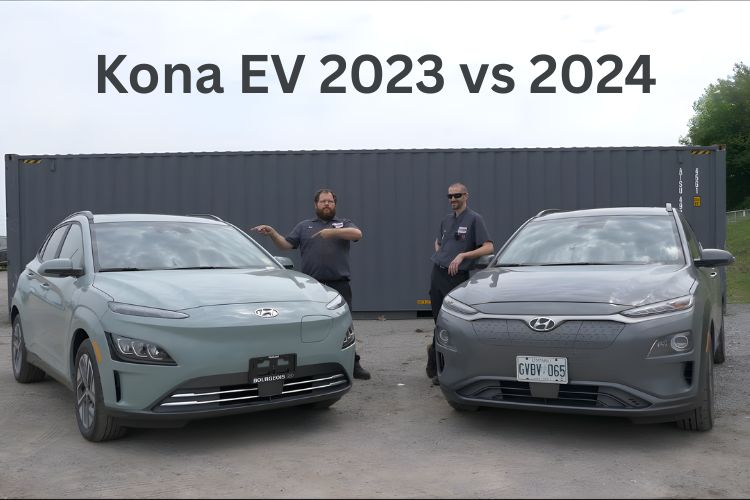
Park them side by side and you’ll immediately understand why some people call this a generational leap rather than a simple refresh.
The 2023 wears its crossover roots proudly. Smooth curves, split-level headlights stacked vertically, prominent black cladding wrapping the wheel arches. It looks friendly, approachable, and conventionally attractive in that “I could be gas or electric” way. Some buyers specifically prefer this timeless aesthetic over the 2024’s bold statement.
The 2024 screams modern EV from every angle. That Seamless Horizon Lamp, a single thin LED strip stretching across the entire front and rear, dominates the design language. Add in the parametric pixel details borrowed from Hyundai’s Ioniq lineup, and you get what reviewers call a “cyborg-inspired” look. It’s polarizing. You either love the futuristic vibe or think it looks like a sci-fi movie prop.
The 2024 also sits wider and lower, with a more planted stance that makes the 2023 look almost cute by comparison. Colors pop differently on the new body panels. The interior design follows suit, everything angles toward the driver in this cockpit-like arrangement versus the 2023’s more traditional dashboard layout.
Truth? The 2024 makes the 2023 look dated when they’re together. But taste is personal. If you prefer understated elegance over attention-grabbing futurism, the 2023’s design might actually appeal more to you.
Range Reality: Conquering That Voice Saying “What If I Run Out?”
The EPA Numbers Versus Your Actual Tuesday
We’ve all felt that pit-in-your-stomach anxiety watching the range estimate drop faster than you expected. Let’s talk real numbers, the ones that matter when you’re deciding if you need to charge before heading home.
The 2023 Kona Electric delivered EPA 258 miles from its 64.0 kWh battery. Owners consistently report achieving 240-280 miles in normal mixed driving conditions. Push it harder on the highway at 75 mph and you’ll see closer to 210-220 miles. Drive conservatively in perfect weather? Some people crack 300 miles.
The 2024 introduced a dual-battery strategy, giving buyers actual choice for the first time:
2024 SE Standard Range: EPA 200 miles from 48.6 kWh battery. Perfect for city dwellers with short daily commutes and home charging. Highway trips require more planning. That 58-mile difference from the long-range version matters if you regularly drive between cities.
2024 SEL/Limited Long Range: EPA 261 miles from 64.8 kWh battery. Essentially matches the 2023 with a slight edge. Owners report similar real-world achievement, hitting 240-270 miles in typical conditions.
The Dual-Battery Strategy That Actually Makes Sense
Hyundai wasn’t just creating trim differentiation. The standard-range 2024 SE targets urban drivers who never need more than 150 miles in a day. They charge at home every night, rarely road trip, and prioritize the lower entry price over maximum range.
The long-range battery remains the choice for everyone else. Weekend warriors who drive to the mountains. Families taking road trips. Anyone without reliable home charging who needs to stretch time between public charging sessions.
Real-world owner data from forums and reviews clusters tightly around EPA ratings for both 2024 configurations. Hyundai’s estimates prove accurate, which builds trust. No overpromising.
Cold weather hits both generations equally hard. Expect 20-30% range loss when temperatures drop below freezing and you’re running the heater. A 261-mile summer rating becomes 180-200 miles in January in Minneapolis. Physics doesn’t care which model year you bought.
When Range Becomes Your Problem (And When It Doesn’t)
Highway driving is the range killer. Both models lose 15-20% versus EPA ratings when sustained at 70+ mph. That’s wind resistance and energy physics at work. City driving actually improves range thanks to regenerative braking recapturing energy.
Heat and AC draw real power. Running climate control full blast can cost you 5-10% of your range. But here’s the thing: nobody wants to sweat or freeze to save 15 miles. Use the climate control. That’s what the battery is for.
| Driving Condition | 2023 Kona EV Range | 2024 Long Range | 2024 Standard Range |
|---|---|---|---|
| EPA Combined | 258 miles | 261 miles | 200 miles |
| Highway (70 mph) | ~210 miles | ~215 miles | ~165 miles |
| City (regenerative braking) | ~290 miles | ~295 miles | ~225 miles |
| Winter (below 32°F) | ~180 miles | ~185 miles | ~140 miles |
Daily commute math? If you drive under 40 miles round trip, even the 2024 SE standard range works perfectly. Charge once or twice a week at home and you’re covered. Drive 60+ miles daily? The long-range battery eliminates any anxiety.
The Tech and Features That Touch Your Life Every Single Day
Imagine sliding into a dashboard that finally treats you like it’s 2024, not 2018. That’s the difference here.
The 2023 Kona EV featured separate screens: a 10.25-inch digital cluster for the driver and either an 8-inch (SE trim) or 10.25-inch (SEL/Limited) touchscreen for infotainment. Functional but fragmented. The graphics looked dated. Processing felt sluggish when switching between menus.
The 2024 changes the entire visual language with a dual 12.3-inch panoramic display under a single curved glass panel. One screen becomes your configurable instrument cluster, the other handles navigation, media, and vehicle settings. It’s standard on every trim, even the base SE.
It’s like upgrading from Windows 7 to a modern MacBook. Everything flows. Graphics pop with richer colors. The new interface responds instantly to touch inputs. And here’s the game-changer: Over-the-Air (OTA) software updates mean the system can improve over time. Bug fixes. New features. Enhanced functionality delivered wirelessly while the car sits in your garage.
The 2023’s system is frozen in time. What you bought is what you’ll have five years from now. The 2024 can evolve.
The Small Conveniences That Become Daily Joys
Some features seem minor until they’re part of your routine. Then you can’t imagine life without them.
Hyundai Digital Key 2 Touch on the 2024 means your phone IS your key. Walk up to the car with your iPhone or compatible Android device, doors unlock automatically. Press the start button, the car recognizes your phone via UWB (ultra-wideband) technology, and you’re driving. Never fumble for keys with grocery bags balanced on your hip again.
Enhanced i-Pedal mode in the 2024 brings the car to a complete stop without touching the brake pedal. Lift your foot off the accelerator and regenerative braking handles everything, recapturing energy back to the battery. City driving becomes this zen, one-pedal experience. The 2023 had regenerative braking but required brake pedal input for final stops.
Vehicle-to-Load (V2L) capability on 2024 Limited trim turns your car into a 1.7 kW mobile power source. Plug an adapter into the charge port and run your camping gear, power tools at a jobsite, or keep essentials running during a home power outage. The 2023 offers no external power capability.
Wireless Apple CarPlay and Android Auto? Standard on all 2024 trims, finally. The 2023 had this confusing situation where the base SE offered wireless connectivity, but upgrading to SEL or Limited with the larger screen forced you back to wired connections. Problem solved on the new generation.
Safety Tech That Gives You Peace of Mind
Both generations include comprehensive Hyundai SmartSense as standard equipment. Forward Collision-Avoidance Assist with pedestrian detection. Lane Keeping Assist. Blind-Spot Collision-Avoidance Assist. Rear Cross-Traffic Collision-Avoidance Assist. You’re covered on safety fundamentals either way.
The 2024 adds more sophisticated versions of these systems plus two visibility features on higher trims that genuinely improve the driving experience:
Blind-Spot View Monitor displays a live camera feed in your digital instrument cluster when you activate the turn signal. No more craning your neck or trusting mirrors alone.
Surround View Monitor uses four cameras to create a bird’s-eye view of the car and its surroundings. Parking in tight spaces becomes dramatically easier and safer.
Highway Driving Assist 2 on the 2024 represents a more capable Level 2 semi-autonomous system, helping with lane changes on highways and reducing driver fatigue on long trips.
| Safety Feature | 2023 Kona EV | 2024 Kona EV |
|---|---|---|
| Forward Collision Avoidance | Standard | Standard (Enhanced) |
| Lane Keeping Assist | Standard | Standard (Enhanced) |
| Blind-Spot View Monitor | Not Available | Available (SEL+) |
| Surround View Monitor | Not Available | Available (Limited) |
| Highway Driving Assist 2 | Basic Version | Advanced Version |
Power, Feel, and Charging: The Drive You’ll Experience Every Morning
The Torque Story Everyone Gets Wrong
Here’s the thing about electric motors: instant torque makes them feel quick regardless of horsepower. But the amount of torque fundamentally changes the driving personality.
The 2023 Kona EV delivers 201 hp and 291 lb-ft of torque with zero delay. Plant your foot and the front tires scramble for traction as the car lunges forward. It’s exhilarating. Fun. Borderline manic in the best possible way. Tested 0-60 mph times hover around 6.6 seconds, which feels even quicker because all that thrust hits immediately.
The 2024 long-range model keeps the 201 hp but slashes torque to 188 lb-ft. That’s a 35% reduction in twist. The result? A gentler, more refined launch that prioritizes smoothness over aggression. Tested 0-60 mph times slow to about 7.0 seconds. Still quick enough for any real-world situation, just less thrilling.
| Performance Metric | 2023 Kona EV | 2024 Kona EV (Long Range) | 2024 Kona EV (Standard Range) |
|---|---|---|---|
| Horsepower | 201 hp | 201 hp | 133 hp |
| Torque | 291 lb-ft | 188 lb-ft | ~~ |
| 0-60 mph (tested) | ~6.6 seconds | ~7.0 seconds | ~8.5 seconds |
| Character | Frisky, eager | Smooth, refined | Adequate, composed |
Translation? The 2023 feels like a hot hatch that happens to be electric. The 2024 drives like a mature, comfortable compact SUV that happens to be quick enough.
Charging Speed Reality Check
Neither model wins any awards for fastest charging, but both deliver reasonable times that work for road trips with proper planning.
Level 2 charging at home: The 2023 takes approximately 9.5 hours for a full charge on a 240V Level 2 charger. The 2024 long-range battery recharges in about 9 hours. The standard-range 2024 SE finishes in roughly 6 hours. Plug in overnight, wake up to a full battery.
DC fast charging: Both hit approximately 43-47 minutes for 10-80% on a 100 kW fast charger. The 2024 shaves a few minutes off thanks to better thermal management, but you’re splitting hairs. Plan on 45 minutes for a road trip charge stop either way.
The 2024’s battery pre-conditioning system makes a real difference in cold weather. Set a DC fast charger as your navigation destination and the car automatically warms the battery to optimal temperature before arrival. This maintains charging speeds even in winter. The 2023 lacks this feature, meaning cold-weather charging can crawl along at reduced speeds.
The Efficiency Edge You’ll Notice at the Electric Bill
The 2024’s improved aerodynamics deliver a slight efficiency advantage. Its drag coefficient drops to 0.27 versus 0.29 on the 2023. You won’t feel this, but your electricity bill notices.
Real-world charging costs? Figure under $6 for a full home charge on either model at typical residential rates of $0.13 per kWh. That’s 250+ miles of driving. An equivalent gas car at 30 mpg and $3.50/gallon gas would cost about $30 for the same distance.
Annual savings over gas, assuming 12,000 miles of driving:
Electric Kona (either model): ~$300 in electricity Gas equivalent: ~$1,400 in fuel Savings: $1,100 per year just on fuel, before factoring in reduced maintenance
Both models use the standard CCS1 connector for DC fast charging. And remember that complimentary NACS adapter for 2024 owners, unlocking Tesla’s Supercharger network starting in 2025. The 2023 can use the adapter too once available for purchase.
The Decision Framework: Which Kona EV Driver Are You?
Buy a Used 2023 If This Sounds Like You
Your wallet is screaming and you’re comfortable with proven technology. You value driving fun over maximum practicality. The 2023 makes perfect sense if:
You found one under $25,000 with reasonable mileage and tax credits don’t help your specific situation. Maybe your income exceeds IRS limits or you’ve already used EV credits recently.
That 291 lb-ft torque snap brings daily driving joy you’re not willing to compromise. You love the eager, almost mischievous way it launches from stoplights. The 2024’s refinement feels boring by comparison.
You don’t regularly haul big loads or need maximum cargo flexibility. It’s primarily your commuter or weekend fun car, not the family hauler.
The missed tax credit already depreciated for the original owner, making their loss your gain. First-year EV depreciation traditionally runs steep, especially when incentive rules change mid-generation.
You prefer the 2023’s more conventional, timeless styling over the 2024’s aggressive futurism. Design matters, and if the pixelated LED look doesn’t speak to you, that’s valid.
Buy the New 2024 If These Ring True
You want the car that still feels modern five years from now. You prioritize space and technology over raw performance thrills. The 2024 is your answer if:
You can capture $7,500 tax credit benefits on a Georgia-built model, fundamentally changing the value equation. Check the VIN to confirm US assembly. This incentive effectively makes the 2024 cheaper than many used 2023s.
Your life demands more space. Growing family with car seats and strollers. Gear-heavy hobbies like biking or camping. Frequent Costco runs. That 63.7 cubic feet of cargo capacity with seats down versus 45.8 transforms the vehicle’s utility.
Access to Tesla Superchargers matters for your road trip patterns and peace of mind. The reliability and density of Tesla’s network eliminates much of the public charging anxiety that plagues other networks.
Latest safety tech and OTA updates feel like smart future-proofing. You want blind-spot cameras, surround-view monitors, and a system that can improve over time rather than remaining frozen at purchase.
You value ride comfort and cabin quietness over sporty handling and immediate throttle response. The 2024’s longer wheelbase and refined suspension deliver that serene highway cruise you actually want on Tuesday mornings.
The Three-Year Ownership Math That Matters Most
Let’s calculate total cost of ownership because purchase price tells only part of the story.
Scenario: Daily Commuter (30 miles round trip)
| Cost Factor | Used 2023 ($24,000) | New 2024 SEL ($36,675 – $7,500 credit) |
|---|---|---|
| Purchase Price After Incentives | $24,000 | $29,175 |
| Insurance (3 years @ $1,200/yr vs $1,300/yr) | $3,600 | $3,900 |
| Electricity (36,000 miles @ $0.025/mile) | $900 | $900 |
| Maintenance (minimal) | $300 | $300 |
| Total 3-Year Cost | $28,800 | $34,275 |
| Estimated Resale Value | $18,000 | $25,000 |
| True Cost of Ownership | $10,800 | $9,275 |
In this scenario, the 2024 actually costs less to own over three years despite the higher purchase price. Better resale value on the redesigned platform offsets the initial premium.
Scenario: Weekend Road Tripper (15,000 miles/year)
For buyers who take frequent long trips and value cargo space plus Supercharger access, the 2024’s utility benefits justify any cost premium. The 2023’s space limitations become genuinely frustrating on the fourth road trip of the year.
Honest verdict: For most buyers in late 2024 and 2025, the 2024 makes more financial sense when factoring in available tax credits. But if you find a 2023 under $23,000 and credits don’t apply to you? That becomes compelling performance-per-dollar value.
Conclusion: Your Next Move (Because You Can’t Research Forever)
We’ve walked through the whole journey together. The 2023 is the smart used-car buy that delivers proven EV performance when your budget demands discipline. The 2024 is the forward-looking choice that gives you more space, more tech, and more future-proof features when you can capture those incentives. But here’s what actually matters: which one fits your real life, not the life you think you should have or the life comparison charts tell you to want.
Go test drive both if you can find them at local dealerships. Sit in the back seat. Open the trunk and imagine loading your actual stuff. Feel the difference between that torquey 2023 launch and the 2024’s planted refinement. Sometimes your gut knows what spreadsheets can’t calculate.
Three years from now, you won’t remember the exact cubic feet of cargo space or the precise EPA range figure. You’ll remember whether your car made your life easier or added stress every time you glanced at the dashboard. Choose the one that gives you peace of mind, not the one that looked best on paper.
Kona EV 2024 vs 2023 (FAQs)
Is the 2024 Kona Electric worth the upgrade over 2023?
Yes, for most buyers. The 2024 offers 33% more cargo space, a vastly superior infotainment system with OTA updates, better ride quality, and eligibility for the $7,500 federal tax credit on Georgia-built models. These benefits typically outweigh the 2023’s more exciting torque delivery.
However, if you find a heavily discounted 2023 under $24,000 and tax credits don’t apply to your situation, the older model delivers excellent performance value.
Does the 2023 Kona EV qualify for the $7,500 tax credit?
No for buyers, potentially yes for lessees. All 2023 Kona EVs were manufactured in South Korea, making them ineligible for the federal Clean Vehicle Credit when purchased. However, the commercial clean vehicle credit for leases has different rules, allowing dealers to potentially pass savings to customers through reduced lease payments. Check with your dealer about current lease incentives that might incorporate tax credit benefits.
What’s the real-world range difference between 48.6 kWh and 64.8 kWh batteries?
Approximately 60 miles in mixed driving. The 2024 SE standard-range battery (48.6 kWh) delivers EPA-rated 200 miles, with owners reporting 180-210 miles in typical conditions.
The 2024 SEL/Limited long-range battery (64.8 kWh) achieves EPA-rated 261 miles, with real-world results of 240-270 miles. For daily commutes under 40 miles, the standard range works perfectly.
For regular highway trips or limited home charging access, the long-range battery eliminates anxiety.
Can I use Tesla Superchargers with a 2023 Kona Electric?
Yes, starting in 2025 with an adapter. Hyundai provides a complimentary NACS adapter to 2024 Kona Electric buyers who purchased before January 31, 2025. The 2023 model can also access Tesla Superchargers once Hyundai makes the adapter available for separate purchase. Both models have CCS1 charging ports and will use the same adapter hardware to connect to Tesla’s NACS-equipped Superchargers.
How much more cargo space does the 2024 model have?
Significantly more: 33% increase with seats up, 39% with seats down. The 2024 offers 25.5 cubic feet behind rear seats versus 19.2 in the 2023. With seats folded, capacity expands to 63.7 cubic feet in the 2024 compared to 45.8 in the 2023.
That’s enough space for a mountain bike without removing the front wheel, multiple suitcases for a family trip, or a week’s worth of Costco groceries. The 2024 also adds a small 0.95 cubic foot frunk for charging cables and emergency supplies.