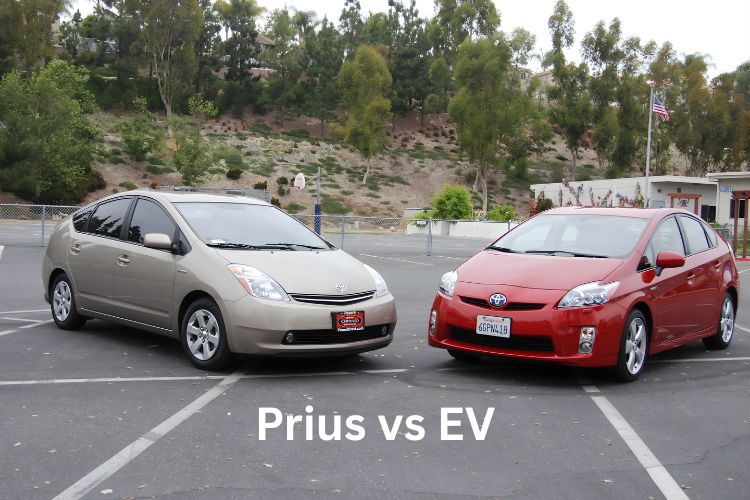
You’re standing between two cars at the dealership, and your heart’s doing this weird flutter thing. On your left: the new Prius, all sleek lines and that Toyota badge that basically screams “I’ll never leave you stranded.” On your right: an electric vehicle that looks like it drove straight out of 2030, promising to free you from gas stations forever.
Your old car keys are still warm in your pocket. Your brain won’t stop spinning.
Here’s the real fear nobody talks about: “What if I’m still paying for this mistake five years from now?”
You’ve already waded through so much noise. Your coworker swears by their Tesla. Your neighbor keeps posting about their Prius’s 600-mile range. Some YouTube guy screamed at you about the planet for eleven minutes. Everyone has an opinion about what’s “better,” but nobody knows if you street-park or have a 240-volt outlet in your garage. Nobody’s asking about your actual Tuesday morning.
Here’s what we’re doing together. We’re cutting through the hype. This is about your mornings, your wallet, and your actual driving habits, backed by the numbers that matter. No marketing speak. No judgment about which choice makes you a “better person.” Just the honest truth about which powertrain fits your life.
Keynote: Prius vs EV
The Prius versus electric vehicle debate centers on infrastructure access and driving patterns. Hybrids excel in flexibility and simplicity. Pure EVs win on running costs if you charge at home. The 2025 market shift comes from federal incentives expiring September 30, fundamentally changing value propositions. Cold weather favors hybrids with only 10 to 20% range loss versus 25 to 50% for EVs. Your parking situation and typical daily mileage determine the right choice more than any technical specification.
Let’s Get Real About What You’re Actually Asking
You don’t want the “greenest” car or the “best” car. You want the one that won’t make you regret your choice when you’re six months in, stuck in traffic on a Wednesday, wondering why you didn’t think this through.
This Isn’t About Tech Specs, It’s About Your Tuesday
Do you have off-street parking with an outlet nearby? That’s not a random question. It changes everything.
Can you charge at work, or are you apartment-hopping every year? Your living situation matters way more than horsepower.
Does “road trip” mean 50 miles to visit family or 500 miles across three states? Be honest. Your definition of adventure determines which car won’t drive you insane.
The Question Hiding Under All the Others
Are you ready to be a pioneer or do you need it to just work?
Your tolerance for planning routes versus just going matters more than 0-to-60 times. Some people love optimizing their charging stops. Others want to turn a key and drive without thinking. Neither is wrong.
Here’s the truth: your daily routine will decide 80% of this for you. The average American drives less than 40 miles per day. That single fact renders most range anxiety completely irrational for most people, but it also means the average person never uses the full capability of either vehicle. You’re choosing between two excellent tools. The question is which one fits your hand.
The Prius Case: Gas-Sipping Simplicity That Never Makes You Think
Picture this: 57 miles per gallon combined on the 2025 Prius LE means you’re filling up maybe twice a month, and every gas station is your friend. You never open an app. You never plan anything. You just drive.
The “Just Works” Factor
Refuel in minutes, not hours. No apps. No planning. Zero anxiety.
Toyota reliability means boring maintenance. Oil changes. Tire rotations. That’s actually the dream. Boring means predictable. Predictable means you can focus on literally anything else in your life.
Over 600 miles of range before you need gas. You never think about it. Your spouse never asks “did you charge the car?” at 11 PM. The mental load is zero.
The Real-World Performance
Note that different trims affect fuel economy. The base LE gets 57 MPG combined. The AWD models with bigger wheels drop to around 49 to 52 MPG. Still phenomenal. Still better than almost anything else on the road.
The regular hybrid gets you 51 to 57 MPG depending on the configuration. The simplest option is often overlooked because it’s not flashy, but it’s brilliantly effective.
Proven resale value because Toyota hybrids hold their worth like gold. Five years from now, when you decide to sell, you’ll actually get a decent check. That matters more than most people realize when they’re making this decision.
The EV Case: Silent Power and Pennies Per Mile
Imagine never visiting a gas station again. You wake up every morning to a “full tank” because you plugged in while you slept. The car sits in your garage, silently drinking electricity that costs a fraction of gasoline.
The Energy Cost Reality
Efficient EVs like the Tesla Model 3 or Hyundai Ioniq 6 use about 25 kilowatt-hours per 100 miles. That’s the number that changes everything.
With electricity at around 25 cents per kilowatt-hour in New York, your cost per mile drops dramatically. We’re talking roughly $1.90 per mile for an EV versus $8.10 per mile for the Prius using local gas prices. That’s not a typo.
| Vehicle Type | Fuel/Energy Need | Local Cost | Approximate Cost per Mile |
|---|---|---|---|
| Prius Hybrid (57 mpg) | 6.8 L per 100 miles | $3.13/gallon | $8.1/mile |
| Efficient EV (25 kWh/100 mi) | 25 kWh | $0.25/kWh | $1.9/mile |
| Prius PHEV (mixed use) | First 44 miles electric, then gas | Variable | Between EV and hybrid rates |
No oil changes. Regenerative braking means brake pads last forever, maybe the entire life of the car. Maintenance is shockingly cheap. EVs save $400 to $1,000 annually compared to gas cars. Over five years, that’s real money.
The Big “If” That Changes Everything
Access to reliable home or work charging is the entire game. Without it, EVs become significantly less compelling.
A survey of 1,430 battery electric vehicle drivers found that 77% rarely or never experienced range concerns. The fear is worse than the reality for most people. But here’s the catch that nobody mentions in the commercials.
Only 34% of charging stations provide real-time status data. Public charging can be a genuine headache. You pull up to a charger and it’s broken. Or occupied. Or charging at half speed because the station’s having a bad day. This friction is real.
The Bridge Option: Prius Plug-in Hybrid (PHEV)
Think of the Prius Prime as training wheels for the electric life. You get up to 44 miles of pure electric range for your daily commute, then gas kicks in for everything else. No commitment issues. No range anxiety. Just options.
The Sweet Spot for Many Lives
Up to 44 miles electric range means most city days feel like driving an EV. You’re silent. You’re smooth. You’re using zero gasoline for your actual life.
When the battery’s done, you still get around 52 MPG on gas. No charger stress. Ever. You can drive to Alaska tomorrow if you want. The gas engine is your safety net.
Charges in roughly 11 hours on a standard wall outlet, about 4 hours on a 240-volt Level 2 charger. That’s overnight, every night, if you want.
The Trade-offs Nobody Mentions
Starts around $33,375 to $34,570. Here’s the big change for 2025: it no longer qualifies for the federal $7,500 tax credit because it’s assembled in Japan. That window closed.
Weighs 240 pounds more than the regular Prius. You’ll notice it gets 43 MPG versus the regular’s 51 MPG when running on gas only. The battery pack adds weight and complexity.
Cargo space drops from 23.8 to 20.3 cubic feet. The battery pack takes room. If you regularly haul stuff, measure your typical load before you commit.
When It Makes Perfect Sense
Your commute is under 40 to 50 kilometers daily. You drive electric all week, gas on weekends. You’re basically operating an EV Monday through Friday.
You can plug in at home but don’t have fast chargers on your road trip routes. This is incredibly common. The infrastructure is still catching up.
You want to dip your toes into electric without the full commitment. There’s no shame in this. It’s actually the smartest move for a lot of people.
The Money Talk: What Your Bank Account Will Actually Feel
Let’s do the math nobody else shows you clearly. This is where rubber meets road, or more accurately, where your monthly budget meets reality.
The 100-Mile Reality Check
With local New York energy prices, EVs cost roughly 75% less per mile on energy alone. That savings is intoxicating when you run the numbers.
But here’s what changes the entire calculation: how you charge matters as much as what you drive. Public DC fast charging can cost 45 to 60 cents per kilowatt-hour. At that rate, charging your efficient EV for 100 miles costs around $11.25. That’s actually more expensive than driving the Prius.
Home charging at 25 cents per kilowatt-hour? Now you’re at $6.25 per 100 miles. Comparable to the Prius.
Off-peak charging on a time-of-use electricity plan? Rates can drop to 2 cents per kilowatt-hour. Your 100-mile cost becomes 50 cents. That’s transformative.
The Five-Year Picture Beyond Fuel
Maintenance savings on EVs add up to $2,000 to $5,000 over five years. No oil. No transmission fluid. No exhaust systems. Fewer brake jobs.
But factor the upfront cost difference and potential charging installation fees up to $1,200 for a Level 2 home charger. That’s real money you need to spend in year one.
Federal tax credits of up to $7,500 were available for EVs, but here’s the critical 2025 update: that credit expires September 30, 2025. After that date, the Tesla Model 3 jumps from a net price of around $32,990 to $40,490 overnight. The Prius Prime never qualified because of where it’s built.
The Forgotten Costs
EV tires can wear faster due to instant torque and vehicle weight. Budget for replacements sooner.
Insurance premiums may be slightly higher on some EV models. Call your insurer with specific VINs before you buy.
Prius has boring, predictable costs. Sometimes boring wins. You know exactly what you’re getting into. Five years from now, you won’t have any financial surprises.
The Emissions Reality: Beyond the Marketing Speak
You want to do the right thing for the planet, but the internet keeps throwing conflicting numbers at you. Some article says EVs are worse because of battery manufacturing. Another says hybrids are greenwashing. Let’s clear it up with actual data.
The Upfront Carbon Debt
EVs start with a bigger carbon footprint. Battery manufacturing creates 11 to 14 metric tons of carbon dioxide versus 6 to 9 for a hybrid. That’s significant.
Manufacturing emissions are 70% higher for EVs than gas cars upfront. This is the inconvenient truth that EV advocates sometimes gloss over.
But here’s the key: EVs pay this debt back and become cleaner within 19,500 to 28,000 miles. That’s often under two years of normal driving. After that point, the EV pulls ahead and never looks back.
The Long Game
Over 150,000 miles, efficient hybrids emit around 200 grams of carbon dioxide per kilometer. EVs emit roughly 150 grams per kilometer. Both crush the EPA’s average of 319 to 400 grams per mile for conventional cars.
The beautiful thing about EVs: their emissions keep improving as your power grid gets cleaner. Every coal plant that gets replaced with solar or wind makes your existing EV greener. The hybrid’s emissions stay the same forever.
Prius PHEV cuts emissions by 40% versus traditional gas cars. That’s a solid environmental win right now, today, with zero infrastructure anxiety.
The Grid Reality
Where your electricity comes from matters hugely for EVs. Coal-heavy grid? Your EV’s advantage shrinks.
Even on a coal-heavy grid, EVs still trend cleaner over their lifetime. The math consistently favors electrification.
New York has a relatively clean energy mix with nuclear and hydroelectric. If you live here, the EV environmental case is strong.
The Lifestyle Fit Test: Your Daily Routine Is the Answer
Stop thinking about cars and start thinking about your mornings, your parking situation, and your spontaneous weekend plans. The winner emerges naturally when you’re honest about your actual life.
You Park Off-Street with an Outlet
EV or Prius PHEV becomes effortless. Plug in every night, start fresh every morning. This is the unlock.
Home charging changes everything. It transforms “refueling” from a weekly errand into a background task you never think about. Like charging your phone.
You’ll rarely think about “fueling” again. It just happens while you sleep. Your mornings start with a full battery. Every single day.
You Street-Park and Road-Trip Often
Regular Prius hybrid keeps life friction-free. No hunting for chargers during errands. No apps. No planning.
Gas stations outnumber chargers massively. Only 10% of U.S. counties had at least 75% minimum viable fast charger coverage in 2023. That’s the infrastructure reality right now.
Your peace of mind has a value. Sometimes simple wins. If you’re already stressed about life, adding charging logistics might not be worth the fuel savings.
Your Commute Is Under 40 Miles Daily
Prius PHEV becomes your weekday EV, your weekend hybrid. Best of both worlds without the compromise.
You drive electric Monday through Friday. Gas kicks in for that spontaneous Saturday adventure to visit friends three states away.
Most people fit this pattern. The average American drives less than 40 miles per day. If that’s you, the PHEV is purpose-built for your life.
The Friction Nobody Warns You About
Let’s talk about what will actually annoy you six months in. These are the things reviews gloss over because reviewers drive cars for a week, not a year.
EV Realities
Public charging reliability varies wildly by region. That “broken charger at 8% battery” moment is real and it’s miserable.
Cold weather drops real-world range by 20 to 30%. Your 300-mile range becomes 210 miles when it’s 20 degrees outside. Plan accordingly.
You’ll download multiple charging apps and learn each network’s quirks. Electrify America works differently than EVgo which works differently than ChargePoint. There’s a learning curve.
Hybrid Realities
You still visit gas stations. That’s not nothing when you’ve tasted the convenience of home charging.
The PHEV only feels special if you actually plug it in. Without home charging, it’s just a heavier, more expensive regular hybrid with less cargo space.
You’ll never experience that electric surge of instant torque. It’s smooth, not thrilling. If driving excitement matters, hybrids are competent but not exhilarating.
The Resale Reality
Policy swings can tilt resale markets unpredictably. EV values have been volatile recently as incentives change and new models flood the market.
Toyota hybrids historically hold value exceptionally well. Track record matters. Five years of data beats one year of promises.
Your five-year-from-now self will care about this. Plan accordingly. Depreciation is often the single largest cost of car ownership.
Your Decision Framework: The Path That Fits Your Life
Here’s how you actually make this call, based on your real circumstances, not abstract ideals or what your friends are buying.
Choose the Regular Prius Hybrid If:
You have zero interest in plugging in anything. It’s just not your thing. That’s valid.
You take frequent, unplanned long trips to areas with scarce charging. Spontaneity matters more than fuel savings.
You want the absolute simplest, most reliable, just-works option. Maximum peace of mind. Minimum mental load.
Your parking situation is uncertain or changes frequently. You’re renting. You move for work. Consistency matters.
Choose the Prius Plug-in Hybrid If:
Your daily commute fits within 40 to 50 kilometers of electric range. You’re in that sweet spot.
You can plug in at home but don’t have reliable fast charging on your typical routes. Common situation.
You want to test electric driving without full commitment. Toe in the water, not cannonball.
Most of your driving is local, with occasional longer trips. Classic suburban or small-city lifestyle.
Choose a Full Electric Vehicle If:
You have reliable home or work charging access. This is non-negotiable. Without this, everything else falls apart.
Your longer trips are usually planned, not spontaneous. You’re comfortable adding 20 minutes to a road trip for charging.
You’re comfortable with new technology and learning charging networks. You don’t mind being an early adopter.
You want the lowest possible cost per mile and zero gas station visits. Maximum savings. Maximum environmental benefit.
Quick Decision Tree
Do you have reliable off-street parking with electrical access? If yes, EV and PHEV open up. If no, regular Prius makes life dramatically easier.
Is 80% of your driving under 60 kilometers per day? If yes, PHEV gives you the electric experience daily without compromise. If no, consider your range needs carefully.
Do you road trip more than three times yearly to areas with limited charging infrastructure? If yes, having that gas backup matters immensely. If no, EV range probably covers you.
Do you crave the absolute lowest energy cost per kilometer? If yes, EV wins if you have home charging. If upfront simplicity matters more, Prius is your answer.
Conclusion: Your New Confidence with Prius vs EV
This was never really about specs or which car wins on paper. It was about matching a machine to your actual life, your parking spot, your wallet, and your tolerance for change.
If you have home charging and your typical routes support it, an efficient EV likely wins on running costs and daily convenience. You’ll genuinely love waking up to a full battery and skipping gas stations forever. The savings are real. The experience is different in a good way. But you need that infrastructure foundation.
If you can’t plug in reliably, the Prius PHEV offers a taste of electric without the commitment anxiety. The regular hybrid is brilliantly simple and proven over two decades. Sometimes the boring choice is the smartest choice.
Your one action for today: Pull up your calendar and honestly map where you drove last week. Circle your typical days. Look at your parking situation with fresh eyes. The answer is probably already there, waiting for you to see it clearly.
Five years from now, you won’t remember the exact MPG figures or the 0-to-60 times. You’ll remember whether your car made mornings easier or harder, whether it fit your rhythm or fought it. Choose the one that disappears into your routine and just lets you live.
EV vs Prius (FAQs)
Does a Prius count as an electric vehicle?
No. The standard Prius is a hybrid electric vehicle that combines a gas engine with an electric motor. It cannot drive on electricity alone for meaningful distances. The Prius Prime plug-in hybrid can drive up to 44 miles on pure electricity before the gas engine kicks in, but it’s still classified as a plug-in hybrid, not a full EV.
How much range does a Prius Prime lose in cold weather?
The Prius Prime loses roughly 10 to 20% of its electric range in extreme cold, dropping from 44 miles to around 35 to 40 miles. However, the gas engine eliminates any anxiety because total range remains over 600 miles. Pure EVs lose 25 to 50% of their range below 20 degrees Fahrenheit, which is significantly more impactful.
Is it worth buying an EV over a Prius Prime?
It depends entirely on your charging access. With reliable home charging and predictable routes, an EV saves more money on energy and maintenance over five years.
Without home charging, the Prius Prime offers better flexibility and comparable total costs. The federal tax credit expiring September 30, 2025 also changes the math significantly.
Can you charge a Prius Prime at EV charging stations?
Yes. The Prius Prime uses the standard J1772 connector found at most Level 2 charging stations. However, it cannot use DC fast chargers, which are much quicker. Charging the Prime at a public Level 2 station takes about 4 hours, so it’s really designed for home charging overnight.
What is the real-world cost difference between owning a Prius and an EV?
Over five years, a standard Prius costs roughly $47,000 total including purchase, fuel, and maintenance. An efficient EV with home charging costs $68,000 to $81,000 depending on model and depreciation, but this assumes you paid full price.
With the pre-expiration federal credit, a Tesla Model 3 dropped to around $33,000 net, making it competitive with the Prius on total cost.