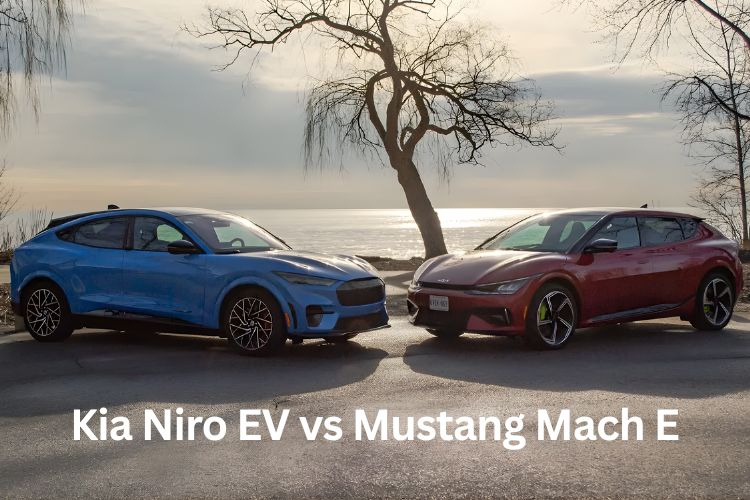
You’re standing in a parking lot between two electric crossovers, and your brain is doing that thing where it splits in half.
One side whispers the sensible stuff. Think about the warranty. Consider the efficiency. Be smart with your money. The other side is practically shouting. Feel that acceleration. Look at those lines. Choose the one that makes you actually want to drive.
This isn’t really about comparing battery capacity or cargo volume, is it? It’s about figuring out who you are when you’re behind the wheel. And here’s the fear nobody wants to admit: What if you pick the wrong one and spend the next five years wondering what might have been?
Here’s what we’re going to do. We’ll blend the cold numbers with the warm feelings. We’ll talk about charging curves that manufacturers love to hide and total cost calculations that actually matter. By the end, you’ll know which EV is yours, not just which one wins on a spreadsheet.
Keynote: Kia Niro EV vs Mustang Mach E
The Kia Niro EV versus Mustang Mach-E debate centers on efficiency versus experience. The Niro delivers exceptional value with 113 MPGe, a 10-year powertrain warranty, and 253-mile range for $39,600. The Mach-E counters with up to 320-mile range, 480-horsepower performance options, and immediate Tesla Supercharger access via NACS adapter. Choose the Niro for lowest total cost of ownership. Choose the Mach-E for driving thrills and road trip capability.
The Fork in the Road: Who Are You Behind the Wheel?
The Niro EV: Your Calm, Brilliant Sidekick
Picture that friend who always has the right answer without making you feel stupid for asking.
That’s the Niro EV. It’s 201 horsepower of quiet competence wrapped in a compact, modern package that never needs to prove itself. This is the friend who helps you move apartments, remembers your coffee order, and somehow makes everything feel easier.
It’s 650 to 1,250 pounds lighter than the Mach-E and a full 11.6 inches shorter. Translation? Parallel parking transforms from a sweat-inducing nightmare into something you barely think about. That tight 34.8-foot turning circle means you can navigate city streets with genuine confidence instead of white-knuckle anxiety.
The Mustang Mach-E: The Reformed Rebel Who Kept the Edge
Ford didn’t just build an electric crossover and call it a day. They had the audacity to badge it with one of the most legendary names in automotive history.
And somehow, it works.
This is 264 to 480 horsepower depending on how brave you’re feeling, with GT models rocketing from zero to 60 in under four seconds. That’s faster than most V-8 muscle cars from the glory days. The Mach-E weighs 673 to 1,254 pounds more than the Niro, which sounds like a bad thing until you realize that planted feeling on the highway and those impressive crash test scores are direct benefits of that extra mass.
The Money Truth Nobody Explains Clearly
Let’s talk about the number everyone sees first and how it doesn’t tell the whole story.
The Niro EV pricing spans from $39,600 for the Wind trim to $44,600 for the fully loaded Wave. The Mach-E? It starts lower at $37,995 for the base Select model, then climbs through the low $40,000s all the way into the mid $50,000s if you want the GT’s thrills.
Here’s the gut punch that changes everything. Neither vehicle qualifies for the $7,500 federal tax credit anymore. That game changer expired on September 30, 2025, which fundamentally shifts the value equation.
And here’s what actually happens when you start configuring. The Mach-E’s price ladder climbs fast. Want real range advantage? You’ll need the Extended Range battery, which adds thousands to your bottom line. Want all-wheel drive for winter confidence? More money. The Niro’s two-trim strategy is refreshingly honest. You pick well-equipped or fully loaded, and you’re done.
The Five-Year Reality Check
The purchase price is just the opening act. Here’s what the next five years actually look like:
| Cost Factor | Niro EV | Mustang Mach-E |
|---|---|---|
| 5-Year Depreciation | 50% loss | 57.9% loss |
| City Efficiency | 126 MPGe | 105 MPGe |
| Combined Efficiency | 113 MPGe | 90-107 MPGe |
| Resale Advantage | Retains $2,000-3,000 more | Lower residual value |
That efficiency gap isn’t theoretical. Over 50,000 miles of driving, you’re looking at real money saved on electricity costs. The Niro sips electrons while the Mach-E gulps them, especially in those powerful trims.
The Warranty That Changes Everything
This is where Kia lands a knockout punch that Ford can’t counter.
Kia backs the Niro EV with a 10-year, 100,000-mile powertrain warranty and 5-year, 60,000-mile basic coverage. That’s a full decade of peace of mind on the most expensive components. Ford counters with a more traditional 3-year, 36,000-mile basic warranty and 5-year, 60,000-mile powertrain coverage, though they do provide an 8-year, 100,000-mile battery warranty.
But here’s Ford’s ace card. They have four times as many service locations as Kia. When something goes wrong at 6 PM on a Tuesday, that dealer network density matters. Still, Consumer Reports rates the Niro’s reliability 11 points higher than the Mach-E. That’s years of worry you simply won’t feel.
Range Reality: Two Different Flavors of Anxiety
The Numbers That Actually Matter on Tuesday Morning
EPA ratings tell you what’s possible in a perfect world. The Niro EV gets 253 miles. The Mach-E spans from 230 miles in some configurations all the way to 320 miles if you spring for the Premium trim with rear-wheel drive and the Extended Range battery.
Real-world truth? Subtract 20 to 30 miles from those highway estimates. Cold weather is even crueler, stealing up to 30% from both vehicles when temperatures drop below freezing.
But here’s the plot twist. The Niro’s efficiency wins the daily commuter game. It achieves roughly 113 MPGe overall, with an incredible 126 MPGe in city driving where most of us spend our time. The Mach-E trades some of those electrons for more power, landing between 90 and 107 MPGe depending on configuration. And in real-world testing, the Niro often exceeds its EPA rating, hitting 280 miles in independent tests. That’s 27 miles more than promised.
Charging: Coffee Stop or Full Lunch Break?
Here’s where marketing numbers crash into reality, and it gets interesting.
| Charging Metric | Niro EV | Mustang Mach-E |
|---|---|---|
| DC Fast Charge (10-80%) | ~43 minutes | ~36-45 minutes |
| Peak DC Rate | 85 kW | 115-150 kW |
| Real Average Rate (20-80%) | ~85 kW sustained | ~84 kW actual |
| Home Charging (240V) | Under 7 hours | 7-8 hours |
| Onboard AC Charger | 11 kW | 11 kW |
You’ll see the Mach-E advertised with that 150 kW peak charging rate. What they don’t tell you is that peak lasts about two minutes before the charging curve tapers dramatically. In practice, the average charging speed from 20% to 80% is around 84 kW. Suspiciously close to the Niro’s more honest 85 kW rating.
Translation? Those 10-80% charging times are nearly identical in the real world, despite what the spec sheets suggest.
But the Mach-E has one crushing advantage. Ford’s partnership with Tesla gives you access to 17,800+ Superchargers with a $230 NACS adapter you can order today. Kia buyers? You’re waiting two to three years for NACS adoption. For road trips, that Supercharger access fundamentally changes what’s possible.
Your Actual Daily Loop Matters Most
If your commute is under 100 miles round trip, the Niro’s range is more than plenty and that slower DC charging becomes completely irrelevant. You’ll charge at home while you sleep, and you’ll almost never think about public charging infrastructure.
The Extended Range Mach-E battery adds $4,000 to $5,500 to your price. For weekend warriors who regularly drive 200+ miles in a day, that might be worth every single penny. For everyone else? It’s expensive insurance you’ll rarely use.
The Daily Living Test: Space That Fits Your Actual Life
Here’s where the numbers flip in unexpected ways.
Seats up: Mach-E wins at 29.7 cubic feet versus Niro’s 22.8 cubic feet. Plus, the Mach-E adds a 4.7 cubic foot frunk under the hood, perfect for wet gym bags, charging cables, or keeping groceries away from your dog in the back seat.
Seats folded: The Niro flips the script completely, offering 63.7 cubic feet versus the Mach-E’s 59.7 cubic feet. That flat load floor in the Niro is beautifully practical for moving furniture or hauling camping gear.
If you regularly need to throw stuff in the back without folding seats, the Mach-E wins. If you occasionally need maximum cargo capacity for big hauls, the Niro surprises you with its TARDIS-like interior.
The Interior Experience You’ll Touch Every Single Day
The Mach-E dominates your field of vision with that massive 15.5-inch vertical touchscreen. It’s the command center for everything, and it looks genuinely futuristic. You also get the available BlueCruise hands-free highway driving system, though NHTSA is actively scrutinizing the technology.
The Niro counters with dual panoramic 10.25-inch displays that blend seamlessly into a curved panel. It feels more upscale than its price suggests. You get over-the-air updates to keep the software fresh, plus Vehicle-to-Load capability that can power your campsite or keep your fridge running during a blackout.
Passenger volume? The Mach-E edges ahead at 101.1 cubic feet versus the Niro’s 99.7 cubic feet. That translates to slightly more hip room and legroom, especially in the back seat where the Mach-E gives you an extra 1.2 inches of legroom. If you regularly carry four adults on longer drives, you’ll feel that difference.
Size in the Real World
That 11.6-inch length difference and 650 to 1,250 pounds of weight savings make the Niro a dream in tight parking garages and narrow city streets. It fits where the Mach-E hesitates.
But if you frequently carry a full load of people and cargo, the Mach-E’s extra interior space becomes comfort you’ll genuinely appreciate. It’s roomier because it’s physically bigger. Simple as that.
Performance Feel: Smooth Jazz vs. Friday Night Concert
Think of the Niro EV as your favorite chill playlist. It delivers smooth, zippy, drama-free acceleration with 201 horsepower that never feels lacking in daily driving. It’s competent, refined, and remarkably quiet. The instant torque of the electric motor makes merging onto highways confident and stress-free.
The Mustang Mach-E, especially in GT or Rally trim with up to 480 horsepower, is a live concert that makes your commute feel like a choice instead of a chore. It brings genuine shove that pins you to the seat. That electric whine replaces the V-8 rumble, but the visceral thrill remains.
The One Number That Tells the Story
GT and Rally Mach-E trims hit zero to 60 in under four seconds. Read that again. Under four seconds.
That’s genuine sports car territory. That’s faster than most things on the road. That’s the kind of acceleration that makes you giggle the first dozen times you floor it.
The Niro doesn’t chase that feeling, and that’s entirely the point. Its zen-like smoothness actually lowers your stress in stop-and-go traffic. No drama. No theatrics. Just calm competence that gets you there without raising your blood pressure.
All-Wheel Drive: The Weather Confidence Factor
The Mach-E offers all-wheel drive options that provide confident grip in snow and rain, though you’ll sacrifice some range for that security. That second motor up front fundamentally changes how the car behaves in bad weather.
The Niro is front-wheel drive only. That’s fine for most conditions and maximizes every electron for efficiency, but you’ll need to exercise more caution when things get slippery. Winter tires will matter more.
The Safety and Reliability Reality Check
The Sleep-Better Factor
Let’s talk about the elephant in the room. From 2021 to 2025, Ford recalled approximately 197,432 Mach-E units for door latch issues that could potentially trap passengers inside the vehicle. Additional recalls hit rear-camera software across multiple Ford models.
That’s concerning. But context matters. The Mach-E still earned the IIHS Top Safety Pick Plus award for 2025, and that heavier weight generally translates to better crash protection. Ford fixed the issues, and newer models don’t have the problem.
The Long-Term Trust Equation
Consumer Reports reliability rating shows the Niro scoring 11 points higher than the Mach-E. J.D. Power ranks Kia consistently above Ford in both initial quality and long-term dependability.
What does that mean in practice? Statistically, you’re less likely to experience problems with the Kia. Fewer service visits. Fewer unexpected repair bills. More predictable ownership.
Always check the specific VIN for open recalls before you sign anything on either vehicle. That’s just smart buying.
The Simple Answer: Which One Is Actually Yours?
Choose the Niro EV If You Value…
The smartest money move with better resale value and 7.9% lower depreciation over five years.
Daily serenity and predictable costs backed by that industry-leading 10-year, 100,000-mile powertrain warranty.
Superior efficiency at 126 city MPGe that means fewer charging stops and lower electricity bills.
Easier parking and city maneuverability with that compact 174-inch length and tight turning circle.
Understated competence that never needs to prove itself. It’s the friend who shows up, does the job brilliantly, and goes home without fanfare.
Choose the Mustang Mach-E If You Crave…
Legitimate 320-mile range options for weekend adventures without constantly calculating remaining miles.
A driving experience that makes your heart rate climb during the morning commute, especially in GT trim with 480 horsepower.
All-wheel drive confidence in bad weather, plus more cargo space with the seats up and that genius frunk for messy stuff.
Performance that puts a smile on your face every time you merge onto the highway or leave a stoplight.
The Mustang badge and head-turning style that makes neighbors ask questions. This is a statement, not just transportation.
The Decision Framework
Sometimes you just need a simple chart to cut through the noise:
| Your Priority | Best Match |
|---|---|
| Lowest total cost of ownership | Niro EV |
| Longest warranty and reliability peace | Niro EV |
| Most thrilling driving dynamics | Mach-E GT/Rally |
| Maximum range for road trips | Mach-E Extended Range |
| Easiest city parking and efficiency | Niro EV |
| Most cargo with seats up | Mach-E |
| Tesla Supercharger access now | Mach-E |
| Hands-free highway driving | Mach-E (BlueCruise) |
Conclusion: Your Perfect Imperfect Choice Starts Now
The Niro EV rewards logic and long-term thinking with unmatched efficiency, a decade-long warranty, and a price that won’t keep you up at night. The Mach-E rewards passion and the belief that daily driving should spark joy, offering genuine performance thrills and the freedom of 320-mile range with Supercharger access.
Both are excellent electric crossovers that get you to the electric future without compromise. Here’s what nobody tells you: your wrong choice doesn’t exist. The real question isn’t which is objectively better. It’s which regret can you live with, wishing you’d been more practical, or wishing you’d had more fun?
Your single actionable step for today: schedule test drives of both vehicles, but not back to back at the same dealership. Drive each one in your actual life for an hour. Take the Niro through your daily commute. Take the Mach-E on the highway route you drive most often. One will feel right in your hands, on your streets, fitting naturally into your daily routine. When you feel that click, trust it, then verify with the numbers above.
The future’s electric either way. Pick the one that makes you actually want to get in and drive.
Mustang Mach E vs Kia Niro EV (FAQs)
Does the Mustang Mach-E qualify for federal tax credit in 2025?
No, it doesn’t. The federal tax credit expired on September 30, 2025, and neither the Mach-E nor the Niro EV currently qualifies. The Mach-E is assembled in Mexico, which eliminated its eligibility even before the program ended. Some state and local incentives may still apply depending on where you live, so check your specific area for potential savings.
Can the Kia Niro EV use Tesla Superchargers?
Not yet, but eventually. Kia announced NACS adoption for future models, but current Niro EV owners face a two to three year wait for adapter availability. Ford Mach-E owners can order a NACS adapter today for $230 and immediately access over 17,800 Tesla Superchargers. This is a significant real-world advantage for road trips right now.
How long does it take to charge each vehicle from 10% to 80%?
They’re surprisingly similar despite different peak rates. The Niro EV takes about 43 minutes, while the Mach-E ranges from 36 to 45 minutes depending on battery size and charger output. The Mach-E’s advertised 150 kW peak only lasts around two minutes before tapering to an average of 84 kW from 20 to 80 percent, nearly identical to the Niro’s sustained 85 kW rate.
Which EV has more cargo space and interior room?
It depends on what you’re measuring. With seats up, the Mach-E wins at 29.7 cubic feet versus 22.8, plus it adds a 4.7 cubic foot frunk. With seats folded, the Niro flips ahead at 63.7 cubic feet versus 59.7. For passenger space, the Mach-E offers more overall volume at 101.1 cubic feet versus 99.7, with noticeably more rear legroom.
What is the real-world range difference in cold weather?
Both vehicles lose 25 to 30 percent of their range when temperatures drop below freezing. That reduces the Niro from 253 miles to roughly 180 to 190 miles, and the Extended Range Mach-E from 320 miles down to 225 to 240 miles. The Mach-E’s 2025 vapor injection heat pump helps minimize this loss compared to earlier models, but physics still wins. Plan your winter road trips with this reality in mind.