You’re sitting in your car. Browser tabs are eating your phone’s battery. ICE vs EV vs hybrid spreadsheets blur together. You’ve read seventeen articles, watched twelve YouTube reviews, and you’re somehow more confused than when you started.
This isn’t just about picking the wrong car. It’s about wasting money you can’t get back and living with regret every time you turn the key.
Your Tesla-driving coworker won’t shut up about how they “never go to gas stations anymore.” Your skeptical uncle insists electric vehicles will strand you in a snowstorm. The salesman? He just wants commission, and he’ll say whatever moves metal off the lot today.
Here’s our path forward. We’re cutting through the hype and the horror stories. We’ll start with your actual life, layer in the 2025 data that matters, and give you a decision framework that feels calm, not perfect.
Keynote: ICE vs EV vs Hybrid
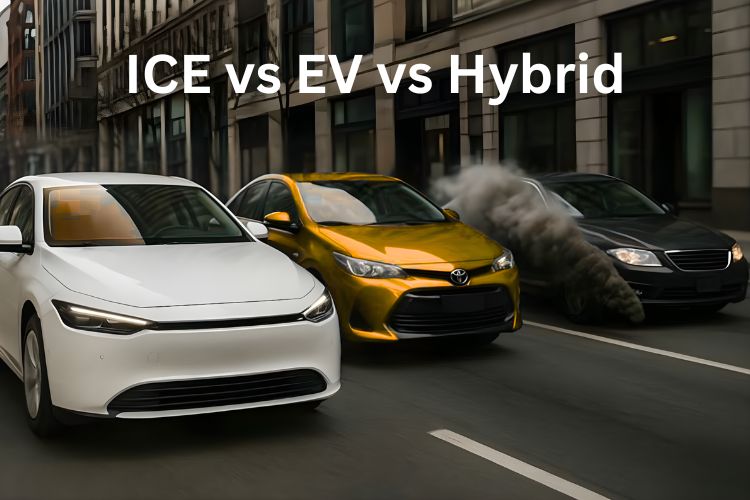
Choosing between internal combustion engines, battery electric vehicles, and hybrids depends on your charging access and driving patterns. EVs dominate with 87-91% efficiency for home-charging commuters under 50 daily miles. Hybrids excel for mixed use without infrastructure dependence. ICE remains practical for high-mileage, long-distance, or rural driving. Post-federal tax credit expiration changes the value equation significantly. Evaluate total cost of ownership over seven years, including fuel, maintenance costs, and depreciation rate specific to your usage.
Why This Choice Feels Impossible Right Now
Technology Is Moving Faster Than Your Research Can Keep Up
Battery tech evolves yearly, making last month’s advice feel obsolete today. You bookmark an article about energy efficiency comparison, and by next week there’s a new battery chemistry that changes everything.
Depreciation headlines terrify. EVs can lose 30-50% of their value in year one. But here’s the context nobody gives you: some models stabilize beautifully after that initial drop, while others continue to bleed value. The used EV market is maturing fast, and resale value trends are becoming more predictable as the technology proves itself.
You’re not buying a car. You’re betting on which powertrain technology survives the next decade.
Everyone Has an Agenda, and They’re All Yelling
EV evangelists make you feel guilty for even considering gas. Internal combustion engine loyalists insist battery electric vehicles will strand you in a snowstorm with no help coming.
Meanwhile, 70% of all car buyers report decision stress on this exact question. You’re not alone in the paralysis.
The noise is deafening because the stakes are real and everyone’s experience is different. Someone with a garage and home charging lives in a completely different world than an apartment dweller hunting for public charging stations.
The Stakes Feel Higher Than They’ve Ever Been
Nearly 30% of global EV owners are switching back to ICE vehicles now. This fact alone creates buyer panic. If people who already made the jump are turning around, what does that tell you?
Upfront costs make your stomach hurt versus theoretical “savings over time” promises that feel like fairy tales. What if charging infrastructure never comes to your area? What if gas hits $6 per gallon and you’re locked into an internal combustion engine?
The federal tax credit that made EVs financially competitive? Gone as of September 30, 2025. That $7,500 safety net vanished, fundamentally reshaping the total cost of ownership equation overnight.
Let’s Talk Money Without the Spreadsheet Headache
The Sticker Shock Is Real, But It’s Not the Whole Story
Battery electric vehicles command a 15-25% premium depending on vehicle size in 2025. The gap is shrinking fast as manufacturing scales up and battery costs drop, but that upfront difference still hurts when you’re signing papers.
ICE feels “cheaper” until you calculate five years of gas, oil changes, and transmission work. Those $1,800 annual fuel bills add up to $9,000 over five years before you even touch maintenance costs.
Plug-in hybrids sit in the middle on MSRP cap requirements but carry the most complex drivetrain. You’re essentially buying two powertrains in one vehicle, which brings its own set of trade-offs.
Where Each Type Actually Bleeds Your Bank Account
Here’s the five-year ownership reality distilled from AAA and multiple total cost of ownership studies:
Purchase price: ICE lowest today at around $28,600 for a compact SUV. Hybrid adds a modest $3,000-$4,000 bump. EV sits highest, but without the federal tax credit anymore, that $33,600 sticker is what you actually pay.
Fuel and electricity annual costs: Gas burns through roughly $1,800 yearly for 15,000 miles. Hybrid drops that to $1,200. EV costs about $600 if you’re charging at home with time-of-use electricity rates. This is where battery electric vehicles start winning, and the gap widens every year you own it.
Maintenance over 5 years: ICE racks up around $11,700 in service. Hybrid comes in at $9,000. EV clocks just $6,900 thanks to 30-40% fewer service needs. No oil changes, no transmission fluid, no exhaust system repairs. Regenerative braking means your brake pads last forever.
Depreciation risk: EVs swing wildly year to year depending on model and market conditions. ICE depreciates steady and slow like clockwork. Hybrids land somewhere between, often holding value better than you’d expect because they’re the “safe” compromise choice.
The Hidden Help That Changes the Math
Federal tax credits and state rebates used to slash EV prices by $7,500 immediately through point-of-sale transfer. That ended September 30, 2025, under current legislation known as the One Big Beautiful Bill.
Run the math for your specific model, not industry averages. TCO studies from the University of Michigan show a $52,000 variance across US cities based on local electricity costs and charging access. Your mileage will literally vary.
The used EV tax credit of $4,000 is still alive, creating a powerful price floor around $25,000. Used EVs eligible for this credit sell up to six times faster than non-eligible vehicles, which actually supports their resale value in unexpected ways.
Range, Charging, and the Anxiety That Won’t Shut Up
It’s Not Range Anxiety, It’s Range Awareness
“Once you’ve got an EV, you don’t have range anxiety. You have range awareness.”
Most people don’t fear running out. They fear needing 400 miles once a year for that family road trip they take every Thanksgiving.
The average driver covers just 37 miles per day, well within any modern EV’s capability. Does your phone need 300-mile battery life? Then why does your car for daily errands?
ICE gives you the 5-minute fill-up security blanket. But is that convenience worth $150 per month in fuel costs when you could be “refueling” overnight in your garage while you sleep?
The Infrastructure Reality Check for Where YOU Actually Live
If you have a garage and a plug, EV life transforms completely overnight. Level 2 charging equipment installation costs $500-$2,000, and then you wake up every morning to a “full tank.”
Urban apartment dwellers without driveways face the biggest legitimate charging challenge today. Public charging infrastructure is expanding at record pace, hitting nearly 60,000 DC fast charging ports by mid-2025 with 19% year-over-year growth. But deployment is heavily concentrated in California, New York, and Florida.
Plug-in hybrids become the “I’m not ready to trust the grid yet” safety net. You get 20-50 miles of electric-only range for daily commutes, then seamless switchover to gasoline for everything else.
Weather, Road Trips, and Other Real-World Curveballs
Range drops 20-30% in winter cold, and that’s not EV-hater propaganda. Battery chemistry requires energy to maintain optimal operating temperature. Preconditioning while plugged in helps, but doesn’t eliminate the hit entirely.
Highway speeds drain batteries faster because aerodynamic drag increases exponentially. City driving is where battery electric vehicles shine brightest, with regenerative braking recapturing energy at every stoplight.
ICE remains boring, predictable, and sometimes that’s exactly what your life needs. You know exactly how far a tank will get you in any weather, any speed, any condition.
The Environmental Question You’re Almost Afraid to Ask Out Loud
Are You Actually Helping, or Just Feeling Better About Yourself?
EVs are 2-3x more efficient than gas cars, even when charged on coal-heavy grids. Electric motors convert 87-91% of electrical energy into wheel power. Internal combustion engines? They waste 60-80% of fuel energy as heat, achieving just 16-25% thermal efficiency.
Fresh 2024 lifecycle studies from the International Council on Clean Transportation show BEV sedans produce 66-70% lower lifetime greenhouse gases than ICE equivalents. That includes manufacturing, operation, and end-of-life recycling.
Here’s the brutal truth most guides miss: PHEVs often pollute nearly as much as pure gas in practice. Owners rarely plug them in consistently, so they end up hauling around a dead battery and driving on gasoline alone, getting worse fuel economy than a regular hybrid.
The Manufacturing Footprint Nobody Shows You Honestly
EV batteries cost carbon upfront during production. That’s the honest starting point, and it gives every new electric vehicle a “carbon debt” compared to an ICE rolling off the line.
Break-even happens within 20-30,000 miles for most EVs on average US grid mixes. After that, every mile driven widens the environmental advantage because the operational emissions footprint is so much smaller.
EVs emit about 20% of the CO and CO2 that ICE vehicles produce over their lifetime, according to EPA EVER data showing battery electric vehicles are 4.4x more efficient on combined cycle, and 5.1x in city driving.
If You Don’t Care About the Planet, Can We Just Say That?
Some people need a reliable workhorse, period. That’s legitimate, not selfish. You might be a contractor who tows 8,000 pounds daily and needs bulletproof reliability in remote locations with zero infrastructure.
Environmental impact might be your top priority, your neighbor’s, or nobody’s in particular. How you factor climate into your choice is personal, and guilt-tripping yourself or getting defensive helps nobody.
The regulatory horizon is forcing the issue anyway. California and at least 17 other states ban new gasoline-powered passenger vehicle sales by 2035. By then, the choice might not be yours to make.
The “What Nobody Warns You About” Reality Check
Reliability Is Improving, But EVs Aren’t Bulletproof Yet
Current 2024 Reuters reliability surveys show EVs still report more issues than gas models today. The technology is newer, and manufacturers are working through growing pains with software, battery management systems, and power electronics controllers.
Battery replacement fears? Actual out-of-warranty failures are rare, but the bills run $5,000-$16,000+ when they happen. Most new EV batteries carry 8-year/100,000-mile warranties, so early failure risk is covered and won’t hit your wallet.
Real-world data shows modern lithium-ion batteries degrade very slowly, often outlasting the typical vehicle lifespan itself. Battery pack lifespan anxiety is mostly overblown based on early-generation fears.
The Depreciation Wild Card That Could Swing Your Decision
Some EVs lost 50% of their value in year one during the 2023-2024 market chaos. Tesla slashed prices repeatedly, creating instant underwater equity for recent buyers who paid full price months earlier.
But the flip side creates opportunity. Used EVs after year two can be incredible value plays if you’re willing to accept that initial depreciation hit someone else took.
One study claims EVs lose just 12% in year one versus 24% for ICE. Another shows the opposite. The truth varies wildly by model, market conditions, and whether new incentives exist to undercut used prices.
Edge Cases People Forget Until They’re Living Them
Don’t buy hiking boots for a beach vacation. Match the tool to the job.
Apartment living with zero reliable plugs? Hybrid removes that daily stress immediately. You’re not gambling on finding a working charger after a long day.
Heavy highway miles in sub-zero climates? Compare real winter ranges, not EPA estimates that assume 72-degree weather. A 300-mile summer range becomes 210 miles in January cold weather performance tests.
Towing needs or weekly road trips? Map DC fast-charge availability along your actual routes using PlugShare. The difference between a charger every 50 miles versus every 150 miles is the difference between confidence and anxiety.
Your Personal Decision Framework: The 20-Minute Clarity Exercise
Where does your car sleep at night? Garage with a 240V outlet available? Street parking with no access to power? Apartment lot where the nearest plug is in the laundry room?
What’s your real weekly mileage based on the last three months, not that one road trip you took two years ago? Pull your odometer history if your car tracks it.
Can you charge at work, or is home your only realistic option? Does your employer offer Level 2 charging as a benefit, or are those spots always full by 8 AM?
Match Yourself to One of These Three Real-Life Profiles
The Suburban Home-Charging Convert: You have garage access and a predictable daily routine under 50 miles. EV wins on math and convenience. You’ll never visit a gas station again, and your kilowatt-hour cost makes gasoline look absurd.
The Long-Haul Road Warrior: You drive 300+ weekly miles on rural routes with limited charging infrastructure. ICE still makes complete practical sense. You need the proven range and 5-minute refueling that only gasoline provides.
The “Best of Both” Pragmatist: You’re worried about infrastructure gaps and want flexibility. Hybrid removes the anxiety completely. Most days you’ll drive electric if it’s a PHEV, but you never worry about finding a charger.
Run Your Specific Numbers, Not Industry Averages
Here’s the mini-worksheet that cuts through the noise:
Step 1: Map your weekly miles and actual parking/charging reality brutally honestly. No aspirational thinking about how you “might” install a charger someday.
Step 2: Price the total five-year cost using AAA’s calculator for your shortlist models. The average ownership cost is $11,577 per year, but your actual number depends on your driving patterns and local energy prices.
Step 3: Check lifecycle emissions using the Department of Energy’s Alternative Fuels Data Center if climate impact matters to your decision personally. An EV charged in West Virginia’s coal-heavy grid has a different footprint than one in Washington’s hydro-powered grid.
The Calm, Data-Backed Truth About What Most People Choose
Society of Motor Manufacturers and Traders data shows 23% of car buyers expect to purchase an EV next, with 30% choosing hybrids. The tide is turning but slowly, not in a sudden wave.
Many households today win with a hybrid when charging access is messy or uncertain. It’s the path of least resistance that still delivers significant fuel savings and reduced emissions footprint.
If you can reliably plug in at home, a BEV often beats gas on running costs and carbon. But “often” is not “always,” and your specific situation matters more than aggregate statistics.
Give Yourself Permission to Choose Wrong
46% of US EV owners say they may switch back to ICE, and they’re not failures. Cars are tools, not identities. You’re allowed to discover electric doesn’t fit your life after trying it.
You can reassess in three years when your lease ends or you’re ready to trade. Vehicle electrification is accelerating, and the options in 2028 will make 2025 models look primitive.
The “slightly worse on paper” choice that reduces daily stress is often the wiser real-world pick. A spreadsheet can’t measure the mental load of charging anxiety or the joy of silent acceleration.
The One Action That Beats All the Research
“Go have a pint with someone who owns one.” Real EV owner advice beats YouTube influencers with sponsorship deals every single time.
Test drive all three types this weekend, even if you think you “know” your answer. Your body will tell you things about daily comfort and confidence that no energy conversion efficiency chart can capture.
Talk to real owners in your area, not internet strangers. Ask about their charging routine, their winter experience, their maintenance costs, their honest regrets. The person at the supercharger or the neighbor with the plug-in hybrid has information worth more than seventeen articles.
Conclusion: Your New Reality With This Decision
You came here drowning in tabs and terror. You’re leaving with something better than certainty: clarity about what actually matters for your specific, weird, irreplaceable life.
The math matters. The charging infrastructure matters. Your daily routine matters most of all, and now you can see how all three align or clash. The post-September 2025 reality without federal incentives means you’re evaluating true costs, not subsidized promises. Home charging access is the single variable that swings the total cost of ownership calculation more than any other factor, potentially saving $10,000-$26,000 over a vehicle’s lifetime.
Stop researching. Pull up your calendar and write down everywhere you actually drove last month. Then test drive one of each type this weekend. Your gut will surprise you.
The “best” car is the one that lets you stop obsessing about this choice and get back to your life. You’re not picking forever. You’re picking for the next chapter, and now you know how to pick with confidence instead of fear.
EV vs Hybrid vs ICE (FAQs)
Are EVs more expensive to own than hybrids without the tax credit?
Yes, upfront. Without the $7,500 federal credit that ended September 30, 2025, EVs now cost $5,000-$8,000 more initially than comparable hybrids.
However, EVs still win on 7-year total cost of ownership if you drive 12,000+ miles yearly with home charging, saving roughly $2,700 annually on fuel and $850 on maintenance.
The break-even point shifted from 3-4 years to 5-6 years post-credit. If you drive under 10,000 miles yearly or lack home charging, hybrids now deliver better financial value.
How efficient are electric motors compared to gas engines?
Night and day different. Electric motors convert 87-91% of stored energy into motion, while internal combustion engines waste 60-80% as heat, achieving only 16-25% thermal efficiency.
This means EVs need far less energy to travel the same distance. EPA data shows battery electric vehicles are 4.4x more efficient than ICE on combined cycles, jumping to 5.1x in city driving where regenerative braking recaptures energy.
Even on coal-heavy grids, EVs still come out 2-3x more efficient than gasoline vehicles.
Do hybrids require more maintenance than EVs or gas cars?
Hybrids sit in the expensive middle. They need all the traditional ICE maintenance like oil changes, spark plugs, and exhaust system service, plus they add a second complex electrical system with batteries and power electronics to maintain.
Five-year maintenance costs average $9,000 for hybrids versus $11,700 for pure ICE and just $6,900 for EVs. The drivetrain complexity of running two powertrains means more potential failure points.
However, hybrids benefit from reduced brake wear thanks to regenerative braking and less engine strain from the electric assist.
Which powertrain is best for cold climates?
ICE and hybrids handle winter effortlessly. EVs lose 20-30% of range in cold weather due to battery heating and cabin warming demands. A 300-mile summer range drops to 210 miles in sub-zero conditions.
However, this doesn’t make EVs impractical in cold climates if you adjust expectations and have home charging to precondition while plugged in. Minnesota and Norway have high EV adoption despite brutal winters.
The key is buying a longer-range model than you’d need in warm weather and accepting reduced efficiency as the winter normal.
How does charging at home affect EV total cost of ownership?
It’s the single biggest financial variable. Home charging with residential electricity rates costs $0.03-$0.06 per mile. Public DC fast charging costs $0.10-$0.15 per mile, erasing most of the advantage over gasoline.
University of Michigan studies show home charging access saves $10,000-$26,000 over a vehicle’s lifetime compared to relying primarily on public infrastructure.
About 80% of EV charging happens at home, which is why garage access with Level 2 charging equipment is the difference between EVs making financial sense or being more expensive than ICE vehicles.