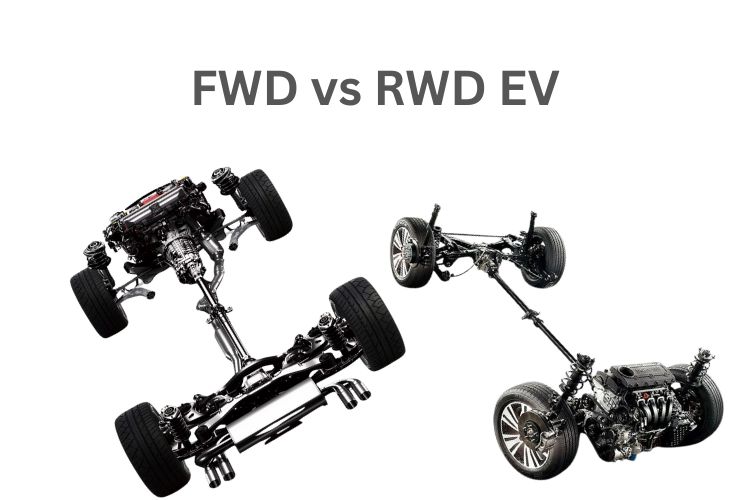
You’re there. Finally. After months of convincing yourself, budgeting, arguing with your spouse, you’re online configuring your dream EV. The colors are perfect. The interior? Chef’s kiss. And then you hit it. That dropdown menu: “Select Drivetrain: FWD / RWD.”
Your palms get sweaty.
Suddenly, your dad’s voice is in your head. “Front-wheel drive is safer in snow, son.” But then you remember that YouTube video claiming modern EVs are all rear-wheel drive for a reason. And your neighbor with the Tesla swears you should just get all-wheel drive to be safe. Three voices. Three different answers. And you’re sitting there, credit card in hand, frozen by analysis paralysis over a $50,000 leap into the unknown.
Here’s what nobody tells you: the old rules are dead.
Everything your parents taught you about FWD being the sensible winter choice and RWD being the tail-happy sports car layout? That wisdom came from a world of front-heavy gas engines and clunky mechanical traction control. Electric vehicles have completely rewritten the physics. The battery sits low and centered like a skateboard deck. The motors respond in milliseconds, not seconds. The weight distribution is balanced in ways a combustion car could never achieve.
We’re going to cut through the engineering jargon together. You’ll get cold, hard data and honest talk about what actually matters for your driveway, your commute, your winter, your budget. By the end, you’ll know exactly which wheels should spin for the life you actually live.
Keynote: FWD vs RWD EV
The choice between front-wheel drive and rear-wheel drive in electric vehicles represents a fundamental engineering question newly freed from internal combustion constraints. Modern EV skateboard platforms with centralized battery placement achieve near-perfect weight distribution, neutralizing traditional RWD winter traction concerns. RWD leverages dynamic weight transfer for superior acceleration and handling precision. FWD maintains cost advantages and familiar driving dynamics.
Tire quality affects safety more than drivetrain layout. Test both configurations to determine which dynamics and value proposition align with your priorities, budget, and climate conditions.
Why Your Dad’s “FWD for Snow, RWD for Fun” Advice Just Broke
The Old Rulebook (And Why It Actually Made Sense Back Then)
Let’s honor the classic wisdom for a second. Your dad wasn’t wrong. He was just working with different physics.
In a gas-powered car, front-wheel drive made genuine sense for winter survival. The engine, that massive hunk of iron and aluminum, sat directly over the front wheels. All that weight pressing down gave those tires grip. FWD pulled you through snow because the heavy end was doing the pulling. Think of it like pushing versus pulling a loaded shopping cart through mud. Pulling wins.
Rear-wheel drive gave you that sporty, connected feeling. The car pushed from behind, leaving the front wheels free to just steer. It felt alive, responsive, fun. But in winter? The rear end was light, almost floating, wanting to swap places with the front at every slippery intersection. That squirrelly, tail-happy reputation was earned through decades of fishtailing Mustangs and backwards-facing BMWs in snowy parking lots.
This wasn’t marketing. This was physics.
How EVs Completely Rewrote the Physics
Here’s where everything changes.
In an electric vehicle, the weight isn’t dumped over the front axle like a nose-heavy gas car. The battery pack, the single heaviest component in the entire vehicle, sits as a flat slab integrated into the floor. Low. Centered. Perfectly balanced between the front and rear axles like a backpack worn in the middle of your back instead of hanging off one shoulder.
This skateboard platform architecture creates something a combustion car could never achieve: a near-perfect 50/50 weight distribution. We’re talking 48/52 to 52/48 splits, compared to a typical gas-powered FWD car’s 65/35 front-heavy bias. That changes everything about traction, handling, and which wheels can effectively put power down.
And the traction control? It’s not some mechanical system cutting spark and fuel a half-second after you’ve already lost grip. Modern EV stability control adjusts motor torque hundreds of times per second, predicting and preventing wheelspin before it even starts. The system reacts faster than your brain can register the slide.
Translation: the fundamental advantages that made FWD “safer” and RWD “dangerous” in gas cars have been neutralized. The playing field just got leveled.
Let’s Talk RWD EVs: The Surprising New “Default”
Why So Many Brands Went RWD First
Pull up any list of new, purpose-built electric vehicles from the last three years. Tesla Model 3. Hyundai Ioniq 5 and 6. Kia EV6. Polestar 2. Genesis Electrified models. BMW i4. Even Volkswagen’s ID.4 offers rear-wheel drive.
EVs are ushering in the return of RWD. Not as a performance luxury, but as the smart engineering choice.
Here’s why. With a skateboard battery platform, there’s no driveshaft tunnel eating up your interior space. That old packaging advantage of FWD? Gone. Now engineers can choose the drivetrain based purely on dynamics, not compromise. And when you remove the constraints, physics points to rear-wheel drive.
RWD is often simpler in an EV. One motor at the rear. No long driveshaft. Fewer components spinning and creating friction. That translates to more miles per charge and lower manufacturing costs. The Tesla Model 3 RWD achieves 25 kWh per 100 miles, compared to the Chevy Bolt FWD at 29 kWh per 100 miles. That efficiency gap adds up to real range.
And here’s a daily win nobody talks about: turning radius. RWD EVs typically have a much tighter turning circle. Without driveshafts limiting the front wheel angle, you can crank the steering harder. That means easier parking, tighter U-turns, less three-point-turn frustration in your garage every single morning.
The Acceleration Advantage You’ll Feel Every Day
Floor the accelerator in any car and physics does something predictable. The weight shifts backward. Your body presses into the seat. The rear of the car squats down while the front lifts slightly. This is dynamic weight transfer, and it’s unavoidable.
Rear-wheel drive works with this law of physics.
When you hit the pedal in an RWD EV, weight shifts onto the driven rear wheels exactly when they need it most. More weight means more grip. More grip means more traction. The car surges forward with confidence, drama-free, no wheelspin, no steering wheel tugging in your hands. You get that addictive shove into your seat, smooth and controlled.
Front-wheel drive fights against this same physics.
The harder you accelerate, the more weight transfers off the front wheels. And those front wheels? They’re the ones trying to claw the car forward. You’re asking tires with less grip to do more work. In a mildly powerful gas car, this creates some wheelspin and torque steer. In an electric motor delivering 100% of its monstrous torque from zero RPM? It’s a traction nightmare.
The Chevrolet Bolt is a perfect example. Stab the throttle from a stop and the front tires light up, spinning uselessly while the traction control frantically cuts power. The steering wheel tugs to one side, fighting you. That instant torque delivery, the core magic of an EV, becomes a liability instead of an asset. RWD doesn’t just win here. It solves a problem that electric motors make worse in front-wheel drive.
But Seriously, What About Snow?
Let’s address the fear head-on. You’ve heard it your whole life: rear-wheel drive in snow equals disaster.
Here’s the honest truth most automotive journalists won’t emphasize. Modern RWD EVs with winter tires are shockingly capable. Not “good enough.” Not “manageable.” Genuinely, confidently capable in conditions that would have sent your dad’s old RWD Camaro spinning into a ditch.
The skateboard battery platform means an RWD EV has substantial weight directly over the rear drive wheels. Not a light, floaty rear end. Real mass pressing those tires into the snow. Combine that with traction control systems that respond in milliseconds, adjusting torque thousands of times per second, and you have a fundamentally different machine than any rear-drive gas car that came before.
Real-world testing backs this up. When Car and Driver tested a Tesla Model 3 on a snow-covered track, they found the RWD mode was actually marginally faster around the lap than the FWD simulation mode. The subjective feedback? FWD was “boring but safe.” RWD was “very enjoyable.”
If you live in flat or gently rolling terrain with occasional snow, RWD with a good set of winter tires is completely viable. Seriously. Your concern should shift from “which wheels spin” to “what rubber is between me and the road.”
Now, if you’re in serious mountain territory with steep grades, frequent ice storms, or genuinely harsh winter conditions where you’re plowing through deep snow weekly? We’ll talk about all-wheel drive in a minute. But for most people in most winter climates, the fear of RWD is a ghost from the past that no longer haunts the present.
Now, FWD EVs: The Practical, Familiar Choice
Where FWD Still Shines
Front-wheel drive isn’t going extinct. It’s just finding its proper place in the new electric order.
FWD feels familiar because, let’s be honest, you’ve probably driven it your entire life. That sensation of the car being pulled forward is comforting, predictable, safe in the way that a well-worn pair of jeans feels safe. There’s value in that familiarity, especially if you’re already anxious about switching to electric.
They’re often cheaper. Building an FWD powertrain typically requires fewer components than RWD, and automakers can pass those savings to you. The Chevrolet Equinox EV starts at $34,995 in FWD configuration. That lower entry price might be the difference between going electric this year or waiting another three years.
In some models, particularly those converted from gas-car platforms, the FWD layout gives you a frunk. That front trunk space where an engine used to live becomes extra storage. Groceries. Gym bags. Charging cables. Luggage. In a world where trunk space matters more than 0-60 times, that’s a tangible daily win.
The Quirks You Need to Know About
But FWD in a powerful EV isn’t without compromise.
Torque steer is real. In high-output FWD electric vehicles, when you unleash that instant torque from a standstill, you can feel the steering wheel tug and pull in your hands. It’s like an invisible gremlin briefly fighting you for control. Electronic systems mitigate it, but they can’t eliminate it entirely. That tug is the physical manifestation of asking your front tires to steer, accelerate, and manage torque vectoring all at once.
You’re pulling a very heavy battery pack rather than pushing it. The handling balance feels different. Less planted. Less connected. For most daily driving, this is irrelevant. But if you value the sensation of a car that responds eagerly to your inputs, that difference matters.
The front tires are doing three jobs simultaneously: steering the car, accelerating the car, and capturing energy during regenerative braking. That’s a lot to ask of two contact patches the size of your palm. Under aggressive driving, those front tires are operating right at the edge of their traction circle, compromising each task because they can’t excel at all three at once.
The Head-to-Head: A Simple Scorecard for Your Actual Life
Let’s lay it all out on the table. This isn’t about Nürburgring lap times or magazine accolades. This is about which one fits the life you actually live, the climate you actually drive in, the budget you actually have.
| Your Priority | RWD EV | FWD EV | AWD EV |
|---|---|---|---|
| Maximum Range & Efficiency | Typically the winner. Fewer drivetrain losses, optimized power delivery. Tesla Model 3 RWD: 25 kWh/100 mi. | Good efficiency, especially in city driving with regen advantage. Chevy Bolt: 29 kWh/100 mi. | Lower range due to added motor weight and dual-system friction. Expect 25-50 mile penalty. |
| Driving Fun & Daily Feel | Balanced, engaging, that sporty “push” sensation. Steering stays pure. | Familiar pulling feel, predictable but less thrilling. Can feel nose-heavy. | Ultimate acceleration and grip. Blistering 0-60 times, but at a cost. |
| Budget-Friendly Entry | Often the base model on dedicated EV platforms. More accessible than AWD. | Common on affordable platforms. Lowest price in many lineups. | Always a significant price premium. $5,000-$10,000 more than RWD. |
| All-Weather Confidence | Highly capable with winter tires. Balanced weight distribution changes the game. | Decent in light snow. That familiar “pulling through” feel. | The ultimate for severe, frequent winter conditions. Overkill for most. |
| Tight Spaces & Parking | Amazing turning circle. Less front-end packaging constraints. | Good maneuverability. | Good, but heavier and sometimes wider turning radius. |
| Tire Wear & Maintenance | Concentrated rear wear. Rotate every 5,000-6,000 miles. | More even wear. Can rotate less frequently. | Most expensive. Aggressive torque wears all four quickly. |
The One Metric That Matters More Than You Think
Turning circle.
It sounds boring. It sounds like something only engineers care about. Until you’re navigating a downtown parking garage at 6 PM on a Tuesday, trying to squeeze into a spot, and you realize your RWD EV can execute a U-turn in a space where your old FWD sedan needed a three-point maneuver.
That tighter turning radius is a legitimate quality-of-life improvement you’ll appreciate every single day. Not on paper. In reality.
The AWD Wild Card: When Is It Worth It?
All-wheel drive in an EV is essentially a rear-wheel drive system with a second motor bolted to the front axle. Torque vectoring. Instant grip at all four corners. Blistering 0-60 times that pin you to the seat and make your passengers gasp.
It’s intoxicating. It’s also expensive and thirsty.
Here’s what the online configurator won’t emphasize when you’re clicking that AWD checkbox: it always costs more (typically $5,000 to $10,000 premium) and it always reduces range. That second motor adds 50-100 kg of weight. The dual-system friction creates parasitic losses. Expect to lose 25-50 miles of EPA range on the same battery pack compared to the RWD version.
The truth most people need to hear: if you don’t live in a place with frequent snow, steep mountain grades, or genuinely severe winter ice storms, you probably don’t need it. Modern RWD with winter tires will handle 95% of what AWD can handle, at a fraction of the cost and with better efficiency for the remaining 11 months of the year.
AWD is the right choice if winter driving is a regular, serious concern. It’s overkill if you’re just checking a box for “peace of mind” based on that one snowstorm five years ago.
Efficiency, Range, and the Cost of Living With Your Choice
It’s Not Just About Which Wheels Spin
Here’s a secret the efficiency charts won’t tell you: architecture and software optimization matter more than the FWD versus RWD label.
A brilliantly engineered RWD system with smart battery thermal management and optimized regenerative braking tuning can outperform a poorly designed FWD system. The Tesla Model 3 RWD is more efficient than many FWD competitors not because of magic, but because of obsessive attention to aerodynamics, rolling resistance, and power electronics efficiency.
What actually affects your real-world range? Tire choice, aggressive acceleration habits, climate control usage, highway speeds, and how cold your winter gets. Switching from all-season tires to low-rolling-resistance tires can improve range by up to 20%. That dwarfs any inherent drivetrain advantage.
There is one nuanced efficiency difference worth understanding: regenerative braking. When you slow down, weight shifts forward onto the front tires. An FWD EV can theoretically apply stronger regenerative braking force before the front tires lose grip, potentially recapturing more energy during city stop-and-go driving. RWD has less weight over the rear wheels during braking, limiting maximum regen force.
In practice? The difference is marginal for normal driving. Both systems are highly efficient at energy recapture. Don’t choose your drivetrain based on theoretical regen advantages. Choose based on how the car feels and drives.
The Long Game: Real Ownership Costs
Consumer Reports analysis found that EVs save owners between $6,000 and $12,000 over the vehicle’s lifetime compared to gas cars. That’s primarily fuel savings and reduced maintenance costs. Fewer moving parts mean fewer things that break, wear out, or need expensive service.
Here’s the critical insight: this cost advantage exists whether power goes to the front wheels or rear wheels. The drivetrain choice doesn’t fundamentally change the core EV economic proposition. You’re still eliminating oil changes, transmission services, spark plugs, exhaust systems, and the endless maintenance parade of combustion engines.
What does differ slightly: tire replacement costs and rotation schedules. RWD EVs concentrate power delivery on the rear tires, creating faster wear. You’ll need to rotate every 5,000 to 6,000 miles to maximize tire life. FWD distributes forces differently, often allowing 7,500-mile rotation intervals. Over five years and 75,000 miles, that can translate to one additional tire rotation visit and potentially needing to replace all four tires at once instead of just two on an FWD car.
But we’re talking hundreds of dollars over years of ownership, not thousands. The bigger economic story remains: electric vehicles are dramatically cheaper to own and operate than gas vehicles, period.
Conclusion: Stop Analyzing, Start Feeling
You came here anxious. Sweaty palms. Stuck in that configurator screen. Paralyzed by conflicting advice from your dad, YouTube, your neighbor, and a dozen blog posts that somehow made everything more confusing.
Now you know the truth.
The old rules are dead. RWD isn’t the winter terror your parents warned you about. Modern EVs achieve balanced weight distribution that gas cars could only dream of. Traction control reacts in milliseconds. FWD isn’t automatically “safer.” It’s just different, with its own set of trade-offs that matter more or less depending on your priorities. AWD is incredible for severe winter climates and acceleration bragging rights, but it’s overkill for most drivers in most conditions.
Here’s your single, incredibly actionable first step for today: Stop obsessing over which wheels spin and put $1,500 in your budget for a quality set of winter tires or high-performance all-weather tires. That decision impacts your safety, traction, and confidence 100 times more than FWD versus RWD ever will.
And then, do this. Go take a test drive. Not a static showroom visit. An actual drive. Feel the instant torque of a RWD launch. Feel how the car settles into a corner, balanced and composed. Then drive an FWD model. Feel that familiar pull. Notice how the steering reacts under hard acceleration. Your body will tell you which one feels right for you.
The best part of the EV revolution isn’t just cleaner air or lower fuel costs. It’s that engineers finally have the freedom to build dynamically excellent vehicles without compromise. You get to drive something truly exciting, efficient, and capable. RWD is back, better than ever, available to everyone, not just the luxury buyer.
You’ve got this. Make your choice. Go electric. Welcome to the future.
RWD EV vs FWD (FAQs)
Do rear-wheel drive electric vehicles slip in snow?
No, not like old RWD gas cars. Modern RWD EVs have near-perfect 50/50 weight distribution from the centered battery pack, ensuring substantial weight over the rear drive wheels.
Combined with millisecond-response traction control, RWD EVs with winter tires perform confidently in snow, often matching or exceeding FWD capability. The old reputation simply doesn’t apply to electric vehicles with skateboard platforms.
Why are most new EVs rear-wheel drive instead of FWD?
Yes, there’s a clear engineering reason. EV skateboard platforms eliminate the packaging advantages that made FWD dominant in gas cars. With no driveshaft tunnel needed and balanced battery weight distribution, engineers can choose drivetrains purely on dynamics.
RWD offers superior acceleration (working with weight transfer), better handling (separating steering and propulsion duties), and often simpler, more efficient single-motor layouts. Major brands like Hyundai, Kia, Tesla, and Volkswagen have all committed to RWD-first EV architectures.
Does FWD or RWD get better range in electric vehicles?
RWD typically wins for highway range efficiency. Tesla Model 3 RWD achieves 25 kWh per 100 miles versus Chevy Bolt FWD at 29 kWh. RWD has fewer drivetrain components and losses.
However, FWD can theoretically recapture more energy during city regenerative braking due to forward weight transfer. Real-world difference? Usually marginal.
Tire choice, driving style, and aerodynamics matter far more than drivetrain layout for actual range.
Can you feel the difference between FWD and RWD in an EV?
Yes, absolutely. RWD delivers that “push from behind” sensation with balanced, predictable handling and pure steering feel uncorrupted by drive forces.
FWD gives a familiar “pulling” sensation but can exhibit torque steer (steering wheel tugging) during hard acceleration, especially in powerful models. RWD feels more engaging and sporty.
FWD feels more familiar and predictable. Test drive both back-to-back and your hands will immediately tell you the difference.
Is AWD worth the extra cost over RWD in an electric car?
Only if you genuinely need it. AWD provides ultimate traction for severe winter climates, steep mountain terrain, or maximum performance acceleration. But it costs $5,000 to $10,000 more and reduces range by 25-50 miles due to added motor weight and friction.
For most drivers in most conditions, RWD with quality winter tires offers 95% of AWD’s capability at much lower cost and better efficiency. Buy AWD for specific needs, not generic “peace of mind.”