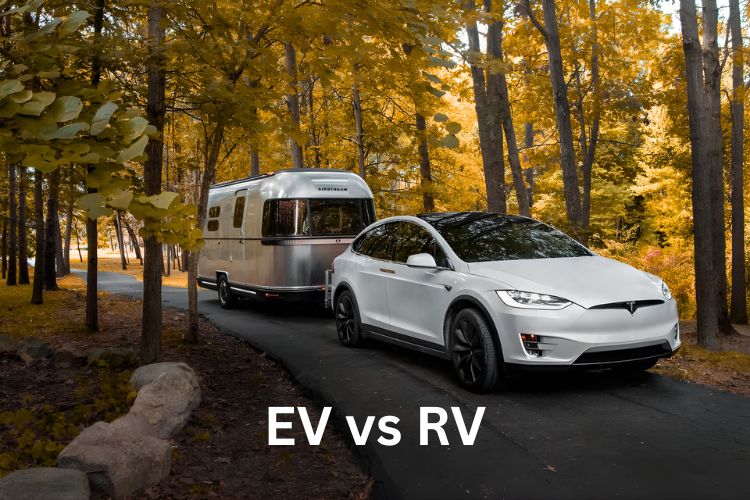
It’s 11 PM. You’ve got seventeen browser tabs open. One shows a Ford F-150 Lightning with its sleek electric profile and that gorgeous instant torque you’ve been dreaming about. Another shows a cozy Winnebago with a kitchen, a real shower, and enough storage for your mountain bikes. You’re toggling between them, and your brain is melting because you’re asking yourself: “Am I choosing between a car and a lifestyle, or am I trying to compare apples and apartments on wheels?”
Here’s the thing. Most articles either gush about towing an RV with an electric truck without mentioning that your range will crater by 50%, or they show you futuristic electric motorhomes that cost more than your first house. You’re left confused, overwhelmed, and no closer to an answer.
Let’s cut through the noise. We’re going to use real data, honest trade-offs, and actual owner experiences to help you figure this out. We’ll map your lifestyle first, then find the vehicle that serves it. No fluff, no fantasy specs. Just clarity.
Keynote: EV vs RV
The EV versus RV decision isn’t really a choice between vehicles. It’s a choice between lifestyles. Electric vehicles optimize daily efficiency with zero emissions and low costs. RVs provide mobile habitation with freedom to explore. The emerging electric RV market seeks to merge both worlds. Self-propelled electric trailers from Lightship and new electric motorhomes from Winnebago represent the future. But today, most buyers choose based on whether they prioritize daily transit efficiency or extended adventure capability.
First Things First: What Are We Really Comparing Here?
Two Very Different Dreams (and that’s okay)
Think of an EV as your Swiss Army knife for modern life. It’s your efficient daily driver that gets you to work for pennies per mile. It’s your weekend adventure enabler with instant torque that makes highway merging feel like a video game. It’s your tech-forward statement piece that says you care about the planet.
An RV? That’s your mobile tiny home. Your declaration of “I want to wake up anywhere.” It’s your kitchen, your bedroom, your living room, and your garage, all on wheels. These aren’t competing choices. They’re answers to fundamentally different questions about how you want to move through the world.
The Hidden Third Option Everyone Misses
Here’s what most people are actually wrestling with: Can my electric truck tow a regular travel trailer without dying halfway to the campground? Spoiler alert: it’s complicated, and the answer involves some brutal math we’ll get into.
Or maybe you’re asking: Should I skip the whole towing mess and just get an all-electric motorhome? That’s the future crashing into the proven present, and it comes with its own set of trade-offs.
Define Your Mission Before You Pick Your Machine
Before you fall in love with any vehicle, get brutally honest about what you’re actually trying to do. Are we talking about a daily commute with occasional weekend escapes within 200 miles? Multi-week cross-country odysseys where you want to wake up in Montana one day and Utah the next? Full-time mobile living where the RV becomes your actual home?
Your answer changes everything. Most guides mush lifestyle types together and skip the use-case-first approach. We won’t make that mistake.
The Range Reality Check: Where Dreams Meet Math
If You’re Thinking “EV Towing RV”
Here’s the gut punch you need to hear: towing can slash your electric vehicle’s range by roughly 40 to 60% on highway trips. That gorgeous F-150 Lightning with its advertised 300-mile range? Hook up a 7,200-pound travel trailer, and you’re looking at 90 to 150 miles before you’re hunting for a charger.
Real-world tests from Car and Driver put the Rivian R1T and Lightning through towing torture tests. The drops were steep. Edmunds drove an EV truck towing a modest trailer and watched the range evaporate like water on a hot skillet. The aerodynamic drag coefficient of a boxy trailer destroys the carefully optimized airflow of your electric truck. Add in the rolling resistance and weight penalty, and you’ve got compounding drag factors working against you.
What does this mean for your road trip? Expect 20 to 40-minute DC fast charging stops every 100 to 150 miles. Route planning becomes a chess game. You’ll need apps like PlugShare and Allstays to map charging stations that can accommodate your rig. And understand that infrastructure in rural America is still patchy. Your spontaneous “let’s take the backroads” moment now requires a different kind of planning.
If You’re Eyeing an All-Electric RV
Picture this: the Winnebago eRV2 concept. Sleek. Silent. Zero emissions. It offers around 108 miles of range on the Ford E-Transit chassis. Now compare that to a traditional gas Class B van’s 300 to 500-mile tank, and you’ll see the challenge.
Early trials with electric motorhomes show gorgeous, serene interiors and that intoxicating quiet hum of the motor. But real-world highway legs? You’re looking at under 100 miles before you’re hunting for a plug. The dream is silent, emission-free boondocking with solar panel integration powering your air conditioning while you sip coffee in total peace. The reality is careful trip planning and accepting that spontaneity has a battery limit, at least for now.
Companies like Thor Industries with their Vision Vehicle concept are chasing 300-mile targets using battery capacity combined with fuel cell range extenders. It’s promising. But it’s not sitting on dealer lots yet.
What About Hybrids and Future Tech?
The most innovative solution might not be making RVs electric. It might be making trailers smart. Lightship’s L1 self-propelled electric trailer can actually push itself to reduce aerodynamic drag on your tow vehicle. The trailer has its own 80 kWh battery pack and motors integrated into the axles. In drive mode, it assists your EV, dramatically reducing the range loss penalty.
Production has started, but this is cutting-edge, early-adopter territory. The Pebble Flow is another self-propelled electric camper hitting the market. These distributed propulsion solutions might be the answer that makes EV towing actually practical.
Charging, Campgrounds, and the Infrastructure Puzzle
The “Where Do I Plug This Beast?” Problem
Here’s the cool trick most people miss: many RV campgrounds already have the exact outlets you need to charge your EV. Most powered campsites feature a NEMA 14-50 outlet, which provides 50-amp, 240-volt service. That’s the same outlet many home EV chargers use.
The United States has over 13,000 RV parks and campgrounds. You’ve just discovered a vast, geographically distributed Level 2 charging network. Plug in overnight, wake up to a full battery, and you’re ready to roll.
But here’s the catch: RV park electrical systems were designed for the intermittent high-power demands of air conditioners and microwaves, not the continuous, sustained load of EV charging for 8 to 10 hours. If multiple EVs start charging simultaneously, you can trip the park’s main breakers and black out the entire campground. Some parks have started restricting EV charging because of this. If the site only has TT-30 receptacle (30-amp service), don’t get creative with sketchy adapters. It’s slow, risky, and could damage your vehicle.
The Mismatch Between EV Chargers and RV Bodies
Most public DC fast charging stations weren’t designed for a 30-foot vehicle. Maneuvering a full-size motorhome or truck with a trailer attached into a Tesla Supercharger stall? Good luck with that geometry.
The vast majority of charging stations are pull-in parking spots. This means if you’re towing, you have to unhitch your trailer at every charging stop, charge the truck, then re-hitch before continuing. It’s a time-consuming, back-breaking hassle that turns a 30-minute charging stop into an hour-long ordeal.
The RV Industry Association is pushing for federal funding to develop pull-through charging stations, similar to truck fueling lanes. Until those exist in meaningful numbers, long-distance EV towing remains a logistical puzzle.
The Cool Trick No One Talks About: V2L
Vehicle-to-load technology lets some EVs power your entire campsite or even parts of a traditional RV. Imagine running your cooler, lights, coffee maker, and phone chargers without a generator’s roar. The F-150 Lightning’s Intelligent Backup Power can run your whole campsite off the truck’s battery.
The catch? Full bidirectional home power systems are still expensive and require professional installation. But for campground use, many modern EVs offer simpler 120V outlets right in the truck bed or cabin. It’s not enough to run a full RV, but it’s perfect for powering the essentials.
Money, Hassle, and the Daily Feel: What You’ll Actually Experience
EV Plus Hotel/Cabin Strategy
This is the simplest path and the one most people overlook. You enjoy cheaper fuel costs (about $73 to drive 1,250 miles versus $159 in a gas car), instant torque, minimal maintenance, and zero range anxiety in your daily life. When adventure calls, you book lodging.
You’re not hauling weight, so you get the full rated EV range. No compromises. No towing capacity ratings to worry about. No tongue weight limits. Just pure efficiency. Your vehicle remains your daily driver that happens to be perfect for road trips to hotels, Airbnbs, or cabins.
EV Plus Lightweight Travel Trailer
You bring your beds, bikes, and kitchen, but you accept a 40 to 50% range hit. This means planning routes with charging stops that can accommodate trailers. Look for pull-through stations or be prepared for the unhitch dance.
This works beautifully for regional weekend warriors. You load up Friday night, tow 150 miles to a state park with 50-amp hookups, charge overnight, explore Saturday and Sunday, then tow home. But cross-country treks become a logistical puzzle that requires patience and flexibility.
Best lightweight trailers for electric vehicles include the Colorado Teardrops Boulder (under 2,000 pounds) and aerodynamic designs like the Bowlus Rivet. These minimize the range penalty while still giving you a comfortable place to sleep.
All-Electric RV Life (The Prototype Era)
Picture this: you’re parked off-grid in the desert. You’re running your air conditioning in total silence. Sipping coffee while the sun charges your solar panels. No fumes. No noise. Pure, emission-free serenity. This is the promise of electric RV models like the Winnebago eRV2 and Coachmen RVEX.
But here’s the trade: your trip legs are the limiter. You’re planning routes around charging infrastructure that’s still catching up to the dream. That spontaneous detour to a hidden hot spring? You’ll need to check if there’s charging within your 100-mile range first.
The upfront cost is brutal. A used gas Class C motorhome runs $30,000 to $100,000. A new electric Class B like the Coachmen RVEX targets around $150,000. You’re paying three to five times more for the electric future, at least today. You’ll need to drive tens of thousands of miles to break even on fuel savings.
Traditional Gas or Diesel RV Freedom
That unshakable feeling of pulling into any gas station in any small town, anywhere in the country. Fill up in five minutes, hit the road, repeat. This is proven, get-you-home reliability that your parents and grandparents have trusted for decades.
Maintenance networks exist everywhere. Parts are standard. Repairs don’t require specialist EV techs or rare battery components. If your water heater breaks in rural Wyoming, you can get it fixed.
Fuel costs are higher per mile. A large Class A motorhome getting 6 to 8 MPG will burn through your wallet at $2,617 per year for just 10,000 miles. But the vehicle’s purchase price is dramatically lower. A solid used Class C starts around $30,000. That price difference buys a lot of diesel.
Most Guides Miss This: It’s Not About Tech, It’s About Your Story
Conduct Your Personal Travel Audit
Look back at the last 12 months. What percentage of your time was daily commuting? Weekend getaways within 200 miles? Week-long road trips? Full-time travel? Be brutally honest.
If 80% of your driving is a daily commute and errands, with only 20% being adventure trips, then optimizing for that 20% by buying an RV makes zero sense. You’ll park it in your driveway 10 months a year while paying insurance, registration, and watching it depreciate.
The vehicle that wins should serve your 80% reality, not your 20% dream, unless that dream is about to become your full-time life.
The “One Vehicle to Rule Them All” Fantasy
Here’s the truth most dealers won’t tell you: no single machine is perfect for everything. The most practical strategy for many people is two vehicles: an EV for daily life and a rented RV for those few epic annual adventures.
Rent a Class C from Outdoorsy for $150 to $200 per day. Take it for two weeks. That’s $2,800 total. Compare that to buying an $80,000 motorhome, paying $1,000 in annual maintenance, $1,000 in insurance, $500 in registration, and watching it lose $8,000 in depreciation the first year. You’d need to rent for 28 days per year just to break even.
This sidesteps the compromises entirely. You’re not towing with reduced range or parking a giant motorhome at the grocery store.
Who Should Choose What, Right Now
Go EV if: Your adventures are mostly regional. You have reliable Level 2 charging at home and destinations. You value low operating costs and cutting-edge tech. Spontaneity for you means “let’s drive to the coast this weekend,” not “let’s disappear into Montana for a month.”
Go traditional RV if: You dream of true cross-country freedom. You want to boondock in remote areas without stress. You value proven fill-up-anywhere reliability. Your budget demands getting the most space and capability for your dollar today.
Go electric RV if: You’re a tech enthusiast and early adopter. Your trips stick to well-developed RV parks with robust electrical hookups. You’re willing to pay a premium to live in the quiet, emissions-free future right now. You understand you’re buying into a prototype era.
Your Next Chapter Starts With One Weekend, Not One Purchase
The Journey We’ve Taken Together
We started with a dream of the open road and navigated range loss percentages, campground charging compatibility, infrastructure gaps, and lifestyle realities. The truth? There’s no universally right answer. There’s only the right answer for you, for your life as it actually is today.
Whether it’s the sleek efficiency of an EV, the boundless freedom of a traditional RV, or the pioneering spirit of an all-electric motorhome, the goal is the same: more life, more adventure, more you.
Your Single, Incredibly Actionable First Step
Don’t visit a dealership yet. Don’t compare GCWR ratings or study SAE J1772 charging standards for another hour. Instead, book a test experience.
Rent an EV on Turo for a weekend. Take a road trip. Live with the charging reality. Feel the instant torque and regenerative braking. Does it make you smile or stress you out?
Or rent a small RV from Outdoorsy for three days. Camp somewhere beautiful. Deal with the propane-free systems (if electric) or the generator noise (if not). Sleep in that fold-down bed. Does it feel like freedom or like work?
Your gut, after 24 real hours, will tell you more than any spec sheet ever could.
The Final Thought
This isn’t just a vehicle you’re choosing. It’s the backdrop for your next chapter. It’s the tool that either gets you to the places that recharge your soul or becomes a beautiful, expensive anchor in your driveway.
The future is electric. That much is certain. But the present is nuanced, and your happiness lives in that nuance. Choose the vehicle that makes you excited to turn the page. Now close this guide, open a map, and start imagining your life in the driver’s seat. Which picture feels more like home?
RV vs EV (FAQs)
How much does towing a camper reduce EV range?
Yes, significantly. Expect 40 to 60% range loss when towing a travel trailer with an electric truck. A Ford F-150 Lightning with 300 miles unladen range drops to 90 to 150 miles while towing a 7,200-pound trailer. The boxy aerodynamic profile and weight create compounding drag factors that destroy efficiency.
Can you charge an EV at an RV campground?
Yes, most of the time. Many RV parks have NEMA 14-50 outlets (50-amp, 240V service) that work perfectly for Level 2 EV charging overnight. But some parks restrict or forbid EV charging due to electrical system limitations. Always call ahead and ask about their EV charging policy before booking.
What electric trucks have the best towing capacity?
The GMC Hummer EV leads with 7,500 pounds maximum towing capacity, followed by the Ford F-150 Lightning at 7,700 to 10,000 pounds (depending on battery size), and the Rivian R1T at 11,000 pounds. But remember: towing capacity and real-world towing range are very different things.
Are there pull-through charging stations for RVs?
Rarely. Most DC fast charging stations are pull-in parking spots that force you to unhitch trailers. The RV Industry Association is advocating for pull-through charging infrastructure, but widespread availability is still years away. This remains the biggest logistical barrier to long-distance EV towing.
Do self-propelled electric trailers really work?
Yes, they’re in production now. The Lightship L1 and Pebble Flow use integrated electric motors and onboard battery packs to push themselves, dramatically reducing the energy burden on your tow vehicle.
Early tests show they can preserve 50% or more of your EV’s range compared to towing a conventional trailer. The technology works, but these trailers cost significantly more than traditional models.