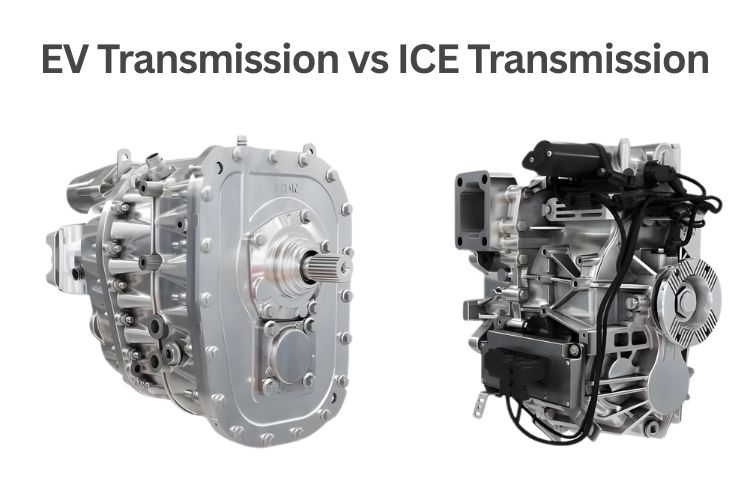
You floor the pedal. The EV leaps. “Wait… no gears?” You’re not imagining things. The drivetrain feels completely different, almost alien.
I get it. You’ve been driving gas cars your whole life, and suddenly someone tells you electric vehicles don’t need transmissions. Except they do? Kind of? It’s confusing as hell. Most guides either oversimplify (“EVs have no transmission!”) or drown you in engineering jargon about planetary gearsets and field weakening. You’ve heard conflicting advice everywhere, and that confusion is exactly why you’re here.
Here’s my promise: We’re going to cut through the noise together, using cold, hard data to find warm, real solutions. You’ll understand this better than 99% of people, and no engineering degree required.
Keynote: EV Transmission vs ICE Transmission
The single-speed EV transmission represents automotive engineering’s elegant solution to propulsion. By eliminating the multi-gear complexity required by gas engines, electric vehicles achieve instant torque delivery, drastically reduced maintenance costs, and superior drivetrain efficiency. While exceptions like the Porsche Taycan prove multi-speed systems have niche applications, the single-speed reduction gearbox remains the optimal choice for mass-market EVs. This fundamental simplicity transforms the ownership experience and redefines expectations for modern driving.
Why Your Gas Engine Is a High-Maintenance Drama Queen
The Grumpy Engine’s Narrow “Happy Place”
Your gas engine is picky. Really picky.
It only makes peak torque in a narrow RPM band, like a toddler who’ll only eat chicken nuggets shaped like dinosaurs. Outside that sweet spot between 2,000 and 6,000 RPM? Your engine is either weak and inefficient at low speeds or screaming for mercy at high speeds. The power band is everything, and it’s frustratingly narrow.
Think of it like constantly shifting a 10-speed bike just to keep moving smoothly. You’re in first gear pulling away from a stoplight, grinding through second and third to merge onto the highway, then hunting for that perfect cruising gear. Exhausting, right?
Enter the Translator: Your Multi-Speed Gearbox
The transmission exists for one reason: keeping that grumpy engine in its happy zone.
Whether you’re starting from a red light or cruising at 70 mph, the transmission is constantly hunting, shifting, and adjusting. It multiplies torque at low speeds so your engine doesn’t stall. It reduces RPM at high speeds so your engine doesn’t explode. The result? Modern automatic transmissions pack 6 to 10+ gears, thousands of moving parts working in perfect harmony, and endless mechanical complexity.
Inside that housing, you’ve got torque converters using hydraulic fluid to transmit power, planetary gearsets creating different ratios, clutch packs engaging and disengaging, and a valve body directing pressurized fluid with split-second precision. It’s a mechanical marvel. It’s also a headache waiting to happen.
The EV’s Superpower: Why It Just Doesn’t Need All That
Electric Motors Are Happy Everywhere
Here’s where everything changes.
An electric motor delivers strong torque from 0 RPM across a wide band. Not at 2,000 RPM. Not after it “warms up.” From zero. The instant you touch the pedal, you get 100% of its pulling power with no winding up, no waiting, no drama. The motor maintains this high torque across an exceptionally broad range, often spinning efficiently all the way to 18,000 RPM or higher.
No narrow sweet spot means no need for a complicated translator juggling 8 different gear ratios.
What “Single-Speed” Actually Means
But EVs do have transmissions. Let’s be clear about that.
It’s technically called a single-speed gear reduction unit or a reduction gearbox. One fixed gear reduces the motor’s screaming-high RPM down to a usable wheel speed. That’s it. No shifting, no hunting, no complexity. Just smooth, continuous pull from 0 to highway speeds.
Tesla once highlighted this beautifully: roughly 17 drivetrain moving parts in an EV versus 200+ in a typical gas car. That’s not marketing spin. That’s fundamental architectural simplicity.
The Beautiful Silence of Fewer Moving Parts
Let me show you what this looks like side by side.
| Component/Feature | EV (Single-Speed) | ICE (Multi-Speed) | So What For You? |
|---|---|---|---|
| Typical Gears | Single-speed reduction | 6-10+ gears | No shift shock or hunting |
| Key Parts | Fewer than 20 moving parts | Thousands (gears, clutches, converters) | Less to break, simpler design |
| Torque Delivery | Instant and flat across speeds | Peaks at high RPM only | No lag, just seamless power |
| Maintenance Needs | Minimal fluid changes | Regular fluid changes, complex repairs | Your wallet will thank you |
This isn’t just about being different. It’s about being fundamentally better for most driving situations.
Your Wallet’s Best Friend: The Maintenance Freedom You’ve Been Dreaming Of
The Joy of Skipping the $200 Transmission Service
Remember that sinking feeling when the mechanic says you need a transmission flush?
Kiss it goodbye. EVs eliminate the entire category of internal combustion maintenance. No transmission fluid services every 30,000 miles. No spark plugs to replace. No timing belts to worry about before they snap and destroy your engine. No oil changes every 5,000 miles. No exhaust system repairs when your catalytic converter finally gives up.
Fewer fluids to service means fewer trips to the mechanic. Fewer surprise bills arriving when you’re already stretched thin.
Brakes That (Barely) Wear Out, Thanks to Regeneration
Here’s something wild: EV brake pads can last 100,000 miles or more.
Regenerative braking turns your electric motor into a generator during deceleration. It slows the car while sending energy back to the battery instead of wasting it as heat through your brake pads. Your physical brakes barely see action during normal driving, saving you hundreds on brake jobs over the vehicle’s lifetime.
It changes how downshifts “feel” too. That smooth, progressive slowdown when you lift off the accelerator? That’s regeneration at work, almost like engine braking but without the engine. Many drivers switch to one-pedal driving, controlling both acceleration and deceleration with just the accelerator pedal.
The Bottom Line in Cold, Hard Numbers
Over five years, EV maintenance costs run roughly 50% lower than comparable gas vehicles.
A typical automatic transmission contains hundreds of moving parts. An EV’s single-speed reduction gearbox? Fewer than 20. The math is brutally simple: fewer parts equal fewer things that can break. The transmission fluid in an EV might not need changing until 80,000, 120,000, or even 150,000 miles. Some manufacturers call it “lifetime” fluid.
Translation: your relationship with your mechanic just got a whole lot more casual.
But What About Performance? Shattering the “No Gears, No Fun” Myth
The Launch That Glues You to Your Seat
Let me paint you a picture.
You’re at a stoplight. Light turns green. You press the accelerator halfway, and the car surges forward with one continuous, powerful whoosh from 0 to 60. No pause. No lurch. No moment where the transmission hunts for the right gear while you’re left hanging. Just instant, seamless, jet-like acceleration that pins you to your seat.
That’s instant torque delivery. The gas car next to you? Its engine is still climbing through its power band, pausing to shift from first to second, then second to third. By the time it finds its rhythm, you’re already three car lengths ahead.
No shift shock. No waiting. Just physics happening in your favor.
The Exception That Proves the Rule: Porsche Taycan’s Two-Speed
Now here’s where it gets interesting.
The Porsche Taycan adds a two-speed gearbox on the rear axle, and there’s real engineering logic behind it. First gear uses a short 16:1 ratio that punches you off the line with breathtaking force. Second gear switches to a taller 8:1 ratio that sustains efficiency at very high speeds, keeping the motor in its sweet spot during Autobahn runs.
Porsche claims the Turbo S can launch ten consecutive times from 0 to 60 in 2.6 seconds with zero performance degradation. That’s the benefit of strategic complexity.
But here’s the big picture: most EVs still use single-speed transmissions because they work brilliantly for 99% of driving. Multi-speed systems appear in niche performance cases where every percentage point of high-speed efficiency matters or where extreme acceleration meets extreme top speed requirements.
Why It Matters for 99% of Your Driving
The Taycan’s two-speed transmission balances launch control thrills with Autobahn-ready capability.
For your daily commute? The single-speed reduction gearbox is perfectly optimized and blissfully simple. It gives you instant response in city traffic, smooth highway cruising, and zero mechanical drama. The complexity trade-off only makes sense when you’re regularly pushing 150 mph on a closed track or need to maximize every mile of range during sustained high-speed driving.
Forget the Tech Specs. What Does This Actually Feel Like to Drive?
The Sensory Reality of Driving ICE vs. EV
Let’s talk about what your body actually experiences.
| Sensation | Gas Car (ICE) | Electric Car (EV) |
|---|---|---|
| Acceleration | Pauses to shift, engine “revs up” | Instant, seamless, constant pull |
| Noise | Engine roars, transmission clicking | A quiet, futuristic hum |
| “Feel” | Mechanical, complex, sometimes jerky | Smooth, simple, effortlessly powerful |
The gas car gives you that familiar mechanical symphony. The rumble at idle. The roar under acceleration. The tactile feedback of each gear change. For enthusiasts, that’s the soul of driving.
The EV? It’s eerily quiet at low speeds. Just a faint high-frequency whine from the motor and power electronics. The complete absence of engine vibration creates a serene, almost luxurious environment. At highway speeds, tire noise and wind become the dominant sounds.
The City Commuter’s Dream Machine
Stop-and-go traffic is where jerky gear changes are most annoying in a gas car.
The transmission is constantly downshifting, upshifting, hunting for the right ratio as speeds fluctuate. Your passengers feel every transition. The engine revs up and down. It’s mechanical chaos for something as simple as creeping forward in traffic.
It’s also where regenerative braking shines brightest. Every time you slow down, you’re capturing energy instead of burning it off as brake dust. The EV turns your daily grind into a glide, perfectly suited for the urban environment where most of us spend most of our driving time.
A New Way to Think About Drivetrain Layout
Without a massive engine block dominating the front of the car, EV engineers have unprecedented freedom.
Motors are compact. They can be mounted directly on the axles. This means rear-wheel drive and all-wheel drive configurations (often with dual motors, one per axle) become more common and more affordable. The result? Better weight distribution, improved handling dynamics, and more balanced performance.
You also get flat floors with no transmission tunnel intruding into the cabin. More interior space. Front trunks where the engine used to live. The architectural simplicity of the drivetrain creates ripple effects throughout the entire vehicle design.
Conclusion: You’re Not Just Buying a Car, You’re Buying Simplicity
We started with the frustration of conflicting information and confusing jargon about whether EVs even have transmissions. We discovered they do, but it’s a fundamentally different beast. We explored how a simpler, more elegant engineering solution offers tangible benefits for your daily life, your finances, and your driving joy. The whole debate wasn’t really about “gears” at all. It was about Complexity vs. Simplicity.
The old way (multi-speed ICE transmissions) is a marvel of intricate, grumpy engineering designed to manage a temperamental power source. The new way (single-speed EV reduction gearboxes) is just smart, simple, and smooth because the power source doesn’t need managing.
Your one action for today: The next time you test-drive an EV, stomp on the pedal from a standstill (safely!) and feel that seamless whoosh. Listen to the silence. That’s it. That’s everything you just learned, condensed into one visceral moment.
Welcome to the conversation. You’re no longer confused. You’re the one who gets it.
ICE Transmission vs EV Transmission (FAQs)
Do electric vehicles have transmissions?
Yes, but not like gas cars. EVs use a single-speed reduction gearbox that steps down the motor’s high RPM to wheel speed. No shifting. No complexity. Just one fixed gear ratio that works from 0 to highway speeds because electric motors deliver strong torque across their entire RPM range.
Why don’t EVs need multiple gears?
Because electric motors are fundamentally different from gas engines. A gas engine only makes peak torque in a narrow band (think 2,000 to 6,000 RPM), so it needs multiple gears to stay in that zone.
An electric motor delivers 100% torque from 0 RPM and maintains it across a wide band, eliminating the need for constant gear changes.
Can EV transmissions fail?
Yes, but it’s much less common. With fewer than 20 moving parts versus thousands in an ICE transmission, there’s simply less to break. The most common issues are bearing wear, seal degradation, or contaminated reduction gear oil. These failures are rare and often covered by extended warranties.
How often does EV transmission fluid need changing?
Rarely. Most EVs specify transmission fluid changes at 80,000 to 150,000 miles. Some manufacturers even list it as “lifetime” fluid requiring no scheduled changes. Compare that to ICE transmissions needing service every 30,000 to 60,000 miles, and the maintenance advantage becomes crystal clear.
What maintenance does an EV transmission require?
Minimal. Besides the infrequent fluid change, there’s almost nothing. No filter replacements. No clutch adjustments. No torque converter services. The single-speed gearbox is a sealed unit that typically runs trouble-free for the life of the vehicle, requiring only basic inspection during routine service appointments.