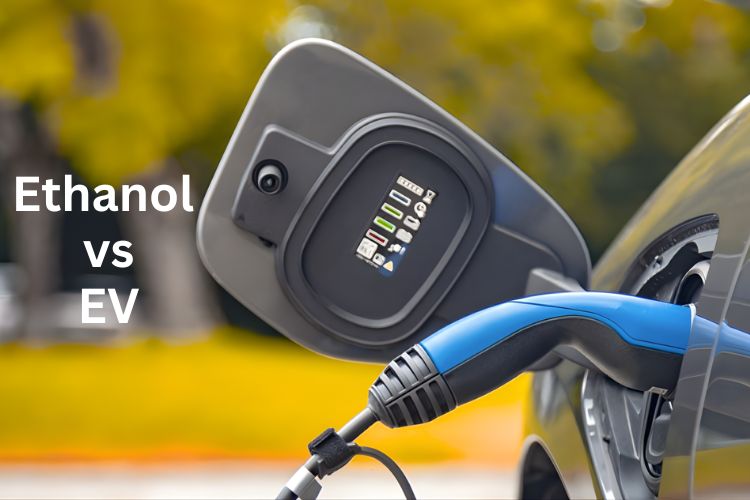
You’re standing at the pump. Eyes flicking between the E85 button and the regular unleaded. Your phone buzzes with another headline about electric cars saving the planet. Your friend just bought a Tesla. Your neighbor swears by his flex fuel truck running on corn juice.
And you? You’re paralyzed by information overload.
One article screams that biofuels are greenwashing. Another claims EVs are just coal-powered cars with good PR. There are charts about carbon footprints that look like spaghetti. Terms like “lifecycle emissions” and “kilowatt-hour” swim in your head. You hear “ethanol,” “zero emissions,” “lithium mining,” and “renewable fuel standard” until it all blurs together. It’s overwhelming, and honestly, you’re worried about making the wrong choice.
Here’s what we’re going to do. We’ll stack feelings next to facts. We’ll cut through the noise and make a calm, honest call together. No engineering degree required. No guilt trips. Just clarity.
We’ll walk through the carbon math that actually matters, the real costs hiding behind sticker prices, the land use nobody talks about, the practicality of your actual life, and where this all lands for you. Ready? Let’s go.
Keynote: Ethanol vs EV
The ethanol versus EV debate hinges on lifecycle impact, cost reality, and infrastructure momentum. EVs deliver 60% to 68% lifecycle emission reductions. E85 offers 40% to 57% cuts but with fuel economy penalties. EVs cost more upfront yet save $1,100+ annually on energy. Charging networks are exploding. E85 stations remain sparse. The future is electric.
What We’re Really Comparing
Think of ethanol vehicles and electric cars as two very different relatives at the family reunion, both loudly claiming to be the eco-friendly one. They’re solving the same problem but using completely opposite playbooks.
Defining Ethanol: The Corn-Based Promise
Let’s start with what ethanol actually is. It’s not some sci-fi fuel. It’s high-proof alcohol mixed with gasoline, mostly made from U.S. corn. You’ve already been using it. That E10 label you see on almost every pump? That’s 10% ethanol blended into regular gas. It’s been sneaking into your tank for years.
E85 is the big brother. It’s 51% to 83% ethanol depending on the season and where you live. To use it, you need a flexible-fuel vehicle, or FFV. These are cars and trucks with slightly beefed-up fuel systems. Special sensors, corrosion-resistant parts, and a smart engine computer that adjusts on the fly.
Here’s the thing. It’s still a combustion engine. You’re still burning fuel. You still have spark plugs and oil changes and exhaust pipes. It’s a small tweak to the status quo, not a reinvention.
Defining EVs: The Battery on Wheels
Battery electric vehicles are the opposite. They rip out the entire engine, the fuel tank, the transmission, the exhaust system, all of it, and replace it with something radically simpler. A big battery. A quiet electric motor. A charging port.
That’s it.
No tailpipe. No engine oil. No 3,000-mile service intervals. The battery stores electricity measured in kilowatt-hours, or kWh. The motor turns that electricity into instant, silent thrust. It’s a commitment to a completely new system.
And here’s what matters. That system is getting cleaner every single year as the grid adds more wind and solar power. An EV you buy today will automatically have lower emissions five years from now without you doing a thing.
The Tradeoffs We Can’t Ignore
Both have baggage. Let’s be honest.
Ethanol uses farmland, water, and mountains of energy to grow that corn. We’re talking about vast fields that could be feeding people, not cars. Add in the fertilizer, the tractors, the diesel-powered processing plants.
EVs need minerals. Lithium, cobalt, nickel. We talk about mining impacts, about battery production, about whether the grid is clean enough. Both have upstream impacts. Neither is perfectly “green” out of the box.
The question isn’t which is perfect. It’s which is better, and which is getting better faster.
The Carbon Math: Lifetime Emissions, No Excuses
This is the big one. This is where the eco-guilt lives. You want to do the right thing, but you need the real numbers.
The EV Advantage: The Numbers Don’t Lie
Today’s battery electric vehicles cut lifetime emissions by roughly 60% to 68% compared to a regular gas car in the U.S. Not 10%. Not 20%. More than half.
And here’s the beautiful part. That advantage grows every single year. As your local power plant retires old coal units and adds solar panels, your EV gets cleaner while sitting in your driveway. An EV is only as clean as the grid that charges it.
In West Virginia, where coal still dominates, the upstream emissions are higher. In Washington State, where hydropower runs the show, they’re almost zero. Geography matters.
Corn Ethanol’s Complicated Story
The carbon math for ethanol is messier. Some models show E85 cutting lifecycle emissions by roughly 40% to 57% below gasoline. Others find much worse results.
Why the wild range? Land use change.
If we’re clearing forests or plowing up native grassland to grow more corn for ethanol, we’re releasing massive amounts of stored carbon from the soil. That can erase ethanol’s carbon gains entirely. One study found that powering miles with corn ethanol takes roughly 85 times more land than powering the same miles with solar panels feeding an EV.
Let that sink in. Eighty-five times.
The median of credible studies favors battery EVs. Ethanol’s results hinge heavily on whether we’re using existing farmland smartly or destroying ecosystems to make more.
The Honest Truth About “Green”
Ethanol is renewable but not always truly sustainable. Growing corn at industrial scale requires fertilizer, which releases nitrous oxide, a greenhouse gas 300 times more potent than CO2. It requires water, diesel-powered equipment, and processing energy.
EVs shift the pressure to power grids and mines. But recycling programs are scaling up fast, and every new wind turbine improves the equation. If ethanol production avoids land use change and uses efficient farming, it improves. Real-world acres complicate the story.
The Wallet Test: What Do They Actually Cost You?
Let’s talk money. Because it’s the first thing we all check, even if we don’t admit it out loud.
The Upfront Sticker Shock
EVs almost always cost more to buy new. That’s just a fact in 2025. The average new electric car costs around $55,500. The average new car overall? About $49,700. That battery pack is expensive.
Flex-fuel vehicles cost almost exactly the same as regular gas cars. Automakers often throw in the E85 capability as a no-cost option. You can find new FFV SUVs and trucks starting in the low $20,000s to $40,000s. No premium.
But wait. Federal and state incentives can cut EV prices by $7,500 or more. You can now transfer that tax credit to the dealer at purchase as an instant discount. That $55,500 EV becomes $48,000 before you drive off the lot.
The Cost Per Mile Reality
Here’s where it gets interesting. E85 has a dirty little secret. It contains about 33% less energy per gallon than gasoline. So your fuel economy drops by 25% to 35%. You fill up more often. Way more often.
For E85 to save you money, its price per gallon needs to be at least 27% cheaper than regular gas to break even. As of January 2025, E85 averaged $2.41 per gallon versus $3.04 for regular. That’s only a 21% discount. You’re actually spending more per mile.
The Department of Energy’s math confirms it. E85 costs the equivalent of $3.34 per gallon when you account for energy content. That’s more expensive than gasoline.
EVs? Different universe. Charging at home costs about 3 to 5 cents per mile. A comparable gas car costs around 15 cents per mile. Over 15,000 miles per year, you’re saving over $1,100 annually just on “fuel.”
Cost to Drive 100 Miles (2025 Averages)
| Power Source | Cost |
|---|---|
| E85 Ethanol | $9.50 |
| Regular Gasoline | $8.75 |
| Home Electricity (EV) | $4.20 |
Your local electricity rates change this equation. But EVs are cheaper to “fill” at home in virtually every state.
The Long Game: Total Cost of Ownership
Maintenance matters too. EVs have fewer moving parts. No oil changes. No spark plugs. No timing belts. No catalytic converters to replace. Regenerative braking means your brake pads last three times longer.
The U.S. Department of Energy estimates maintenance costs at 10.1 cents per mile for gas cars versus 6.1 cents per mile for EVs. That’s a 40% reduction. Consumer Reports found lifetime maintenance and repair costs for EVs are roughly half those of gas cars.
When you add up fuel, maintenance, and resale over five to ten years, the gaps narrow fast. Most analyses show EVs reaching a total cost of ownership break-even point within 3 to 5 years. Over ten years, you can save $6,000 to $12,000.
Your mileage varies, literally. If your local electricity is expensive or E85 is dirt cheap in your area, the math shifts. Personal driving habits matter. Daily commuter? EV wins. Road trip warrior every weekend? Different story.
The “Am I Going to Get Stranded?” Test: Infrastructure Reality Check
Imagine you’re running late for a family event two states away. Which car is less stressful today?
The E85 Scavenger Hunt
You can get regular gasoline everywhere. There are roughly 145,000 gas stations in America. But E85? Only about 5,800 stations carry it. That’s 4% of all stations.
Finding E85 can be its own kind of range anxiety. Availability varies wildly by region. If you live in Minnesota, Illinois, Iowa, or Michigan, you’re golden. The Midwest Corn Belt has stations everywhere. Live on the East or West Coast? Good luck.
This network isn’t growing. It’s been stuck at roughly this size for years. Retailers don’t see the demand. Drivers don’t see the stations. It’s a vicious cycle.
The New Habit of EV Charging
Home charging changes everything. This is the paradigm shift people miss. You wake up every single morning with a “full tank.” You never drive to a station for your daily commute. Never wait in line. Never get gas smell on your hands.
For 90% of your driving, you charge while you sleep. It’s more convenient than gas, not less.
Road trips take planning. There are now over 71,000 public charging stations in the U.S. offering more than 204,000 individual charging ports. That network has nearly doubled since 2020 and is expanding fast.
DC fast chargers can add 200 miles of range in 20 to 30 minutes. Not as fast as a five-minute gas fill-up, but fast enough to grab coffee and use the restroom while the car charges. Apps like PlugShare and ChargePoint show you where every charger is along your route.
Rural areas are still spotty. Planning ahead is required. But the momentum is undeniable. Public charging infrastructure is exploding. E85 stations are standing still.
Performance and the Joy of Drive
Let’s talk about how these cars feel. E85 can deliver a high-octane power boost. That 100+ octane rating means more aggressive engine tuning, more horsepower. Performance enthusiasts love it.
But imagine the silent, instant shove of an EV’s acceleration. No lag. No revving. Just immediate, smooth, relentless thrust from a standstill. It’s addictive. The quiet hum of the motor versus the growl of an engine. Both have their appeal.
This isn’t just about carbon molecules. It’s about how the car feels to you every single day. A Nebraska state fleet study logged hundreds of thousands of E30 miles with no negative effects. FFVs are proven and durable. EVs are thrilling and serene.
The Hybrid Middle Ground: The Compromise We Need to Talk About
You want a simple answer. Electric or ethanol. But there’s a powerful, often-ignored middle path.
The Best of Both Worlds?
What if you didn’t have to choose?
Plug-in hybrid electric vehicles, or PHEVs, run on electricity for daily commutes and switch to gasoline or biofuels for longer trips. You get 30 to 50 miles of pure electric range for errands and work. Then the gas engine kicks in for the road trip to Grandma’s house.
Now add flex fuel capability to that hybrid. You get a plug-in hybrid electric flex fuel vehicle, or PHEFFV. Electric for daily use. E85 for extended range. Real-world testing has logged over 27,000 miles showing 64% lower nitrogen oxide emissions and 73% lower particulate matter when running on E85.
For countries like the U.S. and Brazil with robust ethanol and electric infrastructures, this isn’t a compromise. It’s pragmatic strategy.
The Game-Changer
A 2024 study found that a plug-in flex-fuel hybrid running on E85 could match the climate performance of a full battery EV. Let that sit for a second. This changes the entire “either/or” conversation.
These vehicles can deliver 440 miles of total range. Lower purchase costs than comparable long-range BEVs. Lifecycle greenhouse gas reductions of 38% to 77% depending on driving patterns and grid mix.
This option removes decision paralysis. It addresses range anxiety. It uses existing fuel infrastructure and emerging charging networks simultaneously.
Why This Isn’t a Cop-Out
For your local grid, your access to fuels, and your daily driving life, hybrids bridge the gap. The perfect is the enemy of the good. This option lets you go electric most of the time without the stress of long-distance charging anxiety.
Ethanol is a bridge built on old technology. EVs are the imperfect destination we’re racing toward. Hybrids walk both paths. They give us deep, immediate carbon cuts today while the charging network catches up.
Conclusion: Finding Your Own Lane on the Road to Tomorrow
We started with anxiety, tangled in conflicting claims and cherry-picked stats. We’ve walked through the carbon ledger, the cost spreadsheets, the infrastructure maps, and the real-world trade-offs.
Here’s what we know. There is no single “winner” that works for everyone. The right vehicle depends on your local grid’s energy mix, your access to E85 or charging stations, and your daily driving patterns. Ethanol is a compromise, a cleaner burn that still relies on combustion. An EV is a commitment to a new and rapidly improving system. Both choices beat doing nothing and hoping gas prices stay low forever.
Before you do anything else, spend 10 minutes researching your world. Google “what powers my state’s grid?” to see how clean your electricity is. Use the Alternative Fuels Data Center to find E85 and EV charging stations on your regular routes. Make your choice based on your world, not a generic comparison chart.
The best choice is just an informed one. Whether you choose an EV, a flex-fuel vehicle, or a hybrid, you’re making a more conscious decision than 90% of drivers on the road. You’re thinking critically. You’re weighing trade-offs. You’re refusing to be paralyzed by perfection. And that, in itself, is a powerful step forward. You’re now the informed person in the room. Go use that.
EV vs Ethanol (FAQs)
Is E85 cheaper than charging an electric car?
No, not usually. E85 delivers 25% to 35% worse fuel economy due to lower energy density, which typically erases any pump price savings. Home charging an EV costs 3 to 5 cents per mile versus E85’s 7 to 10 cents per mile in most regions.
Do flex fuel vehicles get worse gas mileage than EVs?
Absolutely, by a landslide. FFVs running on E85 see fuel economy drop by 25% to 35% compared to gasoline. EVs are fundamentally more efficient, converting over 85% of electrical energy to motion versus an ICE’s 20% to 30% thermal efficiency.
Which has lower emissions: ethanol or electric vehicles?
EVs win decisively. Battery electric vehicles reduce lifecycle greenhouse gas emissions by 60% to 68% compared to gasoline cars in the U.S. Corn ethanol reduces emissions by 40% to 57%, and that advantage is static while EV emissions improve as grids get cleaner.
Can you convert a regular car to run on E85?
Technically yes, but it’s risky. Aftermarket E85 conversion kits exist, typically costing $400 to $1,200 plus installation. However, using E85 in a non-flex-fuel vehicle can damage fuel system components not designed for ethanol’s corrosive properties. Factory FFVs have ethanol-resistant parts. Proceed with caution.
What is the real-world range of E85 vehicles vs EVs?
It depends wildly. FFVs on E85 lose 20% to 30% of their gasoline range, dropping a 300-mile tank to 210 to 240 miles. EVs in 2025 average 300 miles per charge, with some exceeding 500 miles. Both require more frequent “refueling” than gasoline-only cars.