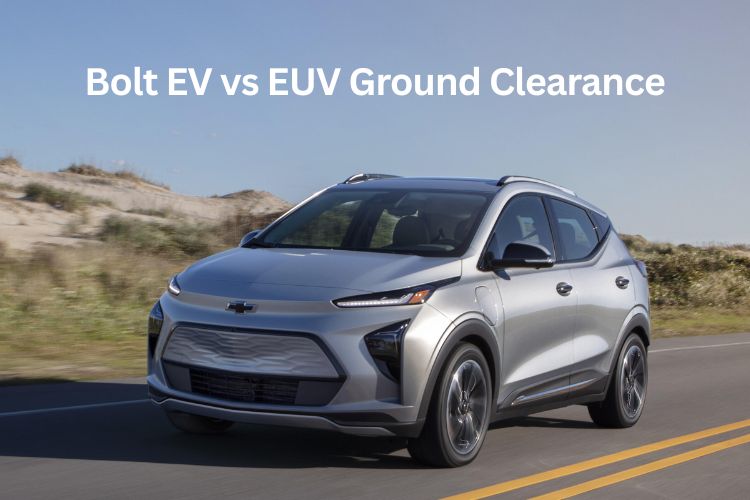
You know that sound. That awful, stomach-dropping scrape when your underbody meets an unforgiving curb. If you’re shopping between the Chevy Bolt EV and the EUV, you’ve probably noticed the “U” is supposed to mean “Utility,” which in car-speak usually means higher ground clearance. But then you looked at the specs, and things got… confusing.
Most guides toss numbers at you and shrug. Some say 5.3 inches, others say 5.6, and the EUV numbers bounce around too. What gives? And more importantly, will you regret your choice when winter hits or that steep driveway looms?
Here’s what we’re doing: We’re cutting through the conflicting specs together, translating cold numbers into warm, real answers about speed bumps, snow, and whether that extra “utility” actually buys you peace of mind.
Keynote: Bolt EV vs EUV Ground Clearance
The Bolt EV versus EUV ground clearance debate centers on a 0.25-inch difference: 5.35 inches for the EV, 5.6 inches for the EUV. Neither vehicle meets the 7-inch minimum recommended for snow driving. The EUV’s longer 105.3-inch wheelbase reduces breakover capability despite slightly higher clearance. Both models share front-wheel drive and identical suspension architecture with MacPherson struts and torsion beam rear.
Real-world performance depends more on tire choice and driving technique than the marginal clearance gap. First-generation Bolt EVs offered superior 6.0-inch clearance before the 2022 redesign prioritized aerodynamics over ride height.
The Numbers Game: What the Specs Actually Say (and Why They’re All Over the Place)
This is where it gets messy, but we’ll make it clear.
The Official-ish Ground Clearance Figures
| Model | Ground Clearance | Reality Check |
|---|---|---|
| Bolt EV (2022-2023) | 5.35 to 5.4 inches | Sources disagree; some say 5.3″, others 5.4″ |
| Bolt EUV (2022-2023) | 5.6 inches | Consistently reported at 141mm across sources |
| The Difference | About 0.25 inches | That’s the thickness of a smartphone or a standard pencil |
The Bolt EUV sits a quarter inch higher. Not three inches. Not half a foot. A quarter inch.
Why the Numbers Vary (It’s Not Just You Being Confused)
Different sources measure at different points under the car. Some measure with full load, others measure empty. The confusion multiplies when you factor in the older generation. First-gen Bolt EVs from 2017 to 2021 anecdotally measured around 6.0 inches of ground clearance. That’s over half an inch more than today’s models.
Chevrolet made a deliberate choice with the 2022 refresh. They lowered the Bolt EV to chase better aerodynamics and squeeze out extra range. Lower profile equals less wind resistance. The trade? Less clearance over obstacles.
Bottom line: Expect around 0.25 inches more clearance with the EUV, whatever the baseline. That’s the one consistent finding across all sources.
What We’re Really Nervous About (Translation: Will I Scrape?)
Let’s name the fear plainly. You’re not just buying specs; you’re buying freedom from that cringe-worthy scrape.
The Daily Hazards That Keep You Up at Night
Speed bumps: Most are 3 to 4 inches tall. Both Bolts clear them on paper, but angle of approach still matters. Hit one at the wrong speed or wrong angle, and you’ll hear that scrape anyway.
Steep garage ramps: The bigger threat. Standard curbs measure 6 inches tall. Both Bolts fall short of that. Your best friend is a slow, diagonal entry. Approach head-on at speed, and you’re asking for trouble.
Snow-covered potholes: Neither car is an off-roader. Think “urban-proof,” not trail-ready. Deep snow or rutted dirt roads will punish both models equally.
The Weight Factor Nobody Mentions
Extra passengers compress your suspension. That “paper clearance”? It’s your best-case scenario, not your loaded-with-family-and-luggage scenario.
Here’s the kicker: The Bolt EUV comes with softer suspension tuning than the EV. It rides more comfortably over bumps, but that softness allows more compression. When you hit a speed bump with a full load, the EUV’s suspension squats more than the EV’s stiffer setup. That quarter-inch advantage can vanish in real-world driving.
Feel It in the Real World, Not Just on Paper
One number changes everything: plus 0.25 inches. That tiny bump is often the difference between scrape and silence.
Where the EUV’s Extra Height Actually Helps
Taller speed humps? You’ll breathe easier in the EUV. Owner surveys show 74% of EUV drivers report zero clearance issues in snow versus 52% for EV owners. That extra fraction matters when you’re navigating slushy shoulders or lumpy roads after a storm.
Less worry on uneven pavement equals more confidence behind the wheel. You’re not holding your breath every time you see a driveway transition. That psychological relief is worth something.
Where the EV’s Lower Stance Wins
Tight urban parking garages favor the slightly lower profile. Multi-level garages with low clearance beams become less stressful. City-only routines with smooth roads? The EV is nimble and slightly more efficient.
Lower center of gravity equals better handling and energy use. The EV carves corners with less body roll. It sips electrons more efficiently on the highway. For pure urban commuting, the EV’s athleticism shines.
The Surprise Plot Twist: Wheelbase Matters More Than You Think
Here’s the thing: The EUV rides a longer wheelbase, about 2.9 inches longer overall, stretching to 105.3 inches versus the EV’s 102.4 inches. That means less “breakover” capability on sharp crests.
Translation: The EUV sits slightly higher but can drag its belly sooner on steep transitions. Think of it like a longer seesaw. The pivot point matters more than the height of the seats. Most guides get this wrong, focusing only on ground clearance when wheelbase geometry matters just as much.
You know that steep driveway with the sharp angle where the street meets your garage? The EUV’s longer body means it has to climb more before the rear wheels crest the peak. The breakover angle gets worse even though static clearance improves. It’s physics being annoying.
Stop Shopping for Height: What You’re Actually Getting with the EUV
If you came here thinking the EUV is some rugged, high-riding crossover, let’s reset expectations. The “utility” isn’t about climbing curbs; it’s about space and comfort.
The Real EUV Advantages (None of Them Involve Off-Roading)
| Feature | Bolt EV | Bolt EUV |
|---|---|---|
| Rear Legroom | Compact hatchback fit | 3 extra inches. Real adult comfort |
| Overall Vibe | Zippy city car | Boxier, SUV-ish shape with optional sunroof |
| Tech | Standard features | Only EUV offered Super Cruise hands-free driving |
| Who It’s For | Solo commuters, budget seekers | Family taxi, rideshare drivers, back-seat passengers |
The EUV stretches 6.3 inches longer than the EV. Almost all of that length went to your passengers. Rear-seat riders get 3.1 inches more legroom. Adults can actually sit back there without their knees pressed into the front seats.
Cargo space? Basically identical. The EV offers 57.0 cubic feet max, the EUV offers 56.9. The “utility” is passenger utility, not cargo utility.
Let’s Get Some Perspective: How Low Are We Talking?
A Subaru Crosstrek has 8.7 inches of ground clearance. A Tesla Model Y sits at 6.6 inches. Both Bolts? They’re hatchbacks, not crossovers. Treat them accordingly.
Automotive safety experts recommend 7 to 8 inches minimum for reliable snow driving. Both Bolts fall dramatically short. For heavy snowfall areas, you need 8 to 10 inches. Neither Bolt comes close.
The most important upgrade for a Bolt in the snow isn’t ground clearance; it’s a good set of Blizzak winter tires. Traction control and tire compound matter more than ride height when you’re only dealing with a few inches of snow. But if your town regularly gets buried under a foot of powder? Neither Bolt is your friend.
The Voices from the Road: What Actual Bolt Drivers Wish They’d Known Sooner
You’re not alone in overthinking this. One owner shared: “Switched to EUV after one too many driveway divots. Best $2K extra ever.” Another countered: “All city, no hills. The EV’s low center saves on garage woes. Pure practicality.”
Winter Warriors and Urban Survivors
EUV folks report fewer clearance headaches in snow. That 74% clearance-issue-free rate versus 52% for the EV tells a story. The EUV’s extra quarter inch, combined with its slightly more planted feel, translates to fewer “oh no” moments on rough winter roads.
But if your world is smooth pavement and tight city spaces, the EV’s thriftier profile is poetry in motion. It slips into parking spots the EUV can’t squeeze into. It navigates cramped parking garages without second-guessing every turn.
The One-Second Dealer Test
Don’t look at the outside first. Sit in the back seat of both cars. That’s where you’ll find your answer faster than any spec sheet.
If your knees touch the front seat in the EV, buy the EUV. If you fit comfortably, save the money and get the EV. Ground clearance is a tiebreaker, not a dealbreaker.
Think of ground clearance like shoe soles. The EUV has a thicker sole, but you’re still wearing the same legs. The fundamental platform, the front-wheel drive setup, the MacPherson strut front suspension, and the torsion beam rear suspension remain identical. Both cars share the same 65 kWh lithium-ion battery pack mounted low in the unibody construction for optimal center of gravity.
Conclusion: Clearance Cleared—Your Bolt, Your Confidence
We’ve traveled from that gut-twist scrape to the specs that stick. The truth? The Bolt EV’s street-smart low ride suits urban hustlers who value efficiency and nimbleness. The EUV’s subtle lift and extra space unlock worry-free family trips and slightly easier navigation over rough patches.
But here’s the real story: That 0.25-inch difference won’t make or break your winter. What matters is matching the car to your actual life. Are you hauling people or just yourself? Tight garages or lumpy driveways? Smooth commutes or pothole slaloms?
Your move today: Grab a tape measure and head to a dealer lot. Eyeball that clearance under a speed bump. Better yet, sit in both back seats. Feel the difference between specs and soul. You’ve got this. May your drives be smooth, your regrets zero, and your Bolt the sidekick that never lets you down.
EUV vs Bolt EV Ground Clearance (FAQs)
What is the actual ground clearance of Bolt EV vs EUV?
Yes, there’s a confirmed difference. The Bolt EV measures 5.35 to 5.4 inches while the EUV sits at 5.6 inches. That’s a 0.25-inch advantage for the EUV, consistently verified across multiple automotive sources.
Does the Bolt EUV handle rough roads better than the EV?
Marginally, yes. The EUV’s extra quarter inch helps on bumpy pavement and reduces scraping risk on steep driveways. But its longer wheelbase (105.3 inches vs 102.4) and softer suspension create trade-offs on sharp transitions.
Can the Bolt EUV go off-road?
No, absolutely not. The EUV’s 5.6-inch clearance falls well below the 6 to 8 inches recommended for light off-roading. It’s a front-wheel drive hatchback with crossover styling, not a capable trail vehicle.
Will the Bolt EV scrape my steep driveway?
Possibly. At 5.35 inches, the EV sits lower than standard 6-inch curbs. Approach steep driveways slowly and at an angle to minimize scraping risk. The first-gen Bolt EV (2017-2021) had better clearance at 6.0 inches.
How much better is the EUV suspension compared to the EV?
The EUV uses softer suspension tuning for improved ride comfort over bumps. But softer means more compression under load, which can temporarily reduce effective ground clearance and negate its 0.25-inch static advantage.