You’re scrolling headlines, and one screams BMW is ditching EVs for hydrogen. The next says hydrogen is dead. You’re about to drop serious money on a car that should last a decade, and even BMW seems to be playing both sides. That confusion you feel? It’s real, and it’s valid.
Here’s the truth nobody’s piecing together: This isn’t about which technology wins some imaginary race. It’s about not being the person who bought the Betamax while everyone else went VHS. It’s about your driveway, your commute, and your wallet.
Let’s cut through the noise together. We’ll look at what BMW actually sells today versus what they promise for tomorrow, unpack the real numbers on infrastructure and costs, and figure out which choice lets you sleep soundly at night.
Keynote: BMW EV vs Hydrogen
BMW offers battery electric vehicles now and hydrogen vehicles maybe in 2028. Battery EVs deliver 70% efficiency, $10-20 home charging costs, and access to 55,000+ U.S. charging locations today. Hydrogen offers 3-minute refueling but only 25% efficiency, $192 fill-up costs, and access to 50 California-only stations. For 95% of buyers, the battery electric path provides superior economics, infrastructure access, and real-world usability right now.
The Now vs The Someday: What You Can Actually Drive Home Today
BMW EVs: Parked at Your Dealer Right Now
Walk into any BMW dealership this week and you’ll find battery electric vehicles waiting for you. The i4 Gran Coupé delivers that sporty BMW feel with instant torque that’ll make you grin. The iX SUV combines family-friendly space with cutting-edge tech. There’s the elegant i5 sedan and the flagship i7 that redefines luxury. In select markets, you can even snag the compact iX1 or iX2.
Real range numbers? The iX delivers up to 324 miles on a charge. The i4 lands around 300 miles. These aren’t pie-in-the-sky promises. These are EPA-tested figures you can verify right now.
Starting prices you can actually see: The i4 begins at $57,900, and with federal tax credits potentially knocking off $7,500, you’re looking at real savings that hit your bank account. Here’s something that should give you perspective: 17 million battery electric vehicles sold globally in 2024. That’s 20% of all car sales. This isn’t experimental anymore.
BMW Hydrogen: The 2028 Promise
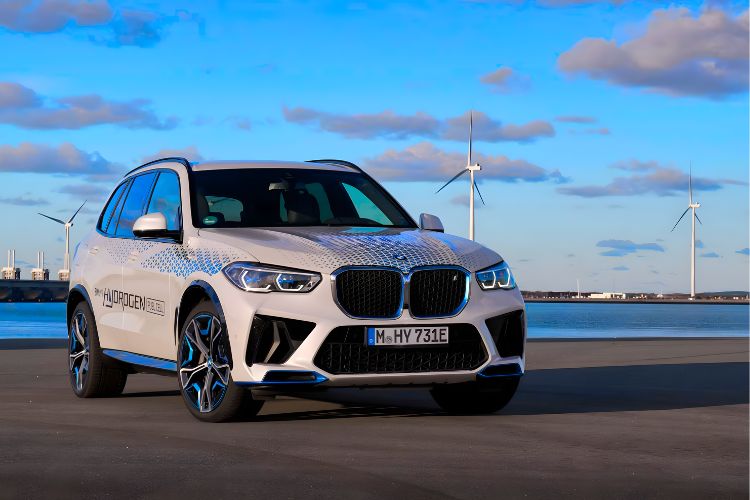
Now let’s talk about the BMW iX5 Hydrogen. It exists. Sort of. BMW built roughly 100 demonstration units for pilot testing. You can’t buy one. You can’t lease one. BMW won’t even let you order one.
The company targets a production model for 2028. Not 2026. Not next year. 2028, and that’s if everything goes perfectly. Here’s a shocking statistic that’ll put this in perspective: only 56 hydrogen vehicles sold in the entire United States as of February 2025. Fifty-six. In a country with 280 million registered vehicles.
Why the Headlines Keep Whipping You Around
BMW CEO Oliver Zipse talks about hydrogen’s long-run role in many regions. That’s a careful, diplomatic statement. Media outlets translate this as BMW abandoning electric for hydrogen or vice versa, depending on which narrative drives more clicks.
Reality sits firmly in the middle. BMW plans to launch 40 new battery electric models by 2027. Forty. Meanwhile, they’re targeting one hydrogen model by 2028. The company’s actions speak louder than any press release. They’re hedging their bets, sure, but the lion’s share of investment, engineering talent, and manufacturing capacity is flowing toward battery electric vehicles.
Refueling Reality: Minutes vs Anxiety
The Hydrogen Speed Dream
Let’s give hydrogen its due. The iX5 Hydrogen refuels in 3 to 4 minutes. You pull up, attach the nozzle, wait less time than it takes to grab a coffee, and you’re done. Full tank. The WLTP range hits roughly 504 kilometers or about 310 miles per fill.
This is genuinely impressive. It mirrors the gas station experience you’ve known your entire driving life. No planning. No waiting. Just fill and go.
The EV Charging Honest Truth
Charging a battery electric vehicle requires a different mindset. At a DC fast charging station, you’ll add significant range to your i4 in about 30 minutes. That’s enough time to stretch your legs, use the restroom, grab lunch. It’s not instant, but it’s also not the end of the world on a road trip.
Here’s where the real magic happens: home charging. You park your BMW iX in your garage, plug it into a Level 2 charger, and walk inside. Eight hours later, usually overnight while you’re asleep anyway, you wake to a fully charged vehicle. Every single morning. You never visit a gas station for your daily driving. Ever.
Long trips do require planning around charging stops. That’s just honest truth. But for most people, most days, you’re charging while you sleep.
The Side-by-Side That Settles It
| Factor | BMW EVs (i4/iX) | BMW Hydrogen (iX5) |
|---|---|---|
| Fill-up time | 30 min fast / 8 hrs home | 3-4 minutes |
| Typical range | 300-324 miles | ~310 miles |
| Where to refuel | 55,000+ US charging locations | ~50 working US stations (California only) |
| Cost per fill | $10-20 home / $28 public fast | $192 at California prices |
Look at that last row. Really look at it. A full charge at home costs you $10 to $20. A hydrogen fill in California, the only state where you can realistically own a fuel cell vehicle, costs $192. That 3-minute convenience comes with a price tag that’ll make your accountant weep.
Infrastructure: The Map That Changes Everything
EV Charging Exploded While You Weren’t Looking
The electric vehicle charging network didn’t just grow. It exploded. In 2024 alone, 1.3 million new public chargers were added globally. Europe crossed the milestone of 1 million total charging points. The United States now has over 192,000 charging ports spread across more than 61,000 locations.
That means 95% of Americans live in a county with at least one public charging station. Nearly two-thirds live within two miles of a charger. The infrastructure is scaling exponentially, following the money and the users.
BMW made this easy for you. Through partnerships with Electrify America and Shell Recharge, your i4 or iX gets access to thousands of fast chargers nationwide. Many new BMW purchases include complimentary charging packages. Two years or 1,000 kilowatt-hours free. That’s real value hitting your wallet immediately.
Hydrogen Stations: The Desert You Can’t Ignore
Let’s talk hard numbers. Roughly 1,000 to 1,160 hydrogen stations exist worldwide by late 2024. The United States has approximately 50 working stations. Fifty. Almost all of them concentrated in California, primarily around Los Angeles and San Francisco.
If you live in Denver, you can’t own a hydrogen car. If you’re in Chicago, forget it. Atlanta? No chance. Even in California, more than half of hydrogen stations were non-operational in 2023. Equipment failures, supply chain issues, maintenance problems. The network is fragile.
The Collapse Nobody Talks About
Here’s what really stings. Shell, one of the world’s largest energy companies, permanently closed all its hydrogen stations for passenger vehicles. All of them. They cited supply constraints and market challenges as fancy corporate speak for “this isn’t working.”
The UK dropped from 15 hydrogen stations in 2019 to just 4 by 2025. That’s not growth. That’s a collapse.
The emotional reality hits hard: Your 3-minute refill is absolutely worthless when you’re 200 miles from the nearest working station. Speed means nothing without access.
Show Me the Money: Costs That Actually Hit Your Account
Hydrogen’s Shocking Price Reality Right Now
Brace yourself. Current California hydrogen costs hit $32 to $36 per kilogram in 2025. The iX5 Hydrogen holds 6 kilograms. Do that math with me: $192 to $216 for a full tank. For roughly 310 miles of range.
That works out to about 62 cents per mile. Compare that to a gasoline car averaging 30 mpg with gas at $3.50 per gallon. That’s about 12 cents per mile. The hydrogen car is five times more expensive to fuel than a regular gas guzzler.
Industry experts say hydrogen would need to cost $5.88 per kilogram just to compete with hybrid vehicles. We’re not even close. In Europe, prices sit at €11 to €13.85 per kilogram. Still absurdly high.
Here’s something wild: Washington state has hydrogen for $4 per kilogram at certain stations. That’s a 9x price difference from California. Why? Supply, demand, subsidies, infrastructure costs. The market is completely unstable.
EV Charging Costs Are Predictable
Charging your BMW i4 at home with the average U.S. residential electricity rate of $0.16 per kilowatt-hour costs about $10 to $20 for a full charge. That gives you 300 miles. That’s roughly 3 to 7 cents per mile. This is gasoline-equivalent pricing of about $1.41 per gallon.
Public DC fast charging costs more. Networks like Electrify America charge $0.40 to $0.64 per kilowatt-hour depending on your membership level. A full charge might run you $28 to $40. Still cheaper than hydrogen, but the real win is home charging.
You’ll spend about $1,500 to install a Level 2 home charger. One-time cost. Then you save on every charge forever. The math works beautifully in your favor.
The Math That Should Scare Hydrogen Buyers
Let me paint the complete picture. You buy a theoretical BMW hydrogen car in 2028. You live in California because you have no other choice. Every fill costs you $192 to $216. You drive 12,000 miles per year, the American average.
At 310 miles per tank, you’re filling up roughly 39 times per year. That’s $7,488 to $8,424 annually just for fuel. Meanwhile, your neighbor with a BMW i4 charging at home spends about $840 per year. They’re saving nearly $7,000 every single year on fuel alone.
Over a 10-year ownership period, that’s $70,000 in fuel savings for the battery electric vehicle. That’s not a rounding error. That’s a down payment on a house.
The Energy Efficiency Gap Nobody Wants You to See
Both Promise Zero Tailpipe Emissions
Let’s be clear about what’s true. Both battery electric vehicles and hydrogen fuel cell vehicles produce zero emissions from the tailpipe. The BMW i4 produces electricity and heat. Nothing comes out the back. The iX5 Hydrogen produces water vapor, electricity, and heat. Also nothing harmful from the tailpipe.
Both technologies are zero-emission vehicles in the strictest local sense. But that’s where the similarity ends.
How the Fuel Actually Gets Made
Here’s the dirty secret they don’t put in the brochures. 98% of today’s hydrogen comes from natural gas through a process called steam methane reforming. This is “grey hydrogen,” and it’s incredibly carbon-intensive. Making 1 kilogram of grey hydrogen releases 11 to 13.9 kilograms of carbon dioxide into the atmosphere.
Green hydrogen, the truly clean version made by splitting water using renewable electricity, costs $4 to $12 per kilogram to produce. Grey hydrogen costs $1 to $3 per kilogram. Guess which one the market prefers?
Meanwhile, electricity for battery electric vehicles is increasingly sourced from solar, wind, and other renewables. The grid is getting cleaner every year. When you charge your BMW iX today, you’re tapping into a grid that’s roughly 40% renewable in many U.S. states. That percentage only improves with time.
The Efficiency Reality That Hurts
Battery electric vehicles achieve 70 to 80% efficiency from power plant to wheels. You take 100 units of energy from a solar panel, and 70 to 80 units actually propel your car forward.
Hydrogen fuel cells manage only 25 to 35% efficiency. Why? You start with 100 units of renewable electricity. You lose 45% converting that electricity into hydrogen through electrolysis. You lose more compressing the hydrogen to 700 bar pressure for storage. You lose more during transport. Then you lose another 55% converting that hydrogen back into electricity in the fuel cell stack.
Think of battery electric vehicles as a direct highway from the power plant to your wheels. Hydrogen is a scenic route with expensive tolls at every junction. You need roughly three times more renewable energy to travel the same distance in a hydrogen vehicle compared to a battery electric vehicle.
This isn’t a small difference. This is a fundamental physics problem that no amount of engineering can completely overcome.
What BMW’s Actually Building: The Strategy Behind the Headlines
The Technical Reality of iX5 Hydrogen
The BMW iX5 Hydrogen is genuinely impressive engineering. It combines a 125-kilowatt fuel cell with a buffer battery and BMW’s fifth-generation eDrive motor, delivering a total of about 295 kilowatts or 401 horsepower. Zero to 100 kilometers per hour happens in under 6 seconds. It drives like a typical BMW electric vehicle because, at its core, it is an electric vehicle.
The car carries roughly 6 kilograms of hydrogen onboard in two carbon-fiber-reinforced tanks pressurized to 700 bar. That’s about 10,000 pounds per square inch. The engineering required to safely store and manage hydrogen at that pressure is extraordinary.
Here’s the context that matters: This is a pilot fleet today. Roughly 100 units built for demonstration and testing. The production version promised from 2028 represents BMW’s third-generation fuel cell system, developed jointly with Toyota.
BMW’s Multi-Path Philosophy in Plain English
CEO Oliver Zipse consistently backs what BMW calls a “technology-open” approach. They’re not betting everything on one solution. Sounds smart, right? But actions speak louder than corporate messaging.
BMW plans to launch 40 new battery electric vehicles by 2027. They’re building entirely new factories. They’re developing the Neue Klasse platform, a revolutionary 800-volt architecture with cylindrical battery cells and rare-earth-free motors. This is where the money flows. This is where the engineering talent concentrates.
Meanwhile, they’re developing one hydrogen model for 2028. One. Hydrogen complements batteries where pumps and green hydrogen actually exist. That’s the honest assessment. It’s not an either-or competition inside BMW. It’s a primary strategy with battery electric vehicles and a backup plan with hydrogen.
Where Hydrogen Actually Makes Sense
BMW positions fuel cell technology for customers who cannot charge conveniently at home or work. If you live in an apartment with no dedicated parking, home charging isn’t an option. If you’re towing heavy trailers across long distances regularly, the energy density of hydrogen offers advantages.
Here’s the reality check from market forecasts: S&P Global projects fuel cell electric vehicles will represent just 0.22% of the global market by 2037. That’s not a typo. Less than a quarter of one percent. Battery electric vehicles are expected to exceed 50% of the global market by that same year.
The technology finds much stronger footing in heavy-duty trucks, buses, and industrial applications. Long-haul trucking, where refueling speed and weight matter enormously, might be hydrogen’s real future. But for passenger cars? The numbers tell a brutally clear story.
Your Decision Framework: Choosing for Your Actual Life
If You’re Buying in the Next Two Years: The EV Path
BMW battery electric vehicles exist right now. The charging infrastructure exists right now. The costs are knowable right now. You can test drive an i4 or iX this week. Not in 2028. This week.
Here’s your action plan. First, check your home situation. Do you have a garage or dedicated parking spot where you can install a Level 2 charger? If yes, you’ve solved 90% of the charging equation. Second, map the DC fast chargers along your three most common long-distance routes. Use PlugShare or the Electrify America app. If you see chargers every 100 miles or so, you’re golden.
Third, run the numbers with your actual electricity rate. At $0.16 per kilowatt-hour, you’re looking at about $2.50 to fill up for 100 miles of driving. Compare that to your current gas costs. The savings stack up fast.
If You’re Hydrogen-Curious: The Reality Check Audit
I respect the curiosity. Hydrogen sounds amazing in concept. But let’s do an honest audit right now. Open Google Maps. Search for hydrogen stations within 50 miles of your home. How many appear? If you don’t live in California, Japan, or South Korea, the answer is probably zero.
Even if you do live in California, check the operational status. The California Fuel Cell Partnership maintains a station map showing which locations are actually working. More than half were down at various points in 2023. That’s not a functioning network.
Ask yourself this hard question: Are you willing to be an early adopter with all the headaches that entails? Limited stations. High fuel costs. Uncertain long-term support. If you answered yes, you’re a special kind of brave. For everyone else, wait until 2030 at the earliest to revisit this question.
The Honest Middle Ground
There’s no universal “best” car. I’ll say that again because it’s crucial. There’s no universal best car. There’s only the best car for your specific daily life.
The practical choice isn’t the boring choice. It’s the smart one. Your lifestyle audit beats any expert’s opinion, including mine. Do you have home charging access? Do hydrogen stations exist on your actual routes today, not theoretical routes five years from now? How many miles do you drive daily versus occasionally?
For 95% of BMW shoppers, battery electric vehicles deliver better economics, better availability, and better real-world usability right now. For a tiny fraction who live in California, drive extremely high mileage, and have access to working hydrogen stations, maybe, just maybe, the future hydrogen option could work. But that’s a lot of “ifs” and “maybes” when you’re spending $80,000 on a vehicle.
Conclusion: From Confusion to Confident Choice
We started with that sinking feeling of conflicting headlines and the fear of making an expensive mistake. Now you’ve seen the complete picture. BMW’s battery electric vehicles are available today with charging infrastructure compounding fast. Hydrogen remains promising but trapped in a 2028 timeline with station networks barely existing and costs that sting.
Your action step for today: Visit your local BMW dealer and test drive an i4 or iX. Feel how it actually accelerates, ask real questions about home charging costs, and get specific numbers for your situation. Then map the DC fast chargers along your three most common long-distance routes.
You’re not late to this decision. You’re making a clear-eyed choice based on what exists right now, not on what might materialize years from now. That’s not settling. That’s wisdom.
Hydrogen vs BMW EV (FAQs)
Is BMW discontinuing electric cars for hydrogen?
No. BMW plans to launch 40 new battery electric vehicles by 2027 and just one hydrogen model by 2028. The company’s primary investment and engineering focus remains firmly on battery electric technology. Hydrogen is a complementary long-term option, not a replacement.
How efficient is hydrogen compared to battery electric?
Battery electric vehicles achieve 70 to 80% well-to-wheel efficiency. Hydrogen fuel cell vehicles manage only 25 to 35% efficiency due to energy losses in hydrogen production, compression, and conversion. You need roughly three times more renewable electricity to travel the same distance in a hydrogen vehicle.
Where can I refuel a hydrogen BMW in the US?
Approximately 50 working hydrogen stations exist in the United States, almost all located in California around Los Angeles and San Francisco. If you live outside California, hydrogen vehicle ownership is currently impossible. The network is not expanding; some stations have permanently closed.
How much does BMW iX5 Hydrogen cost?
The BMW iX5 Hydrogen is not for sale. It exists only as a pilot fleet of roughly 100 demonstration units. BMW has not announced pricing for the planned 2028 production model, but expect it to be positioned as a premium offering, likely exceeding $80,000.
When will BMW sell hydrogen cars?
BMW targets 2028 for its first series-production hydrogen fuel cell vehicle, likely an SUV variant. This timeline is not guaranteed and depends on hydrogen infrastructure development, fuel cost reductions, and market demand. The company has been researching hydrogen for over 40 years but has never sold a production fuel cell vehicle to consumers.