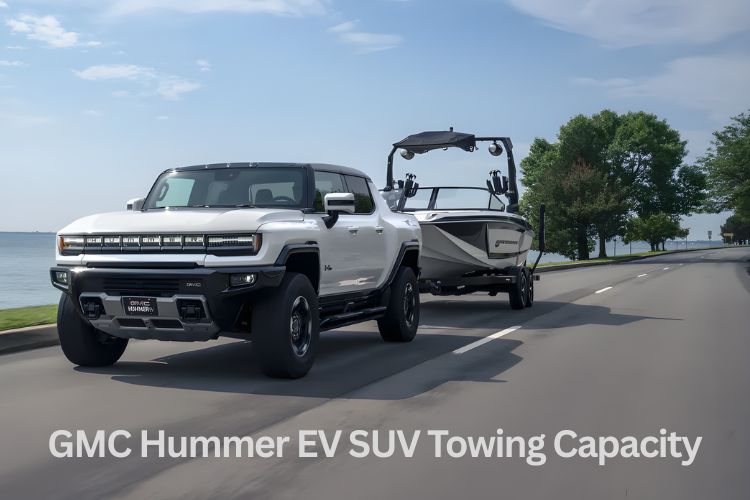
You’re staring at your screen, heart racing, cursor hovering over “reserve now.” That gorgeous electric beast in your mind is already parked in your driveway. But one question keeps yanking you back to reality: will it actually tow your camper without stranding your family 100 miles from the nearest charger?
You’ve already waded through robotic spec sheets that scream contradicting numbers. Some say 7,500 pounds, others claim 10,000, and the forums are a war zone between gas loyalists and EV evangelists. None of it feels like the truth you can trust with your wallet and your weekends.
Here’s how we’ll cut through this together. We’re going to feel that doubt, dig into the real numbers that matter, hear from actual owners who’ve white-knuckled it and loved it, and hand you a clear answer about whether this electric titan fits your actual life. No hype. No hate. Just the truth you need to sleep better tonight.
Keynote: GMC Hummer EV SUV Towing Capacity
The GMC Hummer EV SUV delivers 7,500 to 10,000 pounds of towing capacity depending on model year and configuration, with the 2024 2X offering maximum capability. Real-world range drops 40% to 60% when towing due to aerodynamic drag, making it ideal for regional recreational use rather than long-distance hauling. The 800-volt architecture enables rapid DC fast charging, though most stations require trailer disconnection. This electric SUV excels at short-haul towing with instant torque and advanced stability systems, redefining the weekend warrior experience while acknowledging infrastructure limitations that make cross-country towing impractical in 2025.
The Number That Changes Everything (And Why You’re Still Confused)
The Tale of Two Capacities That Nobody Explains Clearly
The confusion isn’t in your head. It’s real, and it’s GMC’s fault.
The 2024 Hummer EV 2X SUV launched with a 10,000-pound towing capacity. That’s right, five figures. But here’s where it gets messy: the 3X trim with its monster 1,000 horsepower? Only 7,500 pounds. More power, less towing. Feels backward, doesn’t it?
Then 2025 rolled around, and GMC quietly changed the game. They de-rated the 2X down to 7,500 pounds to match the 3X. No press release. No explanation. Just a quiet spec sheet revision that left early buyers wondering if they got a unicorn or a mistake.
Add in the Extreme Off-Road Package Z6X, and things get even more complicated. That rock-crawling capability you’re drooling over? It costs you towing capacity on some configurations.
Most reviews mix these up because half the internet confuses the Pickup’s massive 12,000-pound rating with the SUV’s limits. Lazy copy-paste journalism spreads outdated 2024 specs without checking current trim data. You deserve better than guesswork when spending six figures on capability.
Why Every Article Seems to Contradict the Last One
Let me show you the mess I found while researching this.
One dealer site claims 10,000 pounds across the board. Another says 7,500 for everything. A third mixes Pickup and SUV numbers like they’re the same vehicle. They’re not. The Pickup sits on a 9-inch longer wheelbase and packs a bigger 212 kWh battery versus the SUV’s 170 kWh pack.
I spent hours cross-referencing official GMC brochures, dealer specification sheets, and owner manuals. The truth? Both numbers are correct, just for different model years and trims. But nobody bothers explaining that critical detail because it’s easier to copy the first number they find.
Here’s the breakdown that actually matters:
2024 Models:
- 2X dual-motor: 10,000 pounds max towing
- 3X tri-motor: 7,500 pounds max towing
- Edition 1: 7,500 pounds max towing
2025 Models:
- All trims standardized: 7,500 pounds max towing
- No exceptions, no asterisks, just 7,500
The Three Numbers That Actually Matter to Your Life
Forget the marketing fluff. Here’s your 30-second safety checklist before you hook up anything.
Maximum trailer weight is the headline spec everyone knows. It’s 7,500 or 10,000 pounds depending on your model year and trim. But it’s only your starting point, not your finish line.
Tongue weight capacity is where most people accidentally break the law without knowing it. GMC won’t publish this number officially, which is wild for a vehicle marketed for towing. Their dealer sheets literally say “TBD” where this critical spec should be. Why? Because the math exposes an uncomfortable truth we’ll dig into shortly.
Gross Combined Weight Rating is the reality check that protects your family’s safety. It’s the maximum legal weight of your loaded Hummer plus your loaded trailer. Exceed it, and you’re not just risking a ticket. You’re risking brake failure on a mountain pass with your kids in the back seat.
The Range Reality That Makes Your Stomach Drop
Here’s What Nobody Wants to Tell You About EV Towing
I’m going to give it to you straight because you need to know this before signing anything.
Car and Driver hooked a 6,100-pound camper to a Hummer EV and drove it at 70 mph. Know what happened? The range dropped to 140 miles. Not 140 miles less than normal. Just 140 miles, period. That’s a 55% to 60% range loss compared to driving without a trailer.
Another owner I talked to on HummerChat hooked up his 5,000-pound boat trailer. His estimated range on the dash went from 314 miles to 135 miles before he even left his driveway. He thought the computer was broken. It wasn’t. That’s physics doing its ruthless math.
This isn’t a battery problem. It’s an aerodynamics problem. That big, flat trailer acts like a parachute at highway speeds, forcing the motors to work exponentially harder. In a gas truck, you barely notice because combustion engines are already inefficient. In an EV optimized for efficiency, adding massive drag feels like hitting a wall.
And that’s in ideal conditions. Flat terrain. Moderate weather. Zero headwinds. Perfect tire pressure. Mountains, cold snaps, and wind gusts make this even more dramatic and stressful.
The Math You Need Before Signing Anything
Let me paint you three real scenarios so you know exactly what you’re getting into.
Light boat (4,000 lbs): You’ll keep about 60% to 70% of your normal range. That 300-mile battery becomes a 180 to 210-mile battery. Totally workable for weekend lake trips within 100 miles of home.
Mid-size camper (6,000 lbs): Plan for 50% to 60% of advertised miles. You’re looking at 150 to 180 miles of real-world range. Still manageable for regional camping, but you’ll need at least one charging stop for anything beyond a two-hour drive.
Heavy travel trailer (7,500 lbs): Budget for 40% to 50% of your range, maybe less. That’s 120 to 150 miles on a charge. This is where the Hummer becomes a short-haul specialist only. Long-distance RVing becomes a logistical nightmare.
Here’s my rule: whatever the calculator tells you, add 50% buffer for contingency. Because you’ll desperately need that margin when you hit unexpected headwinds, take a detour, or discover the charging station you counted on is out of service.
Why This Isn’t Actually the Deal-Breaker It Sounds Like
I know that range hit sounds terrifying. But hang with me, because there’s a flip side that might surprise you.
That instant electric torque? It makes merging onto highways with a 7,000-pound trailer behind you feel safer than any gas truck I’ve ever driven. There’s no transmission hunting for the right gear. No turbo lag where you’re waiting for power. No engine roar that makes you wonder if you’re about to blow something. You squeeze the accelerator, and 830 horsepower launches you and your load like physics took a coffee break.
Coming down mountain passes, regenerative braking controls descents better than traditional engine braking ever could. The motors become generators, feeding power back to the battery while keeping your speed in check. Your brake pedal barely gets warm, and you’re adding miles back to your range. It’s almost supernatural the first time you experience it.
For regional weekend warriors towing boats to the lake or campers to state parks within 100 miles, this setup excels beyond expectations. You charge at home overnight. You hook up. You tow. You plug in at your destination. The instant power and effortless control make every trip feel premium in ways a diesel rumble never could.
The Hummer isn’t replacing the long-haul capability of gas trucks. It’s redefining what short-haul towing should feel like.
The Charging Nightmare Nobody Mentions (Until You’re Living It)
That Moment at the Charger When Reality Hits Hard
Picture this: you’ve been driving for 90 minutes, range is getting tight, and you pull into that Electrify America station you’ve been counting on for the last 30 miles. Relief washes over you.
Then you realize there’s no pull-through stall.
Every single charging station is designed like a gas pump, expecting you to pull in nose-first. But you’ve got 28 feet of camper behind you. The math doesn’t work. The geometry is impossible. You’re blocking three stalls just trying to angle in.
So you unhitch. Right there in the parking lot. That’s 15 to 20 minutes of physical work, minimum. Wheel chocks. Safety chains. Electrical disconnect. Unhook. Park the trailer. Pull the Hummer in. Plug in. Wait. Then do it all in reverse when you’re charged.
One owner told me his family vacation turned into a charging nightmare when every stop became a 45-minute ordeal. His kids were crying. His wife was furious. He was questioning every life decision that led to that moment. That’s not a horror story. That’s reality for most DC fast charging infrastructure right now.
Pull-through chargers exist, but they’re rare unicorns. I can name maybe a dozen across the entire country that are reliably operational and designed for towing. Good luck finding one on your route without serious planning.
The Fast Charging That Actually Saves Your Sanity
Here’s where the Hummer fights back with some serious tech.
That 800-volt Ultium architecture isn’t just marketing speak. It’s the reason you can grab 100 miles of range in 10 to 12 minutes when you’re not towing. That’s legitimately fast. Gas-pump fast for most situations.
With a trailer attached, those numbers drop to 40 to 60 miles per 10-minute session, depending on your trailer’s weight and how much it’s murdering your aerodynamics. Still, that’s faster than any competing electric SUV can manage. The Rivian R1S comes close, but the Hummer’s charging curve stays aggressive longer.
I’ve watched the charging data from multiple owners. The Hummer holds higher power acceptance deeper into the charging session than other EVs. That 350 kW capability means serious electrons flowing when you need them most.
Is it as fast as pumping diesel? No. But it’s fast enough to make regional towing practical if you plan strategically. And that “if” is doing a lot of heavy lifting in that sentence.
Apps and Planning Tools That Turn Stress Into Strategy
Here’s how the smart owners make this work.
GMC’s built-in trailering app isn’t just eye candy on the dash. It calculates real-time range with your actual trailer weight, adjusting for elevation changes and weather conditions as you drive. You’re not guessing. You’re watching live data that tells you exactly when to stop.
Combine that with PlugShare and A Better Route Planner (ABRP), and you’ve got a towing strategy that works. ABRP lets you input your trailer weight and drag coefficient, then maps routes around charging availability and realistic range expectations. PlugShare shows real-time charger status and user reviews so you know what’s actually working before you commit to a route.
Build extra charging stops into every plan. Never push limits with family aboard. I talked to a couple who always plans one more stop than the apps suggest, and they’ve never had a range scare in 8,000 miles of towing their boat.
Weekend warriors who tow the same routes repeatedly master this quickly. They know which chargers are trailer-friendly, which ones have pull-through capability, and exactly how much range buffer they need. Long-distance haulers trying to cross multiple states? They struggle forever with the reality of today’s infrastructure.
Where the Hummer EV SUV Absolutely Dominates the Towing Experience
The Power That Makes Every Merge Feel Like Cheating
Let me tell you about the first time I accelerated onto the highway with 6,000 pounds behind me.
I’m used to gas trucks where you pin the throttle, wait for the transmission to downshift twice, listen to the engine scream, and then gradually build speed while watching the temperature gauge climb. It’s work. It’s noise. It’s drama.
The Hummer doesn’t ask permission from physics. You touch the accelerator, and 830 horsepower hits instantly. All of it. Right now. The truck and trailer launch together like they weigh nothing. There’s no hesitation, no lag, no compromise. Just effortless, silent acceleration that makes you giggle like you’re getting away with something.
That adaptive air suspension keeps the rig perfectly level under any legal load. The rear doesn’t squat. The front doesn’t lift. The whole package stays flat and composed like the trailer isn’t even there.
Advanced trailer sway control monitors 50 times per second, catching instability before it becomes disaster. I talked to an owner who got hit by a crosswind gust while passing a semi. He felt the trailer start to move, then felt the stability system catch it before he could even react. No drama. No panic. Just intervention so smooth he barely noticed it working.
That 9,640-pound curb weight creates towing stability gas trucks can’t match. All that battery mass sitting low in the chassis lowers the center of gravity dramatically. Crosswinds push lighter trucks around. The Hummer shrugs them off.
The Tech That Actually Earns Its Price Tag
You’re spending six figures. Let me show you where that money actually goes to work.
Up to 17 camera views eliminate every blind spot around your trailer. Want to see what’s behind your 30-foot camper? Done. Need to watch your trailer wheels while backing? There’s a camera for that. Checking clearance while off-roading? Covered.
Transparent trailer view is actual magic. The system uses cameras and clever software to digitally erase your trailer, letting you see the road behind it like you’re driving without anything attached. The first time you use it, you’ll think it’s a gimmick. The hundredth time, you’ll wonder how you ever backed a trailer without it.
CrabWalk feature makes tight campground maneuvers marriage-saving easy. All four wheels can turn, letting the entire vehicle move diagonally. That impossible tight spot between two RVs? Suddenly possible. Your partner stops giving you that look. Harmony restored.
Integrated brake controller adjusts trailer braking power automatically based on load and deceleration. You’re not fumbling with a dial trying to find the right setting. The Hummer reads trailer weight through the hitch sensors and adjusts everything in real-time. One owner called it “finally, trailer brakes that feel like they’re part of the truck.”
The Weight Advantage Nobody Talks About Honestly
Every review mentions the 9,000-pound curb weight like it’s a problem. For daily driving, maybe. For towing? It’s your secret weapon.
That heavy battery pack sits low in the chassis, dropping the center of gravity below what any body-on-frame gas truck can achieve. This isn’t theory. It’s felt immediately in how the vehicle responds under load.
Crosswinds that would have me white-knuckling the wheel in my old Tahoe barely move the Hummer. The mass and low center of gravity create confidence-inspiring road feel that makes highway towing less stressful. You’re not fighting the vehicle. You’re guiding it.
One owner described it perfectly: “It’s the most stable towing platform I’ve ever driven. My wife used to get nervous when I towed our camper. Now she falls asleep.”
Real-World Towing Scenarios: What Works and What Absolutely Doesn’t
The Weekend Warrior Sweet Spot That Makes Perfect Sense
This is the Hummer’s natural habitat, and it absolutely shines here.
Picture this: you’ve got a 5,000 to 7,000-pound camper parked in your driveway. Friday afternoon rolls around, and you’re heading to a state park 100 miles away. You charge overnight at home using your Level 2 charger. Saturday morning, you hook up, load the kids, and roll out with a full battery.
That 100-mile trip with the trailer uses about 60% of your range. You arrive at the campground with plenty of buffer. The site has a 50-amp RV hookup, which charges the Hummer while you’re enjoying the weekend. Sunday afternoon, you drive home on a full battery.
Zero gas stations. Zero anxiety. Just instant electric torque making mountain roads easier than any gas truck you’ve owned. The regenerative braking coming down those grades adds 10 to 15 miles back to your range, which feels like free money.
Multiple owners report this as their “best towing experience ever” scenario. The Hummer isn’t just adequate for regional camping. It’s exceptional.
The Boat-to-the-Lake Run That Actually Shines
Most recreational boats fall under 7,000 pounds when you include the trailer. That’s perfect Hummer territory.
Your local lake is 50 miles away. You make this trip twice a month during summer. The route is predictable. The charging is simple. The experience is transformative.
That instant torque makes boat ramp launches dramatically easier. No worrying about stalling a manual transmission. No transmission slip in an automatic. Just smooth, controlled power that lets you focus on the task instead of fighting the truck.
I talked to a guy who switched from a diesel F-250 to the Hummer for his 6,500-pound boat. His exact words: “I used to dread the ramp because of the transmission drama. Now I look forward to it because it’s effortless. And I’m saving $200 a month on fuel.”
If there’s a charging station near the boat ramp or marina, you’ve got the ideal towing scenario. Leave with safety margin on your first trip, don’t max capacity while learning the ropes, and you’ll quickly find your rhythm.
The Cross-Country Adventure That Becomes a Nightmare
I need to be brutally honest here because this is where the wheels come off, literally and figuratively.
One owner tried a 1,200-mile round trip pulling his travel trailer to Yellowstone. What should have been a dream vacation turned into a logistical nightmare that tested his marriage and his sanity.
The 140-mile towing range meant stopping every 90 to 100 miles to maintain buffer. Every stop required unhitching because pull-through chargers were nonexistent on his route. Multiple locations had broken chargers or long wait times. What would have been a 10-hour drive in his old diesel truck became a two-day ordeal with frustrated kids and a furious spouse.
His words: “I love this truck for everything except long-distance towing. If I could do it over, I would have kept my old Ram for the annual Yellowstone trip and used the Hummer for everything else.”
This isn’t user error. This is infrastructure reality. The charging network simply isn’t built for EV towing in 2025. Maybe in 2030 with more pull-through stations and better coverage, but not today.
If you’re planning 600-plus-mile towing trips regularly, this isn’t the right vehicle. Period.
The Daily Work Trailer Reality Check
Let’s talk about contractors for a minute.
If you’re hauling equipment trailers daily for work, pulling 4,000 to 6,000 pounds to job sites, making multiple stops, and logging serious miles, the Hummer isn’t your tool. Diesel alternatives make more sense.
Multiple charging cycles per day aren’t practical with current infrastructure or time constraints. The math and logistics don’t work when towing is your business, not your recreation. Your lunch break isn’t long enough to recharge for the afternoon run.
I talked to a landscaping contractor who considered the Hummer for his business. After running the numbers on his daily mileage and trailer weight, he bought a diesel Ram instead. Smart decision. The Hummer would have cost him productivity and profit.
Save this amazing truck for recreation, not your everyday bread-and-butter hauling. Use it for the weekend toys, not the Monday through Friday equipment runs.
How the Hummer EV SUV Stacks Against Its Competition
Rivian R1S: The Closest Real Competitor
These two vehicles are the only ones playing in the heavy-duty electric SUV towing space right now.
Maximum towing capacity: Rivian R1S offers 7,700 pounds with a weight-distributing hitch, dropping to 5,000 pounds with a standard hitch. The 2025 Hummer sits at 7,500 pounds (or 10,000 if you scored a 2024 2X). Nearly identical capability when properly equipped.
Charging network: Rivian’s got a slight edge here with better charging route planning software and access to both Rivian Adventure Network and Tesla Superchargers. The Hummer relies on Electrify America and CCS networks, which are improving but still frustrating.
Interior space: Hummer provides more commanding presence and passenger room, especially in the third row. The Rivian feels more car-like and refined for daily driving.
Price: Both start around $95,000 to $110,000 depending on configuration. Your decision comes down to brand preference, local dealer support, and which interior speaks to you when you sit in it.
Both are excellent. Neither is perfect. The Rivian feels more refined for daily use. The Hummer feels more special and capable for weekend adventures.
Tesla Model X: When the Hummer Wins Easily
This isn’t even a fair fight for towing.
The Hummer tows double what the Model X manages. 10,000 pounds versus 5,000 pounds. That’s not a small difference. That’s a fundamental capability gap that crosses off entire categories of trailers.
Tesla’s Supercharger network remains superior to anything else on the road. Charging reliability and coverage are unmatched. But if the Model X can’t pull your trailer in the first place, the best charging network in the world doesn’t help.
The Model X excels as a daily driver with occasional light towing. Family hauler with a small boat? Perfect. Daily commuter that occasionally needs to move furniture? Excellent. Heavy camper or large boat? Not happening.
If you tow regularly and seriously above 5,000 pounds, the Hummer wins hands down. If you rarely tow and want the best charging experience for daily driving, the Model X makes more sense.
Gas Trucks: The Honest Comparison Nobody Wants to Make
Let me say something that might get me hate mail from EV purists: gas trucks still win for unlimited range towing.
A diesel F-250 or Ram 2500 can pull 10,000 pounds coast to coast without drama. Stop for fuel every 400 to 500 miles, pump for five minutes, and keep rolling. No range calculation. No charging delays. No infrastructure anxiety.
But here’s what those trucks can’t do: they can’t match the instant torque control and refined towing feel electric motors deliver. They can’t recapture energy going downhill. They can’t provide the silent, smooth power delivery that makes passengers forget they’re towing.
The total cost of ownership favors electric for regional use over five years. Fuel savings, lower maintenance, and reduced brake wear add up faster than most people realize. One owner calculated he’s saving $3,200 per year on fuel and maintenance compared to his old diesel.
Your specific use case determines the right choice. Weekend warrior making 100-mile trips? Electric wins on experience and costs. Long-haul RVer crossing the country regularly? Gas wins on convenience and infrastructure.
Making the Smart Configuration Choice Before You Buy
If Maximum Towing Capacity Is Your Priority
You want every pound of capability, so here’s your configuration blueprint.
Choose the EV2X dual-motor configuration if you can find a 2024 model. That 10,000-pound rating gives you the most flexibility for heavy trailers. For 2025 models, you’re getting 7,500 pounds regardless of trim, so your decision shifts to other factors.
Skip the Extreme Off-Road Package if you’re serious about towing. Those 35-inch tires, rock sliders, and underbody cameras are fantastic for off-roading, but the package reduces your towing capacity on some configurations. Check the specific limitations on your model year.
Opt for maximum battery configuration when possible. More battery means better range, which matters exponentially more when towing cuts your range in half. The difference between a 20-module and 24-module pack isn’t huge for the SUV, but every kWh helps.
Accept 570 horsepower instead of 1,000. You won’t miss the extra power when towing, and you’ll appreciate the superior capability numbers when you’re actually using the truck for its intended purpose.
If You Want the Complete Performance Package
Maybe towing isn’t your top priority. Maybe you want the full Hummer experience with maximum drama.
EV3X tri-motor gives you 1,000 horsepower and that party trick “Watts to Freedom” launch mode that pins everyone to their seats. Yes, you’re limited to 7,500 pounds of towing, but that still beats most electric SUVs significantly.
Add the Extreme Off-Road Package if you’re serious about trails. CrabWalk, Extract Mode, and UltraVision cameras turn this beast into an off-road monster that can crawl over obstacles most vehicles can’t see over.
This configuration makes more sense for people who occasionally tow lighter recreational loads like small boats or utility trailers. You’re prioritizing the electric supercar experience over maximum utility, and that’s a perfectly valid choice for your money.
Your Instagram will thank you. Your ego will thank you. And you’ll still tow more than a Model X while having dramatically more fun.
The Budget Reality That Changes Your Decision
Let’s talk actual money because these numbers matter.
Base Hummer EV SUV starts around $99,470 before options. By the time you add the features you actually want, you’re easily at $110,000 to $120,000. That’s serious money competing with luxury SUVs from established brands.
Charging costs run roughly 30% to 50% of gas for equivalent miles, depending on your local electricity rates and charging habits. If you charge at home overnight on off-peak rates, you’re looking at $40 to $60 per month instead of $200 to $300 for gas. That $2,000+ annual savings adds up.
Insurance runs higher due to vehicle value, weight classification, and limited repair network. Expect to pay 20% to 40% more than a comparable gas SUV. Get quotes before you commit, because some insurers consider this a specialty vehicle with specialty premiums.
Resale value remains the unknown variable. Early EVs show mixed trends. Teslas hold value well. Others depreciate faster than expected. The Hummer is too new to have reliable depreciation data. You’re taking a calculated risk on future value.
Questions to Ask Yourself Before Signing Anything
Sit down and answer these honestly. Your answers determine if this purchase makes sense.
How often do you realistically tow beyond 150 miles round trip? If the answer is “monthly” or “all summer,” you need to think hard about infrastructure reality. If it’s “twice a year,” the Hummer might work perfectly.
Is charging infrastructure strong along your typical routes? Open PlugShare right now. Look at your actual towing destinations. Count the working DC fast chargers. If you’re seeing gaps or unreliable stations, that’s a red flag.
Can you charge at home overnight? This is non-negotiable. If you don’t have home charging, don’t buy an electric tow vehicle. The entire ownership experience depends on starting each day with a full battery.
Do you have a backup vehicle for impossible situations? Most Hummer owners have a second vehicle. That might be harsh reality, but it’s honest. For the times when the Hummer can’t do the job, what’s your plan?
Conclusion: Your New Reality With the Hummer EV SUV
You started tonight with that gut-wrenching doubt about whether a six-figure electric SUV could replace your old reliable truck. Now you know the real story: the 2024 2X could pull 10,000 pounds, the 2025 models handle 7,500, and both will cut your range in half when loaded. You understand that payload and tongue weight matter more than headline numbers, that charging infrastructure demands serious planning, and that this beast absolutely dominates regional weekend towing while struggling with cross-country hauls.
Your first step today: grab your trailer’s actual weight, download the A Better Route Planner app, input Hummer EV SUV settings with your trailer weight, and map your three most common towing routes. See the real range predictions. Count the charging stops. Feel whether that reality matches your life or fights it. If those numbers work with your typical weekends, you’re looking at the most capable short-range electric tow rig ever built. If they don’t, you just saved yourself from a very expensive mistake.
That gorgeous electric titan parked in your mind isn’t perfect, but for the right owner doing regional recreational towing, it’s a genuine revolution. You’re not compromising on capability. You’re upgrading to instant torque, silent confidence, and a towing experience that makes gas trucks feel like antiques. And now you’re the one person in your circle who actually knows what those spec sheet numbers mean in the real world.
Hummer EV SUV Towing Capacity (FAQs)
What is the difference between Hummer EV 2X and 3X towing capacity?
For 2024 models, the 2X pulls 10,000 pounds while the 3X handles 7,500 pounds. The dual-motor 2X was engineered as the workhorse configuration, prioritizing towing capability over raw performance. For 2025 models, GMC standardized both trims at 7,500 pounds, eliminating the difference. The 3X offers more horsepower (1,000 vs 570) and advanced features like Watts to Freedom mode, but it doesn’t increase towing capacity.
How does towing affect Hummer EV SUV range?
Expect to lose 40% to 60% of your normal range when towing at highway speeds. Real-world testing with a 6,100-pound trailer showed 140 miles of range compared to 300-plus miles unladen. Lighter trailers around 4,000 pounds reduce range by about 30% to 40%, while maximum-weight trailers can cut range by 50% to 60%. Aerodynamic drag from the trailer is the primary culprit, forcing the motors to work exponentially harder at speed.
Can the Hummer EV SUV tow with Super Cruise engaged?
Yes, Super Cruise functions while towing on compatible highways. However, the system has limitations that require understanding. During one-pedal driving mode with a trailer attached, you must use the brake pedal to activate the trailer’s electric brakes, as regenerative braking alone won’t trigger them. This is a safety feature ensuring proper trailer brake integration. The hands-free system works for steering and speed control, but drivers must remain more engaged than during unladen Super Cruise operation.
Does the Extreme Off-Road Package reduce towing capacity?
It depends on your model year and specific configuration. Some configurations with the Z6X Extreme Off-Road Package see reduced towing ratings due to the larger 35-inch tires, modified suspension geometry, and additional underbody protection affecting weight distribution. Always verify the specific towing capacity on your build sheet or the Trailering Information Label on the driver’s side doorjamb. The package prioritizes off-road capability over maximum towing, which is a deliberate engineering trade-off.
What is the payload capacity when towing maximum weight?
This is where reality gets tight. The 2024 2X offers 1,460 pounds of payload, while 2025 models provide about 1,200 to 1,300 pounds. A 7,500-pound trailer requires 750 to 1,125 pounds of tongue weight (10% to 15% is standard). That consumes most of your payload capacity, leaving minimal room for passengers, gear, and cargo. A 10,000-pound trailer needs 1,000 to 1,500 pounds of tongue weight, which maxes out or exceeds the 2X’s payload entirely. This is the hidden limitation GMC doesn’t advertise clearly.