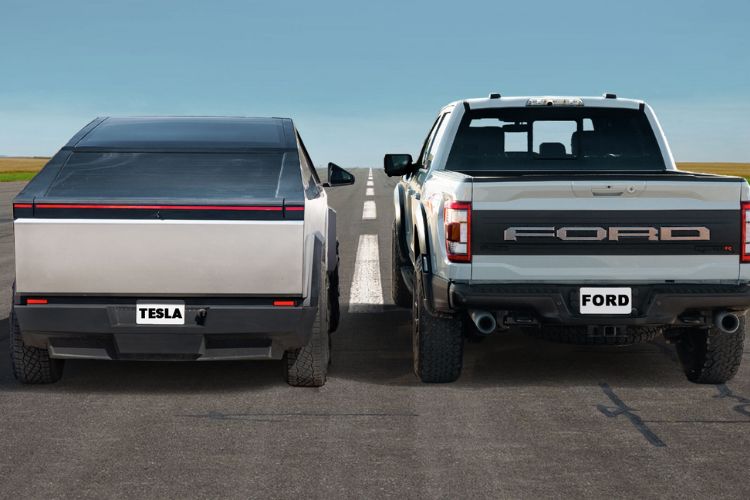
It’s 2 AM. Your finger hovers over “place order.” Heart racing. Because deep down, you know this isn’t just about buying a truck.
This electric pickup sitting in your driveway tomorrow morning will broadcast your identity before you say a single word. Are you the person who trusts proven dependability, or the one who bets on radical disruption? The comfortable choice everyone understands, or the conversation starter that makes neighbors stop mid-walk?
You’ve read the conflicting reviews. Watched the fanboy wars in comment sections. Felt overwhelmed by marketing promises clashing with sobering reality checks from actual owners.
Here’s the thing: comparing the Ford F-150 Lightning and Tesla Cybertruck isn’t about memorizing horsepower numbers you’ll forget by breakfast. It’s about choosing between two fundamentally different philosophies wrapped in sheet metal.
We’re cutting through the noise together. Using real data, honest emotion, and the kind of straight talk you’d expect from a friend who’s already made the leap to electric. Let’s find your answer.
Keynote: F150 EV vs Cybertruck
Electric pickup trucks fundamentally changed in 2025. The F-150 Lightning vs Cybertruck comparison reveals two valid paths. Lightning delivers proven reliability, massive storage, home backup power, and familiar truck DNA. Cybertruck offers radical design, faster charging, superior acceleration, and polarizing aesthetics. Both lose 50% range towing heavy loads. Both cost under 7 cents per mile charging at home. Choose based on risk tolerance, service network access, and identity comfort. The mainstream trusts Ford. Early adopters bet on Tesla. Your driveway broadcasts that choice daily.
The Identity Crisis No One Admits: Transportation or Statement?
The Lightning’s Warm, Familiar Embrace
This is the truck you already know, just quieter and smarter. Think of it like your reliable friend who finally got their life together. Same dependable presence, upgraded capabilities, zero drama.
Ford’s unbreakable legacy means you blend in at job sites, family BBQs, anywhere judgmental eyes might watch. And you know what? That’s not a weakness. That’s strategic invisibility with a revolutionary powertrain hiding underneath.
The moment you slide into that familiar F-150 cabin, it feels like home. The steering wheel sits where your hands expect it. The buttons make sense. There’s no learning curve stealing your attention from the road.
The Cybertruck’s Bold, Polarizing Bet
That stainless steel angular beast looks like it landed from another planet. And owning one means embracing being “that person” everywhere you go.
Picture this: heads turning at every stoplight. Conversations stopping mid-sentence when you park. Kids pointing. Adults staring. Some with admiration, others with barely concealed judgment.
You’ll either love the attention or hate it within the first week. There’s no middle ground here.
And yet, 86% of Cybertruck owners say they’d buy it again despite the frustrations. That’s not rational math. That’s either cult following or genuine conviction that the future arrived early.
The Truth About Your Truck Choice
Neither option is neutral anymore in 2025’s charged cultural landscape. Your driveway decision broadcasts risk tolerance louder than any LinkedIn profile.
Lightning owners consistently report relief that it “looks normal” while doing revolutionary work quietly. They’re transitioning to electric without announcing it to the neighborhood.
Cybertruck owners? They’re making a statement about innovation, about rejecting convention, about being willing to live on the bleeding edge of automotive evolution.
Both choices are valid. But understanding what each says about you matters more than the spec sheets suggest.
The Price Promise That Stings (And the Math That Saves You)
The Sticker Shock Reality
Let’s talk about the number that hits your bank account first. The F-150 Lightning starts around $50,000 for the work-focused Pro trim, climbing to $63,000 for the popular XLT, and reaching $85,000+ for the luxury Platinum.
The Cybertruck? It starts at $80,000 for the dual-motor AWD version. The tri-motor Cyberbeast roars in over $100,000.
Remember when Tesla promised the Cybertruck at $39,900 back in 2019? That’s a 106% price increase breeding trust issues before you even take delivery. The Lightning stayed relatively honest with its pricing trajectory.
Factor in the federal tax credit situation. That $7,500 incentive expires September 30, 2025. If you’re signing before that deadline, several Lightning trims qualify easily under the $80,000 MSRP cap. The Cybertruck? You’re priced out of federal help on both models.
The 10-Year Truth Nobody Tells You
But sticker price is just the opening chapter. Let’s look at what actually empties your wallet over a decade of ownership.
| 10-Year Ownership Cost | Lightning Extended | Cybertruck AWD | Gas F-150 |
|---|---|---|---|
| Purchase Price | $70,000 | $80,000 | $55,000 |
| Federal Tax Credit | -$7,500 | $0 | $0 |
| Fuel/Electricity (120k miles) | $14,760 | $13,440 | $88,740 |
| Insurance (annual avg) | $1,800/yr | $2,500/yr | $1,600/yr |
| Maintenance | $3,200 | $2,800 | $12,000 |
| Total 10-Year Cost | $98,460 | $108,240 | $171,740 |
That fuel cost difference compounds every single year. Charging at home costs roughly 9 cents per kilowatt-hour. That’s $0.069 per mile for the Lightning versus $0.18 per mile for a gas F-150 at $3.50/gallon.
Lightning holds about 70% resale value after three years, based on early market data. The Cybertruck’s resale value remains an unpredictable gamble. Too new, too polarizing, too uncertain.
One striking study showed the Cybertruck potentially saving $54,000 over 10 years versus a gas F-150 Raptor. But that assumes you’d be buying a Raptor in the first place, and that gas prices don’t spike higher than today’s averages.
What That Money Gap Actually Buys
That extra $20,000 for the Cybertruck gets you bold dystopian design, stronger on-paper specs, and native Supercharger access without adapters.
The Lightning’s lower entry point includes proven reliability, Ford’s dealer network everywhere, and home backup power that can run your house for three days during blackouts.
Before you obsess over spec-sheet horsepower, calculate your real weekly miles and actual towing needs. Most truck owners dramatically overestimate how often they’ll max out capabilities.
Range, Towing, and the Numbers That Actually Change Your Day
The Range Reality Check
Let’s cut to what actually matters when you’re planning trips or hauling to job sites.
| Range Comparison | Lightning Standard | Lightning Extended | Cybertruck AWD | Cyberbeast |
|---|---|---|---|---|
| EPA Range | 240 miles | 320 miles | 340 miles | 320 miles |
| Real-World Daily | 210-230 miles | 280-300 miles | 300-320 miles | 290-310 miles |
| Towing 7,000 lbs | 110-120 miles | 150-180 miles | 160-180 miles | 150-170 miles |
| Cold Weather (-10°F) | 145-165 miles | 200-230 miles | 230-260 miles | 215-240 miles |
Notice how those numbers shrink fast when reality hits? The Cybertruck holds a slight range advantage in daily driving. But when you’re towing heavy loads, both trucks lose 50-60% of their EPA range.
That 320-mile Lightning becomes a 150-mile truck with a loaded trailer. Suddenly, your weekend camping trip requires charging stops every 100 miles. Plan conservative buffers.
Cold weather hammers electric trucks differently. The Lightning using LFP-compatible battery chemistry can lose 35-40% range in sub-zero temps while preheating. The Cybertruck’s NMC cells report 25-30% losses. That matters if you’re working construction in Minnesota winters.
Towing: Where Marketing Meets Pavement
The Cybertruck can tow up to 11,000 pounds. The Lightning Extended Range maxes at 10,000 pounds with the Max Trailer Tow Package. The Standard Range taps out at 7,700 pounds.
Those numbers sound impressive until you hook up a real trailer and watch your range evaporate.
The Lightning wins on practicality here. Smart Hitch technology helps you load evenly. Onboard Scales estimate payload weight, preventing dangerous overloading. Pro Trailer Backup Assist lets you steer a trailer in reverse using a simple knob.
Real contractor feedback from owner forums: “Lightning tows like a dream, no drama. Cybertruck has tech glitches mid-haul that make me nervous on the highway.”
Speed You’ll Use Once to Impress Family
Both trucks hit 60 mph absurdly fast for vehicles weighing three tons. The Lightning does it in just under 4 seconds with the Extended Range battery. That’s Mustang GT territory in a full-size truck.
The Cybertruck Cyberbeast? It hits 60 mph in 2.6 seconds. That’s faster than most Ferraris and Lamborghinis. It’s genuinely ridiculous.
The dual-motor Cybertruck AWD still rockets to 60 in about 4 seconds. Both configurations deliver 845 horsepower and instant torque that pins you to the seat.
Honest take: neither truck needs more power for actual work. This is pure bragging rights and grin-inducing acceleration runs you’ll do twice before settling into normal driving.
Charging: The Hidden Lifestyle Tax You’ll Pay Daily
Home Charging Habits That Save Sanity
Here’s where the daily routine gets interesting. The Lightning with its 80-amp Charge Station Pro tops off that big Extended Range battery in about 8 hours from empty.
The Cybertruck’s 48-amp onboard charger takes about 11 hours for a full charge. Fine if you’re not rushing dawn patrols to job sites.
But here’s the math that compounds monthly: home charging averages $0.17 per kWh. At those rates, the Lightning costs $0.069 per mile. Public DC fast charging averages $0.48 per kWh, jumping your cost to $0.21 per mile.
The Cybertruck runs $0.063 per mile at home, $0.19 per mile DC fast charging. Compare both to a gas F-150 at $0.18 per mile, and you see the savings stack up fast with home charging.
Optimize further: charge during off-peak hours (midnight to 6 AM) when some utilities drop rates to $0.09 per kWh. Suddenly you’re at $0.037 per mile. That’s transformative.
Road Trip Reality: Tesla’s Trump Card
| Charging Networks | Lightning | Cybertruck |
|---|---|---|
| Peak DC Fast Charging | 155 kW | 325 kW |
| 15-80% Charge Time | 32-38 minutes | ~35 minutes |
| Primary Network | BlueOval + adapters | Tesla Supercharger |
| Network Reliability | 85-90% uptime | 98%+ uptime |
| Payment Experience | Multiple apps | Seamless plug-in |
The Cybertruck’s native Supercharger access is Tesla’s trump card. You pull up, plug in, walk away. The truck handles payment automatically. The chargers just work, reliably, everywhere.
Lightning owners now have NACS adapters for Supercharger access, but the experience isn’t quite as seamless yet. And when you’re on third-party networks like Electrify America? Stories of broken chargers, confusing payment apps, and frustrating delays fill owner forums.
The Cybertruck can add 136 miles in just 15 minutes at peak charging speeds. The Lightning needs closer to 40 minutes for similar range addition. On long road trips, that time difference compounds with every stop.
The Home Backup Power Game-Changer
This is where the Lightning absolutely dominates. With the Intelligent Backup Power system, your Lightning can power your entire house for up to 3 days during blackouts.
That 9.6 kW Pro Power Onboard system transforms job sites into plug-and-play operations. Need to run power tools in the middle of nowhere? The Lightning becomes your silent, emission-free generator.
Camping? Tailgating? Emergency backup during storms? The Lightning delivers real utility beyond transportation.
The Cybertruck? It offers basic vehicle-to-load capability through bed outlets. But Tesla canceled the promised $16,000 Powershare home backup range extender, refunding disappointed customers. Zero integrated home backup power as of 2025.
If you live in areas with unreliable power grids, this feature alone might justify choosing the Lightning.
Quality Control: The Frustration Factor You Can’t Ignore
Lightning’s Boring, Beautiful Reliability
The Lightning earns an 8.4 out of 10 expert rating. Real owners give it 4 out of 5 stars consistently.
Browse owner forums and you’ll see the same phrase repeated: “Boring reliability is actually the biggest win.” It starts every morning. It does what it promises. It doesn’t surprise you with weird failures.
Ford’s 3,000+ dealers across North America mean warranty work doesn’t require road trips. You schedule service, you get it fixed, you’re back on the road. One owner reported a minor electrical issue fixed in two hours on a Saturday morning.
The 8-year/100,000-mile battery warranty on both trucks provides baseline peace of mind. But Ford’s established quality control processes and massive dealer network translate to confidence.
Cybertruck’s Quality Control Gamble
The Cybertruck scores 6.9 out of 10 from expert reviewers despite impressive specifications.
Early owners report rattles. Panel gaps. Mysterious noises. Some noticed the letters “CYBER” appearing on wet stainless steel panels from water spots. Weathering and metallic rail dust create surface “rust” that needs special cleaning products.
As of mid-2025, the Cybertruck has had 8 recalls. Some trucks literally died after 5 minutes of operation. Tie rods broke during off-road testing. Upper control arms described as “laughably wimpy” failed under stress.
Tesla service centers remain scarce outside major metro areas. Appointments take weeks. One owner compared experiences: Lightning fixed in 2 hours versus Cybertruck stuck at service for 30+ days waiting for parts.
You’re buying the first model year of radically new technology. You’re a beta tester with an $80,000+ vehicle. Know that going in.
When Something Breaks at 2 AM in Montana
Picture this: you’re towing your boat through Montana. Something fails mechanically. It’s 2 AM.
With the Lightning, you search “Ford dealer near me” and find options within 50 miles. You limp there in the morning. They fix it.
With the Cybertruck, you search “Tesla service center” and find one… 180 miles away in Bozeman. You’re calling roadside assistance and hoping for a flatbed that can handle a 7,000-pound stainless steel truck.
You also can’t test drive a Cybertruck before buying. Tesla’s policy requires you to place an order, wait months, then decide when it arrives. The Lightning? Walk into a Ford dealer, take one for a spin, make an informed decision.
Daily Living: The Stuff Reviews Skip That Becomes Deal-Breakers
Frunk Wars and Bed Space Reality
The Lightning’s Mega Power Frunk delivers 14.1 cubic feet of weatherproof, lockable, drainable storage. It’s the size of a walk-in closet versus a medicine cabinet.
You can fit six carry-on suitcases in there. Groceries stay cold with integrated coolers. Tools stay secure. It’s genuinely transformative for how you use a truck daily.
The Cybertruck’s frunk? 7 cubic feet. Some owners call it a joke in comparison. It fits a backpack and maybe a gym bag. That sloped front end prioritizes aerodynamics over storage.
Both trucks feature innovative bed designs. The Cybertruck’s 6-foot composite bed includes a powered tonneau cover and hidden “gear locker” underneath. But those high, angled bed walls make side access frustrating. You’re climbing or reaching awkwardly for cargo.
The Lightning’s familiar 5.5-foot aluminum bed feels conventional but practical. Integrated tailgate step. Spray-in bedliner options. Easy side access. It works like every F-150 bed you’ve known.
Tech and Comfort for Real Humans
The Cybertruck forces you into a touchscreen-only world. Want to adjust your mirrors? Touchscreen. Turn on wipers? Touchscreen. Climate control? You guessed it.
That 18.5-inch screen is gorgeous and lightning-fast. But it’s distracting while driving. The squared-off “squirkle” steering wheel takes getting used to. The stiff suspension feels like a sports car, not a truck.
Rear seat comfort? Reviews describe it as less spacious and comfortable than the cavernous Lightning. The angular interior design prioritizes aesthetic over ergonomics.
The Lightning cabin feels like… well, an F-150. Comfortable, spacious, intuitive. Physical buttons for climate and audio controls. Seamless wireless Apple CarPlay and Android Auto integration. Generous rear seat with 43.6 inches of legroom and a flat floor.
Higher trims add massaging Nirvana leather seats, twin-panel moonroof, premium B&O sound. It’s a luxury truck interior you actually want to spend hours in.
The Over-the-Air Update Promise
Tesla’s proven over-the-air software updates continuously improve vehicles remotely. Your Cybertruck genuinely gets better over time with new features, performance tweaks, efficiency gains.
That stainless steel exoskeleton brings unique ownership quirks. No paint to fix means no paint to chip or fade. But higher insurance costs because collision repair requires panel replacement, not traditional body work.
The Lightning now routes you to Superchargers via Ford navigation. Recent updates added CarPlay improvements and better towing range estimates. Ford’s learning, playing catch-up to Tesla’s software maturity.
The Verdict: Choose Your Truck Without Fence-Sitting
Buy the Lightning If You Want the Dependable Power Tool
You need home backup power that doubles as a silent generator during blackouts. That feature alone might justify the purchase if you’ve suffered through extended outages.
You value the mainstream cabin, proven towing technology, and now-available Supercharger access through NACS adapters. The learning curve is measured in minutes, not weeks.
You rely on local Ford service network for repairs. You appreciate boring reliability over cutting-edge features. You need to blend in professionally at job sites or with clients who might judge radical choices.
Your family, coworkers, or community culture makes the Cybertruck’s bold statement problematic. Sometimes invisibility is strategic.
Buy the Cybertruck If You Want the Conversation-Starter Blade
That bold dystopian design genuinely thrills you. You smile every time you see it parked. Attention from strangers doesn’t bother you. In fact, you kind of like it.
Native Supercharger access without adapters is critical for your travel patterns and charging lifestyle. You value the seamless Tesla ecosystem.
You have patience for service delays, quality issues, and being a beta tester with an expensive vehicle. You’re okay with a 6.9 expert rating because the audacity speaks to something deeper in your identity.
You don’t need home backup power. The 6-foot bed and smaller frunk don’t limit your actual truck use. And you’re willing to embrace touchscreen-only controls and that unconventional steering wheel.
Conclusion: Your New Reality With Electric Truck Ownership
You came here for clarity, not fan wars or brand worship. So here’s what we’ve cut through together.
The Lightning is the safer, saner bet. It’s the trustworthy tool that doubles as home generator, blends into any environment, and delivers proven Ford reliability backed by 3,000+ dealers. It starts $15,000-$37,000 cheaper, qualifies for the expiring federal tax credit more easily, and treats you like an adult who values buttons over touchscreens. The Cybertruck thrills if you want audacity and acceleration. It charges faster on road trips, looks like nothing else on Earth, and makes you “that person” everywhere you park. Native Supercharger access remains Tesla’s killer advantage. But you’ll live with quality issues, limited service centers, and the reality of being a beta tester with serious money.
Both lose 45-50% range when towing 7,000 pounds. Both cost pennies per mile charging at home versus gas trucks. Both hit 60 mph faster than most sports cars. Neither needs more power than it has for actual work.
First step today: Write down your real weekly miles, typical towing weight, and your home’s outage history. Match those numbers to the comparison tables above. Then book test drives for the Lightning trim that fits your budget. You can’t test drive a Cybertruck before ordering, but you can sit in your driveway visualizing which truck belongs there. You’ll feel the answer clearly.
Final thought: In five years, Lightning owners will be happily hauling lumber and powering through blackouts without drama. Cybertruck owners will either be evangelical believers praising their radical choice or deeply regretting the quality issues and service nightmares. There’s rarely an in-between with Tesla. Choose the version of yourself you’re willing to become.
Cybertruck vs F150 EV (FAQs)
Which is cheaper: F-150 Lightning or Cybertruck after tax credits?
Yes, the Lightning is significantly cheaper. The Lightning starts around $50,000-$63,000 for popular trims and qualifies for the $7,500 federal tax credit (expiring September 30, 2025) on most configurations. That drops real cost to $42,500-$55,500. The Cybertruck starts at $80,000-$100,000+ and doesn’t qualify for federal credits due to price caps.
How far can F-150 Lightning and Cybertruck tow on one charge?
Both lose 45-50% range when towing heavy loads. Expect 115-150 miles towing 7,000 pounds with the Lightning Extended Range, about 150-180 miles with the Cybertruck AWD. Real-world tests show even worse numbers. Plan charging stops every 100 miles when towing, regardless of EPA estimates. Cold weather compounds the pain.
Which electric truck charges faster at public stations?
The Cybertruck wins DC fast charging decisively. It accepts up to 325 kW peak rates versus the Lightning’s 155 kW maximum. That translates to 136 miles added in 15 minutes for Cybertruck versus 40 minutes for similar range on the Lightning. But at home overnight, the Lightning’s 80-amp charger finishes in 8 hours versus Cybertruck’s 11 hours.
Does F-150 Lightning or Cybertruck have better resale value?
The Lightning holds approximately 70% value after three years based on early market data. Cybertruck resale remains unpredictable. Too new, too polarizing, too uncertain. The radical design means it’s either deeply desirable or completely undesirable to used buyers. Time will tell, but Ford’s mainstream appeal suggests safer long-term value retention.
Can Cybertruck and Lightning power your home during outages?
Only the Lightning offers true home backup power. With Ford’s Intelligent Backup Power system and 9.6 kW Pro Power Onboard, it runs your entire house for up to 3 days during blackouts. The Cybertruck canceled its home backup system. It has basic bed outlets for vehicle-to-load, but zero integrated home power capability.