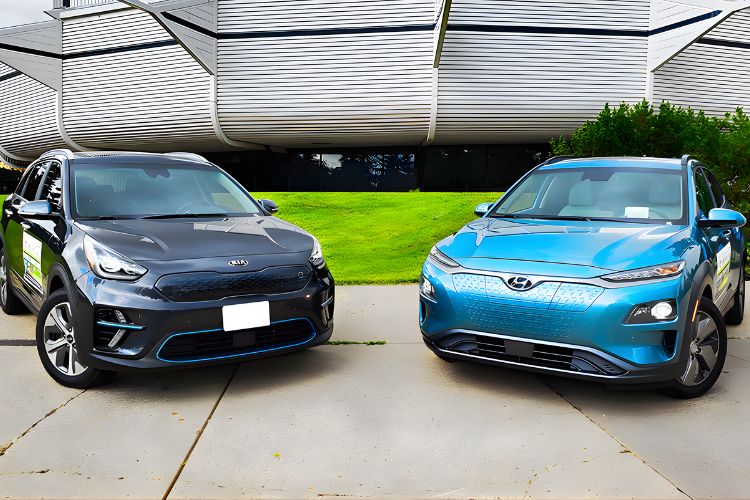
You’re standing in a showroom, or maybe you’re drowning in browser tabs at 11 PM. Again. You’re staring at two electric crossovers that feel like twins separated at birth, and one costs thousands more.
Here’s what you’ve already discovered: spec sheets that blur together until your eyes cross. Dealer sites pushing their brand like it’s the only rational choice. Contradictory reviews that make the decision harder, not easier. And underneath it all, that gnawing fear that you’re about to drop forty grand on the wrong car.
Here’s the uncomfortable truth nobody’s saying out loud: the 2025 Kia Niro EV and 2025 Hyundai Kona Electric are corporate siblings built by the same parent company, Hyundai Motor Group. They share the same 64.8 kWh battery pack, the same 201 horsepower motor, and roughly the same charging speed when you compare apples to apples. That makes choosing between them feel impossible.
But we’re going to cut through it together. We’ll translate the specs into feelings, the numbers into your actual life, and by the end, you’ll know which one is quietly calling your name.
Keynote: 2025 Kia Niro EV vs 2025 Hyundai Kona Electric Specs
The 2025 Kia Niro EV and Hyundai Kona Electric share identical 64.8 kWh battery packs and 201-hp motors in comparable trims. The Kona offers dual battery options (200 or 261 miles), larger 12.3-inch screens, and lower pricing. The Niro provides superior rear legroom, standard premium features, and simplified trim structure. Both charge in 43 minutes (10-80%) and gain Tesla Supercharger access in 2025. Choose Kona for tech and value; choose Niro for space and comfort.
The Family Secret: Why These Two Feel Like the Same Car (Because They Basically Are)
The Shared DNA You Need to Understand First
Let’s start with what unites them. Both the Niro EV and Kona Electric in their long-range configurations are built on related Hyundai Motor Group platforms with the identical 64.8 kWh lithium-ion battery pack. Both run a permanent magnet synchronous motor mounted up front, driving the front wheels. And in their comparable trims, both deliver exactly 201 horsepower and 188 lb-ft of torque.
The acceleration? A virtual tie. The Niro hits 60 mph in 7.1 seconds. The long-range Kona clocks in between 7.0 and 7.2 seconds. You won’t feel that 0.1-second difference at a stoplight.
Charging reality? When you plug into a DC fast charger, both vehicles take approximately 43 minutes to charge from 10% to 80% under ideal conditions. Not 42 minutes versus 45. Forty-three minutes. Same coffee break, same restroom stop, same time to stretch your legs on a road trip.
This is a perfect tie where it counts for daily driving.
Where the Siblings Actually Diverge
But here’s where Hyundai and Kia made different bets on what you’d want.
The Kona Electric offers flexibility with two battery options. Its base SE trim comes with a smaller 48.6 kWh battery delivering 200 miles of EPA range and a less powerful 133-hp motor. Step up to the SEL, N Line, or Limited trims and you get the full 64.8 kWh long-range battery with 201 hp. Think of the Kona as the customizable menu where you pick your battery size based on your budget and daily driving distance.
The Niro EV? It’s the prix fixe. Kia said, “Everyone gets the big battery.” Both the Wind and Wave trims come standard with that 64.8 kWh pack and 253 miles of range. No confusion, no trim-level math, no worrying you picked wrong.
The design philosophies split here too. The Kona chases sporty, tech-forward vibes with aggressive styling and a digital cockpit. The Niro prioritizes steady comfort, generous interior space, and that premium-but-practical feel families love.
And then there’s the price gap that matters most. The Kona Electric SE starts at $32,975. The Niro EV Wind opens at $39,600. That’s a $6,625 difference that looks massive until you realize you’re comparing a 200-mile car to a 253-mile car. But there’s a catch we’ll unpack in the pricing section.
The Range Reality Check: Translating Miles Into Peace of Mind
The EPA Numbers Everyone Quotes (But Misunderstands)
Let’s talk about the numbers on the window sticker, because everyone obsesses over them and then drives differently anyway.
The Kona Electric Long Range delivers 261 EPA miles. The Niro EV posts 253 miles. That’s an 8-mile gap, which sounds meaningful until you realize it’s a 3% difference. In real life? That’s the distance between forgetting to preheat your cabin or not. It’s a rounding error, not a deal-breaker.
The Kona Electric Standard Range with its smaller battery? 200 EPA miles. Perfect if you’re a city dweller with a predictable 30-mile daily commute and access to home charging.
Efficiency ratings tell a similar story. The long-range Kona posts up to 116 MPGe combined (the measure of how many miles you can drive on the energy equivalent of one gallon of gasoline). The Niro clocks in around 113 MPGe combined. Both sip electrons efficiently, and you won’t notice the difference at your electric bill.
What Real-World Driving Actually Reveals
Here’s where it gets interesting, because EPA estimates are done in a lab, and you don’t drive in a lab.
Real-world testing flipped the script. The Niro EV crushed expectations, hitting 280 miles in Edmunds’ real-world range test. That’s 27 miles over its EPA estimate, the kind of relief that means never sweating your commute or obsessing over charging station locations.
The Kona Electric? It achieved 230 miles in real-world highway conditions with the larger battery pack. Still respectable, but it came in under its EPA promise.
Why the difference? The Niro’s more conservative, comfort-tuned driving dynamics and slightly better aerodynamics likely helped it overdeliver. The Kona, tuned for sportier handling and running on less efficient wheel and tire packages (especially the N Line with its 19-inch wheels), paid a small penalty.
And cold weather? Expect a 20-30% range drop in winter for both vehicles, just like your phone battery in January. Plan accordingly. If you live in Minnesota, mentally budget 180-200 miles of usable winter range and you’ll never get stranded.
The Tesla Supercharger Game-Changer You Can’t Ignore
Here’s the headline buried in the fine print: Both vehicles gain access to 18,000+ Tesla Superchargers in 2025 with free NACS (North American Charging Standard) adapters provided by the manufacturers.
What this actually means for your life: shorter detours on road trips, way more charging peace of mind, and the end of that “will I find a working charger?” panic that haunts every EV owner on unfamiliar routes. Tesla’s Supercharger network is the gold standard, fast and reliable, and now it’s yours too.
This levels the playing field completely when it comes to charging infrastructure anxiety. Neither vehicle has an advantage here anymore.
The Price Trap: Unpacking What That Gap Really Buys You
The Base Model Illusion (Don’t Get Fooled)
That $32,975 Kona Electric SE starting price looks tempting in the marketing materials. It is tempting. But here’s the honest take: it’s a different car. You’re getting 200 miles of range, a smaller battery, less power (133 hp), and you’re missing key comfort features that come standard on higher trims.
To compare apples to apples with the Niro EV, you need the Kona’s Long Range trims starting around $38,000 for the SEL or $41,150 for the Limited. Now the price gap shrinks or even reverses.
The Niro’s philosophy is simpler but pricier upfront. All trims start at $39,600 to $44,600 with the full 253-mile battery included, no surprises, no upgrade decisions. You’re paying for that simplicity and for more standard equipment.
The Long-Term Money Truth
Let’s zoom out to what five years of ownership actually costs, because the sticker price is just the opening bid.
| Cost Factor | Kona Electric | Niro EV | Winner |
|---|---|---|---|
| Starting MSRP (comparable trim) | ~$38,000 | $39,600 | Kona |
| 5-Year Depreciation | 57.8% value loss | 59.5% value loss | Kona (holds value 1.7% better) |
| Energy Cost (per mile) | ~$0.03 | ~$0.04 | Kona |
| Warranty Coverage | 10yr/100k mile + 3yr free maintenance | 10yr/100k mile | Kona |
The Kona edges ahead on total cost of ownership. It depreciates slightly less, costs marginally less to charge per mile, and Hyundai throws in 3 years of complimentary maintenance (tire rotations, inspections) that Kia doesn’t offer. Over five years, that free maintenance is worth $500-800 in avoided service costs.
But here’s the emotional reality: both will save you thousands compared to a gas SUV. If you’re driving 12,000 miles a year and gas costs $3.50/gallon while electricity costs $0.13/kWh, you’ll save roughly $1,200-1,400 annually on fuel costs alone with either EV.
The Federal Credit Loophole Worth Knowing
Here’s the tax credit situation as of 2025: these vehicles’ eligibility for the $7,500 federal EV tax credit depends on complex battery sourcing and final assembly rules that change year to year. Check the current IRS guidelines.
But here’s the loophole: leasing either vehicle could unlock that full $7,500 credit passed to you via lower monthly payments, even if you wouldn’t qualify when buying outright. Dealers can claim the credit themselves and reduce your lease cost. Ask specifically about lease structures when you negotiate.
Interior Space: Where Your Actual Life Happens Every Single Day
The Cargo Showdown That Matters for Groceries, Strollers, and Reality
Trunk space behind the rear seats? The Kona wins daily usability with 25.5 cubic feet versus the Niro’s 22.8 cubic feet. That’s the difference between fitting one extra bag of dog food, a folded stroller, or your Costco run without Tetris-ing everything.
But flip those rear seats down and it’s a tie. Both offer approximately 63.7 cubic feet of maximum cargo capacity, plenty for hardware store runs, camping gear, or moving your college kid into a dorm.
The Kona’s secret weapon? A small front trunk (frunk) of about 1.0 cubic foot. It’s not huge, but it’s the perfect spot for your charging cables, takeout bags, or things you don’t want rolling around the main trunk. The Niro lacks this entirely.
The Niro counters with a longer, flatter load floor thanks to its extended wheelbase. If you’re hauling 2x4s from the lumber yard or flat-pack furniture from IKEA, the Niro’s shape is more accommodating.
The Backseat Test Nobody Talks About (But Everyone Feels)
Here’s where the Niro EV dominates. Its 2.4-inch longer wheelbase creates noticeably more generous rear legroom at 36.9 inches versus the Kona’s 36.4 inches. That half-inch sounds small on paper, but sit back there. You feel it.
If you regularly carry adults in the back seat or you’re wrestling car seats and diaper bags, the Niro’s wagon-like shape feels airier and less cramped. Think of the Niro as the spacious hatchback backpack; the Kona is the nimble urban tote.
Front legroom? The Kona edges slightly at 41.7 inches for the driver’s stretch versus the Niro’s 41.5 inches. Tall drivers won’t notice.
The Little Comfort Touches That Add Up Over Years
The Niro includes a heated steering wheel standard across all trims. The Kona? You only get that luxury on the top Limited trim. If you live anywhere that sees frost, this is the kind of detail you appreciate every single winter morning.
The Niro uses premium SynTex vegan leather seats as standard. The Kona varies by trim, with cloth on the base SE and synthetic leather on upper trims.
Both vehicles embrace eco-friendly materials and thoughtful storage cubbies for your phone, sunglasses, and the debris of daily life.
Tech & Screens: Where Your Eyes Go 100 Times a Day
The Dashboard Face-Off: Futuristic Command Center vs User-Friendly Simplicity
The Kona Electric delivers dual 12.3-inch panoramic displays that stretch across the dashboard like a tech showcase. The digital instrument cluster and central touchscreen feel like stepping into tomorrow. Critically, it offers wireless Apple CarPlay and Android Auto across the entire lineup.
The Kona’s screens feel like stepping into tomorrow.
The Niro counters with slightly smaller but still excellent 10.25-inch screens with wired smartphone connectivity. This is a curious choice since the Niro includes a wireless phone charger standard. You can charge your phone wirelessly but still need to plug in a cable for CarPlay? It’s a minor frustration in an otherwise polished package.
Reality check: both infotainment systems are intuitive, responsive, and packed with navigation. The Kona just looks flashier and eliminates one annoying cable from your daily routine.
The Safety Tech That Protects Your People
Both vehicles earn IIHS Top Safety Pick status and come loaded with standard adaptive cruise control, blind-spot monitoring, forward collision avoidance with pedestrian detection, and lane keeping assist. You’re getting best-in-class safety either way.
The Kona Limited offers two exclusive high-tech features the Niro lacks: Blind-Spot View Monitor (live camera feed in your instrument cluster when you signal) and Remote Smart Parking Assist (move the car into tight spaces from outside using the key fob). These are genuinely useful, not gimmicks.
The Niro provides standard knee airbags and collision avoidance that actively brakes, not just warns you. Both philosophies work.
The Daily-Use Features You’ll Actually Touch
Both offer robust one-pedal driving. The Niro calls it i-Pedal; the Kona uses regenerative braking paddles behind the steering wheel. Lift off the accelerator and the motor acts as a brake, capturing energy back into the battery. Once you learn this, you’ll rarely touch the brake pedal in city traffic.
Both vehicles include Vehicle-to-Load (V2L) capability. You can power your camping gear, tailgate setup, tools at a job site, or even emergency home backup during outages. It’s the EV party trick that’s actually useful.
The Niro wins on standard wireless phone charging across all trims. The Kona makes it optional on lower trims.
The Driving Personality Split: Sporty Flirt vs Steady Confidant
How They Actually Feel Behind the Wheel
The Kona’s compact size and slightly lighter curb weight deliver nimble, responsive city driving with sportier handling. It darts through traffic with confidence, the steering feels more direct, and the overall vibe is energetic.
The Niro prioritizes smooth, comfortable rides over most surfaces, tuned for relaxed cruising. It soaks up bumps better, the cabin is quieter, and the overall character is calm competence. The Kona is the fun friend who drags you on spontaneous adventures. The Niro is the reliable one who remembers your coffee order.
Acceleration? The Niro hits 60 mph in 6.7 seconds. The long-range Kona does it in 7.0 seconds despite identical power specs. This is about tuning philosophy, not capability. Both feel brisk and responsive for everyday merging and passing, described as “relaxed by EV standards” compared to the face-melting acceleration of performance EVs.
The Design Vibe That Either Thrills or Comforts You
The Kona Electric embraces aggressive styling with sharp character lines, bold pixelated LED lighting, and the N Line trim’s dramatic spoiler and black trim. It wants attention. It looks like the newest smartphone, sleek and modern.
The Niro’s “Wave” design features quirky, unique body creases and smooth curves that prioritize function over flash. It looks friendly and approachable, the premium commuter that doesn’t shout but quietly impresses.
Which speaks to you? Be honest. One will make you smile every time you walk up to it in a parking lot. The other won’t.
The Two-Question Personality Test (Your Decision Made Simple)
“Am I a Tech & Flexibility Person?”
Does this sound like you?
You want the absolute lowest entry price with the option to choose battery capacity based on your needs. You crave the biggest screens, wireless everything, that panoramic digital cockpit, and the practical frunk for charging cables. You drive mostly solo or with one passenger, so rear seat comfort isn’t a priority. You value sporty handling, nimble city maneuverability, and that zippy, engaging feel. You want slightly better resale value and that included maintenance plan.
Your answer: Hyundai Kona Electric.
“Am I a Practicality & Premium-Basics Person?”
Does this sound like you?
You want the big battery standard with no confusion about trim levels or battery options. You frequently carry passengers in the back seat and need that extra legroom for adults or car seats. You value premium-feeling touches like heated steering wheels on every trim, better standard seats, and a more comfortable, quiet ride. You prefer simplicity, set-it-and-forget-it reliability, and a vehicle tuned for smooth family duty over sporty thrills.
Your answer: Kia Niro EV.
The Specs That Genuinely Don’t Matter (So Stop Obsessing)
Let me save you hours of spreadsheet torture. These differences are red herrings:
The 8-mile range difference (261 vs 253 EPA) is a rounding error. You won’t notice it in daily life.
The identical 43-minute charging time means neither is faster when you’re actually on a road trip.
The same 201 hp and 188 lb-ft in comparable trims means power is a perfect tie.
The 100 kW vs 85 kW peak DC charging rate sounds meaningful until you realize both hit 80% in the same time due to charging curves and thermal management.
Focus instead on price, interior space, screen size, driving feel, and which one you’d rather look at in your driveway for the next five years. Those are the decisions that matter.
Conclusion: Your New Reality With Whichever EV Wins Your Heart
We started with that gut-twisting paralysis of two nearly identical choices and the fear of a $40,000 mistake. Now you’ve got the map.
The Kona Electric offers: sportier tech flair with bigger screens, wireless connectivity, better daily cargo space, a practical frunk, lower entry price, and included maintenance. It’s the value-driven tech enthusiast’s choice.
The Niro EV delivers: family-friendly rear legroom, premium standard equipment, heated steering wheels on all trims, quieter comfort, and set-it-and-forget-it simplicity with one battery option that just works.
Your single, actionable first step for today: Go sit in the driver’s seat of both at a dealer. Then climb in the back seat. You’ll feel which one is already yours in five minutes, and all these specs will finally make sense.
And remember this truth: The perfect EV isn’t flawless. It’s the one that quiets your worries and fits your chaotic, beautiful, real life. In three years, you’ll love whichever one is sitting in your driveway, because both will save you gas money, both will get you to work quietly, and both will make you feel like you made the smart choice. Now go claim your electric future.
2025 Hyundai Kona Electric Specs vs 2025 Kia Niro EV (FAQs)
Does the Kia Niro EV or Hyundai Kona Electric have better range?
Yes, the Kona Electric Long Range edges ahead with 261 EPA miles versus the Niro EV’s 253 miles. But real-world testing flipped this, with the Niro achieving 280 miles in Edmunds testing compared to the Kona’s 230 miles on highway runs. The Niro overdelivers on its EPA promise while the Kona underdelivers slightly. For daily driving, this 8-mile EPA difference is meaningless. Both provide plenty of range for commuting and weekend trips.
Which is faster charging between Niro EV and Kona Electric?
No, neither charges significantly faster despite the Kona’s higher 100 kW peak DC charging rate versus the Niro’s 85 kW. Both vehicles take approximately 43 minutes to charge from 10% to 80% on DC fast charging. The charging curves (how long they sustain peak power before slowing down) are nearly identical due to similar battery thermal management systems. On Level 2 home charging, the Kona is slightly faster at 6.1 hours versus the Niro’s 7.5 hours for a full charge.
What are the trim level differences between 2025 Niro EV and Kona Electric?
The Niro EV offers two straightforward trims: Wind (base, $39,600) and Wave (loaded, $44,600), both with the same 253-mile battery. The Kona Electric offers four trims with more complexity: SE (standard range, 200 miles, $32,975), SEL (long range entry, $36,975), N Line (sporty styling, $38,375), and Limited (luxury, $41,150). The Kona lets you choose battery size and feature level separately. The Niro simplifies by giving everyone the big battery standard.
Is the Hyundai Kona Electric cheaper than Kia Niro EV?
Yes, but with caveats. The base Kona SE starts at $32,975 versus the Niro Wind’s $39,600, a $6,625 gap. However, that SE has a smaller 200-mile battery. To compare equivalent long-range models, the Kona SEL ($36,975) or Limited ($41,150) compete with the Niro Wind ($39,600). The top Kona Limited offers more luxury features for $1,550 more than the base Niro. Long-term, the Kona includes 3 years of free maintenance and depreciates slightly less.
Which has more cargo space, Niro EV or Kona Electric?
The Kona Electric wins daily trunk space with 25.5 cubic feet versus the Niro’s 22.8 cubic feet behind the rear seats. The Kona also adds a small 1-cubic-foot frunk the Niro lacks. With rear seats folded, both tie at approximately 63.7 cubic feet maximum.
However, the Niro’s longer wheelbase creates a flatter, more usable load floor for large items. The Niro also offers significantly more rear legroom (36.9 inches vs 36.4 inches), making it better for passengers but slightly worse for cargo with seats up.