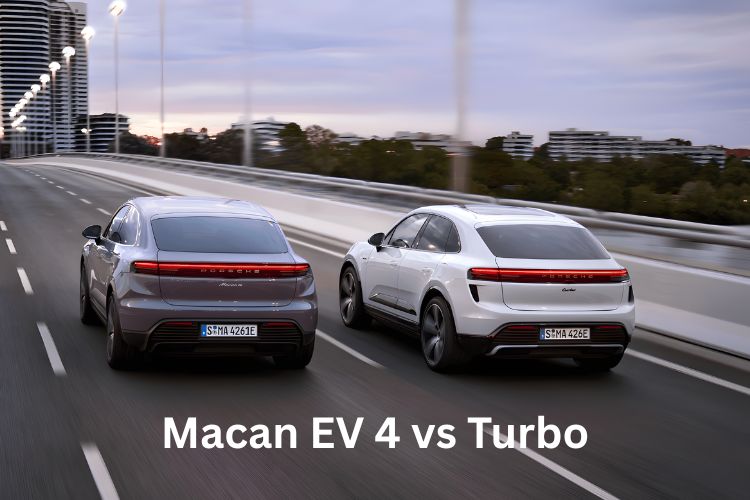
You’ve spent three weeks researching. You know the Macan EV is the one. Then you configure the Turbo, see that final price, and your stomach drops.
Here’s the truth no one tells you: the Macan 4 is already wildly fast. But somewhere in your brain, a voice whispers that you’ll regret not getting the badge. The fear isn’t about speed. It’s about wondering, three years from now, if you cheaped out on yourself.
Most guides drown you in specs or tell you both are “great choices” without helping you choose. We’re taking a different path. We’ll pair your gut feelings with cold facts, show you where that extra $25,000 actually goes, and help you pick the one you’ll still love when the new car smell fades. Let’s cut through the noise together.
Keynote: Macan EV 4 vs Turbo
The Macan EV 4 versus Turbo comparison boils down to value versus ultimate performance. The 4 delivers 402 hp, 308-mile range, and 4.9-second acceleration for $78,800. The Turbo counters with 630 hp, 3.1-second sprints, and superior braking for $105,300. Both share the PPE platform’s 800-volt architecture, enabling 21-minute fast charging. Choose the 4 for daily versatility and efficiency. Select the Turbo only if you demand supercar-level acceleration in SUV form.
The Price Gap Everyone Undersells
The Sticker Shock Reality
The Macan 4 starts at $78,800. That’s the number Porsche wants you to see first. Clean, approachable, almost reasonable for a Porsche.
The Turbo? It launches at $105,300 and climbs faster than the car accelerates.
That’s a $26,500 gap on paper. But here’s what the brochure won’t tell you: nobody buys a base Macan 4. And nobody stops at a bare Turbo either. The real transaction prices tell a different story entirely.
The Configurator Trap That Changes Everything
Open Porsche’s configurator and watch the prices shift like quicksand. Add rear-wheel steering to the 4 (you’ll want it for city parking). Upgrade to 21-inch wheels (because the standard 20s look small). Throw in the Premium Package for better headlights and sound. Suddenly you’re sitting at $95,000.
Now you’re only $10,000 from a Turbo. That voice in your head gets louder.
But flip it around. The Turbo includes equipment that costs over $8,000 to option on the 4. Those gorgeous 18-way adaptive sport seats? They’re standard on the Turbo, optional on the 4. The LED matrix headlights that bend around corners like they’re reading your mind? Bundled into the Turbo’s base price. Porsche Torque Vectoring Plus, which actively shuffles power between the rear wheels for sharper cornering? Standard on the Turbo, a pricey add-on for the 4.
The real-world gap shrinks or expands wildly based on your choices. Build them honestly, with the features you’ll actually use, and the difference ranges from $15,000 to $30,000. That’s not a typo. Your priorities reshape the math.
What That Money Actually Buys You
Let’s be clear about what separates these two. The Turbo delivers 228 extra horsepower through its dual permanent magnet synchronous motors. You’ll unleash that full fury maybe ten times a year, probably less.
You get bigger brakes. The Turbo sports massive 400mm front discs grabbed by six-piston calipers, compared to the 4’s already-capable 350mm rotors with four-piston clamps. Three people will notice them through your wheels. You’ll appreciate them once, maybe twice, if you ever truly push the car.
The body kit looks meaner. The Turbonite accents gleam under showroom lights. Standard torque vectoring adds precision the 4 can only match with an option box ticked.
Here’s the honest question nobody asks: when will you actually use these upgrades after the test drive?
The Performance Numbers That Look Incredible (But Are They?)
The Shocking Gap That Isn’t
Zero to sixty in 4.9 seconds for the Macan 4. Zero to sixty in 3.1 seconds for the Turbo.
That 1.8-second difference looks huge on a spec sheet. In reality, both numbers live in a universe beyond what you’ll ever encounter in traffic. The Macan 4 hits 60 mph faster than 95% of everything around you. It generates 402 horsepower with overboost active through launch control, delivering 479 lb-ft of torque that shoves you back into those comfort seats with authority.
The Turbo? It produces an absurd 630 horsepower and 833 lb-ft of torque. That 3.1-second sprint to 60 mph is supercar territory. It’s faster than a Porsche 911 GT3 to the same benchmark. The Turbo doesn’t just accelerate. It teleports.
The Honest Question No One Asks You
Think about your last month of driving. How many times did you floor it from a standstill? How many empty on-ramps did you find where you could actually explore triple-digit speeds?
The Macan 4 is like ordering a strong coffee when you need to wake up. It works perfectly. The Turbo is like downing a triple espresso when you’re already wide awake. Sure, you’ll feel something, but was it necessary?
Owner forums tell the real story. “The 4 is more than adequate for daily driving,” one long-term reviewer notes. Translation: it’s thrilling without being exhausting. The Turbo’s violence under full throttle? Some owners report literal headaches from the launch force. Your passengers might not thank you for demonstrating it.
Both cars top out higher than you’ll ever legally drive. The 4 maxes at 137 mph. The Turbo stretches to 161 mph. Unless you’re booking track days in Germany, these are academic numbers.
The Range Trade You’re Making
Here’s where the Turbo exacts its price beyond dollars. The EPA rates the Macan 4 at 308 miles per charge. The Turbo manages 288 miles.
You surrender 20 miles of range for power you won’t regularly deploy. That’s the honest trade.
Real-world testing backs these numbers up. The Macan 4 achieves remarkable efficiency, with some testers recording consumption that would stretch total range beyond 300 miles in mixed driving. Highway runs at a steady 70 mph show the Turbo can meet or slightly exceed its EPA estimate, but the efficiency gap between the two models widens when you’re cruising.
Both share the same 100 kWh battery pack with 95 kWh of usable capacity, built on that advanced 800-volt architecture Porsche co-developed with Audi for their Premium Platform Electric. The hardware is identical. The Turbo just drinks harder when you ask it to perform.
What You’ll Actually Feel Behind the Wheel
The Intangible Porsche Problem
This is where numbers fail and feelings take over. Both cars steer like a Porsche. Planted, precise, playful on demand. That low center of gravity from mounting the battery pack low in the PPE chassis fights the 5,200-plus-pound curb weight beautifully.
But multiple reviewers note something crucial: the Macan 4 lacks that raw emotional spark that defines the brand for enthusiasts. It’s competent, even excellent. But it doesn’t make your heart race when you’re just thinking about it in the garage.
The Turbo launches like a slingshot. The 4 is a strong, confident elastic band. Both get you there. Only one leaves you giggling.
The Hardware Differences That Matter
The Turbo’s rear-axle torque vectoring comes standard. This isn’t marketing fluff. During hard cornering, the system actively distributes power between the rear wheels using an electronically controlled differential lock. It improves traction, sharpens turn-in, and keeps the tail planted when you’re asking for everything.
The 4 can’t match this without adding the optional Porsche Torque Vectoring Plus package.
Those bigger brakes on the Turbo? They’re not just for track days. They inspire confidence during aggressive mountain descents or when you need to scrub speed repeatedly. The additional thermal capacity means less fade, more consistency, better modulation under heavy use.
Both models come standard with adaptive air suspension and Porsche Active Suspension Management, featuring advanced two-valve dampers that span a remarkable range between comfort and sport. This shared foundation is brilliant, absorbing broken pavement without losing composure, then tightening up for canyon runs.
But the Turbo’s suspension tuning separates competent daily driver from heart-pounding machine. It’s firmer, more focused, always ready even when you’re tired.
The Daily Comfort Reality
Tuesday morning commute. You’re half awake, coffee in hand, just need to get to work. The Macan 4 is calm, composed, effortless. It glides. The power is there when you want it, invisible when you don’t.
The Turbo? It’s firm, focused, constantly reminding you it’s a performance machine. That tautness feels incredible on Sunday morning when the roads are empty and your mind is sharp. On Tuesday at 7 AM in stop-and-go traffic, it’s less charming.
Ask yourself honestly: do you track your vehicles or just think you might someday? Most Turbo buyers never see a circuit. They’re paying for potential they admire but rarely access.
Living With Your Choice: Range, Charging, and Real Life
The Weekly Commute Math
Let’s get practical. Most people drive fewer than 40 miles daily. Both Macans exceed a week of typical commuting without needing to charge.
For highway sprints, the 4’s 20 extra EPA miles provide genuine value. Long road trip to visit family? That’s potentially one fewer charging stop, or at least more buffer for detours and discovering the charger is broken when you arrive.
Independent road tests confirm both vehicles can meet or beat their EPA ratings under reasonable driving conditions. One extensive test saw the Macan 4 achieve efficiency numbers suggesting a real-world range exceeding 300 miles. The Turbo, when driven with restraint, can match its 288-mile estimate.
The Charging Advantage They Share
Here’s the beautiful part: both cars share the exact same charging hardware. That 800-volt architecture enables DC fast charging up to 270 kW at compatible stations. In optimal conditions, you’ll see 10 to 80 percent charge replenished in about 21 minutes.
Let me translate that: one coffee stop makes road trips painless. You’re not spending 45 minutes scrolling your phone at Electrify America. You’re grabbing a bathroom break and a latte, then rolling out with 200-plus miles added.
At home with a typical 11 kW Level 2 charger, figure roughly 10 hours for a complete overnight top-up. Plug in when you park Tuesday evening, wake up Wednesday to a full battery. The routine becomes invisible.
Both vehicles can even charge efficiently at older 400-volt DC fast chargers thanks to a clever “bank charging” feature that splits the 800-volt battery into two 400-volt packs, allowing up to 135 kW charging rates.
Why the Turbo Drinks More
Physics doesn’t negotiate. Bigger motors consume more energy. Stickier performance tires create more rolling resistance. Constant readiness costs electrons.
The Turbo’s power demands more from the battery pack even during casual driving. Those 630 horses need feeding. You’re paying in range, not just upfront dollars.
For daily driving efficiency, the 4 holds a measurable advantage. Not dramatic, but consistent. Over a year of ownership, that compounds into real savings at the charger and fewer interruptions to your routine.
The Money Talk You Need to Hear
The Total Cost Picture Beyond MSRP
The sticker is just the opening bid. Let’s examine what ownership actually costs.
| Cost Factor | Macan 4 | Macan Turbo |
|---|---|---|
| Base MSRP | $78,800 | $105,300 |
| Realistic Options | +$12,000-$18,000 | +$8,000-$15,000 |
| Annual Insurance (Est.) | $2,400 | $2,800-$3,200 |
| Tire Replacement (Every 30K miles) | $1,600 | $2,200 |
| Home Charging Cost (12K miles/year) | ~$550 | ~$650 |
Insurance companies aren’t blind. The Turbo’s performance credentials translate to higher premiums, typically 12 to 18 percent more annually. That’s an extra $800 to $1,200 every year you own it.
Tires wear faster under 630 horsepower. The Turbo’s larger, stickier rubber costs more to replace and needs replacing sooner. Over three years of ownership, this adds up.
The federal tax credit situation? Neither qualifies for the $7,500 consumer tax credit on purchase because they’re assembled in Leipzig, Germany. But here’s a potential loophole: leasing might allow access to the Commercial Clean Vehicle Tax Credit through Porsche Financial Services. They can apply the credit and pass some savings to you through reduced monthly payments. This fundamentally reshapes the lease versus buy equation and deserves a detailed conversation with your dealer.
The Wildcard Worth Considering
Rumors suggest Porsche might introduce a Macan 4S with around 509 horsepower, landing between the 4 and Turbo at roughly $86,000 to $87,000. If this materializes, it could be the sweet spot: 80 percent of the Turbo’s thrill for 60 percent of its price premium.
This middle child would likely deliver sub-4-second 0-60 times while maintaining better range than the Turbo. For those wanting more kick without full commitment, it’s worth monitoring.
The Decision Framework: Matching Your Real Life to the Right Macan
Who the Macan 4 Is Secretly Built For
You want Porsche feel, stealth speed, and longer range per dollar. The badge matters, but the bank account matters more. You’re coming from a non-performance SUV, and 4.9 seconds to 60 mph feels absolutely wild.
Your daily roads are crowded and flat. The 4’s calm power wins daily serenity. You value efficiency and extended road trips over bragging rights. You’ll configure it thoughtfully, adding rear-wheel steering and maybe the Premium Package, then stop before the price spirals out of control.
You’re smart enough to know that 402 horsepower in an SUV is already absurd. You don’t need validation from strangers at Cars and Coffee.
Who Needs the Turbo (And Knows It)
You want giggle-inducing punch every single on-ramp, period. Empty stretches of asphalt are your therapy sessions. You’ve owned fast Porsches before and will genuinely miss that edge if you downgrade.
Flagship status matters to your identity. You want the best, not the second-best. That 3.1-second 0-60 time isn’t just a stat; it’s a source of joy. You’ll actually use launch control more than twice a year.
Money isn’t the primary obstacle. You can afford the Turbo without financial stress, and you’d rather have it and not need it than need it and not have it.
The Three Questions That Cut Through Everything
How do you really drive Tuesday mornings versus Sunday fantasies? Be honest. If your commute is 15 miles of stop-and-go traffic, the Turbo’s 228 extra horsepower lives a sad, underutilized life.
Will you use these features or just talk about having them? Dinner party bragging fades fast. Daily driving satisfaction compounds over years.
What will haunt you more: overspending or feeling underwhelmed? This is the gut-check question. Only you know which regret would sting harder.
Your Move: The Back-to-Back Test Drive Strategy
The Configuration Exercise First
Before you step foot in a dealership, do this homework. Open the Porsche configurator and build your loaded Macan 4 with options you’ll truly use. Not fantasy builds, real choices. See that final price.
Now build a bare-bones Turbo. Compare the honest gap. If it’s under $18,000 and you genuinely love driving, maybe the Turbo makes sense. If it’s over $22,000 and you’re being practical, the 4 wins on value.
The Real-World Driving Test
Schedule two test drives back to back on the exact same route. Not different days, same afternoon if possible. This eliminates variables like weather, traffic, and mood.
Do three full-throttle pulls in each. One highway merge at 65 mph. One rough pavement stretch to feel the suspension differences. Pay attention to the window sticker showing EPA range and standard equipment.
The Macan 4 will feel quick, refined, confidence-inspiring. The Turbo will feel violent, exhilarating, almost excessive. Your body will react differently to each.
The Sleep-On-It Truth
Don’t decide at the dealership. Pressure and excitement cloud judgment. Drive both, thank the salesperson, and go home.
Sleep on it. Tomorrow morning over coffee, you’ll know. Your body knows before your brain admits it. The right choice is the one you stop second-guessing.
Neither is wrong. But only one is right for your actual life, not your imagined one.
Conclusion: The New Calm of Knowing
You don’t need the fastest. You need the right fast for how you actually live. The Macan 4 trades a touch of drama for easier range, lower spend, and daily serenity that doesn’t exhaust you. The Turbo trades dollars and miles for that always-there gut punch that makes you grin at every stoplight, even on tired Tuesdays. Both carry Porsche’s steering magic and 800-volt charging that erases range anxiety.
Today’s single move: Book those twin test drives, same route, same weather, then let it sit overnight. Tomorrow morning, you’ll know which badge belongs in your garage.
You deserve a Porsche that excites you without regret. Make the choice that fits your real roads, not your fantasy ones.
Turbo vs Macan EV 4 (FAQs)
Which Macan EV is the best value?
Yes, the Macan 4 offers superior value for most buyers. It delivers 90% of the Turbo’s real-world capability at 75% of the cost. The 4’s 308-mile range, 4.9-second 0-60 time, and included Porsche driving dynamics satisfy nearly everyone’s needs.
You save $26,500 upfront plus ongoing costs like insurance and tire replacement. Unless you genuinely crave that 3.1-second launch or plan regular track days, the 4 is the smarter financial choice. Add rear-wheel steering and the Premium Package, and you’ve built the ideal electric Porsche SUV without overspending on power you’ll rarely access.
How much does it cost to fully charge a Macan EV?
Between $14 and $18 for a complete home charge, depending on your electricity rates. Both models pack a 100 kWh battery with 95 kWh usable capacity. At the national average of roughly 16 cents per kWh, a full charge runs about $15. In California or New England with higher rates, expect $18 to $22. Charge during off-peak hours for better rates.
DC fast charging costs more, typically $0.40 to $0.60 per kWh at Electrify America stations, making a 10-80% rapid charge cost $23 to $34. For most people driving 12,000 miles annually, total energy costs stay under $600 yearly.
Does the Porsche Macan EV qualify for federal tax credit?
No for purchases, maybe yes for leases. The $7,500 consumer tax credit requires North American final assembly. Both Macan EVs are built in Leipzig, Germany, disqualifying them from the purchase credit.
However, leasing offers a workaround. Porsche Financial Services may access the Commercial Clean Vehicle Tax Credit and pass savings through reduced lease payments. This fundamentally changes the financial equation. If buying, you pay full price.
If leasing, you might capture $7,500 in effective savings. Always verify current incentive availability with your dealer, as programs change and have specific eligibility requirements.
What is the real-world range of Macan 4 vs Turbo?
Macan 4 achieves 280-320 miles; Turbo delivers 270-290 miles in typical mixed driving. EPA rates the 4 at 308 miles and Turbo at 288 miles, but real conditions vary. One extensive test saw the Macan 4 stretch to 352 miles using efficient driving techniques.
Highway-only runs at 70 mph show both can meet or slightly exceed EPA estimates. The 4’s advantage widens in city driving and moderate speeds. The Turbo consumes more energy due to its larger motors and performance focus. For daily use, both provide more than enough range.
For road trips, the 4’s extra 20-30 miles translates to fewer charging stops annually.
Is the Macan Turbo acceleration worth the price difference?
Only if you genuinely value ultimate performance as an experience, not just a spec. The Turbo’s 3.1-second 0-60 sprint costs an extra $26,500 base ($15,000-$30,000 real-world depending on options).
You get supercar acceleration, bigger brakes, standard torque vectoring, and flagship bragging rights. But the Macan 4’s 4.9-second time already outpaces 95% of traffic. Most Turbo buyers use full power a handful of times yearly.
If you’ve owned fast Porsches before and crave that edge, yes, it’s worth it. If you’re upgrading from a standard SUV, the 4 will feel plenty thrilling without the premium.