You know that sound. That gut-wrenching click, click, click on a freezing Tuesday morning when you’re already late. Your car battery is dead, and you’re stranded in your driveway with jumper cables in hand and a silent prayer on your lips.
We’ve all been there with traditional car batteries. It’s annoying, sure, but it’s also familiar. You call a friend, get a jump, swing by the auto parts store, drop $150, and you’re back on the road by lunch.
But then someone mentions electric vehicles and throws around numbers that make your head spin. $15,000 battery replacements. 800 volts. Lithium-ion versus lead-acid. Suddenly, you’re not just comparing batteries anymore.
Here’s the thing: we’re not actually comparing apples to apples. We’re comparing a lawnmower pull-cord to an entire V8 engine. And once you understand that difference, everything else clicks into place.
Keynote: EV Battery vs Car Battery
EV batteries use lithium-ion chemistry (NMC or LFP) at 400-800V, storing 40-100+ kWh for vehicle propulsion. They last 12-15 years with 1.5% replacement rates outside recalls. Federal law mandates 8-year/100,000-mile warranties. Costs dropped from $1,355/kWh (2008) to $139/kWh (2025), approaching $100/kWh soon. Modern thermal management and BMS technology enable 1,000-5,000 charge cycles with minimal degradation.
Wait, Your EV Has Two Batteries? (Yes, and Here’s The Job Description for Each)
This is where most people’s brains short-circuit. Your shiny new electric car actually uses TWO completely separate battery systems. And no, that’s not a design flaw. It’s genius engineering that keeps costs down and reliability up.
The 12-Volt Battery: The “Housekeeper”
Yes, EVs still have a regular 12-volt battery, just like your gas-powered sedan. This little workhorse handles all the everyday stuff: your headlights, door locks, radio, windshield wipers, and those fancy touchscreens that control everything.
Think of it as the housekeeper. It keeps the lights on, the doors working, and the computers thinking. It stores less than 1 kilowatt-hour of energy, which is basically nothing in the EV world.
And yes, this battery can die. And yes, you can jump-start it with regular jumper cables, just like any other car.
The Traction Battery: The “Big Boss”
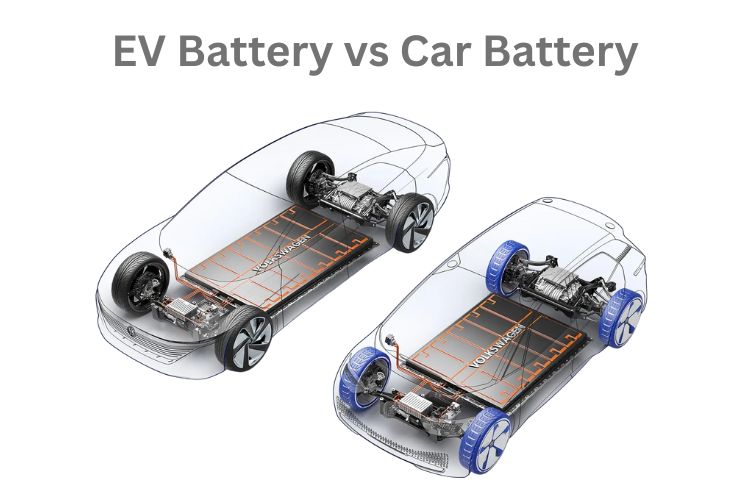
Now we’re talking about the real star of the show. This massive battery pack doesn’t mess around with your radio. It powers the wheels. It IS the engine and the fuel tank, all rolled into one incredible piece of engineering.
We’re talking 400 to 800 volts of raw electrical power coursing through hundreds of interconnected cells. Most EVs pack between 40 and 100+ kilowatt-hours of usable capacity. That’s enough energy to power your entire house for several days.
This is what makes your car move. This is what everyone’s really asking about when they say “EV battery.”
The Sprinter vs. The Marathon Runner (Why They’re Built for Completely Different Races)
The best way to understand these two batteries? Think about Olympic athletes.
Your Gas Car Battery: A 10-Second Burst
Your traditional 12-volt battery is a world-class sprinter. Its entire existence revolves around one explosive moment: cranking your engine to life.
For those first few seconds, it dumps hundreds of amperes into your starter motor. That’s a massive jolt of power, like a sprinter exploding off the blocks. Then it’s done. It catches its breath while your engine’s alternator takes over and gently recharges it for the next start.
The whole system operates around 12 to 14.4 volts when your car is running. It’s measured in amp-hours because its job is about quick power delivery, not long-term energy storage.
Your EV Traction Battery: An All-Day Grind
The EV battery is an ultra-marathoner. It doesn’t do quick bursts. It provides steady, relentless power for hours on end, propelling a 4,000-pound vehicle down the highway at 70 mph.
Those 400-volt systems? They actually operate between 300 and 500 volts depending on the charge level. The newer 800-volt architectures double that range. This high voltage allows more efficient power transfer and, critically, much faster charging speeds.
We measure this battery in kilowatt-hours because it’s all about total energy capacity. How far can you drive? That’s determined by how many kWh are packed into those cells under your floorboard.
Let’s Talk Chemistry (Without the Boring Lecture, Just the “Why”)
The materials inside these batteries tell you everything about their purpose.
Old School: Lead-Acid (The Reliable Sprinter)
Your gas car battery uses technology that’s been around since 1859. We’re talking lead plates, sulfuric acid, and a design philosophy that hasn’t fundamentally changed in over a century.
And you know what? For starting your car, it’s perfect. It’s cheap to manufacture, incredibly recyclable (over 95% of lead-acid batteries get recycled), and it delivers that massive power burst when you turn the key.
But it’s heavy. Really heavy. About 40 pounds for something that stores less energy than your laptop battery. And if you drain it deeply by leaving your lights on overnight? You’ve probably just killed it.
The chemistry is simple: lead and lead dioxide plates sit in sulfuric acid. Turn the key, and a chemical reaction releases electrons. Your alternator reverses the reaction to recharge it.
New School: Lithium-Ion (The Lightweight Marathon Champion)
EV batteries use lithium-ion chemistry, the same family as your smartphone but scaled up dramatically. The two main varieties you’ll encounter are NMC (Nickel Manganese Cobalt) and LFP (Lithium Iron Phosphate).
NMC batteries pack serious energy density. We’re talking 150 to 220 watt-hours per kilogram. That means more range in a lighter package, which is why premium long-range EVs use them. But they’re expensive because of the cobalt and nickel, and they prefer to live between 20% and 80% charge for maximum longevity.
LFP batteries are the scrappy underdogs taking over the market. Lower energy density, sure (90 to 160 watt-hours per kilogram), but they’re cheaper, safer, and basically indestructible. They can handle 3,000 to 7,000 full charge cycles. You can charge them to 100% daily without guilt. They’re showing up in more affordable EVs and dominating the Chinese market.
Here’s the real difference: lithium-ion batteries can hold 3 to 4 times the energy of lead-acid at the same weight. That’s not an incremental improvement. That’s a revolution.
The $15,000 Question: Breaking Down The Massive Cost Difference (And Why It’s Not What You Think)
Let’s address the elephant in the garage.
| Feature | Gas Car Battery (12V) | EV Traction Battery |
|---|---|---|
| Job | Start the engine | Be the entire engine and fuel tank |
| Lifespan | 3 to 5 years | 10 to 20 years (100,000+ miles) |
| Weight | Around 40 lbs | Around 1,000+ lbs |
| Replacement Cost | $150 to $300 | $5,000 to $20,000+ |
It’s Not a Part; It’s the Entire Drivetrain
You’re not comparing two “batteries” in any meaningful sense. You’re comparing a disposable part that helps start your engine to the actual propulsion system of the entire vehicle.
When you replace a traditional car battery, you’re swapping out a support component. When you replace an EV battery (which, spoiler alert, almost never happens), you’re replacing what would be equivalent to the engine, transmission, and a full tank of gas in a conventional car.
That $150 starter battery powers your radio and cranks your engine. That $15,000 traction battery propels 4,000 pounds of metal and glass at highway speeds for 300 miles. See the difference?
And here’s what the scary headlines won’t tell you: lithium-ion battery pack costs have crashed from over $1,000 per kilowatt-hour in 2010 to around $139 per kWh in early 2025. That’s an 86% drop in 15 years. Projections show costs hitting $100 per kWh soon and potentially $50 to $65 per kWh by 2030.
Translation? That $15,000 replacement could be $7,000 in a few years. And you’ll probably never need it anyway.
Lifespan, Degradation, and Warranties (The Rules That Calm Your Anxiety)
Let’s talk about the legal protections that most people don’t know exist.
Federal Protection You Can Count On
U.S. federal law mandates that all EV traction batteries must maintain at least 70% of their usable energy capacity for a minimum of 8 years or 100,000 miles. Most manufacturers meet or exceed this standard with their warranties.
Tesla? 150,000 miles on most models. Rivian? 175,000 miles. Hyundai? 10 years or 100,000 miles. These aren’t suggestions. They’re legally binding guarantees backed by billion-dollar companies.
Real-world data from Recurrent Auto shows that only 1.5% of EVs have required battery replacement outside of recalls. For vehicles made after 2016, that number drops to 0.5%. You’re more likely to need a new transmission in your gas car than a new battery in your EV.
California Goes Even Further
California’s Advanced Clean Cars II regulations raise the bar even higher. Starting with 2030 models, batteries must maintain 80% of their certified range for 10 years or 150,000 miles. That’s not a hope. That’s a requirement to sell cars in the largest U.S. auto market.
Your traction battery isn’t a ticking time bomb. It’s a regulated, warrantied, carefully managed system designed to outlast the rest of your car.
Meanwhile, your traditional 12-volt battery? Three to five years, maybe 1 to 3-year warranty if you’re lucky, and it’s on you when it dies at the grocery store.
Safety, Management, and The Real-World “Can I…?” Questions
Every modern EV has an invisible guardian watching over its battery 24/7.
The Battery Management System: Your Onboard Lifeguard
Think of the Battery Management System (BMS) as a hypervigilant lifeguard who never blinks. It monitors the voltage, current, and temperature of every single cell or cell group in your battery pack. It’s constantly calculating state of charge and state of health. It balances cells to prevent any one from aging faster than the others.
Most importantly, it’s the safety kill switch. If temperatures spike, if there’s a short circuit, if voltage goes haywire, the BMS cuts power instantly. This prevents thermal runaway, the technical term for “battery fire.”
This is why EV fires are statistically less common than gas car fires. The BMS is always watching.
And that 12-volt auxiliary battery? It plays a critical safety role too. The high-voltage system in an EV can’t connect itself to the motor. It needs a command from the low-voltage system. No 12-volt battery power, no way to close the high-voltage contactors. It’s a built-in safety interlock.
Answering Your Quick-Fire Questions
“Can I jump-start my gas car with my EV?” Yes! Your EV’s 12-volt battery works exactly like any other 12-volt car battery. Just connect the jumper cables to the appropriate terminals (check your manual for location) and you’re good to go.
“Can I jump-start my EV’s big battery?” Nope. The high-voltage traction battery is a completely sealed system. You charge it via the charging port, not with jumper cables. Trying to access it directly would be dangerous and impossible for the average person.
“What happens if my EV’s 12-volt battery dies?” This is the most common “my EV won’t start” call to roadside assistance. Even with a fully charged traction battery, if the 12-volt is dead, the car can’t boot up its computers or close the high-voltage contactors. You’ll need a jump or a 12-volt battery replacement, just like any other car.
Charging, “Refueling,” and Environmental Reality (Where The Experiences Truly Diverge)
This is where the daily experience changes completely.
How Each System Stays Topped Up
In your gas car, the alternator is constantly spinning while you drive, generating electricity and keeping that 12-volt battery charged. It’s a closed loop powered by burning gasoline. If the battery dies, a quick jump gets you going again.
In your EV, you plug into the grid. Level 1 charging uses a regular 120-volt outlet and adds 2 to 5 miles of range per hour. It’s painfully slow but works for plug-in hybrids or people with tiny commutes.
Level 2 charging uses 240 volts, like your electric dryer. This is the sweet spot for home charging, adding 10 to 20 miles per hour. Plug in overnight, wake up to a full battery.
DC fast charging is where that 800-volt architecture shines. These stations bypass your car’s onboard charger and pump DC power directly into the battery at rates of 50 to 350 kilowatts. You can go from 20% to 80% in 20 to 40 minutes. That’s not gas-station fast, but it’s coffee-break fast.
And here’s the hidden convenience nobody talks about: you charge at home while you sleep. No more gas station trips in the rain. No more detours on the way home. You wake up every morning with a “full tank.”
What Gets Recycled (And What’s Catching Up)
Lead-acid batteries have recycling down to a science. Over 95% get recycled, making them one of the most recycled products on Earth. The lead, plastic, and acid all get reused. The infrastructure is mature and established.
Lithium-ion recycling is the new frontier. It’s more complex, but the industry is scaling fast. Modern recycling processes can recover 90%+ of valuable materials like cobalt, nickel, manganese, and lithium.
Here’s the kicker: producing battery materials from recycled sources instead of mining reduces greenhouse gas emissions by 58% to 81%, cuts water usage by 72% to 88%, and slashes energy consumption by 77% to 89%. The circular economy for EV batteries isn’t just environmentally smart. It’s economically inevitable.
Conclusion: From “Click, Click, Click” to Understanding Your Power Plant
We started with that sinking feeling of a dead battery on a cold morning. Now you understand the difference between a $150 support part and a $15,000 technological marvel.
The traditional 12-volt battery is a specialized sprinter, perfected over 100 years to do one job brilliantly: start your engine. The EV traction battery is the entire powertrain, the fuel tank, and the future of transportation wrapped into one sophisticated, managed, and warrantied system.
This isn’t an “EV battery.” It’s a power plant on wheels. And the real question isn’t “What happens when it dies?” The question is: “Are you ready for 200,000 miles of quiet, instant torque, and never visiting a gas station again?”
Your first step? The next time someone worries about EV “batteries,” ask them: “Are you talking about the $150 housekeeper or the $15,000 engine?” Watch their eyes light up when they realize they’ve been comparing two completely different things all along.
The tech is new, but the goal is the same: freedom to hit the road. And now, you get it.
Car Battery vs EV Battery (FAQs)
Do electric cars have two batteries?
Yes. EVs use a 12-volt auxiliary battery (lead-acid or lithium) for accessories and computers, plus a high-voltage traction battery (400-800V, 50-100 kWh) for propulsion. The 12-volt system powers low-voltage components while the traction battery moves the vehicle.
How long do EV batteries last compared to regular car batteries?
EV traction batteries last 12 to 20 years with minimal degradation, often exceeding 200,000 miles before dropping below 70-80% capacity. Traditional 12-volt car batteries last 3 to 5 years. Federal law mandates 8-year/100,000-mile EV battery warranties.
Can you replace just one module in an EV battery?
Sometimes. Brands like Chevrolet and BMW allow module-level replacement, costing $3,500 to $6,000 per module instead of $15,000 to $30,000 for the full pack. This depends on manufacturer design and diagnostic capabilities.
Why do EVs still need 12-volt batteries?
Cost and safety. Millions of automotive components (lights, locks, computers, sensors) are designed for 12V operation. Using them is cheaper than redesigning everything for high voltage. The 12V system also provides a critical safety interlock for the high-voltage system.
How much does it cost to replace an EV battery vs a car battery?
Traditional 12V batteries cost $150 to $300 and last 3 to 5 years. EV traction batteries cost $5,000 to $20,000+ but last 12 to 20 years. Battery costs have dropped 86% since 2010 and continue falling toward $100 per kWh.