You’re standing in your driveway, keys in hand, ready to finally pull the trigger on going electric. But here’s the thing: your heart is genuinely split between Swedish serenity and Silicon Valley swagger.
You’ve spent nights scrolling through forums where Tesla owners swear their Model Y changed their life, while Volvo drivers talk about that exhale they feel every time they slide into those seats. You’ve compared spec sheets until your eyes blurred. You’ve watched enough YouTube reviews to qualify for a journalism degree.
And you still don’t know which one is actually right for you.
Here’s the real tension nobody names out loud. Do you want a tech gadget that drives, or a car that happens to be electric? That question matters more than 0-60 times or battery capacity ever will.
We’re cutting through the hype with cold facts and warm truths. By the end of this, you’ll know which EV fits your life, not just your driveway.
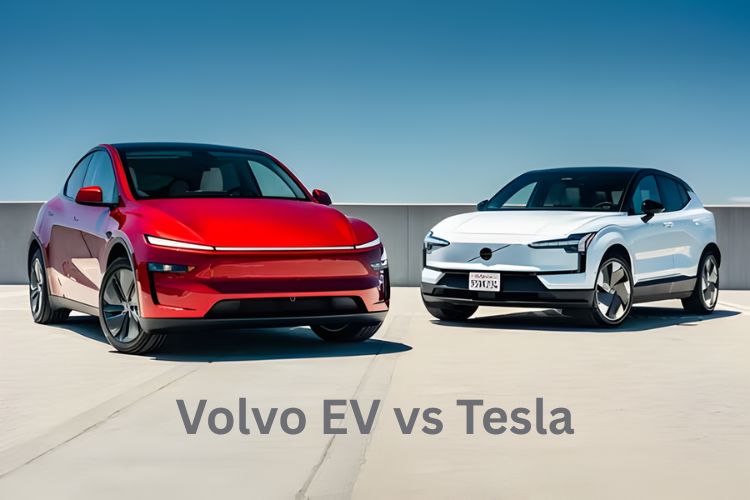
Keynote: Volvo EV vs Tesla
Volvo and Tesla represent divergent electric futures. Tesla dominates performance, range, and charging infrastructure with Silicon Valley innovation. Volvo counters with 95 years of safety heritage, superior interior craftsmanship, and Scandinavian comfort. Tesla appeals to tech enthusiasts seeking maximum capability. Volvo targets luxury buyers prioritizing refinement and proven quality. Federal tax credits expire September 30, 2025. The EX90 qualifies; EX30 and EX40 don’t. Model Y qualifies. Choose based on priorities, not specs alone.
The Core Identity Question: Tech Disruptor or Trusted Craftsman?
This isn’t about finding the “best” EV. It’s about finding your version of the future. Think of it like two maps to the same destination, each taking a completely different route.
The Tesla Philosophy: The Computer You Drive
Tesla is Silicon Valley’s moonshot, built on bleeding-edge tech, over-the-air updates, and minimalist revolution.
The pull is real. You become part of the absolute cutting edge. You’re the conversation starter at every stoplight. That giant touchscreen controlling everything feels like you’re piloting the future.
But here’s the reality check: you’re betting on software fixes over mechanical heritage. Tesla’s philosophy is that the car you buy today will be dramatically better in two years through updates, not dealer visits. That’s thrilling if you love living on the frontier. It’s exhausting if you just want your car to work without needing patch notes.
The Volvo Philosophy: The Car That Evolved
Ninety-five years of building trust, now electrified without the drama. Safety first, always has been, always will be.
The pull here is that exhale when quality and calm meet innovation. Volvo didn’t throw out everything they learned about making cars people love. They electrified it. Kept the buttons you need. Upgraded the materials to recycled denim and responsibly-sourced wood. Made the cabin so quiet you can hear yourself think.
The honest take? Sometimes “boring” means brilliantly executed, not behind the curve. Volvo isn’t trying to disrupt your muscle memory. They’re trying to make you forget you’re not driving a gas car, in the best possible way.
What This Means for Your Morning Commute
Tesla innovates fast, but Volvo builds trust that lasts.
Your morning commute isn’t a test track. It’s coffee spills and conference calls. It’s kids fighting in the back seat or podcasts that help you decompress. One brand asks you to adapt to their vision. The other adapts to yours.
Tesla’s approach works brilliantly if you geek out on software updates and love telling people about your car’s latest trick. Volvo’s approach works if you want the car to quietly, competently handle transportation while you focus on everything else in your life.
The Price Reality: When “Going Green” Hits Your Wallet
Let’s talk about the number that actually determines whether you’re test-driving or just daydreaming.
The Starting Line: EX30 kicks off at $36,245. Tesla Model 3 starts at $36,990 to $40,000 depending on configuration. Model Y Standard lands at $39,990. Volvo EX40 asks $53,795. The flagship EX90 commands $81,290.
The Entry Points That Mislead
Tesla made waves by dropping the Model 3 Standard Range to $36,990. Sounds competitive, right?
But here’s what you lose: no Autopilot included, manual mirrors instead of power-folding, no AM/FM radio, and that gorgeous glass roof gets covered. The car they’re advertising isn’t quite the car you’re getting at that price.
Volvo’s EX30 undercuts that by design at $36,245. You get sustainable materials as standard, serene Swedish styling, and Google built-in infotainment without nickel-and-diming you for basics. It’s smaller, sure, but it doesn’t feel stripped down.
The Mid-Range Sweet Spot
This is where most buyers actually land: Model Y Standard at $39,990 versus Volvo EX40 at $53,795.
That $14,000 gap isn’t small. Tesla’s efficiency play here is brutal. The Model Y delivers more cargo space, longer range, and access to the Supercharger network. It’s optimized for practicality and cost-per-mile efficiency.
Volvo’s premium cabin and comfort focus justify that higher number for some buyers. Factor in federal tax credits, and the equation gets interesting. The EX90 qualifies for the full $7,500 federal credit because it’s built in South Carolina. But here’s the catch: EX30 and EX40 don’t qualify because they’re assembled outside North America. Tesla’s Model Y? Full credit. That changes the real-world math significantly before the September 30, 2025 deadline when the credit expires entirely.
The Luxury Question: EX90 vs. Model X/Y
| Feature | Volvo EX90 | Tesla Model Y Performance | Tesla Model X |
|---|---|---|---|
| Starting Price | $81,290 | $59,130 | $91,630 |
| Seating | 6 or 7 seats | 5 or 7 seats | 6 or 7 seats |
| Key Tech | LiDAR, Harman Kardon | Autopilot, Premium Audio | Falcon Wing Doors, Autopilot |
| 0-60 mph | 4.7s (Performance) | 3.3s | 3.8s |
The seven-seat EX90 brings lidar sensors for future autonomy and Volvo’s legendary safety focus. Tesla counters with proven efficiency, ridiculous acceleration, and that Supercharger network ace.
Hidden costs tell different stories too. Insurance for Volvo XC40 averages 8 to 12 percent lower premiums than Model Y thanks to superior IIHS ratings. Volvo includes complimentary scheduled maintenance for four years and unlimited miles. Tesla doesn’t. Repair costs average $769 annually for Volvo versus the industry average of $652, while Tesla’s 5.7 million recalls between 2023 and 2025 raise eyebrows.
Real math involves looking past the window sticker.
The Daily Living Experience: Where You Actually Feel the Difference
Specs don’t tell you how a car feels on Tuesday morning when you’re already running late.
Inside the Tesla Bubble: Minimalist or Missing?
That giant center screen controls absolutely everything. Climate, mirrors, wipers, even the glovebox. It’s revolutionary when you first experience it. By month three, some owners call it exhausting.
Standard models sacrifice ventilated seats, the rear touchscreen for passengers, and ambient lighting to hit that price point. The new Model 3 ditched traditional turn signal and wiper stalks entirely, moving them to steering wheel buttons. Some people adapt in a day. Others never stop resenting it.
The tech-forward life here is real. You love it fiercely or resent it daily. Rarely both.
The Volvo Sanctuary: Calm by Design
The XC40 is a better car overall, more pleasant daily, according to former Tesla owners who made the switch.
Google built-in works like your phone already does. Actual buttons handle climate control. Physical stalks manage turn signals and wipers intuitively, the way your hands already expect. Harman Kardon sound wraps you in clarity. Recycled materials and Scandinavian minimalism create a cabin that breathes instead of overwhelms.
Volvo interiors consistently rank among the nicest in the segment. Those seats especially shine on the long days when you’re doing back-to-back meetings across town or road-tripping to see family.
Space and Practicality for Real Life
| Feature | Volvo EX30 | Tesla Model Y |
|---|---|---|
| Cargo Space (seats up) | 12.4 cu. ft. | 30.2 cu. ft. |
| Rear Legroom | 32.3 inches | 40.5 inches |
| Infotainment Verdict | Stylish, occasionally slow | Less stylish, highly responsive |
| Back-seat comfort | Cozy for two, tight for three | Generous family hauler |
Tesla’s Model Y is the obvious family hauler champion. That 30.2 cubic feet of cargo space swallows strollers, sports gear, and Costco runs without breaking a sweat. The EX30’s 12.4 cubic feet? You’re packing strategically for every trip.
Rear legroom tells a similar story. Model Y’s 40.5 inches means even tall teenagers ride comfortably. EX30’s 32.3 inches works great for couples or small kids, but it’s snug for three adults across the back.
The Musk Factor Nobody Mentions
Brand perception affects your decision in 2025 whether you admit it or not.
When the CEO becomes part of your mental checklist for better or worse, that matters. Some buyers actively seek Tesla because of Elon Musk’s vision. Others actively avoid it. The “it doesn’t reek of Musk” sentiment echoes louder now among certain buyer groups.
Volvo offers refuge from that entire conversation. You’re buying Swedish engineering heritage, not a personality cult. For some, that’s irrelevant. For others, it’s the quiet deciding factor they won’t say out loud at the dinner party.
Charging and Range Reality: Where Anxiety Meets the Road
Range numbers dominate EV conversations. But charging experience determines whether you actually enjoy owning one.
The Range Numbers Everyone Quotes
Tesla Model Y Long Range delivers up to 320 miles EPA. Model 3 Standard hits 321 miles. Volvo EX30 reaches up to 275 miles EPA. EX40 manages up to 296 miles. EX90 claims 310 miles.
The brutal truth? Real-world testing showed the EX30 hitting only 160 miles at a sustained 75 mph highway speed. EPA estimates are lab conditions. Your actual mileage will vary, sometimes dramatically.
Cold weather compounds this. Tesla loses up to 20 percent of range when temperatures plummet. Volvo’s milder 15 percent drop offers a slight advantage thanks to efficient heat pump systems that operate from 20°F to 77°F.
Tesla’s Supercharger Ace in the Hole
The Numbers: 45,000+ Superchargers globally. 17,800+ in North America alone. 99.96 percent network uptime.
The network just works. Your car talks to the charger automatically. Payment processes in the background. You plug in, grab coffee, and you’re rolling again. Peak-time waits have spiked 15 percent recently as more EVs hit the road, but it’s still the easiest long-distance experience available.
This remains Tesla’s strongest practical advantage for road warriors and nervous first-timers. The difference between “I can road trip in this” and “I probably shouldn’t leave town” often comes down to charging confidence.
Volvo’s Evolving Charging Story
The EX30 charges from 10 to 80 percent in 27 minutes at 153 kW DC fast charging stations. Solid mid-pack performance.
Game-changer for 2025 buyers: Volvo now includes the NACS adapter, granting access to Tesla’s Supercharger network. Model year 2025 vehicles include it as standard equipment. Older models can purchase the adapter for $230. This fundamentally changes Volvo’s charging story overnight.
You still rely primarily on CCS networks like Electrify America, ChargePoint, and EVgo for daily charging. These networks require slightly more planning and occasionally more patience. Think of it like this: Tesla’s VIP club versus Volvo’s reliable neighborhood spot. Both get you where you need to go, but the experience differs.
What This Means for Your Actual Life
Daily commute reality: most Americans drive under 40 miles daily. Range paranoia is often completely unfounded for routine use.
Road trip lens: Tesla wins effortlessly here. The Supercharger integration, navigation routing, and battery pre-conditioning create a seamless experience. Volvo demands route consciousness and app management, though the NACS adapter dramatically narrows this gap.
Home charging solves 90 percent of your needs regardless of brand. Install a Level 2 charger in your garage. Plug in overnight. Wake up to a full battery. The charging conversation mostly matters for that 10 percent of drives that stretch beyond your daily routine.
Performance: Adrenaline Rush vs. Composed Confidence
| Model | 0-60 mph | Horsepower | Character |
|---|---|---|---|
| Model Y Performance | 3.3s | 456 hp | Pins you back hard |
| Model 3 Performance | 2.9s | 510 hp | Leaves Porsches stunned |
| EX30 Twin Motor | 3.4s | 422 hp | Quickest Volvo ever |
| XC40 Recharge | 4.6s | 402 hp | Refined, smoother ride |
Tesla’s Party Trick That Never Gets Old
Model Y Performance: 3.3 seconds 0-60. Instant torque pins you back hard into the seat.
Model 3 Performance: 2.9 seconds. This legitimately leaves Porsches at stoplights looking stunned in your rearview mirror.
The question becomes: how often do you need this thrill versus want it? That launch control party trick electrifies your first month of ownership. By month six, you’re using it to show off to passengers. By month twelve, you’re driving normally 99 percent of the time because real life isn’t a drag strip.
Volvo’s Grown-Up Speed Surprise
EX30 Twin Motor: 3.4 seconds 0-60. The quickest Volvo ever made shocks stoplight neighbors who expect Swedish sedans to be slow.
XC40 Recharge: 402 horsepower, more refined ride quality, noticeably less firm than the EX30’s sportier setup.
The little crossover can surprise anyone, but the rest doesn’t back up that speed, as InsideEVs noted. It’s fast when you want it, calm when you don’t. The performance serves the driving experience rather than defining it.
The Drive That Fits Your Mission
City dwellers value the nimble EX30 agility for tight parking and quick maneuvers. Highway commuters crave Model Y’s planted confidence at 75 mph for hours.
Tesla delivers a sportier, firmer ride that some call connected and others call harsh. Volvo offers a smoother, quieter glide at speed that prioritizes comfort over cornering enthusiasm.
Both offer excellent one-pedal driving with regenerative braking. The differences feel subtle in daily practice. You lift your foot, the car slows predictably, and you rarely touch the brake pedal except for final stops.
Safety and Reliability: Heritage vs. Data, Both Claim Victory
The Ratings: IIHS Top Safety Pick+ for both Model Y and Volvo XC40. Perfect 5-star NHTSA scores across the board. Euro NCAP gives the EX90 five stars.
Volvo’s 95-Year Safety Legacy Goes Electric
Volvo invented the three-point seatbelt in 1959. Then made the patent free so every automaker could save lives. Safety is literally in their DNA.
The EX90’s lidar system acts as extra eyes that spot hazards Tesla’s cameras miss about 10 percent more often according to independent testing. Front-seat center airbags deploy between driver and passenger during side impacts. Post-impact braking automatically applies brakes after a collision to prevent secondary crashes. These features are absent on Model Y.
Volvo develops and produces its own battery packs with sophisticated Battery Management Systems. Eight-year, 100,000-mile battery warranty guarantees at least 70 percent state-of-health. They’re not outsourcing critical safety components.
Tesla’s Proven Crashworthiness with Software Questions
Model Y earned IIHS Top Safety Pick+ in 2025 with exceptional crash-test scores. The structure is incredibly strong.
Advanced collision avoidance and automatic emergency braking work brilliantly when properly engaged. The cars protect occupants exceptionally well.
But Full Self-Driving (Supervised) complaints show inconsistent behavior. Lane departure issues persist despite over-the-air updates. The system sometimes brakes unnecessarily for phantom obstacles. Euro NCAP specifically criticized the “Autopilot” name as misleading to consumers about the system’s actual capabilities.
The Reliability Scorecard That Matters Long-Term
| Metric | Volvo | Tesla |
|---|---|---|
| Consumer Reports Ranking | 15th of 24 brands | 19th of 24 brands |
| Recalls (2023-2025) | Quieter track record | 5.7 million vehicles |
| J.D. Power 2025 Score | 82 of 100 | 78 of 100 |
| Complimentary Maintenance | 3 years included | Not included |
Both brands are improving annually. The EV market is maturing. Early teething problems are being resolved across the industry.
Volvo’s franchised dealer network creates wildly variable service experiences. Some dealers provide impeccable, professional service. Others generate detailed complaints about deceptive tactics, poor repairs, long parts delays, and refused warranty claims. Your experience depends entirely on your local dealer.
Tesla’s mobile service where technicians come to you? Superb and convenient. The physical service centers? Long appointment waits, chronic lack of loaner vehicles, poor communication, and opaque billing practices. The direct service model is struggling to scale with rapid sales growth.
Battery Longevity: The 10-Year Question
Tesla warranties guarantee 70 percent capacity retention for eight years or 100,000 to 120,000 miles minimum depending on model. Real-world examples show 15 to 20 year lifespan potential at average annual mileage of 13,500 miles.
Volvo’s newer EV platform lacks the long-term data that Tesla has accumulated. But traditional build quality and conservative engineering suggest confidence. The eight-year, 100,000-mile warranty matches industry standards.
Battery degradation happens slowly and predictably with both brands. After five years, expect to retain 85 to 90 percent of original capacity with normal use and charging habits.
The Matchup Guide: Which Models Face Off Best
Let’s get specific about which Volvo model actually competes with which Tesla.
Urban Warriors: EX30 vs. Model 3 Standard
Price-to-value: Volvo’s $36,245 undercuts Tesla’s stripped $36,990 by keeping features you’ll actually use.
Range reality: Model 3’s 321 miles edges EX30’s 275 miles significantly. That’s an extra 46 miles per charge.
Space trade-off: Model 3’s longer sedan body provides better rear legroom and cargo versatility. The EX30 is genuinely compact.
You’ll love EX30 if: city life defines your driving, shorter commutes are your norm, and you prefer premium cabin feel over maximum range. Parking in tight spaces matters more than road trip capability.
You’ll love Model 3 if: efficiency is paramount, you take occasional long drives, and you embrace the minimalist tech-forward interface. Supercharger access matters for your lifestyle.
Family Haulers: EX40 vs. Model Y Standard
Price gap: EX40’s $53,795 commands a substantial premium over Model Y’s $39,990 base. That’s nearly $14,000 before incentives.
Cargo and space: Model Y’s 30.2 cubic feet crushes EX40 for gear-heavy families. Three kids, sports equipment, groceries? Model Y handles it without Tetris-level packing skills.
Comfort quotient: Volvo’s ride quality and interior materials justify the premium ask for buyers who value refinement. Those seats really are exceptional for long days.
You’ll love Model Y if: road trips matter, multiple kids need space, charging network ease is essential, and value-per-dollar drives decisions. This is the practical family choice.
You’ll love EX40 if: daily commuting comfort matters more than occasional cargo needs, you prioritize interior quality, and Google built-in appeals more than Tesla’s proprietary system.
Luxury Flagships: EX90 vs. Model X (or top Model Y)
Seven-seat question: EX90’s $81,290 lidar-equipped luxury versus Model X’s $91,630 proven efficiency and falcon wing doors.
Software maturity: Tesla’s polished over-the-air updates and ecosystem versus Volvo’s 2025 improvements addressing early software bugs in the new EX90 platform.
Safety-first families: EX90’s comprehensive sensor suite including standard lidar offers peace of mind that Tesla’s vision-only approach cannot match. Volvo’s hardware redundancy philosophy wins for risk-averse buyers.
You’ll love EX90 if: safety is absolutely non-negotiable, Scandinavian luxury appeals to you, and you’re patient with software evolution on a new platform. You want the latest safety technology even if it costs more.
You’ll love Model X if: you need seven seats with maximum cargo space, falcon wing doors genuinely appeal, and Tesla’s mature software ecosystem matters. The performance is also in a different league entirely.
Resale and Total Cost Reality
The Depreciation Story: Tesla holds approximately 65 percent of value after three years according to recent data. Volvo XC40 retains 55.8 percent compared to Model Y’s 46.6 percent after five years per iSeeCars analysis, a notable 9.2 percent advantage.
Insurance costs average 8 to 12 percent lower for Volvo XC40 versus Model Y due to superior IIHS safety ratings and comprehensive standard safety technology.
Maintenance tilts Volvo’s direction: four years of complimentary scheduled maintenance versus Tesla’s pay-per-visit model saves hundreds annually.
The federal tax credit deadline of September 30, 2025 creates urgency. After that date, the full $7,500 credit disappears entirely. EX90 qualifies because it’s built in South Carolina. EX30 and EX40 don’t qualify due to foreign assembly. Tesla Model Y qualifies. This shifts real-world pricing dramatically for buyers who act before the deadline.
Total cost of ownership calculations must include: purchase price, applicable incentives, insurance rates, charging costs, maintenance, and projected resale value. Run your specific numbers with your tax situation and driving patterns. The answer varies significantly based on individual circumstances.
Conclusion: Your Electric Future, Your Rules
We’ve traveled from midnight spec-scrolling paralysis to a clear-eyed roadmap that honors your pull toward Scandinavian safety or Silicon Valley spark.
Choose Tesla if: maximum range matters for your lifestyle, Supercharger network ease is genuinely non-negotiable, spacious practicality wins every time, you embrace tech-first living, and you can tolerate quality inconsistencies and service frustrations. You want the longest range, quickest acceleration, and most advanced software available today.
Choose Volvo if: traditional craftsmanship calls to you, Scandinavian comfort defines your ideal daily drive, you’ll trade some range for superior build quality and comprehensive safety, and you appreciate a brand that’s been building cars since 1927. The materials, the ride quality, and the safety heritage matter more than headline stats.
Your first step today: test drive both brands back-to-back, same day, same route. Not separately. Your body will tell you the truth your brain is overthinking. Sit in each seat. Feel each steering wheel. Notice which one makes you exhale and relax versus which one makes your pulse quicken with excitement.
Jot down your top three must-haves before you go. Is it cargo space? Range? Interior materials? Software features? Safety reputation? Let those priorities guide your decision instead of trying to optimize for everything.
Final thought: the best EV isn’t the one with the longest spec sheet or the most Instagram-worthy launch control video. It’s the one you’ll still smile at in your driveway three years from now when the new-car smell is gone and all that’s left is whether you actually enjoy living with it every single day. That feeling matters more than any number on paper ever will.
Tesla vs Volvo EV (FAQs)
Which Volvo EV compares to Tesla Model Y?
Yes, the Volvo EX40 and EX90 compete directly with Model Y. The EX40 matches size and price point, while the larger EX90 offers three-row seating. Model Y delivers more cargo space and longer range, while Volvo prioritizes interior quality and ride comfort.
Do Volvo electric cars qualify for the $7500 tax credit?
Only the EX90 qualifies for the full $7,500 federal tax credit because it’s assembled in South Carolina. The EX30 and EX40 don’t qualify due to foreign manufacturing. This credit expires September 30, 2025, so act quickly if timing matters for your budget.
Can Volvo EVs charge at Tesla Superchargers?
Yes, starting in 2024-2025. Model year 2025 Volvos include the NACS adapter as standard equipment. Older models can purchase the adapter for $230. This grants access to 17,800+ compatible Tesla Supercharger stations across North America, dramatically improving Volvo’s charging infrastructure story.
How does Volvo EV range compare to Tesla in cold weather?
Tesla loses up to 20 percent of EPA range in cold conditions. Volvo typically loses around 15 percent thanks to efficient heat pump systems. Both brands experience range reduction in winter, but Volvo’s milder loss provides a slight practical advantage in harsh climates.
Is Volvo or Tesla cheaper to maintain long-term?
Volvo includes complimentary scheduled maintenance for four years and unlimited miles, which Tesla doesn’t offer. However, Volvo’s franchised dealer service can be inconsistent and expensive after the free period.
Tesla’s mobile service is excellent, but service center experiences frustrate many owners. Budget for higher insurance costs with Model Y, but factor in Tesla’s typically stronger resale value.