You saw it, right? That headline promising a brand-new electric truck for under $20,000. You felt it, that rare flutter of hope that maybe, finally, someone was building something for regular people who just need a solid little truck. Then you watched the price creep up to $27,000, and that hope turned into something heavier.
Now you’re standing at a fork in the road, and both paths feel risky. Do you wait 18+ months for a startup’s bold promise, a truck that doesn’t even exist yet? Or do you walk into a Ford dealer right now and drive away with something proven?
Here’s what over 100,000 people discovered when they reserved a Slate in just two weeks: you’re not alone in wanting this choice to be simple.
We’re going to walk through this together. Not with hype or sales pitches, but with the trade-offs that actually matter when you’re lying awake at 2 a.m. wondering if you’re about to make a major mistake. We’ll unpack the real costs, the startup gamble nobody talks about, and which truck fits your Tuesday morning reality.
Keynote: Slate EV vs Ford Maverick
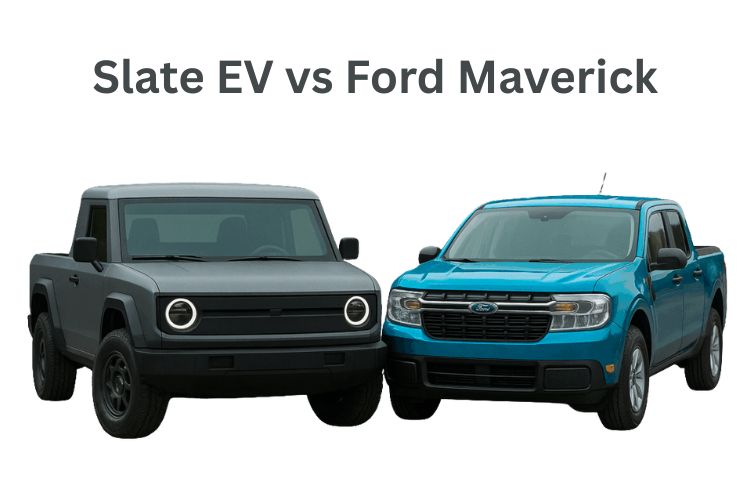
The slate ev vs ford maverick comparison reveals two distinct paths in compact trucks. Slate offers electric minimalism and radical customization for urban DIY enthusiasts willing to wait until 2027. Maverick delivers proven hybrid efficiency, 4,000-pound towing capacity, five-seat practicality, and availability today. Without federal tax credits, prices are nearly identical at $27,000 to $28,145. Choose electric potential or hybrid certainty.
What We’re Actually Choosing Between
The Slate Truck: A Blank Canvas (Or a Risky Bet?)
This isn’t just a truck. It’s a philosophy wrapped in unpainted plastic panels. Think of it as the IKEA of trucks, if IKEA also asked you to assemble the engine.
The Slate Truck EV rolls out of Warsaw, Indiana as a two-seat electric pickup that’s 174.6 inches long, genuinely city-friendly. It converts to a five-seat SUV with optional kits you install yourself. Ships with zero paint, manual crank windows, no sound system, no screen. Just bare-bones electric truck honesty.
Built in the Midwest, backed by Jeff Bezos and Re:Build Manufacturing, it’s targeting late 2026 or 2027 delivery. The base version packs a 52.7 kWh battery delivering 150 miles of range, a 201 horsepower electric motor, and a starting price around $27,000.
This is the “radically simple” pitch, stripped down to save you money up front. That rear-wheel drive setup, that single cab configuration, those unpainted composite panels. Everything screams intentional minimalism.
The Ford Maverick: The Truck That Just Shows Up
While Slate is still sketching blueprints, the Maverick hybrid is parked at your local Ford dealer right now. You can smell that new-truck scent today, not in 18 months.
This is a five-seat crew cab that stretches 199.7 inches long, compact but family-ready. The 2.5L hybrid engine comes standard for 2025, delivering 42 mpg city without a plug. It arrives complete: SYNC 4 infotainment touchscreen, power everything, paint included, warranty included, dealer network included.
Starting around $28,145 for the Maverick Hybrid XL, it’s available in multiple trims with AWD options. The unibody construction makes it ride like a car but work like a truck. It’s the sensible choice that sold like crazy because it actually works.
The Price That Changed Everything
The Dream That Disappeared
The one number that broke hearts: $7,500.
The Slate was supposed to be under $20,000 after federal EV tax credits. That was the headline that got your attention and convinced 100,000 people to put down reservations. Then the One Big Beautiful Bill Act axed the federal credit on September 30, 2025, and suddenly that $20k dream became a $27k reality.
This isn’t just math. It’s broken trust. The affordable electric truck promise evaporated when Congress changed the rules.
What You’re Actually Paying Today
Slate Truck: Around $27,000 to $28,000 base, no incentives left. The 84.3 kWh extended range battery costs extra, probably pushing you past $32,000.
Ford Maverick Hybrid XL: Around $28,145 MSRP, often with dealer incentives that actually reduce the price.
The catch? One exists. One doesn’t. Yet.
Here’s the monthly payment reality:
| Vehicle | Today’s Price | What You Get | Availability |
|---|---|---|---|
| Slate Truck | ~$27,000 | Bare-bones 2-seater, late 2026 delivery, startup warranty | 18+ month wait |
| Ford Maverick | ~$28,145 | Feature-complete 5-seater, Ford warranty, dealer network | Drive away today |
Without the federal tax credit, these trucks cost nearly the same. But the Maverick gives you seats for five people, proven reliability, and keys in your hand this week.
The Five-Seat Question That Decides Everything
Who Actually Rides With You?
Here’s the truth most comparisons skip: Slate seats two people. Period. Unless you buy conversion kits later and install them yourself, which adds thousands of dollars and requires tools, time, and patience.
The Maverick seats five, always. No kits, no projects, no tools required. Four doors. Five seatbelts. Done.
Ask yourself honestly: Do you need to carry more than one passenger at least 3 days a month? If yes, Maverick wins this round before you even get to range or towing. If no, keep reading, because Slate’s story gets more interesting.
Bed and Space Reality Check
Daily life dimensions matter:
| Feature | Slate Truck | Ford Maverick |
|---|---|---|
| Bed Length | 5 feet (60 inches) | 4.5 feet (54 inches) |
| Bed Volume | 35.1 cu ft + 7 cu ft frunk | 33 cu ft |
| Doors | 2 | 4 |
| Parking Length | 174.6 inches (tight-spot hero) | 199.7 inches (still reasonable) |
| Payload Capacity | 1,433 lbs (standard battery) | 1,500 lbs |
The Slate’s extra half-foot of bed length is genuinely useful for lumber runs. And that 7-cubic-foot frunk under the hood? It’s a game-changer for groceries or tools you want to keep dry and secure.
But the Maverick counters with its FlexBed system, built-in slots for custom dividers, and that flexibility of four doors when your kid’s friend needs a ride.
If you parallel park daily in a crowded city, those 25 inches Slate saves might be your deciding factor. If you’ve got a family, those missing back doors might be a dealbreaker.
Range Anxiety vs. Gas Station Fatigue
The Electric Promise
Slate delivers 150 miles on the base 52.7 kWh battery, 240 miles if you upgrade to the 84.3 kWh extended range pack. That instant EV torque, that silent acceleration, that zero-emissions smugness when you pass a gas station. Imagine merging onto the highway like a whisper.
The 201 horsepower electric motor hits 0-60 mph in about 8 seconds. Not fast, but perfectly adequate. The NACS charging port means access to Tesla Superchargers. DC fast charging at 120 kW gets you to 80% in under 30 minutes.
But here’s what the brochure doesn’t tell you: 150 miles means planning. It means thinking about chargers. It means that road trip to your parents’ place becomes a logistics puzzle. Cold weather? That range drops. Towing that 1,000 pounds? Range drops even more, potentially to under 90 miles.
Most Americans drive under 40 miles per day, so range works for daily commutes. But weekend adventures? That’s when the limitations bite.
The Hybrid Comfort Blanket
The Maverick Hybrid delivers 42 mpg city with the FWD model, 40 mpg city with the new AWD version, and 35 highway. That’s 430 miles of total range on a single 13.8-gallon tank. “Hybrids remain the practical middle path for most buyers right now,” the automotive press keeps saying, and the sales numbers prove it.
No range anxiety. Ever. No hunting for chargers. Just gas stations everywhere, the same infrastructure you’ve used your entire life. Weekend road trips? Not even a second thought. The 2.5L hybrid engine and electric motor work together seamlessly, managed by a CVT that makes the power delivery smooth and predictable.
Want more power? The available 2.0L EcoBoost turbocharged engine delivers 250 horsepower and 277 pound-feet of torque. It’s not as efficient at around 22-23 mpg city, but with its 16.5-gallon tank, you’re still looking at over 350 miles of range.
For city dwellers with home charging and predictable routines, Slate makes sense. For everyone else, the hybrid is stress-free living. No Level 2 charger installation costs, no electrical panel upgrades, no wondering if you’ll make it home.
Capability: Can It Actually Do Truck Things?
Towing and Payload Reality
The work-truck scorecard tells a brutal story:
| Capability | Slate Truck | Ford Maverick |
|---|---|---|
| Max Towing | 1,000 lbs (light utility) | 2,000-4,000 lbs (actual truck work) |
| Payload | 1,433 lbs standard / 1,131 lbs extended range | 1,500 lbs |
| Available AWD | No (RWD only) | Yes (with hybrid or EcoBoost) |
| Outlets in Bed | TBD | Standard 110V available |
The Maverick with the 4K towing package can tow a decent-sized boat or camper. The Slate is designed for weekend projects and Costco runs. There’s a massive difference between 1,000 pounds and 4,000 pounds when you’re standing at the trailer rental place.
And here’s the painful compromise Slate forces on you: choose the extended range battery to make the truck useful for longer trips, and your payload capacity drops 302 pounds to just 1,131 pounds. That’s like losing two adult passengers worth of hauling ability just to get decent range.
The Maverick doesn’t make you choose. You get consistent capability regardless of configuration.
Driving Dynamics: What Does It Feel Like?
Slate: 201 hp, 0-60 in about 8 seconds, rear-wheel drive only. That RWD layout is fun on dry pavement, gives you a usable frunk, but becomes a liability when it rains or snows. No AWD option exists.
Maverick: 191 hp hybrid or 250 hp EcoBoost, 0-60 in 7-8 seconds depending on engine, available AWD. The Maverick Tremor even offers off-road capability with lifted suspension.
Both are peppy enough for merging. Neither will win drag races. The difference is what happens when it rains and you need AWD, or when you want to take a dirt road to the campsite.
The Philosophy Fork: Builder vs. Buyer
The Slate Itch: For People Who See Potential, Not Limits
This truck whispers to a specific person. Do you look at a blank wall and dream of custom shelving? Do you get excited about 100+ modular accessory attachment points? Does the idea of installing your own SUV conversion kit on a Saturday afternoon sound fun?
The Slate Auto philosophy is “We Built It. You Make It.” Those unpainted composite panels aren’t a bug, they’re a feature. Vinyl wrap it any color you want. Add the squareback or fastback SUV roof. Install manual crank windows or upgrade to power. Mount accessories to those dozens of attachment points on the bed rails and roof.
This is for the DIY enthusiast, the tinkerer, the person who names their tools. Slate University will teach you to do your own repairs. Parts ship to your home. You’re creating something unique, something that evolves with you.
The joy: You’re building exactly what you want, nothing you don’t.
The reality: You’re also troubleshooting things, waiting for parts, explaining your choices to skeptical friends who don’t understand why you bought an unpainted truck.
The Maverick Comfort: For People Who Value Their Time for Other Things
This truck exists for a different person. When you see a blank wall, do you appreciate that it’s already clean and finished? Do you have hobbies and a family that fill your weekends? Does “it just works” sound like the highest compliment?
The Maverick comes complete. SYNC 4 infotainment with that big 13.2-inch touchscreen. Wireless Apple CarPlay and Android Auto. Ford Co-Pilot360 safety features standard. Power windows, power locks, air conditioning. Paint included. It’s ready for life the moment you drive it off the lot.
Drive it off the lot, enjoy it immediately, call the dealer if something breaks. Spend Saturday with your kids instead of installing conversion kits.
It’s less customizable, more predictable, utterly dependable. You’re buying Ford’s vision of what a compact truck should be, not creating your own.
The Waiting Game: Today vs. Tomorrow
Availability: The Tiebreaker Nobody Wants to Admit
Timing is everything:
Maverick dealer lots right now, in stock, ready to test drive and buy today. You can sit in it. You can smell it. You can drive it home tonight.
Slate target delivery late 2026 or early 2027, subject to startup delays that historically affect most new automotive companies. That’s 18 to 24 months minimum. Maybe longer.
Ask yourself: What happens to your current vehicle while you wait? What if Slate hits production delays like most startups do? What if your needs change? What if you have a kid, get a new job, move to a different climate?
That $50 refundable deposit locks in your reservation, but it doesn’t lock in your life circumstances.
The Startup Risk You’re Not Thinking About
Nobody wants to say this out loud, but we need to. Slate is a three-year-old company building its first vehicle. Founded in 2022, revealed in April 2025, targeting production in late 2026. There’s no service network yet. There’s no track record. There’s no proven parts supply chain.
The company has $700 million in funding from Jeff Bezos and others. The team includes veterans from Ford, GM, and Stellantis. Those are good signs. But the automotive startup graveyard is full of well-funded companies with experienced teams.
Who fixes it when something breaks? Slate’s answer is innovative but unproven: Slate University for DIY repairs, plus partnerships with a “major national auto repair chain” for warranty work. But which chain? How many locations? What happens if the partnership dissolves?
Where do you take it for recalls? What happens if Slate folds in Year 3 and you need parts?
The Maverick has a century-old company and over 3,000 Ford dealers backing it. That’s not sexy, but it’s real. Ford’s 5-year/100,000-mile hybrid component warranty is a known entity. Slate’s warranty terms are still being finalized.
This is the gamble that keeps you up at night. Are you willing to bet $27,000 on a company that’s never built a vehicle before?
Total Cost Over Five Years
The Math That Actually Matters
Five-year ownership snapshot based on 15,000 miles per year:
| Cost Category | Slate Truck (estimated) | Ford Maverick Hybrid |
|---|---|---|
| Purchase Price | ~$27,000 | ~$28,145 |
| Fuel/Electricity (5 yr) | ~$2,500 (home charging at $0.13/kWh) | ~$7,000 (at $3.50/gallon, 42 mpg) |
| Maintenance (5 yr) | ~$1,500 (EVs need less) | ~$3,500 (oil changes, etc) |
| Insurance (5 yr) | ~$6,500 (startup unknown factor) | ~$6,000 (established rates) |
| Total 5-Year Cost | ~$37,500 | ~$44,645 |
Slate saves roughly $7,000 over five years if everything goes perfectly and you charge at home. That’s $117 per month. Real money, but not life-changing money.
And that calculation assumes home charging. If you’re relying on public DC fast charging at $0.40 to $0.50 per kWh, your electricity costs nearly match gasoline costs. The savings evaporate.
The Hidden Costs Nobody Mentions
You’ll spend money customizing the truck you actually want to drive. Paint or vinyl wrap: $2,000 to $5,000. SUV conversion kit: estimated at $3,000 to $5,000. Level 2 home charger installation: $500 to $2,000. Electrical panel upgrade if needed: $1,500 to $3,000. Budget an extra $5,000 to $10,000 to transform that bare-bones pickup into the vehicle you actually want.
Ford dealers aren’t known for generosity. In high-demand periods, expect dealer markups of $2,000 to $5,000 over MSRP. Some dealers play fair, others don’t. You’ll need to shop around and be patient.
The true cost comparison becomes murkier once you factor in what you’ll actually spend versus what the sticker says.
The Verdict: Which Truck Is Calling Your Name?
Choose the Slate Truck If…
You view vehicles as platforms and projects, not just transportation. Your daily driving is genuinely under 100 miles and you have reliable home charging infrastructure. You get joy from customization and don’t mind troubleshooting issues yourself.
You’re emotionally prepared for startup risks and comfortable with long wait times. You typically drive solo or with one passenger. Tight urban parking is a daily challenge. You’re excited by the idea of being part of an automotive movement, of owning something different.
You believe in the right to repair. You want to support American manufacturing and EV adoption. You’re willing to accept uncertainty in exchange for ownership of something unique.
Choose the Ford Maverick If…
You need a dependable vehicle today that seats five people. You value peace of mind: that dealer network, proven reliability, established warranty structure. Your budget is firm and you can’t afford significant post-purchase project costs.
You occasionally tow boats, campers, or anything over 1,000 lbs. You take road trips and don’t want to plan around charging infrastructure. You want your weekends for family, not vehicle projects.
You live in an area with harsh winters and need AWD. You need a truck that can do actual truck work without compromise. You want the security of buying from a company that will definitely exist in 10 years.
Conclusion: Your Truck, Your Story
You didn’t come here for clickbait or hype. You came because this choice feels weightier than it should. And you’re right, it is. This isn’t just specs on paper. This is a choice between two fundamentally different approaches to life.
The Slate is the visionary’s bet. The builder’s blank canvas. The dreamer’s affordable EV that asks you to invest not just money, but time, faith, and patience. It’s exciting. It’s risky. It might be brilliant. But it won’t arrive until late 2026, and when it does, you’ll be starting a project, not just driving a truck.
The Maverick is the pragmatist’s smart move. The family hauler that works overtime as a weekend warrior. The truck that’s already proven itself to hundreds of thousands of buyers who just needed something sensible that doesn’t break the bank. It’s reliable. It’s boring in the best way. It’s here.
Your first step for today: Go to your garage or parking spot. Look at the space. Now close your eyes. Do you see a blank Slate waiting for your story, or a dependable Maverick ready for your next adventure? The answer is already there, in that quiet feeling in your gut.
Whichever path you choose, you’re part of a movement bringing back affordable, sensible trucks. And that future? That’s worth driving toward.
Ford Maverick vs Slate EV (FAQs)
Will the Slate truck actually cost less than Ford Maverick without the tax credit?
No, not really. Base models are nearly identical at around $27,000 for Slate and $28,145 for Maverick. But the Maverick includes paint, power windows, a touchscreen, and seats for five.
The Slate is bare-bones and seats two unless you spend thousands more on conversion kits. Factor in customization costs and home charging installation, and the Slate could easily cost more than a Maverick.
How long does it take to charge the Slate truck at home?
With a Level 2 home charger at 11 kW, you’re looking at about 5 hours to fully charge the standard 52.7 kWh battery from empty, or 8 hours for the extended 84.3 kWh pack. Most people charge overnight and wake up with a full battery. Using a regular 110-volt outlet takes days, so you’ll need to invest $500 to $2,000 in a Level 2 charger installation.
Can the Ford Maverick hybrid tow my boat or camper?
Yes, if you get the 4K towing package. The Maverick can tow 4,000 pounds with that package, enough for most small to mid-size boats, pop-up campers, and utility trailers. Without the package, it’s rated for 2,000 pounds. The Slate can only tow 1,000 pounds maximum, which severely limits your options. If towing is important, the Maverick wins decisively.
What happens if my Slate truck needs warranty service?
That’s the big unknown. Slate plans to use a network of third-party service partners and has announced a partnership with a “major national auto repair chain,” but details are scarce. They also offer Slate University for DIY repairs.
Compare that to Ford’s 3,000+ dealerships with trained technicians and established warranty procedures. The startup service model sounds great in theory but remains unproven in practice.
Is 150 miles of range enough for a work truck?
It depends on your work. For urban delivery, landscaping, or construction within a 50-mile radius of home with nightly charging, yes. For anything involving long distances, rural areas, or towing, absolutely not. That 150-mile EPA rating drops significantly in cold weather or when loaded.
Real-world range with cargo and cold temps might be 110 miles or less. The Maverick’s 430-mile hybrid range eliminates that anxiety entirely.