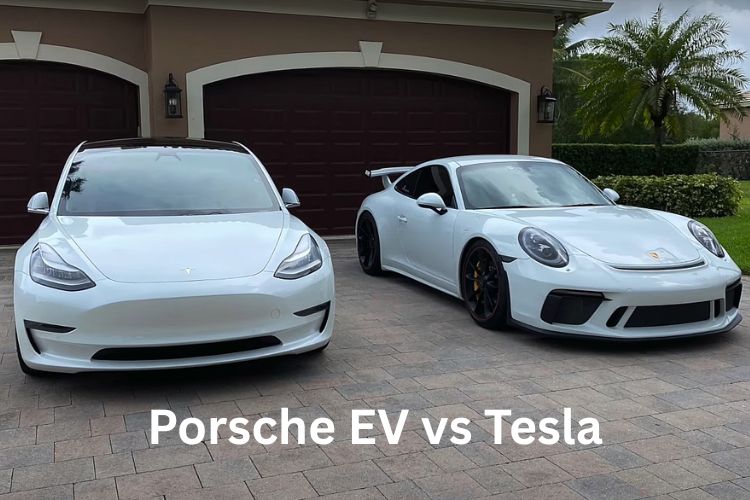
It’s 11:47 PM and you’re three browser tabs deep into EV configurators, your deposit ready, but something in your gut won’t let you click.
One side of your brain screams “Porsche is Porsche“—70 years of driving soul, the badge that makes valet attendants stand up straighter. The other whispers “But Tesla owns the future” with that Supercharger network and software that updates while you sleep. And you’re stuck in the middle, drowning in spec sheets that somehow all miss the point.
Here’s what we’re doing together. We’re cutting through the noise with cold, hard data paired with warm, real feelings. No dealer propaganda. No sterile comparisons. Just the honest path to the luxury electric sedan that fits you, whether that’s the track-proven German engineering of the Porsche Taycan or the range-dominating American innovation of the Tesla Model S.
Keynote: Porsche EV vs Tesla
The Porsche Taycan and Tesla Model S represent different philosophies in luxury electric performance. Porsche delivers track-proven 800V engineering, superior driving dynamics, and repeatable acceleration. Tesla dominates with 402-mile range, lower pricing, and seamless Supercharger integration. September 2025 brought Porsche Supercharger access, closing the infrastructure gap. Neither qualifies for federal tax credits. The choice hinges on priorities: driving engagement versus technological convenience and efficiency.
The Identity Question Nobody’s Asking You Directly
What are you optimizing for when nobody’s watching?
Think about it like camera gear for a second. Porsche is that professional DSLR you cradle with both hands, feeling every dial click, every perfectly weighted control. Tesla is the computational photography smartphone that’s always connected, always learning, taking brilliant shots you didn’t know were possible.
Neither choice is wrong. But one will feel right.
Try this: Write one sentence right now. “If I had to trade range for driving feel, I’d pick ___.” Or flip it: “If I had to trade steering feedback for maximum efficiency, I’d choose ___.” Your gut already knows the answer.
Here’s the truth most guides miss: the regret doesn’t come from specs. It comes from ignoring how steering feel or software updates will make you feel on a random Tuesday morning three years from now.
The badge matters, admit it
Let’s get uncomfortable for a second. Tesla went from revolutionary to everywhere. There are four in your office parking lot. The Model S that once screamed “early adopter genius” now whispers “I bought the default option.”
That’s not a criticism. That’s success. Tesla normalized the EV like Apple normalized the smartphone.
But Porsche? Porsche carries 70+ years of motorsport DNA, Stuttgart engineering heritage, and a badge that still makes people look twice. The Taycan isn’t trying to reinvent transportation. It’s electrifying what Porsche has always done best: make you feel alive behind the wheel.
The question you need to answer honestly: Is that intangible feeling worth $16,000 to $30,000 more? Is ego, or is it justified?
Range and Charging: The Numbers That Rewire Road-Trip Anxiety
The one stat that changes everything
Peak charging speed sounds like marketing fluff until you’re standing at a rest stop with screaming kids and 200 miles still to go.
Porsche’s 800V architecture delivers up to 320 kW DC fast charging. In real-world terms, the Taycan goes from 10% to 80% in roughly 18 minutes at a capable charging station. Tesla’s Model S hits similar speeds where the Supercharger V3 stations can deliver it, but here’s the engineering flex: Porsche maintains over 200 kW past 50% state of charge while Tesla’s charging curve drops to around 150 kW.
Think of it like this: higher peak kilowatts mean shorter pit stops, but only if the charger can actually deliver that power. The “if” matters more than the marketing promise.
Real-world range comparison
Let’s cut through the EPA optimism with actual numbers from Car and Driver highway testing and owner reports:
| Model | Real-World Range | Notes |
|---|---|---|
| Taycan 2025 (base to 4S) | 246-318 miles | Highway test hit 330 miles on 4S trim |
| Model S Long Range | ~402 miles | EPA estimate, consistently delivers in real-world driving |
| Model S Plaid | 348-368 miles | Maker estimate, real-world varies with driving style |
Truth bomb: Tesla’s range advantage is real and significant. If long legs matter desperately for your life, if you regularly drive 300+ miles between charges, this gap might be your entire answer. The Taycan improved dramatically in 2025, but the Model S still wins on total distance capability.
The September 9, 2025 game-changer
Everything just shifted. Porsche EVs gained full Tesla Supercharger access starting September 9, 2025. Over 23,500 charging stations across North America just opened up to Taycan and Macan Electric owners.
Here’s how it works: You can buy a NACS adapter right now (free for 2025+ models, $185 for 2024 and older). Future 2026 model year vehicles will come with native NACS ports built in. Porsche’s navigation system now shows Supercharger locations, and the “plug and charge” simplicity works just like it does for Tesla owners.
This is massive. Porsche just erased its biggest road-trip excuse overnight. The charging convenience gap that used to be a canyon just became a crack in the sidewalk. Electrify America’s 350 kW stations are still faster for the Taycan’s 800V architecture, but now you’ve got options everywhere.
Performance and Feel: Where Your Money Actually Shows Up Daily
The 0-60 party trick versus the Tuesday morning commute
Let’s talk numbers first, then feelings. The Tesla Model S Plaid hits 0-60 mph in 1.99 seconds with 1,020 horsepower. But here’s what the brochure doesn’t mention: you need to activate Drag Strip Mode and wait 8 to 15 minutes for the battery to heat up to optimal temperature before you get that time consistently.
The Porsche Taycan Turbo GT matches that with 2.1 seconds and 1,019 horsepower, but does it on repeat. No prep ritual. No asterisks. Launch control, wait for the green light, experience physics questioning reality, do it again three minutes later.
Here’s the stat box breakdown:
| Spec | Taycan Turbo GT | Model S Plaid |
|---|---|---|
| Horsepower (Overboost) | 1,019 hp | 1,020 hp |
| 0-60 mph | 2.1 seconds | 1.99 seconds (with prep) |
| Top Speed | 190 mph | 200 mph |
| Thermal Management | Track-ready, repeatable | Limited consecutive launches |
Most guides get this wrong: Taycan feels alive in corners and on backroads. Model S feels like physics is taking a coffee break in straight lines.
The “Grin Factor” no spreadsheet captures
Porsche spent 70 years learning how to make steering wheels talk to your fingertips. That knowledge didn’t evaporate when they swapped pistons for batteries.
The Taycan’s steering feedback is communicative. You know exactly what the front tires are doing. The brake modulation gives you confidence. The chassis balance begs you to take the long way home through that canyon road you love. The dual-motor AWD setup with rear-wheel steering makes a 5,000-pound luxury sedan feel like it weighs half that through tight switchbacks.
Tesla’s reality is different. The Model S delivers effortless, silent thrust that makes highway merging genuinely thrilling. But the steering? It’s quick but indirect. The suspension? Competent but a bit numb. You’re not bonding with the road, you’re supervising a very fast, very quiet appliance.
Here’s where each car delivers joy:
| Moment | Porsche Wins | Tesla Wins |
|---|---|---|
| Launch from stoplight | Repeatable thrill, no waiting | Ludicrous shock value, once battery is ready |
| Winding canyon road | Precision, feedback, confidence | Quiet, competent, but emotionally flat |
| Highway passing | Planted, stable, refined | Instant, effortless, silent |
| Track day (if you care) | All-day capability, consistent laps | Party trick, then thermal limitations |
The Money Talk: Where Honesty Gets Uncomfortable
Sticker shock versus the options rabbit hole
Base pricing reality check: The 2025 Porsche Taycan starts around $99,400. The Tesla Model S starts around $79,990 for the dual-motor Long Range trim, $94,990 for the Plaid.
That $20,000 to $25,000 gap is just the beginning of the story.
Porsche’s options list is a financial trap designed by someone who clearly enjoys watching people justify heated steering wheels and ambient lighting packages. Choose your packages with brutal discipline or watch your MSRP balloon past $150,000 for features you’ll forget exist by month three. The Taycan Turbo GT can exceed $239,000 when fully optioned.
Tesla’s pricing is refreshingly simple. A few clicks for paint, wheels, and whether you want the Full Self-Driving package. Performance value per dollar is genuinely high, especially with the Model S.
Depreciation: The silent wealth destroyer both camps ignore
Here’s the part that hurts. Luxury EVs depreciate like smartphones, not like classic cars.
The Taycan loses roughly 59% of its value over five years. The Model S sheds about 65%. Neither is kind to your net worth. Used EV market data shows 43% of all used electric vehicle sales are under $25,000. Taycan’s luxury tax shows up everywhere: higher insurance premiums, more expensive service visits, pricier replacement parts.
Context: Tesla’s market share in the EV space is softening while competitors like GM grow 60% year over year. This matters for long-term resale values and the perception of being “dated” versus “classic.”
The total ownership picture
Let’s build the full five-year snapshot:
| Cost Factor | Porsche Reality | Tesla Reality |
|---|---|---|
| Starting Price | $99,400+ | $79,990-$94,990 |
| Federal Tax Credit | $0 (over $55K sedan cap) | $0 (over $55K sedan cap) |
| Service Experience | White-glove dealer, Cayenne loaners, traditional appointments | Mobile tech visits, uneven quality reports, digital-first |
| Insurance Premium | Higher (luxury brand tax) | Lower (mass market rates) |
| Charging Costs | Now includes Supercharger access via NACS adapter | Native Supercharger simplicity, lower cost per kWh at home |
| Reliability Score (J.D. Power) | 75-80/100 (Average to Great) | 76-79/100 (Average) |
Neither vehicle qualifies for the $7,500 federal tax credit. Both exceed the IRS $55,000 MSRP cap for sedans under Form 8936 guidelines.
Living With It: Software, UX, and the Daily Grind Reality
Tesla’s tech-first philosophy
Over-the-air updates arrive like midnight surprises. Your car gains features, fixes glitches, sometimes changes muscle memory on controls you’ve used for months. It’s brilliant and occasionally maddening.
The Model S’s giant 17-inch touchscreen governs nearly everything. Climate, navigation, driving modes, even opening the glovebox. Autopilot genuinely reduces traffic stress on long highway drives. The Full Self-Driving (Supervised) system is the most capable driver-assistance technology you can buy, though “supervised” is doing heavy lifting in that description.
Honest admission: After month three, that minimalist touchscreen interface can feel more distracting than delightful if you just want to drive without hunting through menus.
Porsche’s driver-focused approach
The 2025 Taycan update brings Apple CarPlay integration, improved voice controls, and a more refined multi-screen layout. It’s not Tesla’s software development pace, but it’s stable. Your muscle memory stays intact. Physical buttons still exist for critical functions.
The cabin itself matters more over 50,000 miles than you think. That real leather smell. The click of switches that feel machined, not plastic. The perfectly weighted steering wheel. The materials that don’t squeak or rattle after three winters.
This is what decades of building driver’s cars feels like translated to electrons.
UX comfort beats 0-60 times after month three. Choose the interface you’ll touch 47 times per drive, not the one that looks coolest in YouTube reviews.
Warranty and support reality check
Both brands offer 8-year battery and drive-unit coverage. Tesla provides unlimited mileage. Porsche caps it at 100,000 miles.
The service philosophy gap is real. Tesla’s mobile technicians come to your driveway for minor issues. When they show up. When parts are available. Reviews are wildly inconsistent. Porsche dealers offer traditional white-glove service with loaner vehicles, but you’re driving to them and scheduling appointments weeks out.
The Lineup Context: What You’re Actually Shopping
Sedans: Two different missions
Let’s clarify what you’re actually comparing:
| Model | Core Identity | Starting Price | Best For |
|---|---|---|---|
| Porsche Taycan | Driver’s car first, luxury EV second | $99,400 | Winding roads, tactile joy, repeatable track performance |
| Tesla Model S | Maximum range, cutting-edge tech, software ecosystem | $79,990 | Long trips, Supercharger simplicity, FSD capability |
The Taycan also comes in Sport Turismo (wagon) and Cross Turismo (lifted wagon) body styles if you need more cargo versatility. Up to 22 different model configurations depending on your market. That’s the Porsche way: endless personalization.
Crossovers: Family haulers with different souls
If you’re actually shopping compact luxury SUVs, the comparison shifts to Porsche Macan Electric versus Tesla Model Y.
The Macan Electric starts at $75,300 with a 100 kWh battery pack and up to 630 horsepower in Turbo trim. It drives like a Porsche: precise, refined, engaging. The ride quality is what Model Y owners wish they had. J.D. Power gives it an 84/100 quality score.
Tesla Model Y starts at $46,630. That’s a $30,000 gap. The Model Y offers more cargo space (76 cubic feet versus 59), an optional third-row seat for kids, and significantly better value if your priority is utility over driving dynamics. J.D. Power rates it 69/100 for quality, with persistent owner complaints about harsh ride quality and inconsistent build.
The Model Y dominates sales charts because it hits a practical sweet spot. The Macan EV wins if you actually care how your SUV drives and you’re willing to pay luxury prices for luxury execution.
The Decision Framework: Stop Comparing Specs, Ask Who You Are
Choose Porsche if this resonates
You crave steering feel and brake modulation enough to justify the premium. This isn’t ego, it’s self-knowledge about what brings you joy.
Build quality and interior craftsmanship are daily touchpoints that matter more than 0-60 bragging rights at dinner parties.
You want repeatable track performance or the confidence to carve canyon roads without asterisks, prep rituals, or thermal management concerns.
The badge represents 70+ years of motorsport engineering heritage you want to be part of, not just own. You understand you’re paying for intangibles and you’re okay with that.
Choose Tesla if this feels true
Range anxiety is real for your driving patterns. There’s no shame in picking the practical solution that adds 100+ miles per charge.
The tech ecosystem, continuous software updates, and Full Self-Driving capability matter more than steering feedback. You value your car as a smart device that improves over time.
You want maximum performance per dollar. The math is the math: Tesla delivers more straight-line speed for less money. Period.
Supercharger network simplicity beats everything for your lifestyle. You want the least planning, longest legs, most plug-and-go ease for road trips. Even with Porsche’s new Supercharger access, Tesla’s native integration remains smoother.
The gut-check script
Read these out loud:
“I’ll trade some EPA range for road feel and luxury craftsmanship.” That’s Porsche calling.
“I’ll trade some tactile joy for convenience, tech leadership, and efficiency.” Tesla makes sense for you.
You’re not buying specs. You’re buying how your days will feel, how you’ll look back at your parked car in the garage, how you’ll answer when someone asks “What do you drive?”
Conclusion: Your New Reality With Porsche EV vs Tesla
We faced the feelings first, then pinned them to real numbers. Porsche’s 800V architecture charging at 320 kW with 18-minute top-ups. That game-changing September 2025 Supercharger access that erased the biggest excuse. Tesla’s genuine 402-mile range advantage and software development lead. The Taycan Turbo GT’s 2.1-second 0-60 time with repeatable, track-ready performance. The reliability concerns on both sides. The $20,000+ price gap. The identity question only you can answer.
One action for today: Write your one-sentence tradeoff on a sticky note. Then test-drive the matching car this weekend on a road you actually know, your commute route, that favorite backroad, wherever. Your hands on the steering wheel and your gut will tell you what spreadsheets can’t.
Final nudge: Pick the experience you’ll crave on a random Tuesday morning in 2028, not the spec that looks best on forums today. Whether you choose electrified heritage or revolutionary technology, you’re choosing brilliantly. Now go get the keys to your new electric reality.
Tesla vs Porsche EV (FAQs)
Does the Porsche Taycan qualify for the federal tax credit?
No. The Taycan exceeds the $55,000 MSRP cap for sedans under IRS Form 8936 guidelines. The Model S also doesn’t qualify due to the same price restrictions. Neither vehicle is eligible for the $7,500 federal EV tax credit.
How long does it take to charge a Porsche Taycan at a Tesla Supercharger?
Roughly 20-22 minutes from 10% to 80% using a NACS adapter at V3 Superchargers. The Taycan’s 800V architecture can charge even faster (18 minutes) at Electrify America’s 350 kW stations. Since September 9, 2025, all Porsche EVs can access over 23,500 Tesla Superchargers.
Is the Porsche Taycan more reliable than the Tesla Model S?
Slightly. J.D. Power rates the Taycan around 75-80/100 versus the Model S at 76-79/100. Both have had early reliability issues: Taycan with software glitches and occasional battery failures, Model S with inconsistent build quality and panel gaps. Neither is bulletproof, but Porsche edges ahead on quality consistency.
What is the real-world range of Porsche Taycan vs Tesla Model S?
Tesla wins decisively. The Model S Long Range delivers around 402 miles in real-world mixed driving. The Taycan ranges from 246 miles (base) to 318 miles (4S trim), with highway testing reaching 330 miles. If range is your primary concern, the Model S provides 80-150 more miles per charge.
Can I track the Porsche Taycan without performance degradation?
Yes. The Taycan’s thermal management and 800V architecture enable back-to-back launches and sustained track sessions without power limiting. The Model S Plaid requires Drag Strip Mode preconditioning and limits consecutive full-power launches to protect components. For repeatable track performance, the Taycan delivers.