You know that feeling, right?
It’s past midnight. You’ve got seventeen browser tabs open. Half show the Kona Electric. The other half show the Niro EV. And somewhere around tab twelve, you’ve lost track of which forum post said what about winter range.
You’re exhausted. Your eyes hurt. And every single article ends with the same useless conclusion: “Both are great choices!”
Thanks for nothing.
Here’s what nobody wants to admit out loud: These two Korean compacts are corporate cousins. They share the same 64.8 kWh battery pack, the same 201 horsepower permanent magnet synchronous motor, the same Hyundai Motor Group DNA. That shared electric heart should make your decision easier.
Instead, it makes everything worse.
You’re not paralyzed because you’re indecisive. You’re stuck because most comparisons drown you in MPGe ratings and lithium-ion polymer battery specs without ever addressing the question that’s actually keeping you up: Will I regret spending $35,000 on the wrong one?
So let’s take a different path together. We’ll start with the feelings, the real-world frustrations, the actual daily life stuff that matters when you’re sitting in traffic or loading groceries. Then we’ll bring in the cold facts that genuinely make a difference, not just filler from a spec sheet.
By the end, you’ll know which one is yours. I promise.
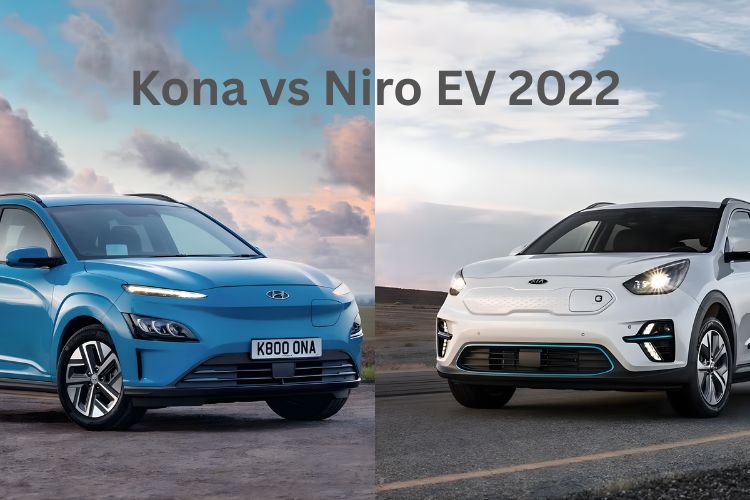
Keynote: Kona vs Niro EV 2022
The 2022 Hyundai Kona Electric and Kia Niro EV represent strategic variations on shared Hyundai Motor Group electric vehicle architecture. Both utilize permanent magnet synchronous motors, lithium-ion polymer batteries, and CCS Combo 1 charging compatibility. The Kona prioritizes efficiency with 258-mile EPA range and lower $34,470 entry pricing. The Niro emphasizes utility with 53.0 cubic feet maximum cargo capacity and 36.0 inches rear legroom.
Federal tax credit eligibility ($7,500 for 2022 purchases) and ten-year battery warranties strengthen both value propositions. Real-world charging infrastructure compatibility and cold-weather range performance remain critical factors in ownership satisfaction across both models.
What You’re Really Choosing: The Personality Behind the Platform
Meet Your Contenders (not just numbers, but vibes)
The Kona Electric is that friend who’s always ready to go. Tighter body. Quicker reflexes. Feels like a pocket rocket when you thread through city traffic and punch it from stoplights. It’s the zippy, tech-forward companion that turns your commute into something you actually look forward to, not just endure.
The Niro EV is your calm, collected friend. The one who brings extra snacks and never complains about road trips. Roomier cabin. Softer ride. It feels like a proper small SUV that swallows real life without complaint. Strollers, dog crates, Costco hauls. It just handles it.
Same motor under the floor. Completely different personalities above it.
The Core Question You Need to Answer First
Before you dive into range numbers and charging curves, ask yourself this: Do you crave a playful, efficient solo driver that makes fewer charging stops, or do you need cargo flexibility and a serene family vibe?
Here’s the truth from owners who’ve lived with these cars for years: You genuinely can’t make a wrong choice here. Both are excellent, affordable compact EVs. The only real question is which one fits your actual life better, not which one looks better on paper.
The best EV is the one that makes your everyday feel lighter. Not the one that wins a spec sheet battle.
The Money Reality: When $5,000 Feels Huge (And When It Doesn’t)
The Sticker Shock vs. Your Actual Cost
Let’s talk about that number that hits you right in the chest when you first look at dealer inventory.
The 2022 Kona Electric SEL started around $34,000. The Niro EV EX started around $39,990. That five-grand gap is real. It’s not a rounding error. It’s a home charging station installation. It’s six months of your old gas budget.
But hold on.
If you bought either vehicle before the Inflation Reduction Act kicked in (August 2022), both qualified for the full $7,500 federal tax credit. That cut the effective prices to roughly $26,500 and $32,490. Suddenly that gap shrinks from five thousand to six thousand but feels more manageable when both are deeply discounted.
And here’s a twist for used shoppers: 2022 models purchased from dealers after January 2023 might qualify for a $4,000 used EV credit under the new rules, even though neither vehicle qualifies for the new EV credit due to their South Korea assembly location.
What You Keep When You Sell
Depreciation is that silent thief that steals value while your car sits in the driveway.
After five years, the Kona Electric holds about 42.2% of its original value. The Niro EV retains roughly 40.5%. Neither wins any awards here, but in actual dollars, that means a $34,000 Kona might be worth around $14,350, while a $40,000 Niro could be worth about $16,200 at trade-in time.
Both carry identical warranty protection: five years or 60,000 miles basic, and ten years or 100,000 miles on the EV battery and electric powertrain. That’s one of the best battery warranties in the industry, crushing the federal eight-year minimum and giving you genuine peace of mind about the most expensive component.
The Kona’s hidden edge? Its lower entry price combined with its longer EPA range creates a value perception that helps it retain slightly more of its worth over time. Budget shoppers remember those extra 19 miles.
Range and Charging: The Numbers That Quiet (or Feed) Your Road Trip Anxiety
The EPA Range Gap That Actually Matters
Here’s the headline that cuts through the noise: The Kona delivers 258 miles of EPA-estimated range. The Niro delivers 239 miles.
That 19-mile cushion matters more than it sounds. It’s the difference between “I’ll definitely make it” and “Maybe I should charge just in case” on that drive to visit family. It’s mental peace, not just math.
| Metric | 2022 Kona EV | 2022 Niro EV |
|---|---|---|
| EPA Range | 258 miles | 239 miles |
| MPGe (city/highway) | 132/108 | 123/102 |
| Real-world tested (Edmunds) | 308 miles | 285 miles |
Both vehicles exceeded their EPA estimates in controlled real-world testing. That’s rare and excellent. But the Kona kept its advantage across every test, confirming its efficiency edge isn’t just marketing.
Highway driving at sustained 75 mph speeds? Expect both to drop. The Niro hit around 210 miles in testing. The Kona held closer to 230 miles. Physics doesn’t care about your schedule.
Winter Is Coming (and taking miles with it)
Most comparison guides skip this part because it’s uncomfortable. So let’s be honest.
Cold weather murders EV range. Both the Kona and Niro drop to roughly 200 miles or less when temperatures plunge below freezing. Your heated seats, your defrosters, your cabin heater—all of it pulls from that same battery that’s also trying to move the car.
The Niro’s potential lifeline? An optional heat pump in the Cold Weather Package that can preserve 10 to 20 percent more winter range compared to the Kona’s standard resistive heating setup. If you live where January routinely brings single-digit temperatures, that heat pump isn’t a luxury. It’s a sanity saver.
The Kona offers a battery warmer in its SEL Convenience Package and standard on the Limited trim. It helps, but not as dramatically as a heat pump.
Charging Speed Without the Drama
Both vehicles peak around 77 to 80 kW on a DC fast charger. That’s the real world, not the marketing brochure. Expect about 44 to 47 minutes to charge from 10% to 80% state of charge at an optimal Electrify America or similar CCS Combo 1 station.
The catch? After 80%, both slow to a crawl. You’ll wait nearly as long to charge from 80% to 100% as you did from 10% to 80%. That’s why experienced EV owners plan road trips in 10% to 80% hops, not full charges.
On a slower 50 kW public charger (still common in many areas), you’re looking at about 75 minutes to reach 80% in the Niro. The Kona shaves maybe ten minutes off that time.
Home charging is where life gets easy. Both have a 7.2 kW onboard charger. Plug into a Level 2 (240V, 40-amp circuit) overnight, and you’ll wake up to a full battery after about 9.5 hours from empty. Set your departure time through the app. Let the car handle the rest.
Here’s the pro move for battery longevity: Arrive home above 20%, set your charge limit to 80% or 90% for daily driving, and only charge to 100% before long trips. Your battery will thank you over the years.
Space Wars: When Inches on Paper Meet Real Life in Your Driveway
The Daily Hauling Truth
With the rear seats up and ready for passengers, the cargo space is nearly identical. The Kona offers 19.2 cubic feet. The Niro gives you 18.5 cubic feet. That’s the same grocery haul, the same gym bag and laptop combo, the same daily reality.
| Cargo Spec | 2022 Kona EV | 2022 Niro EV |
|---|---|---|
| Seats Up | 19.2 cu ft | 18.5 cu ft |
| Seats Down | 45.8 cu ft | 53.0 cu ft |
| Rear Legroom | 33.4 inches | 36.0 inches |
But drop those 60/40 split-folding rear seats, and the story changes completely.
The Niro opens up to 53.0 cubic feet of cargo capacity. The Kona maxes out at 45.8 cubic feet. That 7.2 cubic foot difference is the gap between “it barely fits” and “no problem” when you’re hauling camping gear, moving furniture, or doing that monthly Costco run where you convince yourself you need a 30-pack of paper towels.
If you regularly haul bulky equipment, have kids with sports gear, or just like knowing you can handle whatever weekend adventure throws at you, the Niro wins this fight decisively.
The Backseat Reality for Families
Here’s where the numbers translate into actual human comfort.
Total passenger volume: Niro provides 96.6 cubic feet. Kona offers 92.4 cubic feet. But the real story lives in one specific measurement: rear legroom.
The Niro gives rear passengers 36.0 inches of legroom. That’s genuinely comfortable for adults on road trips.
The Kona provides just 33.4 inches. That 2.6-inch gap is the difference between “fine for an hour” and “my knees hurt after twenty minutes” for anyone over five-foot-eight.
Owner forums tell the same story repeatedly: Kona buyers love their cars but warn prospective buyers the back seat is best for kids or short trips. Niro owners consistently praise the surprisingly roomy cabin that makes carpools and family drives actually pleasant.
The Solo Driver’s Perspective
If it’s just you, or you plus one passenger most of the time, and cargo means a gym bag and groceries? The Kona’s tighter footprint becomes an advantage.
That subcompact size threads through city parking like it’s cheating. Parallel parking in tight spots? Easy. Quick lane changes in traffic? Nimble. Fitting into that last spot in the crowded garage? Done.
The Niro’s extra size isn’t a penalty, but it’s not helping you here either.
Inside the Cabin: The Little Things That Become Your Daily Big Things
The Controls That Make or Break Winter Mornings
Picture this: It’s 15 degrees outside. You’re wearing winter gloves. You need to turn up the heat.
The Kona kept physical climate control buttons. You can hit them without looking, with gloves on, while your coffee’s balanced in the other hand.
The Niro went with touch-capacitive controls. They look sleeker in photos. In real life, they’re frustrating when you’re bundled up or trying to adjust temperature while driving.
After 1,000 miles of ownership, that seemingly small design choice becomes your daily reality. One works. One makes you swear.
Tech features split between the two in interesting ways. The Kona offers wireless Apple CarPlay and Android Auto on its base 8-inch screen, plus an available head-up display on the Limited trim. But here’s the weird part: upgrade to the larger 10.25-inch screen in the Limited, and CarPlay goes back to requiring a cable. Yes, really.
The Niro comes standard with that 10.25-inch touchscreen, built-in navigation, and a premium Harman Kardon audio system on even the base EX trim. But CarPlay is wired-only across the board. Both also include standard cooled front seats, which the base Kona lacks.
The Driving Feel You’ll Notice Every Single Day
Same 201 horsepower motor. Same 291 lb-ft of torque. Same front-wheel-drive setup. Yet they feel surprisingly different when you’re actually behind the wheel.
| Performance | 2022 Kona EV | 2022 Niro EV |
|---|---|---|
| 0-60 mph | 6.4-6.6 seconds | 7.8 seconds |
| Horsepower | 201 hp | 201 hp |
| Torque | 291 lb-ft | 291 lb-ft |
| Curb Weight | 3,715-3,836 lbs | 3,854 lbs |
The Kona’s tuning is sharper. More eager. The throttle responds like it’s been drinking espresso. Steering feels alive in your hands. It eggs you on to drive a little more aggressively, to find the fun route home instead of the fastest one.
The Niro’s calibration prioritizes smoothness. The suspension soaks up bumps better. Road noise stays muted. The throttle response is gentler, more linear. Your passengers will appreciate how the car doesn’t jerk them around at stop lights.
Neither is better. They’re just aimed at different moments in your life.
The Regenerative Braking Personality
Both vehicles give you steering-wheel-mounted paddles to control regenerative braking levels. Pull the left paddle, and regen increases. Pull the right paddle, and it decreases. At maximum regen, you get true one-pedal driving where lifting off the accelerator brings you to a complete stop without touching the brake pedal.
The Kona’s regen feels more aggressive. More immediate. It takes a day or two to smooth out your driving style, but then it becomes second nature and you start wondering how you ever drove without it.
The Niro’s regen is more gradual. Gentler transitions. Your carpool passengers won’t get that slight neck-snap when you lift off the accelerator in traffic.
Both systems work beautifully. Both recapture energy that would otherwise be wasted as heat in traditional brake pads. You’ll just notice the difference in how assertive they feel.
The Quick-Decision Table: Screenshot This and Circle Your Winner
| Feature | 2022 Kona EV | 2022 Niro EV |
|---|---|---|
| Starting MSRP | $34,000 | $39,990 |
| EPA Range | 258 miles | 239 miles |
| Real-World Range (tested) | 308 miles | 285 miles |
| MPGe (city/highway) | 132/108 | 123/102 |
| 0-60 mph | 6.4-6.6 seconds | 7.8 seconds |
| Cargo (seats up) | 19.2 cu ft | 18.5 cu ft |
| Cargo (seats down) | 45.8 cu ft | 53.0 cu ft |
| DC Fast Charge (10-80%) | ~44-47 minutes | ~60-75 minutes |
| Passenger Volume | 92.4 cu ft | 96.6 cu ft |
| Rear Legroom | 33.4 inches | 36.0 inches |
| Climate Controls | Physical buttons | Touch capacitive |
| Winter Heat Pump | Not available | Optional package |
| Standard Screen Size | 8 inches | 10.25 inches |
| Driving Character | Sporty, nimble | Smooth, composed |
| Warranty (Basic) | 5 years/60k miles | 5 years/60k miles |
| Warranty (EV Battery) | 10 years/100k miles | 10 years/100k miles |
The Decision Framework: Three Questions to End the Madness
The Honest Budget Question
Can you comfortably stretch to the Niro’s $40,000 starting price without losing sleep? If yes, you get more refinement, more space, and better standard equipment.
If every dollar matters and you’re counting carefully, the Kona’s $34,000 entry point leaves you with an extra $6,000 for home charger installation, or just breathing room in your budget. That’s not nothing.
Remember the total cost picture. Both qualified for $7,500 federal tax credits when purchased new in 2022. Both carry the same excellent ten-year battery warranty. The Kona includes three years of complimentary scheduled maintenance that the Niro doesn’t match.
The Life-Tetris Assessment
Grab your phone right now. Open your notes app. Write down your actual weekly driving patterns:
Your daily commute distance (round trip). The typical cargo you haul (just a backpack, or strollers and groceries). The number of passengers you regularly carry (solo, or family of four). The weather where you live (mild year-round, or brutal winters).
Now look back at the comparison table above. Match your real life to these specs. The answer should start becoming obvious.
If your list says “65-mile commute, two kids, regular Costco runs, Minnesota winters,” that’s screaming Niro. If it says “30-mile commute, mostly solo, occasional road trips, California weather,” that’s pointing hard at the Kona.
The Test Drive That Decides Everything
Here’s what actually works: Schedule back-to-back test drives. Same day. Same route if possible. Give yourself at least 20 minutes in each vehicle, not the rushed ten-minute loop most dealers push.
Spend the first five minutes just sitting in the parked car. Adjust the seat. Play with the climate controls while wearing whatever you normally wear. Try to pair your phone. Open the cargo area and imagine loading your actual stuff.
Then drive. Highway merging. Tight parking lot maneuvers. Stop-and-go traffic if you can find it. Listen to how quiet or loud the cabin feels. Notice which steering wheel feels right in your hands.
Trust your body’s reaction. The one that doesn’t make you think “I could get used to this” but instead makes you think “This already feels right”? That’s your answer.
The Clear Pathways: Which One Is Actually You?
Choose the Kona EV if…
You’re primarily carrying yourself and maybe one passenger, not hauling kids and cargo daily. That longer 258-mile EPA range and superior efficiency give you peace of mind between charging stops.
You value that sporty, responsive driving character. You want your commute to feel engaging, not just tolerable. The Kona’s nimble handling and quicker acceleration make boring drives actually fun.
That $5,000 to $6,000 price gap matters to your budget math. You’d rather put that money toward home charging installation or just keep it in your savings account.
You live in a city where tight parking and easy maneuverability make daily life measurably easier. The Kona threads through urban chaos like it was designed for it.
You take occasional road trips and that faster DC charging capability (even though we’re talking minutes, not hours) will save you real time and frustration over years of ownership.
Choose the Niro EV if…
Cargo flexibility defines your daily reality. You’ve got kids, pets, hobbies, or just regularly haul stuff that needs that extra 7.2 cubic feet when the seats fold down.
Passenger comfort matters because you regularly carry people in the back seat. Those 2.6 extra inches of rear legroom transform adult passengers from uncomfortable to content on longer drives.
You want a serene, composed driving experience. You prioritize a quiet, comfortable ride over sporty handling. The Niro’s suspension tuning is genuinely better at soaking up rough roads.
You live where winters are brutal and that optional heat pump will preserve 10 to 20 percent more range when temperatures plunge. That’s the difference between range anxiety and confidence.
You value that premium standard equipment package. The larger 10.25-inch screen, navigation, and Harman Kardon audio system on the base EX trim justify the higher price for your priorities.
Permission to Trust What You Already Know
We started with that exhausted, 2 AM version of yourself, drowning in browser tabs and conflicting opinions. You were stuck because everyone kept saying “both are great” without ever acknowledging that doesn’t actually help you decide.
So we named the feelings first. The anxiety about spending $35,000 on the wrong choice. The frustration of specs that don’t translate into your real life. Then we sorted the facts that genuinely matter: 19 miles of extra range, 7.2 cubic feet of cargo difference, $5,000 of budget gap, a second’s difference in acceleration that you’ll feel every single day.
Here’s the truth you needed to hear: The wrong choice doesn’t exist here. Both are excellent, affordable electric crossovers from the same corporate parent. Both qualified for substantial federal incentives when purchased new. Both carry industry-leading ten-year battery warranties. Both deliver on the core promise of electric driving: quiet, instant torque, cheap fuel, and minimal maintenance.
The only real question was never “which is better.” It was “which one annoys me less and fits my actual life better.”
You have that answer now.
Do this today: Pull out your phone. Open your notes. Write down your top three real-world priorities. Is it range? Cargo space? Budget? Driving fun? Passenger comfort? Write them down. Look back at the comparison table one more time. Circle your winner.
That confident decision you were searching for at 2 AM? You’re holding it now. The best EV isn’t the one that wins on a spreadsheet. It’s the one that makes your everyday life feel lighter. Trust your gut. You’ve got this.
Niro vs Kona EV 2022 (FAQs)
Are the Kona Electric and Niro EV mechanically identical?
Yes, they share the same powertrain. Both use a 64.8 kWh battery pack and a 201 horsepower permanent magnet synchronous motor with identical 291 lb-ft torque. They’re built on the same Hyundai Motor Group electric platform with front-wheel drive. The differences come from chassis tuning, exterior dimensions, and interior packaging, not the fundamental EV components.
Which charges faster, Kona or Niro EV, in real conditions?
The Kona charges meaningfully faster. It reaches 80% from 10% in about 44 to 47 minutes at peak DC fast charging rates of 77-80 kW. The Niro takes 60 to 75 minutes for the same 10% to 80% charge, with slightly lower peak charging rates. On road trips requiring multiple charging stops, this time difference compounds and becomes significant for total journey time.
Does the warranty transfer to second owners on 2022 models?
Partially, with conditions. The basic warranty and the EV battery warranty both transfer to subsequent owners, but coverage may be reduced. Second owners typically get the remainder of the 5-year/60,000-mile basic warranty and 10-year/100,000-mile battery warranty. However, the Kona’s three years of complimentary maintenance does not transfer. For full original warranty coverage, purchase a Certified Pre-Owned model from an authorized dealer.
What is actual charging time from 20% to 80%?
About 35 to 40 minutes for the Kona, 45 to 55 minutes for the Niro on optimal DC fast chargers. This 20% to 80% window is the sweet spot where both vehicles charge fastest. Below 20%, they taper charging speed to protect the battery. Above 80%, charging slows dramatically (sometimes to just 7-19 kW), which is why experienced owners plan road trips around this middle range, not full charges.
How much does cold weather reduce range on both vehicles?
Expect 20% to 30% range loss in freezing temperatures. Both vehicles drop from their EPA ratings of 258 miles (Kona) and 239 miles (Niro) to around 180 to 200 miles in sustained cold weather below 32°F.
The Niro’s optional heat pump in the Cold Weather Package can reduce this loss by preserving 10% to 20% more winter range compared to standard resistive heating. Battery thermal management, cabin heating, and reduced battery chemistry efficiency all contribute to this winter penalty.