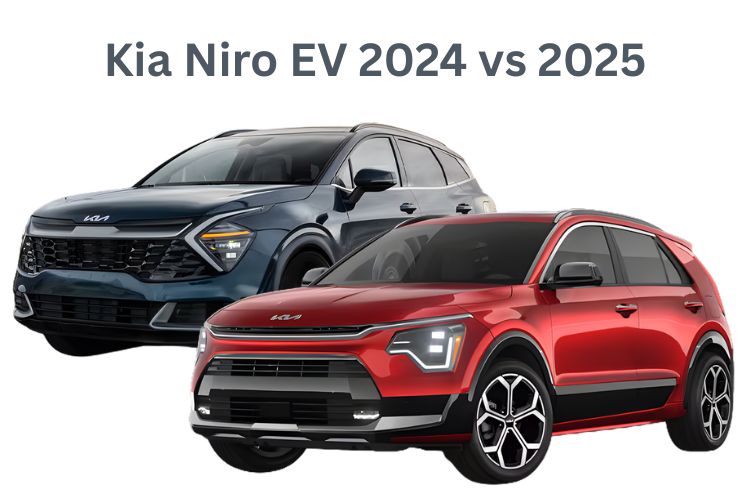
You’re sitting at your kitchen table, two dealer quotes spread out in front of you. One’s a 2024 Kia Niro EV with a tempting $2,000 discount. The other’s a 2025 at full sticker price. Your stomach tightens. They look the same. Are they the same?
You’ve spent the last week clicking through a dozen articles that all say the same thing: regurgitated spec sheets with zero actual guidance. Nobody’s telling you what you really need to know. What if you choose wrong? What if you waste $40,000 on yesterday’s model, or overpay for nothing new?
Here’s the truth that’ll set you free: we’re cutting through this together using real data, real pricing, and real talk about what actually matters when you pull into your driveway every morning. No marketing spin. No vague platitudes. Just the clear answer you came here for.
Keynote: Kia Niro EV 2024 vs 2025
The Kia Niro EV delivers 253 miles of range, 201 horsepower, and 85 kW DC fast charging in both 2024 and 2025 model years. The 2025 adds rear seatbelt pretensioners and extends Kia Connect. The 2024 offers better dealer incentives. Neither qualifies for federal tax credits. Choose based on price, not specs, they’re identical where it counts.
The Truth That Changes Everything: Kia Barely Touched the 2025
What Actually Changed (Spoiler: Almost Nothing)
Let’s get this out of the way fast. The 2025 Kia Niro EV adds rear seatbelt pretensioners as standard across all trims. That’s the primary mechanical safety update. It’s a good addition, absolutely, but it’s not reinventing the wheel.
On the Wave trim specifically, you’ll get a head-up display, upgraded parking assist, and a 10-way power passenger seat. The Wind trim gains a larger 10.25-inch digital cluster and a rotary shifter. These are polish moves, not game changers.
That’s it. That’s the whole list.
What Stayed Exactly the Same (And Why That’s Good News)
The stuff that actually moves you down the road? Identical.
You get the same 64.8 kWh battery delivering 253 miles of EPA-estimated range in both years. That beats plenty of rivals in this price bracket. The same 201 horsepower motor with 188 lb-ft of torque delivers peppy city driving with that instant electric kick. The same 45-minute DC fast charging session takes you from 10% to 80% at 85 kW max charging speed.
Front-wheel drive only. No all-wheel drive option in 2024 or 2025.
The dimensions, the cargo space (22.8 cubic feet with seats up, 63.7 with them folded), the weight, the handling. All unchanged.
Why This Means You Can’t Make a Wrong Choice
Here’s the emotional reframe you need: the 2024 isn’t “outdated” because Kia got the formula right the first time. There was nothing meaningful to update.
You’re not missing out on extra range. You’re not losing power. You’re not skipping some revolutionary tech breakthrough. The 2024 gives you the exact same driving experience, the exact same daily capability, and the exact same long-term reliability as the 2025.
This isn’t a compromise. It’s permission to focus on price.
The Money Reality: Where Your Actual Savings Hide
Sticker Price Showdown
Let’s end the confusion right now with the numbers that matter:
| Trim Level | 2024 MSRP | 2025 MSRP | Real Difference |
|---|---|---|---|
| Wind (Base) | $39,600 | $39,600 | Identical pricing |
| Wave (Premium) | $44,600 | $44,600 | Identical pricing |
Official pricing is a dead heat. But official pricing isn’t what you’ll actually pay.
The Hidden Discount Game Dealers Play
Walk into a Kia dealership today and mention a 2024 model. Watch what happens.
Dealers are actively discounting 2024 Niro EVs by $1,100 to $1,700 below MSRP just to clear inventory. Some markets are seeing even steeper cuts, with reports of up to $6,500 in total incentives when you stack manufacturer rebates with dealer discounts. Lease deals on 2024 models? As low as $279 per month with a $5,000 lease cash incentive baked in.
Now ask about the 2025. Full MSRP. Zero negotiation leverage. Dealers have no motivation to budge when the car just hit their lot.
Real-world transaction prices show 2024 buyers paying 2 to 4% less than sticker, while 2025 buyers are paying full freight. On a $40,000 vehicle, that’s $800 to $1,600 staying in your pocket for the exact same car.
The Tax Credit Trap Nobody Warns You About
Here’s the thing that trips up half the people researching this car: neither the 2024 nor the 2025 Kia Niro EV qualifies for the $7,500 federal EV tax credit. Zero dollars. The car is built in South Korea, not North America, so it never met the eligibility requirements.
That federal credit? It expired entirely on September 30, 2025 anyway.
There is one tax loophole worth knowing: if you lease, the dealer may qualify for commercial credits and pass those savings to you as a lessee. Both years can tap into this, so it doesn’t favor one over the other.
Your state might offer separate incentives. California’s Clean Vehicle Rebate Program, Colorado’s tax credit, utility company rebates for home charger installation. Those vary wildly by location, but they apply equally to both model years.
Depreciation: The Cost Most Guides Ignore (But You’ll Feel Later)
Why EVs Lose Value Faster Than You Think
Here’s the uncomfortable truth: EVs depreciate about 30% in their first year, compared to 20% for gas cars. It’s brutal. Kelley Blue Book estimates the Niro EV’s total cost of ownership over five years at around $66,916 when you factor in depreciation, fuel costs, insurance, and maintenance.
That first-year hit is the steepest drop you’ll face.
How Buying 2024 Protects Your Wallet
When you buy a 2024 model now, someone else already absorbed that brutal first-year depreciation hit. Think of it like buying a car with the price-drop cushion already built in.
You start with a lower cost basis. If you paid $37,900 for a 2024 (after that $1,700 discount) and someone else paid $39,600 for an identical 2025, you’ve got $1,700 more equity protecting you when you eventually sell or trade in.
In absolute dollar terms, your net loss is smaller. You’re not reversing depreciation. You’re just starting from a smarter position.
When the 2025 Makes Financial Sense Instead
If you’re planning to keep this car for 10-plus years, depreciation curves flatten out. The 10-year, 100,000-mile warranty outlasts the steep depreciation period, so that initial discount matters less over time.
Also, if the dealer discount on the 2024 is under $1,000 in your market? Don’t bother. The hassle of hunting down leftover inventory isn’t worth it for minimal savings.
The Features You’ll Actually Notice Every Single Day
Charging Reality Check
“45 minutes isn’t slow if it matches your life.”
The Niro EV charges from 10% to 80% in approximately 45 minutes at a DC fast charging station. That’s using its 85 kW maximum charging rate, which is unchanged in both years. For overnight home charging, the 11 kW onboard charger handles a full top-up easily while you sleep.
Is 45 minutes competitive? Honestly, no. Rivals like the Hyundai Ioniq 5 or Chevrolet Equinox EV charge at 150 to 350 kW, slashing charging times to 18 to 25 minutes for the same 10-80% session. If you’re road-tripping every weekend, that difference stacks up.
But here’s the bonus that changes everything: official Tesla Supercharger access via a NACS adapter is coming in spring 2025 for both model years. You’ll pay around $200 to $300 for the adapter, but it unlocks access to over 18,000 Supercharger stalls. Suddenly, your charging map gets a lot less stressful.
This is a network upgrade, not a vehicle feature. Your 2024 gets the exact same expanded access as a 2025.
Cabin Tech That Matters
Your rolling office meets your living room in the Niro EV’s interior.
Both years come standard with dual 10.25-inch panoramic displays: one for your driver instruments, one for the infotainment system. Built-in navigation, wireless Apple CarPlay and Android Auto, SiriusXM satellite radio, and a wireless phone charging pad are all standard equipment. Kia Connect lets you remote-start the car and precondition the cabin from your smartphone.
The 2025 polishes the interface feel slightly with over-the-air update capability refinements, but it doesn’t revolutionize day-to-day usability. You’re getting the same core tech experience.
One thing to know: the 2024 added a dual-level cargo floor as standard. If storage ergonomics matter to you (think hiding valuables under a false floor or organizing smaller items), that’s a feature worth checking is present on any specific vehicle you’re considering.
The Compromises Both Years Force You to Accept
Let’s be honest about what you’re giving up.
No all-wheel drive. Period. If you live in snow country and need that extra traction, the Niro EV isn’t your car. Look at the Hyundai Kona Electric or Volkswagen ID.4 instead.
Slower charging than competitors. That 85 kW rate means longer road trip stops compared to rivals pulling 150-plus kW.
Front-wheel drive also means some torque steer when you punch the accelerator hard. The car pulls slightly to one side under aggressive acceleration. It’s not dangerous, just annoying if you like spirited driving.
Safety Deep Dive: What Owners Were Actually Notified About
What’s Standard in 2025 That Wasn’t Before
Rear seatbelt pretensioners are now standard on all 2025 trims. These devices automatically tighten seatbelts in a crash to reduce occupant movement and improve airbag effectiveness. It’s upgraded passive safety that works even if the active systems fail.
The Wave trim adds Blind-Spot Collision-Avoidance Assist with rear cross-traffic alert and parallel exit warning. These systems actively brake if you’re about to back into something or open your door into traffic.
Forward collision warning, adaptive cruise control, lane-keeping assist, and all the core safety tech carry over unchanged from 2024. Both years give you 17 standard driver-assistance features, making them exceptionally well-equipped for safety right out of the gate.
The Recall You Need to Know About
Critical owner information: The 2023 to 2025 Niro family (including the EV) was subject to a recall addressing wiring that could affect airbag and seatbelt pretensioner deployment. Over 80,000 vehicles were affected.
The fix is provided free at any Kia dealer nationwide. If you’re considering a specific used or new 2024 or 2025 model, run the VIN through Kia’s recall lookup tool and confirm the work has been completed. Don’t skip this step.
Who Should Walk Away From Both Models
If you need all-wheel drive for harsh winters, walk away. The Hyundai Kona Electric offers AWD.
If you road trip frequently and charging speed is critical, walk away. The Chevy Equinox EV charges twice as fast.
If 253 miles gives you genuine range anxiety because you routinely drive 200-plus miles between charges, walk away. Competitors like the Tesla Model Y Long Range offer 280 to 330 miles.
The Niro EV is an outstanding commuter and errand-runner. It’s not an all-conditions, all-purposes vehicle.
Your 60-Second Decision Framework
Choose the 2024 If…
| Your Situation | Why 2024 Wins |
|---|---|
| Dealer offering $2,000-plus off MSRP | Immediate savings beat the marginal 2025 safety additions |
| You’re leasing for 24 to 36 months | Lease incentives are significantly better on the outgoing model |
| You found clean inventory with the heat pump option | You’re not sacrificing range, power, or meaningful features |
Choose the 2025 If…
| Your Situation | Why 2025 Wins |
|---|---|
| Discount on 2024 is under $1,000 | Not worth buying “old” for minimal savings |
| You want the latest safety tech standard | Seatbelt pretensioners and upgraded driver-assist matter in accidents |
| Peace of mind is your currency | “New” feels psychologically better even if specs match |
The Negotiation Move That Changes Everything
Use 2024 pricing as leverage when negotiating a 2025 purchase price. Print out the 2024 incentives you found online. Show them to the dealer. Ask why you should pay full price for an identical car.
Walk away if the dealer won’t budge below MSRP on the 2025. Another dealership will compete for your business.
Average EV negotiations save $1,600 when you’re willing to walk. Don’t be afraid to use your feet.
Conclusion: Your Calm, Confident Next Move with the Niro EV
You came here paralyzed by choice, terrified of buyer’s remorse on a $40,000 decision. Here’s what the data revealed: the 2024 and 2025 Kia Niro EV are functionally identical cars with 253-mile range, solid everyday performance, and excellent practical usability. The 2025 adds minor safety polish with those rear seatbelt pretensioners and a better Kia Connect subscription. The 2024 offers substantially better deals through dealer and manufacturer incentives. Neither choice is wrong. You’re choosing between saving money now or having the newest model year badge. Both get you to work quietly, both charge at the same speed, both unlock Tesla Superchargers next year.
Get out-the-door quotes from three dealers on both model years. Include destination fees, taxes, and the heat pump package if you’re in a cold climate. The numbers will make your decision obvious.
The “best” EV is the one that fits your budget comfortably and makes your commute painless. Both versions nail that job. You weren’t choosing a spec sheet. You were choosing calmer mornings with no gas station stops and simpler road trips with predictable charging. Trust yourself. You’ve got this.
Kia Niro EV 2025 vs 2024 (FAQs)
What are the main differences between 2024 and 2025 Kia Niro EV?
No. The 2025 adds rear seatbelt pretensioners and extends Kia Connect from one to three years. All powertrain specs, range, charging speed, dimensions, and core features remain identical between model years.
Does the Kia Niro EV qualify for the federal tax credit?
No. The Niro EV is manufactured in South Korea, not North America, so it never qualified for the $7,500 federal Clean Vehicle Credit. That credit expired entirely on September 30, 2025. Check your state for local EV incentives that may apply.
How long does it take to charge a Kia Niro EV to 80%?
About 43 to 45 minutes. The Niro EV charges from 10% to 80% in roughly 45 minutes using a DC fast charger. Its 85 kW maximum charging rate is slower than competitors, which can complete the same session in 18 to 25 minutes at 150-350 kW.
Is the 2025 Kia Niro EV worth the extra cost?
No, not usually. If the 2024 discount is $2,000 or more, buy the 2024 and pocket the savings. The only meaningful upgrade in the 2025 is the rear seatbelt pretensioners, which doesn’t justify paying thousands more for an otherwise identical vehicle.
When will Kia Niro EV support NACS Tesla Superchargers?
Spring 2025. Kia announced NACS adapter availability starting in late 2024 or early 2025 for all its EVs, including both 2024 and 2025 Niro EVs. The adapter will cost approximately $200 to $300 and unlock access to over 18,000 Tesla Supercharger stalls across North America. Both model years get the same access.