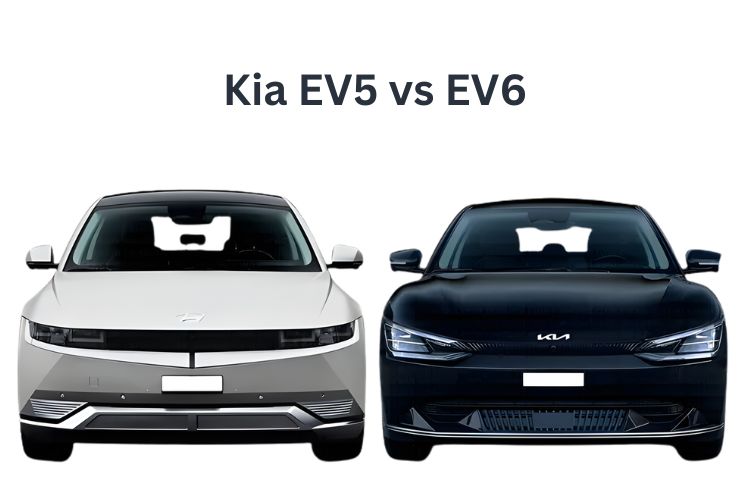
You’re drowning in browser tabs, coffee cold, heart racing because the EV6 looks like it drove out of a dream and the EV5 looks like it actually gets you.
Both are brilliant electric SUVs from Kia. Both promise to end your gas station misery. But here’s the truth nobody’s saying: this isn’t about which car is better. It’s about which life you’re actually living versus the one you think you should want.
And if you’re in the US? There’s a plot twist that changes everything.
We’re cutting through the noise together, using real numbers and honest feelings to find your match. No regrets, no second-guessing.
Keynote: Kia EV5 vs EV6
The Kia EV5 versus EV6 decision hinges on market availability and charging architecture. US buyers have one choice: the Georgia-built EV6 with its 800V fast charging and federal tax credit eligibility. Canadian buyers face a genuine trade-off between the EV5’s superior cargo space and value pricing versus the EV6’s ultra-fast charging and sporty performance. The 400V versus 800V architecture gap creates an 18-minute versus 30-minute charging reality that matters most for frequent road-trippers. Both excel as electric SUVs; they simply serve different markets and lifestyles.
What This Decision Really Means: Your Tuesday Morning vs. Your Fantasy Self
The styling divide is actually a values confession.
The EV6 Whispers “You’re Still That Person”
Lower, aggressive stance makes neighbors ask if it’s a Tesla. It’s better.
That fastback roofline appeals to who you were before car seats dominated your life. The swept-back silhouette, the short nose, the full-width light bar that doubles as a spoiler. Every line screams performance.
Honest truth: choosing practical doesn’t mean surrendering style entirely. But the EV6 reminds you that style was always part of your identity.
The EV5 Says “I Know What Matters Now”
Upright SUV silhouette matches what your actual week demands.
Taller stance with 167mm ground clearance means easier loading at 6am with zero back pain. You can stand a suitcase upright in the trunk. You can actually see the road ahead without craning your neck.
That boxy shape stopped bothering you around age 35 when you realized it just works. The digital Tiger Face with Star Map LED lights gives it personality without being loud about it.
Why Both Make Other EVs Look Boring
Kia’s “Opposites United” design philosophy created two completely different interpretations of electric mobility. The EV5 follows the “Bold for Nature” pillar with its commanding, family-first stance. The EV6 embodies “Power to Progress” with aerodynamic optimization that challenges every conventional SUV form.
The result? Both vehicles make legacy automakers look like they’re still designing for 2010.
The Side-by-Side Reality Check: Numbers That Actually Change Your Day
Let’s end the spec sheet paralysis right now.
The Essentials That Matter
| What You’re Really Asking | Kia EV5 | Kia EV6 |
|---|---|---|
| Size & Stance | 4,615mm long, 1,715mm tall, boxy SUV | 4,680-4,695mm long, 1,550-1,570mm tall, sporty crossover |
| Wheelbase | 2,750mm (108.3 in) | 2,900mm (114.2 in) |
| Battery & Range | 64-81.4 kWh, up to 555km WLTP | 58-84 kWh, up to 319 miles EPA (RWD long-range) |
| Charging Architecture | 400V, 10-80% in ~30 minutes | 800V, 10-80% in 18-20 minutes |
| Max Charging Speed | 141-150 kW | 240 kW |
| Performance Span | 160kW, 310Nm, ~8.4 sec 0-100km/h | RWD to 641hp GT, 3.2 sec 0-60mph possible |
| Drivetrain Focus | Primarily FWD, AWD available | RWD standard, AWD available |
| Starting Price | ~CAD $50,000 (Canada 2026) | $42,600 US (2025) |
What These Numbers Feel Like on Wednesday
EV5’s 400V system is your reliable daily driver. Steady, predictable, totally fine for overnight charging and weekend trips within 300 miles.
EV6’s 800V is the express lane. Add serious range in a coffee break, making 300-plus-mile road trips actually enjoyable. Think airport security line versus TSA PreCheck. Same destination, wildly different experience.
But here’s the thing that changes everything for US buyers: the EV5 isn’t sold in the United States. At all.
Kia made a strategic choice to keep the Korean-built EV5 exclusive to Canada starting spring 2026. Meanwhile, the EV6 is built in West Point, Georgia, and sold throughout North America. This isn’t just about where you can buy it. It’s about federal tax credits, long-term support, and whether you’re even in this decision at all.
The Space Test Nobody Photographs: Strollers, Costco Runs, and Real Life
Instagram won’t show you the grocery store parking lot reality.
Cargo Space Where It Counts
EV5 delivers 513-571 liters of smart, stackable space. Seats down? That explodes to 1,714 liters for camping gear, moving day boxes, or that IKEA run you’ve been dreading.
EV6 offers 480-520 liters with that sloping roofline stealing vertical inches you’ll miss when standing a suitcase upright. Maximum cargo with seats folded is around 1,300 liters. Still good. Just not EV5 good.
The frunk situation reveals priorities. EV5 gives you 60-67 liters up front for charging cables and groceries you don’t want rolling around. EV6? That depends. RWD models have a practical 52-liter frunk. But AWD models cram a front motor in there, shrinking storage to a nearly useless 20 liters.
The Back Seat Truth for Families
EV5’s taller roofline and upright design equal easier car seat installation and less “are we there yet” claustrophobia.
Both have flat floors, which is a blessing. But here’s something reviewers whisper: fitting three child seats across the EV5 back is quoted as “very tight” at the limit. This is your test-drive-with-car-seats moment. Don’t skip it.
The EV6’s longer wheelbase should mean more rear legroom. And it does, technically. But that swooping roofline creates a more confined feeling for taller passengers in back.
The Details That Reveal Everything
EV5 towing capacity hits 1,600 kg. The EV6 can pull between 1,600-1,800 kg depending on configuration, with US models rated up to 2,700 lbs. Both handle bike racks and small trailers without drama.
Both include V2L capability. Turn your car into a giant power bank for tailgating, camping, or running power tools at a job site. It’s a party trick until the power goes out and you’re the neighborhood hero.
EV6’s charge port is in the rear. EV5 puts it up front. This actually matters at crowded charging stations where cable reach determines which stalls you can use.
The Charging Experience: How Your Road Trips Actually Flow
Range numbers lie. Charging speed tells the truth about your weekend.
Real-World Stop Math
EV6: 10-80% in 18-20 minutes on a 350kW DC fast charger equals a bathroom break plus coffee. You’re back on the road before your kids finish their snacks.
EV5: 10-80% in roughly 30 minutes. Still totally doable. Long enough for a proper lunch stop but not so long you’re pacing the parking lot.
Both now work with Tesla Superchargers via the NACS port. Game-changer for network access. The EV6 already has this rolled out. The EV5 will get it when it launches in Canada.
The Daily Reality Most People Miss
Over 90% of charging happens at home overnight. You wake to a “full tank” every morning with either car, just like plugging in your phone.
Range anxiety is marketing fear, not your actual Tuesday problem when most people drive under 40 miles daily. Both cars exceed daily needs by 250-plus miles of cushion.
For Long Trips, EV6 Crushes It
That 12-minute difference multiplies across three to four stops on a 500-mile journey.
Let’s get specific. You’re driving from Atlanta to Miami, roughly 660 miles. In the EV6, you stop twice for 20 minutes each. In the EV5, those same stops stretch to 35 minutes each. Over a full day’s drive, the EV6 saves you 30 minutes of standing around charging stations.
The 800V architecture isn’t just about speed. It’s about lower heat generation during charging, which means the battery maintains peak charging power longer. The charging curve stays flatter. Your second and third stops are nearly as fast as your first.
Performance Feel: Giggle-Inducing vs. Confidence-Inspiring
One drives like a hot hatch. The other drives like an SUV that knows its job.
EV6’s Playful Personality
Even base RWD feels sprightly. Instant torque never gets old when merging onto highways.
The Long Range AWD with 320 combined horsepower and 605 Nm of torque makes highways your playground. That 5.0-second sprint to 60 mph puts you ahead of most traffic without trying.
And then there’s the GT. 577 horsepower. 0-60 in 3.2 seconds. This thing embarrasses sports cars at stoplights and costs half as much. The rear-biased power delivery gives it a planted, confidence-inspiring feel through corners.
EV5’s Calm Competence
160kW and 310 Nm deliver solid, no-drama acceleration. Enough pep without the neck-snap. You merge confidently. You pass when needed. You never feel slow.
Suspension is tuned for comfort first, handling second. Your back appreciates this by hour three of a road trip. The higher seating position gives you command of the road without feeling like you’re piloting a bus.
AWD models with 230kW combined power cut the 0-100 km/h time to 6.1 seconds. That’s quick enough to surprise yourself occasionally.
The Verdict Your Body Gives You
EV6 for the driver who needs that throttle-response thrill. Who remembers what driving used to feel like before kids and meetings took over.
EV5 for the driver who needs steady, predictable, all-day comfort. Running shoes versus hiking boots. Different jobs, both excellent.
Money Reality: Where Your Heart Meets Your Wallet
Let’s talk about the number that makes you wince or smile.
The Sticker Truth
EV5 is positioned as Kia’s first “reasonably-priced” electric SUV, undercutting the Tesla Model Y and VW ID.4. Expected around CAD $50,000 in Canada for early 2026. Remember: not available in the US market.
EV6 starts at $42,600 USD for the 2025 Light RWD model. But most people spec up to $48,000-$55,000 after choosing real-world features like AWD, the long-range battery, and premium tech packages. The GT tops out over $61,000.
The Ownership Math Nobody Shows You
Both backed by Kia’s bulletproof 7-year, unlimited-kilometer warranty. Huge weight off your mind when you’re spending this much on a new technology.
Here’s where US buyers get a massive advantage: the EV6 is built in Georgia and qualifies for the full $7,500 federal tax credit under IRS Form 8936. That drops the effective price of a base EV6 to around $35,000. Suddenly it’s cheaper than many gas-powered SUVs.
The EV5? Even if you could buy it in the US, Korean production means zero tax credit eligibility. Canadian buyers don’t get the US federal incentive, but provincial rebates may apply depending on where you live.
Long-Term Value Consideration
EV5’s LFP battery in base models offers longer lifespan and more durable chemistry for high-mileage families. The trade-off is slightly reduced cold-weather performance.
EV6’s proven track record with five-star ANCAP safety ratings and established resale values offers peace of mind. It’s been on the market since 2022. You’re not buying into an unknown.
The total cost of ownership tilts heavily toward the EV6 for Americans when you factor in the tax credit. Even with the higher sticker price, that $7,500 federal incentive makes the math work decisively in the EV6’s favor.
Your Match: Stop Comparing, Start Imagining Your Tuesdays
The better choice isn’t about specs. It’s about which Tuesday makes you smile.
Choose EV5 If This Sounds Like You
You live in Canada and car seats are in your life now, or will be within two years.
Upright space, easy loading, and calm road manners matter more than sporty thrills. You want an electric Sportage that just works without drama.
Most charging happens at home. DC fast charging is occasional, maybe once a month for a weekend getaway.
Budget flexibility matters. Spending an extra $5,000-$8,000 for the EV6’s faster charging feels wasteful when your daily driving never uses it.
Choose EV6 If This Sounds Like You
You’re in the United States, which means the EV5 isn’t even an option. Decision made.
You’re child-free, kids are grown, or you embrace the sportier family hauler lifestyle. Highway driving dominates your miles and road trips are frequent.
That 18-minute charge time genuinely improves your life rhythm. You take multiple long trips per year where charging speed compounds into real time savings.
“Sporty” isn’t negotiable. It’s part of your identity. Over 70% of EV buyers prioritize practicality, but you’re the 30% who lead with heart.
The Test Drive Strategy That Reveals Everything
If you’re in Canada with access to both models:
Drive EV6 first. Feel that electric thrill and futuristic tech. Notice the tight trunk space and sportier ride.
Immediately get in EV5. Picture your actual Thursday with errands, passengers, cargo. Notice the space, the calm, the practicality.
The right answer clicks when you stop thinking about what you “should” want.
Conclusion: You Walk Away Clear, Not Conflicted
We’ve cut through the late-night scroll paralysis.
EV6 is your “cover distance fast with style” pick. Proven 800V charging, sporty soul, head-turning design, and that crucial $7,500 tax credit for US buyers. It’s the established performer that’s already shipping from Georgia.
EV5 is your “carry the crew calmly with zero drama” pick. Roomy, right-sized space, sensible pricing, family-first thinking. But it’s Canada-exclusive, arriving spring 2026, with no US availability in sight.
Both are phenomenal electric SUVs. They’re just built for different Tuesdays and different countries.
Your first step today: If you’re in the US, the decision is made. Test drive the EV6 and configure your build to stay under the $80,000 MSRP cap for SUV tax credit eligibility. If you’re in Canada, block 90 minutes next spring when the EV5 arrives. Test drive both in one afternoon. Bring your car seat, your weekend bags, your honest self. Write down your two-week life reality: errands, trips, passengers, charging access, budget truth.
Then decide with zero second-guessing. Either way, you’re ditching gas for good and joining the electric future. The only mistake is choosing the car that fits someone else’s life instead of yours.
Kia EV6 vs EV5 (FAQs)
Why isn’t the Kia EV5 sold in the United States?
No, the EV5 is not available in the US market. Kia strategically limited North American sales to Canada only, starting spring 2026. This avoids internal competition with the US-built EV6 and preserves federal tax credit eligibility for the Georgia-manufactured EV6. Korean production would disqualify the EV5 from the $7,500 federal incentive anyway.
What’s the difference between 400V and 800V EV charging?
Yes, it’s a huge difference. The EV6’s 800V architecture charges from 10-80% in 18 minutes versus 30 minutes for the EV5’s 400V system. Higher voltage allows the same power with half the current, reducing heat and enabling 240kW peak charging speeds versus 141kW. On long road trips, this saves 30-plus minutes of total charging time.
Does the Kia EV6 qualify for the federal tax credit?
Yes, absolutely. The EV6 is assembled in West Point, Georgia, and fully qualifies for the $7,500 federal tax credit under IRS Form 8936. Your modified AGI must be under $300,000 for joint filers, and the vehicle MSRP must stay under $80,000. This drops the effective price to around $35,000 for base models.
How much faster does the EV6 charge compared to the EV5?
Yes, significantly faster. At a 350kW DC fast charger, the EV6 completes 10-80% charging in 18-20 minutes versus 30-38 minutes for the EV5. That’s a 40% reduction in charging time. Over multiple stops on a 500-mile road trip, the EV6 saves you 30-plus minutes of total charging downtime.
Which Kia EV is better for long road trips?
The EV6 wins decisively for frequent highway travelers. Its 800V ultra-fast charging, established Tesla Supercharger access via NACS, and superior charging curve make 300-plus-mile journeys genuinely convenient. The EV5 handles occasional road trips fine, but the charging speed difference compounds over multiple stops. For daily commuting under 50 miles? Both are equally excellent.