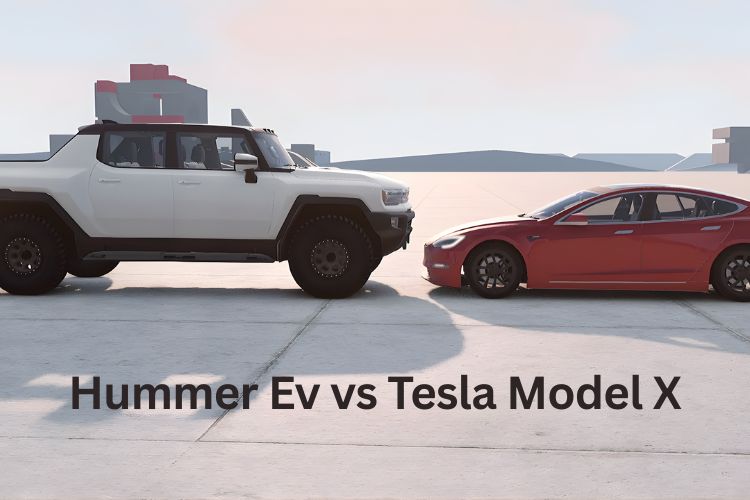
You’re standing in the showroom, palms sweating, about to drop six figures on an electric SUV. One voice in your head screams for the tech-genius Tesla everyone raves about. The other craves that beast-mode Hummer that makes people stare.
This isn’t just about specs on paper. It’s about the next 5-10 years of your life. You’ve read the reviews, but they all just throw numbers like confetti without telling you what it feels like to live with either one. Here’s the truth: both are incredible, and wildly different answers to completely different questions. We’re cutting through the noise together, using cold hard data to find warm real solutions.
Here’s an uncomfortable truth to start: the Hummer guzzles 57.8 kWh per 100 miles compared to the Model X’s efficient 30-35 kWh. That’s more than double the electricity for the same distance. Yeah, we’re starting with the stuff nobody wants to talk about.
Keynote: Hummer EV vs Tesla Model X
The Hummer EV versus Tesla Model X comparison reveals two opposing electric SUV philosophies. Model X prioritizes efficiency (104 MPGe), family space (7 seats), and Tesla’s charging network. Hummer EV delivers unmatched off-road capability with Extract Mode, CrabWalk, and 7,500-lb towing but sacrifices efficiency (53 MPGe) and costs $18,000 more. Choose Model X for daily efficiency and highway miles. Choose Hummer EV for weekend adventure capability and commanding presence.
The Identity Crisis: Who You Are vs Who You Wish You Were
Ever catch yourself daydreaming about mud-splattered glory, only to snap back to efficiency guilt? That’s the real battle happening here.
The Hummer EV: Your Electric Adventure Tank
This is raw American swagger electrified with 830 hp in the SUV and party tricks like CrabWalk. It’s a statement about untamed spirit, built for conquering where roads end. You’re buying presence and off-road confidence, not just transportation.
Think of it like strapping on armor for life’s battles. The GMC Hummer EV SUV isn’t subtle. With its muscular proportions and aggressive stance, it’s the vehicle equivalent of walking into a room and everyone turning their heads. The tri-motor powertrain in the 3X edition delivers 1,000 hp in the pickup variant, though the SUV “settles” for 830 hp. Watts to Freedom launch mode? That’s not just acceleration. That’s theater.
The Tesla Model X: Your Silent Private Jet
This is Silicon Valley’s definition of luxury with seamless tech and supercar acceleration. Falcon-wing doors turn every school drop-off into a mic-drop moment. You’re buying into the future with software that evolves overnight.
The Model X Plaid hits 60 mph in 2.5 seconds flat. Let that sink in. That’s faster than a Lamborghini Aventador. And you can do it while your kids are buckled in the third row eating Cheerios. It’s not about conquering trails. It’s about redefining what a family vehicle can be.
“Tesla’s like having a co-pilot psychic; Hummer’s your reliable trail buddy.”
The Brutal Honesty Checkpoint
Hummer owners accept this is part toy, part lifestyle statement. If you’re buying a 9,063-pound electric truck, you’re not doing it purely for practicality. You’re doing it because you want that Extract Mode suspension lift and those underbody cameras showing you the rocks you’re about to crush.
Tesla owners value efficiency and that smug planet-saving feeling despite build quality quirks. Yes, those Falcon Wing doors will malfunction. Yes, you’ll spend time on hold with service. But you’ll also accelerate past Porsches and arrive at your destination having used half the energy.
Both share zero-emissions pride, but your daily reality will look completely different.
The Price Tag That Made You Wince
Let’s talk about the money that’s keeping you up at night, because one of these stings way more than the other.
What the Sticker Actually Says
Hummer EV SUV starts around $98,845 for the base 2X trim and climbs to approximately $104,650 for the tri-motor 3X Edition. Model X ranges from $79,990 for the dual-motor Long Range to $104,990 for the Plaid variant after recent price adjustments.
That’s a $17,000 to $18,000 premium for the Hummer’s off-road edge right from the start. And we haven’t even talked about what comes after you sign.
The Hidden Costs Nobody Mentions
| Cost Factor | Hummer EV SUV | Model X |
|---|---|---|
| Starting MSRP | ~$98,845-$104,650 | ~$86,880-$101,880 |
| Efficiency (MPGe) | 53 MPGe | 98-104 MPGe |
| Annual electricity (15k miles) | ~$2,580 at $0.15/kWh | ~$1,310 at $0.15/kWh |
| 5-year cost-to-own estimate | ~$93,888 | ~$104,000-$121,000 |
| Federal tax credit | Up to $7,500 | Up to $7,500 |
Here’s what keeps me up at night about these numbers. That efficiency gap means the Hummer costs nearly double to charge. Over five years of typical driving, that’s an extra $6,000+ just in electricity. Add the NACS adapter you’ll need ($225) to access Tesla Superchargers, and the premium keeps climbing.
The First Payment Reality
Imagine that monthly hit. Does the Hummer’s wow-factor justify the pinch? Picture yourself explaining to your spouse why you need a vehicle that weighs as much as two Honda Civics.
Or does Tesla’s charging network access whisper “smarter long-term choice”? Both qualify for the federal clean vehicle credit of up to $7,500, but the Hummer’s thirst adds up fast. Really fast.
Range Anxiety Unmasked: The Road Trip That Tests Your Nerve
Nothing kills the EV buzz faster than watching that battery bar drop on a lonely highway. Let’s map the real endurance test.
EPA Numbers vs Your Actual Highway Life
Model X EPA range: 335 miles for the Plaid, up to 352 miles for the dual-motor Long Range. Hummer EV SUV: up to 315 miles EPA rating with its massive 170 kWh battery pack.
Translation: same road, fewer charging stops in the Tesla, especially at highway speeds. But here’s the kicker. The Hummer achieves that 315-mile range by brute force, carrying a battery pack that weighs nearly 3,000 pounds. The Model X’s smaller 95 kWh usable battery gets you farther because the vehicle is simply more efficient.
The Efficiency Elephant in the Room
Hummer uses a staggering 57.8 to 59 kWh per 100 miles. That massive 205 kWh battery in the pickup (170 kWh in the SUV) is like carrying a second car’s worth of weight. Every time you accelerate, you’re moving 9,000+ pounds of vehicle.
Model X sips electricity by comparison at 104 MPGe for the Long Range variant. In real-world terms, that’s roughly 2.8 to 2.9 miles per kilowatt-hour versus the Hummer’s 1.3 to 1.6 mi/kWh. More than double the efficiency.
Cold weather destroys both, with the Hummer showing a brutal 26% range loss in winter testing. The Model X’s heat pump system outperforms the Hummer’s resistance heating, creating a 15-25% range variance in sub-freezing temps.
Charging: Your New Weekly Ritual
| Charging Reality | Model X | Hummer EV SUV |
|---|---|---|
| Max DC fast charging | Up to 250 kW | Up to 300 kW |
| Architecture | 400-volt | 800-volt |
| Network access | Native 50,000+ Superchargers globally | CCS1 standard, adapts to Tesla via NACS |
| Real-world experience | Smoothest, integrated billing and routing | Requires myGMC app, third-party networks |
| 15-minute top-up | ~170 miles added | ~100 miles with variability |
Here’s the brutal irony. The Hummer EV has superior charging hardware with its 800-volt Ultium architecture. On paper, it can pull up to 350 kW at capable stations. But here’s what they don’t tell you: most Tesla V3 Superchargers are 400-volt systems. That means your fancy 800V Hummer gets throttled down, negating much of its speed advantage despite that $225 NACS adapter.
“At 82% charge, my Hummer was only pulling 20kW. The top 20% became useless on road trips.” That’s from an actual owner on the forums.
Meanwhile, Model X owners plug in, the system recognizes the car, billing happens automatically, and the navigation routes you through the most reliable network in North America. No apps. No frustration. Just seamless charging that actually works.
Performance: Road Rocket vs Trail Monster
You slide behind the wheel, foot hovering. Which one delivers the rush that matches your soul’s speed?
Straight-Line Speed That Steals Your Breath
Model X Plaid: 0-60 in 2.5 seconds with 1,020 hp. Dual-motor Long Range: 3.8 seconds with 670 hp. Hummer EV: 0-60 around 3.3 to 3.5 seconds with 830 hp in the SUV, and a quarter-mile-blistering 11,500 lb-ft of wheel torque.
Wait. Let’s talk about that torque number because it’s marketing genius and physics trickery rolled into one. GMC quotes 11,500 lb-ft, but that’s wheel torque after gear reduction. Actual motor torque is closer to 1,200 lb-ft, which is still bonkers but not the earth-shattering figure the brochure screams.
Hummer’s Watts-to-Freedom mode is wild theater. The suspension lowers, the battery conditions itself, and then it launches like a freight train possessed by a demon. But speed comes second to off-road prowess in this beast’s DNA.
Think of it like this: scalpel versus sledgehammer. One slices through air with surgical precision. The other crushes obstacles through sheer overwhelming force.
The Handling and Capability Reality
Neither is a sports car. They weigh 5,152 to 5,434 lbs (Model X) and 8,700 to 9,100+ lbs (Hummer) respectively. These aren’t Miatas.
Model X feels planted on pavement, refined for highway cruising and spirited merges. That low center of gravity from the floor-mounted battery gives it handling dynamics that embarrass traditional SUVs. But push it into a corner hard and you’ll feel the weight fighting the laws of physics.
Hummer’s four-wheel steer, CrabWalk diagonal driving, and 35.4-foot turning circle shine off-pavement and in tight trails. In an urban parking garage? That four-wheel steer is the only thing saving you from a three-point-turn nightmare in a vehicle that’s 86.7 inches wide.
Towing: Weekend Toys vs Weekly Routines
| Capability | Model X | Hummer EV SUV |
|---|---|---|
| Tow rating | 5,000 lbs | 7,500 lbs (pickup: 8,500-12,000 lbs) |
| Ground clearance | ~8.1 inches standard | Up to 16 inches in Extract Mode |
| Off-road credentials | None, all-weather AWD only | 50° approach, 46° departure, 34° breakover angles |
| Real use case | Light trailers, bikes, small boats | Serious adventure gear, heavy trailers |
The Model X can pull your jet skis or a small camping trailer. The Hummer EV can pull a legitimate boat or overlanding trailer loaded with gear and still have headroom.
Off-Road: Where the Hummer Dominates
Extract Mode lifts the suspension a full 6 inches for extreme terrain and water crossings up to 24 inches deep. CrabWalk and King Crab rear-steer modes conquer tight trails and parking nightmares that would stop any other electric SUV cold.
UltraVision with up to 18 cameras, including waterproof front and rear underbody cameras, builds legitimate trail confidence. You can literally watch rocks pass under your differential in real-time. The system acts as a virtual spotter, something absolutely critical when you’re piloting a 9,000-pound vehicle over obstacles you can’t see.
Underbody armor protects that massive battery pack from trail damage. Standard 35-inch Goodyear Wrangler Territory all-terrain tires (37-inch optional) were designed for this exact purpose.
When was the last time you actually went off-roading? Be brutally honest about your usage. Because if your answer is “I like knowing I could,” you might be paying a steep efficiency penalty for capability you’ll never use.
Space, Seats, and Daily Ease: Family Life or Flex Life?
This is where the rubber meets your real routine, not your fantasy weekend.
Seating and Cargo Reality
Model X seats up to seven people with three rows, offering 94.5 cubic feet of total cargo space with all rear seats folded. That third row isn’t just theoretical. It actually fits adults for short trips and kids comfortably for long ones.
Hummer EV seats five maximum, two rows only by design. No third-row option exists, and given the vehicle’s mission, that makes sense. The SUV offers 81.8 cubic feet of cargo space plus an 11.3 cubic-foot front trunk.
Falcon-wing doors look cool until they malfunction. And owner forums say they absolutely will. Sensor issues, slow operation, refusing to close in tight spaces. They’re a complexity tax you pay for the wow factor.
Hummer’s cabin feels armored, upright, and unapologetically truck-like. At 86.7 inches wide without mirrors, you’re piloting a tank. The interior has a sci-fi theme with a 13.4-inch touchscreen and unique touches like speaker grilles showing the Sea of Tranquility. But multiple reviews point out the prevalence of cheap plastic panels that feel wrong in a six-figure vehicle.
The Parking Garage Nightmare
Hummer is 86.7 inches wide. Picture your local grocery store parking lot. Now picture a vehicle wider than most pickup trucks trying to squeeze between the lines. That four-wheel steer with its 35.4-foot turning circle helps, but you’re still piloting a tank through daily life.
Model X’s 79.3-inch width feels almost nimble by comparison. Almost. It still dwarfs sedans but fits into standard parking spaces without the white-knuckle anxiety.
If you live in a city, this matters more than any performance spec. Trust me.
Tech Life: Autopilot vs Super Cruise
Tesla’s Full Self-Driving has predictive visualization that feels psychic. The massive 17-inch touchscreen shows you what the car sees: pedestrians, traffic cones, vehicles changing lanes before they actually do. It’s simultaneously impressive and unnerving.
Hummer’s Super Cruise is true hands-free driving on over 400,000 miles of pre-mapped highways. That driver-facing camera tracks your eyes, ensuring you’re paying attention. The system is more confident and reliable within its defined domain than Tesla’s broader but less predictable approach.
Model X’s giant screen controls everything. Want to adjust the mirrors? Menu dive. Want to open the glovebox? Touchscreen. It’s minimalist but requires taking your eyes off the road for functions that used to have physical buttons.
Both score 5-star safety ratings where tested, but real-world reliability tells a different story. Model X owners report phantom braking on highways and suspension component wear by 60k miles. Hummer owners report first-generation issues like leaking roof panels and Super Cruise glitches.
The controversial yoke steering wheel in the Model X? You’ll love it or truly, deeply hate it. There’s no middle ground.
The Weight of Your Decision: Safety, Efficiency, and Reliability
Here’s where we get honest about the compromises nobody wants to discuss until you’ve already signed.
The Hummer’s Heavyweight Problem
Curb weight: 8,700 to 9,100+ pounds. That’s not a typo. The battery pack alone weighs roughly 2,900 pounds. That’s an entire Honda Civic.
NTSB officials have publicly flagged heavy EVs’ crash-energy risks to other vehicles. In a collision, basic physics dictates that the Hummer’s occupants will be exceptionally well-protected. The occupants of the smaller vehicle? Not so much.
That heft helps off-road presence and stability. It crushes efficiency and maneuverability everywhere else. From a 70 mph stop, the Hummer requires 211 feet to halt. That’s legitimately disappointing and potentially dangerous.
It’s an environmental paradox: electric, yes. But is hauling 9,000+ pounds really “green” when it guzzles twice the electricity of comparable EVs?
The Tesla’s Documented Quirks
Falcon-wing door failures are legendary. Sensor malfunctions, refusing to close, hitting people in the head during operation. These aren’t isolated incidents. They’re a known compromise for the signature feature.
Phantom braking terrifies owners on highways. The car suddenly slams on the brakes for no visible reason. Tesla calls it a “vision system recalibration.” Owners call it heart-attack-inducing.
Service centers are overwhelmed. Wait times stretch for weeks. Communication is terrible. Warranty honoring is complicated and often requires multiple escalations.
Build quality remains below par for such a costly car. Panel gaps, squeaks, trim pieces that come loose. These are fixable issues, but they shouldn’t exist at this price point.
The Reliability Question
J.D. Power ranks GMC higher in both initial quality and long-term dependability compared to Tesla. That’s not an opinion. That’s measurable data from thousands of owners.
But the Hummer reports first-generation issues. Leaking Infinity Roof panels. Super Cruise system glitches. Software updates that introduce new bugs.
Here’s the silver lining: GM’s dealer network is vast. You can get service almost anywhere. Tesla’s service infrastructure is sparse and overwhelmed.
Both offer 8-year battery warranties. Tesla covers 150,000 miles with 70% capacity retention. GM covers 100,000 miles with 60% retention. That 50,000-mile and 10% capacity difference matters enormously for resale value and long-term ownership costs.
The Decision Map: End the Debate Right Now
You’ve felt the feelings and seen the facts. Time to match your actual life to the right machine.
Choose the Model X If You Want:
Maximum EPA range of 335 to 352 miles and minimal charging fuss on road trips. That Supercharger network is the most reliable in North America. Period.
Three rows of seating for family hauling with up to seven people. Your kids’ friends can actually come along.
Native access to 50,000+ Superchargers globally without adapters, apps, or anxiety. Plug in. Charge. Leave. That’s it.
Efficiency that eases the eco-guilt at 104 MPGe versus 53 MPGe. You’ll spend half as much on electricity over the life of the vehicle.
Choose the Hummer EV If You Want:
Legitimate off-road capability with Extract Mode, CrabWalk, and comprehensive trail camera systems. This isn’t posturing. It’s genuine capability.
Towing headroom up to 7,500 lbs in the SUV or a staggering 8,500 to 12,000 lbs in the pickup variants. Heavy trailers? No problem.
Show-stopping presence and party-trick technology that makes people stare. CrabWalk diagonal driving isn’t just functional. It’s pure theater.
Confidence on serious trails with 50° approach angles, 46° departure angles, and 6 inches of suspension lift on demand.
Your Final Shortlist Filter
| Your Priority | Pick This | Because |
|---|---|---|
| Family seats + long highway range | Model X | 7 seats, 352 miles, seamless charging access |
| Rock crawling + weekend adventures | Hummer EV | Extract/CrabWalk modes, UltraVision cameras, armor |
| Towing trailers > 5,000 lbs | Hummer EV | SUV: 7,500 lbs; pickup: up to 12,000 lbs capability |
| Daily efficiency + lower costs | Model X | 104 MPGe vs 53 MPGe, half the charging costs |
| Off-grid capability + presence | Hummer EV | 16-inch ground clearance, extreme angles, statement-making |
Conclusion: Your Garage, Your Story
We started with that gut-wrenching standoff, your inner adventurer duking it out with your practical side. Now you’ve got clarity.
If your life is school runs, long highway miles, and tech-forward thinking, the Model X just fits. Three rows, 350+ miles of EPA range, and that Supercharger network make daily life frictionless. You’ll arrive faster, use less energy, and spend less time at charging stations. If your weekends are muddy, your trailer’s loaded, and you want people to stop and stare, the Hummer shines. Extract Mode, CrabWalk, and 7,500 lbs of towing capability are built for the life you actually crave. That off-road prowess and commanding presence come with real capability, not just marketing.
List your top three real-world use cases. Not fantasy scenarios. Actual things you’ll do in the next 30 days. Match them honestly to Section 8’s decision map. That’s your answer.
The “wrong” choice isn’t about specs. It’s about choosing a vehicle that doesn’t match your actual life. Be honest about who you are today, not who you wish you were on Instagram. You’ve got this.
Tesla Model X vs Hummer EV (FAQs)
Can the GMC Hummer EV charge at Tesla Superchargers?
Yes, but with limitations. Hummer EV can access Tesla Superchargers using a NACS adapter (costs $225 from GM, available since September 2024). However, the Hummer’s 800-volt architecture gets throttled to 400 volts at most Tesla V3 stations, reducing the charging speed advantage. You’ll also need the myGMC app for payment and session management since it’s not native integration.
Which is more efficient: Hummer EV or Tesla Model X MPGe?
Model X is dramatically more efficient. The Long Range Model X achieves 104 MPGe compared to the Hummer EV’s 53 MPGe. In real-world terms, the Model X uses roughly 30-35 kWh per 100 miles while the Hummer consumes 57.8-59 kWh for the same distance. Over 15,000 annual miles, that’s about $1,300 in electricity costs for the Model X versus $2,600 for the Hummer at typical rates.
What is the warranty difference between Hummer EV and Model X battery?
Tesla offers superior battery coverage: 8 years or 150,000 miles with 70% capacity retention guarantee. GM’s Hummer EV warranty covers 8 years or 100,000 miles with 60% retention. That 50,000-mile difference and higher retention threshold significantly impact long-term value and resale. Tesla’s warranty gives more confidence for high-mileage drivers and better protects battery degradation.
Does Hummer EV have better off-road features than Model X?
Absolutely. The Hummer EV is in a different league for off-road capability. Extract Mode provides 16 inches of ground clearance versus Model X’s 8.1 inches. The Hummer offers 50° approach angles, 46° departure angles, CrabWalk diagonal driving, and UltraVision with 18 cameras including underbody views. Model X has capable all-wheel drive for weather and light dirt roads but zero serious off-road credentials.
How much does the Hummer EV NACS adapter cost for Tesla charging?
The official GM NACS adapter costs $225 and became available in September 2024. You purchase it through GM’s parts network. This adapter allows Hummer EV access to approximately 17,500 Tesla Supercharger locations across North America.
However, remember that charging speeds will be limited at older V3 stations due to voltage architecture differences, and you’ll need the myGMC app for payment integration.