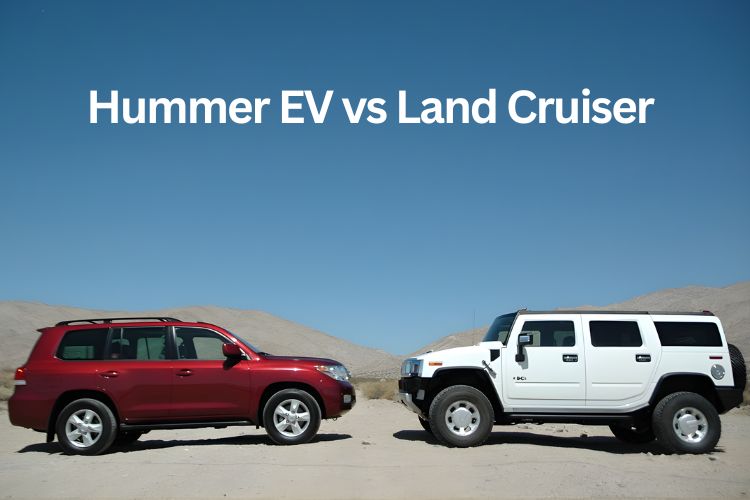
It’s 11 p.m. and you’re three browser tabs deep into a comparison you can’t escape.
The Land Cruiser stares back at you with that timeless, heritage grin, promising trails your grandkids will still be conquering. Then you click over to the Hummer EV, all silent thunder and 830 horsepower, flexing like it just invented off-roading. Your heart races. Your wallet trembles.
You’re not choosing between two trucks. You’re choosing between two identities: the revolutionary headline-maker or the timeless heirloom that’ll outlive your mortgage. One costs $99,045 and makes Tesla owners jealous. The other starts at $56,700 and makes financial advisors nod approvingly. That’s a $40,000+ gap before you add a single option.
Here’s the truth nobody’s telling you: one’s a bet on GM’s beta test. The other’s a bet on 75 years of not letting people down. Are you ready to be an early adopter paying the electric super-SUV tax, or are you clinging to proven legacy while the world supposedly goes electric?
Here’s our path: feelings first, then cold facts you can trust, then a decision framework that makes Tuesday mornings easier, not just Saturdays epic.
Keynote: Hummer EV vs Land Cruiser
The Hummer EV versus Land Cruiser comparison reveals two fundamentally different philosophies: electric brutality at $99k with 830 hp versus hybrid efficiency at $56k with proven reliability. The $40k price gap, catastrophic Hummer depreciation (51% over five years), and five-year total ownership cost difference of $46k make the Land Cruiser the smarter long-term investment for most buyers. Choose the Hummer for thrilling performance and cutting-edge tech if you can absorb early-adopter risks. Choose the Land Cruiser for go-anywhere confidence and value retention.
What You’re Really Choosing: Statement vs. Tool
This isn’t about horsepower. It’s about who you see yourself becoming.
Let me be blunt. The GMC Hummer EV SUV is a party trick you drive. It makes pedestrians stop mid-stride. It gets Instagram comments from people you haven’t spoken to in years. It announces your arrival with 9,063 pounds of silent, electric audacity that says, “I’m betting on the future and I can afford the admission price.”
The Toyota Land Cruiser is a partner you trust. It’s the friend who shows up at 3 a.m. when you need help moving, who doesn’t brag, who’s still around when the exciting people have moved on to the next shiny thing. It whispers reliability in a world screaming for attention.
Name the unspoken split running through your gut right now: Do you crave the spectacle of a vehicle that redefines physics with CrabWalk and Extract Mode, or the quiet confidence of body-on-frame construction that’s proven itself across seven decades and every continent?
You’re not buying specs. You’re buying how you’ll feel on a rainy Tuesday at 7 a.m. when one starts instantly with zero range anxiety and the other needs charging math and route planning. Which stress can you actually handle?
The Sticker Shock That Changes Everything
That gut-punch moment when fantasy meets your bank account.
The Hummer EV begins at $96,550 for the 2X trim and climbs to $99,045 for the 3X version. Some dealers are still asking over $104,000 for loaded examples. The Land Cruiser starts at a comparatively reasonable $55,000 for the 1958 base trim and tops out at $62,450 for higher trims, with the limited First Edition commanding $74,950.
That’s a $40,850 difference at the entry point. Visualize what that money could become in five years: a down payment on a vacation property, two years of college tuition, or simply compound interest working in your favor instead of evaporating on a dealer lot.
The Hidden Wallet Bleed
Insurance premiums tell the real story. The Hummer EV, with its 830-hp tri-motor setup and $99k+ replacement value, averages $3,218 annually to insure. But that’s the rosy national average. Depending on where you live and your driving record, quotes swing wildly from $3,000 to over $7,000 per year. The Land Cruiser’s insurance costs settle into typical premium Toyota territory at $1,800 to $2,400 annually.
Home charging infrastructure isn’t free money, either. The Hummer EV’s 19.2 kW onboard charger demands real electrical work. You’re looking at $1,200 to $3,000 to install a proper 240V/50A circuit for Level 2 home charging. Older homes might need panel upgrades adding another $1,500 to $3,000. Then your monthly electricity bill climbs $40 to $80 for typical use. The Land Cruiser needs nothing but a gas station.
Tires, brakes, consumables: that massive 9,063-pound curb weight means massive replacement cycles on the Hummer. Those 35-inch Goodyear Territory MTs aren’t cheap. The Land Cruiser’s 5,360 to 5,445 pounds is heavy for a mid-size SUV but downright svelte compared to the electric beast.
And here’s the kicker: the Land Cruiser’s disappointing 22 city/25 highway/23 combined mpg means higher fuel costs than the hybrid system promised. You’ll need premium unleaded, too. Budget $2,300 to $4,000 annually in fuel depending on how much you drive.
The Five-Year Nightmare Scenario
Let’s talk about the money you’ll never see again.
| Cost Factor | Hummer EV Reality | Land Cruiser Reality |
|---|---|---|
| Purchase Price | $104,650 average | $61,470 average |
| 5-Year Depreciation | Loses $53,446 (51% drop to $51,474 value) | Loses $23,973 (39% drop to $37,497 value) |
| 5-Year Insurance | $16,160 to $25,720 | $9,000 to $12,000 |
| 5-Year Energy Costs | ~$9,966 in electricity | ~$11,500 to $18,215 in premium fuel |
| 5-Year Maintenance | ~$2,156 projected | ~$2,178 to $2,320 |
| Total Cost to Own | $101,728 to $124,438 | $55,710 to $74,858 |
First-gen electric vehicle depreciation is brutal. Early Hummer EVs sold with dealer markups of $40,000 over MSRP crashed hard when reality set in. Now dealers are discounting new inventory by over $40,000 just to move units. That 51% depreciation rate means you’re lighting money on fire.
The Land Cruiser? Legendary Toyota resale protection. That 39% five-year depreciation is among the best in the industry. Owners keep them an average of 11 years. Used models command premium prices. It’s not just transportation. It’s a store of value.
You’re gambling on first-gen tech aging well versus betting on 75 years of proven DNA.
Power and Range: The 10-Minute Reality Test
Imagine your last road trip. Now replay it in each truck.
The Hummer EV 3X unleashes unholy force: 830 horsepower from three electric motors (one up front, two in back), with GMC claiming up to 11,500 lb-ft of wheel torque through gearing amplification. Activate “Watts to Freedom” launch control and this 9,000-pound monument to excess hits 60 mph in approximately 3.5 seconds. The sensation defies physics. Your stomach drops. The nose lifts skyward. Passengers gasp or scream.
The Land Cruiser i-FORCE MAX delivers 326 horsepower and 465 lb-ft of torque from its 2.4-liter turbocharged four-cylinder paired with a 48-hp electric motor. It hits 60 mph in a measured 7.7 seconds. Not a rocket. Not trying to be. Just brutally adequate and reliable.
Be honest with yourself: When will you actually use launch control? How often do you need to terrify passengers at stoplights versus how often do you need confidence that the engine will start in Patagonia?
The Refueling Litmus Test
Here’s where theory meets your actual life.
The Hummer EV promises 312 to 314 miles of EPA range from its massive 180 to 200 kWh Ultium battery pack. Real-world driving brings that closer to 272 miles. DC fast charging at 350 kW can add 100 miles in about 14 minutes at optimal conditions. But here’s the catch: you need to find a working 350 kW charger. Average charging sessions take over two hours for 10% to 90%. And if you’re towing that 7,500-pound max capacity? Range drops catastrophically, potentially 55% based on similar EV towing tests. Your 272 miles becomes 150 miles of white-knuckle range anxiety.
The Land Cruiser runs on the ancient magic of gasoline. Fill the 17.9-gallon tank in five minutes at literally any gas station in the world. That 23 mpg combined gives you roughly 412 miles between fills. When towing its 6,000-pound max capacity, fuel economy drops to around 15 to 17 mpg. Still predictable. Still refuelable anywhere.
Ask yourself the hard question: Is your life set up for home charging, route planning around public charging infrastructure, and accepting range loss under load? Or do you need the freedom of “fuel anywhere, five minutes, done”?
Off-Road Theater vs. Off-Road Truth
That sinking dread when tires spin uselessly and you’re stuck, cursing your choice.
The Hummer’s High-Tech Wizardry
Extract Mode is genuinely spectacular. Press a button and the adaptive air suspension lifts the Hummer EV nearly six inches, achieving 15.9 to 16 inches of ground clearance. Approach angle stretches to 50 degrees. Departure angle hits 46 degrees. Breakover angle reaches 34 degrees. These numbers embarrass dedicated rock crawlers.
CrabWalk turns heads and saves bacon on tight trails. Four-wheel steering lets the rear wheels turn up to 10 degrees in the same direction as the fronts, moving the entire vehicle diagonally at speeds under 20 mph. It’s not a gimmick when you’re threading between boulders on a shelf road with zero margin for error.
The UltraVision camera system provides up to 18 different views, including forward and rear underbody cameras with their own washers. Given the vehicle’s immense size and terrible natural sightlines over crests, these cameras become your digital spotter. You’re not just looking at screens. You’re relying on them to place 35-inch tires precisely on rock ledges.
Front and rear electronically locking differentials, underbody armor, rocker protection, and torque vectoring through those electric motors create genuine capability. It’s spectacular engineering.
Translation: This is a superhero suit, not a work uniform. Short bursts of incredible capability backed by complex systems that need to work perfectly every time.
The Land Cruiser’s Mechanical Grit
The numbers look modest on paper: 8.3 inches of ground clearance, 31-degree approach angle, 17-degree departure angle. No drama. No height adjustments. Just steady, repeatable geometry.
But here’s what the spec sheet doesn’t capture: locking center and rear differentials you can feel engage. Multi-Terrain Select that genuinely tailors throttle, traction control, and braking to mud, sand, rock, or snow. Crawl Control that acts as low-speed cruise control, managing throttle and brakes so you just steer through technical sections.
The optional disconnecting front stabilizer bar increases wheel articulation at the push of a button. The body-on-frame construction and live rear axle aren’t fancy, but they’re fixable with hand tools if something breaks.
Translation: Consistent, mechanical confidence that doesn’t need software updates or cell signal. It’s the friend who shows up with a toolbox, not the consultant who needs the cloud.
The Fear No One Admits
What happens when the Hummer’s 13.4-inch screen goes black 100 miles from cell signal? What happens when a software glitch disables Extract Mode on a trail that requires it? Owner forums tell brutal stories: complete battery management system failures, vehicles refusing to move at just 3,000 miles, multiple recalls for rear drive unit failures, extended dealer stays waiting for specialized parts.
One owner vented: “My $116K car has these issues, Chinese BYD cars at $20K work fine.”
What happens when the Land Cruiser breaks a CV joint in the backcountry? A local mechanic probably has the part or can fabricate a solution. The service network spans continents. The systems are proven across decades.
Real talk: Which nightmare can you actually handle?
Daily Living: The Stuff Brochures Hide
What if your beast feels like a bully in parking garages or a bore on commutes?
The Size and Weight Reality Check
The Hummer EV SUV stretches 206.7 inches long and 86.5 inches wide. It weighs 9,063 pounds. That’s longer than a Chevy Tahoe and heavier than two Honda Accords. It fills every parking spot completely. The rear power liftgate takes forever to open and requires significant clearance behind you. Tight grocery store lots become anxiety exercises. Downtown parking garages with low clearances and tight turns become nightmares.
The Land Cruiser measures 196.4 inches long and 77.9 inches wide, weighing 5,360 to 5,445 pounds. It feels like a normal mid-size SUV in urban life. You can park it. You can navigate it. You don’t stress every time you need to maneuver.
Visualize your actual parking situation: tight grocery lots, downtown garages, your own narrow driveway, that one friend’s steep driveway that’s already tricky.
The Interior You’ll Actually Live In
The Hummer EV’s cabin screams tech command center. Massive 13.4-inch central touchscreen, 12.3-inch digital instrument cluster, graphics developed by Epic Games. Removable Infinity Roof panels create an open-air experience. Bose audio system pumps sound through the blocky interior.
But here’s the disappointment: extensive hard plastics everywhere that feel wrong at a $99k price point. Rear legroom is surprisingly tight for such a massive vehicle, comparable to a midsize sedan. Those chunky, oversized controls look dramatic but lack refinement.
GM’s Super Cruise hands-free driver assistance is genuinely excellent on compatible highways, a clear tech advantage.
The Land Cruiser 1958 Edition interior has been described as “a sea of black plastic” with cheap-feeling materials. Higher trims get SofTex synthetic leather that’s more pleasant. The 8-inch or optional 12.3-inch touchscreen runs Toyota’s newer, responsive infotainment with wireless Apple CarPlay and Android Auto. The Cool Box feature keeps drinks cold. There are vents and cupholders for a non-existent third row.
Not luxurious. Functional. Durable. Scratch-prone hard plastics signal this truck prioritizes substance over style.
Which cockpit will you still love after 500 hours behind the wheel?
Towing Math That Actually Matters
| Towing Spec | Hummer EV SUV 3X | Land Cruiser 2024-2025 | The Hidden Truth |
|---|---|---|---|
| Max Capacity | 7,500 lbs | 6,000 lbs | Hummer wins on paper, but… |
| Real-World Impact | Towing decimates range by ~55%; 272 miles becomes 150 miles of anxiety | Predictable MPG drop to 15-17 mpg; refuel in 5 minutes anywhere | Which stress can you handle? |
| Cargo Space | 35.9 cu ft (81.8 with seats down) | 46.2 cu ft (82.1 with seats down) | Land Cruiser has higher cargo floor, harder loading |
| Payload | ~1,300 lbs estimated | Not widely published | Both prioritize capability over people hauling |
If you tow regularly, the Hummer’s range anxiety becomes debilitating. Finding DC fast chargers while towing a trailer is genuinely difficult. The Land Cruiser’s predictable fuel consumption and universal refueling makes towing stress-free.
Reliability: Where Dreams Die (Or Don’t)
The phrase that haunts every buyer: “Will this thing still run in five years?”
The Hummer’s Dirty Secrets
Multiple recalls haunt the Hummer EV’s short life: rear drive unit failures causing complete loss of drive power, battery system failures, charging system glitches. Real forum nightmares include propulsion errors leaving vehicles dead at 3,000 miles, software freezes requiring complete system reboots, extended dealer stays (weeks, sometimes months) awaiting specialized parts or diagnosis.
Projected 10-year maintenance costs of $5,821 look reasonable on paper for an EV. But you’re betting on GM’s EV Concierge and over-the-air software fixes. You’re accepting the reality of being an early adopter guinea pig.
The vehicle’s newness means unknown long-term reliability. What happens to that massive Ultium battery pack at 100,000 miles? What’s the replacement cost? How does the 800-volt architecture age? Nobody knows yet. You’re the test case.
The Land Cruiser’s Compromised Legacy
The 2024 model isn’t perfect. It logged 19 NHTSA complaints in its first year, mainly brake squealing issues. Average annual repair costs project at $843. There’s a 21% probability of major issues over time. Not bulletproof, but known quantities.
The i-FORCE MAX hybrid system introduces complexity: turbocharged engine plus electric motor plus high-voltage Nickel-Metal Hydride battery. More parts mean more potential failure points than the old naturally aspirated V8. But early reports from Tundra and Tacoma owners with the same powertrain have been largely positive.
Real owner complaints focus on disappointing fuel economy (that 23 mpg combined feels like betrayal after hybrid promises), rough ride quality on certain surfaces, and jarring engine engagement when the hybrid system switches between electric and gas power.
Going mainstream has diluted the special, low-volume exclusivity older Land Cruisers carried. This isn’t the $90k luxury icon. It’s a $56k volume player trying to recapture heritage.
The Verdict Your Mechanic Would Give
One vehicle has 75 years of proven DNA, a global service network, and parts availability on every continent. The other has two years of over-the-air updates, specialized EV technicians in major cities, and unknown long-term durability.
Ask yourself: Can you handle being stranded with cutting-edge problems 200 miles from civilization, or do you need bulletproof predictability that a shade-tree mechanic can diagnose?
The Identity Crisis: What Your Driveway Says About You
Your neighbors will judge. Your friends will ask questions. Own it.
The Hummer EV Owner’s Reality
You’re willing to be an early adopter and accept growing pains for the thrill of the future. You want attention. Head-turns at stoplights. The statement that you’re forward-thinking, bold, and can afford to make bold choices.
You’ll defend it when environmentalists point out it’s been ranked as one of the “meanest” vehicles for the environment despite being electric. That 9,063-pound curb weight and 64 kWh per 100 miles energy consumption makes it worse than many gas trucks.
You’ll explain to friends that yes, it costs more to insure than their entire car payment. Yes, it needs special charging infrastructure. Yes, the depreciation is catastrophic. But none of that matters when you hit Watts to Freedom and reality bends.
The Land Cruiser Loyalist’s Truth
You value the “Goldilocks zone”: capable without Wrangler brutality, prestigious without Land Rover repair bills, reliable without boring Camry stigma.
You’re betting on Toyota’s legacy but accepting a downgraded, more mainstream version of past glory. The old V8 Land Cruiser was special. This hybrid version is… practical.
You’ll explain to friends why you didn’t just get the Lexus GX 550 instead (same platform, more luxury, similar capability). You’ll defend the $56k price tag for a truck with cheap interior plastics. You’ll justify the disappointing fuel economy.
But you’ll sleep well knowing this truck will probably outlive your mortgage and still be worth something when you sell it.
Three Real-World Personas
The Weekend Spectacle: You want Watts to Freedom thrills on Saturday mornings. You want CrabWalk videos for social media. You want futuristic party tricks that make people ask questions. You commute 40 miles roundtrip and charge at home nightly. The Hummer EV is your playground.
The Long-Term Overlander: You’re planning multi-week expeditions through remote terrain. You need lighter weight for actual rock crawling. You need fix-anywhere simplicity when you’re four days from the nearest town. You need fuel availability in places electricity grids fear to go. The Land Cruiser is your trusted partner.
The Tow-Then-Trail Family: You need clear towing math for the boat or camper. You need stable daily manners for the school run. You need calm loading without range calculations. You want weekend trail capability without gambling on cutting-edge reliability. The Land Cruiser makes life easier.
The Decision Flow: Five Questions That Make the Answer Obvious
Stop overthinking. Answer these honestly.
| Question | If YES → Hummer EV | If NO → Land Cruiser |
|---|---|---|
| Do you have reliable at-home Level 2 charging and mostly drive within 200 miles daily? | Electric convenience wins | Gas-anywhere freedom wins |
| Do you crave maximum off-road theatrics (CrabWalk, Extract Mode) for short bursts? | High-tech wizardry thrills | Mechanical reliability calms |
| Is your parking life spacious (suburban, rural) with room for a 206-inch beast? | Size doesn’t stress you | Urban life demands smaller |
| Can you handle being a first-gen EV guinea pig with potential catastrophic depreciation? | You love cutting-edge risk | You need proven value protection |
| Will the $40,000+ price difference genuinely improve your adventures more than it would sitting invested? | Money buys the future | Money stays working for you |
If you answered YES to all five, buy the Hummer EV and enjoy every ridiculous, thrilling second.
If you answered NO to three or more, the Land Cruiser is your obvious choice.
If you’re split 50/50, ask yourself one final question: Which vehicle will you curse less on a Tuesday morning when life gets complicated?
Conclusion: The Choice That Makes Sense for Your Actual Life
You came in torn between electric fire and timeless soul, between a headline-grabber and a heritage workhorse.
The brutal truth neither dealer will tell you: The Hummer EV is spectacular engineering that demands infrastructure, patience, and deep pockets. It’s a spectacle you drive, an experience you buy, a statement you make. It will make you grin every time you pin the throttle and watch the world blur. But it will also make you calculate range, explain depreciation, and defend your choice to people who don’t understand why you spent $99k on a truck that weighs as much as their house.
The Land Cruiser is proven engineering that demands nothing but fuel. It’s a tool you trust, a partner that shows up, an investment that holds value. It will make you smile when you pass gas stations in remote places knowing you can fuel anywhere. But it will also make you explain why you paid $56k for cheap plastics and disappointing fuel economy.
Neither is perfect. Both have real compromises. The Hummer sacrifices efficiency, value retention, and simplicity for raw performance and technological spectacle. The Land Cruiser sacrifices excitement, power, and luxury for reliability, resale value, and go-anywhere confidence.
But one matches how you actually live.
Book back-to-back test drives on the same route. Include a tight parking situation, a highway merge, and a rough back lane. Bring a notebook. Write down which truck made you feel calm, not just excited. That feeling at the end of the drive, when the adrenaline fades and reality sets in, that’s your answer.
The best vehicle isn’t the one with the most impressive specs or the coolest party tricks. It’s the one that makes Tuesday mornings easier and won’t make you curse your past self three years from now when you’re staring at depreciation numbers or repair bills or range anxiety. Pick the beast that amplifies your actual life, not the one that impresses strangers at stoplights who don’t have to make your payments or live with your choice.
Land Cruiser vs Hummer EV (FAQs)
Which is cheaper to own: Hummer EV or Land Cruiser over 5 years?
The Land Cruiser is dramatically cheaper. Total five-year cost of ownership ranges from $55,710 to $74,858 for the Land Cruiser versus $101,728 to $124,438 for the Hummer EV.
That $46,000 to $50,000 difference comes from catastrophic depreciation (Hummer loses 51% vs. Land Cruiser’s 39%), much higher insurance ($16k-$25k vs. $9k-$12k), and significant home charging infrastructure costs.
The Hummer’s 51% depreciation means a $104k purchase becomes worth only $51k after five years.
How does Hummer EV range change when towing compared to Land Cruiser mpg?
Towing devastates the Hummer EV’s range. Its 272-mile real-world range drops approximately 55% when towing the 7,500-pound max capacity, leaving you with only 150 miles of anxious range between charges.
Finding DC fast chargers while towing a trailer is genuinely difficult. The Land Cruiser’s 23 mpg combined drops to 15-17 mpg when towing 6,000 pounds, but you can refuel in five minutes at any gas station worldwide. The predictability matters more than the raw numbers.
Does Hummer EV qualify for federal tax credit in 2025?
No. The Hummer EV never qualified for the $7,500 federal Clean Vehicle Tax Credit because it exceeded the $80,000 MSRP cap for electric SUVs. The base 3X trim starts at $96,550, well above the threshold. Additionally, the federal EV tax credit program expired on September 30, 2025, so no new electric vehicles purchased after that date qualify regardless of price.
What happens to Hummer EV range in winter vs Land Cruiser cold weather mpg?
Cold weather hammers electric vehicle range harder than gas engines. The Hummer EV can lose 30% to 40% of its range in temperatures below 20°F due to battery chemistry limitations and the need to heat the massive cabin.
That 272-mile real-world range becomes 160-190 miles in winter. The Land Cruiser experiences typical cold-weather fuel economy drops of 10-15%, bringing 23 mpg down to 20-21 mpg. Both vehicles suffer, but the Land Cruiser maintains refueling convenience and predictability.
Can Land Cruiser match Hummer EV off-road capability?
It depends on your definition of capability. The Hummer EV wins the spec-sheet battle with Extract Mode’s 16-inch ground clearance, 50-degree approach angle, CrabWalk maneuverability, and underbody cameras.
These create spectacular short-burst capability for technical rock crawling. But the Land Cruiser’s mechanical simplicity, lighter weight (5,360 lbs vs. 9,063 lbs), proven locking differentials, and fix-anywhere reliability provide consistent, dependable capability for extended remote expeditions.
The Hummer is more capable on paper. The Land Cruiser is more trustworthy in practice 200 miles from cell signal.