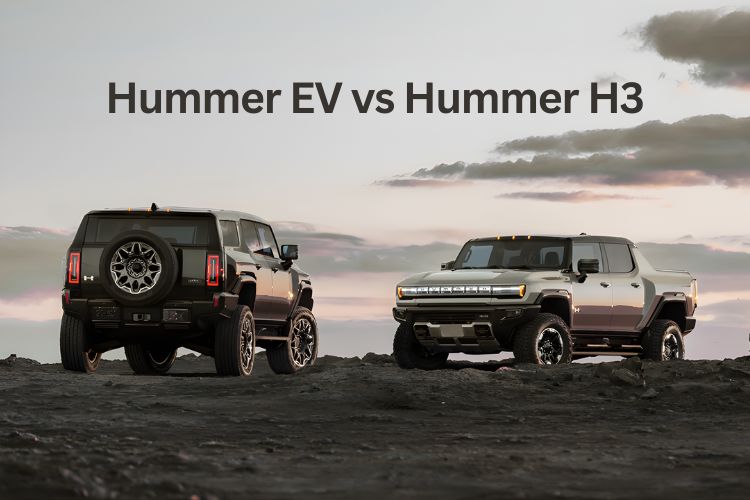
You remember the feeling. That first time you saw an H3 rumbling past, all swagger and unapologetic presence, and thought “someday.” Now there’s this new thing wearing the same badge, silent as a spaceship and twice the price of your first house.
Here’s what nobody’s saying out loud: this isn’t really about choosing between two trucks. It’s about choosing between two versions of yourself. The H3 represents that last gasp of mechanical rebellion, when “excessive” meant burning fuel without apology. The EV represents something stranger: using technology to out-Hummer the original Hummer, but plugged into your garage wall.
We’re going to cut through the hype and the spec sheets together. You’ll get the cold numbers you need and the honest feelings you’re wrestling with. Because the right choice isn’t about which one’s “better.” It’s about which contradiction you can live with.
Keynote: Hummer EV vs Hummer H3
The Hummer EV and H3 comparison reveals two opposing philosophies wearing the same badge. The H3 delivered affordable, mechanical off-road capability with predictable costs. The Hummer EV amplifies everything through the Ultium battery platform, tri-motor all-wheel drive, and 1,000 hp performance, but demands six-figure commitment. Neither prioritizes efficiency or practicality. Both reward emotional decision-making over financial logic. Your choice reflects your values: nostalgic simplicity or technological excess.
Two Hummers, Two Planets: What You’re Actually Comparing
The H3 Reality (2006-2010)
Mid-size body on a Chevrolet Colorado platform, 3.7L inline-5 or 5.3L V8, around 4,700 pounds of old-school toughness. Base price started at $30,945, topped out around $40k for Alpha trim.
The “accessible” Hummer that made the attitude affordable to actual humans. While the H2 was pushing six figures and the H1 was military-grade insanity, the H3 shared bones with everyday pickup trucks. This was the civilian military aesthetic without the financial apocalypse.
The Hummer EV Reality (2022-Present)
Ultra-heavy electric supertruck, three motors, 9,000 to 9,640 pounds of battery-powered excess. Starting at $96,550 for 2X trim, climbing past $104,650 for 3X with full capability.
GMC’s moonshot: proving EVs can be the most outrageous thing on four wheels. Up to 1,000 hp and 11,500 lb-ft of torque from electrons. That’s not a typo. The Ultium battery platform enables power figures that would make a hypercar jealous, stuffed into a truck that weighs as much as two Honda Civics.
Same Attitude, Different Universe
Both will make your neighbors talk, just for completely different reasons. One says “I don’t care about gas prices,” the other says “I don’t care about physics.”
The H3 was GM’s admission that not everyone could afford the H2’s excess. The Hummer EV is GM’s declaration that electrification removes all previous limits. Where the H3 compromised to reach more buyers, the EV amplifies everything to technological extremes.
The Power Story: Adequate Grit vs Absurd Fury
What the H3 Actually Delivered
220 hp from the inline-5, or 300 hp from the V8 Alpha. 0-60 mph in about 9 to 10 seconds. Nobody bought this to race.
Real-world feel: capable and honest, never thrilling. Like a dependable work horse that knows its job. The base inline-five was widely criticized as underpowered for a 4,700-pound SUV. GM responded by offering the 5.3L V8 in the Alpha trim, which transformed the experience from sluggish to adequate.
But even with the V8, you weren’t winning any stoplight battles. You were getting where you needed to go with mechanical confidence.
The EV’s Physics-Breaking Numbers
Here’s where things get unhinged.
| Spec | H3 (V8 Alpha) | Hummer EV (3X) |
|---|---|---|
| Power | 300 hp | 830-1,000 hp |
| Torque | 320 lb-ft | 11,500 lb-ft |
| 0-60 mph | ~9-10 seconds | 3.0-3.3 seconds |
| Weight | ~4,700 lbs | ~9,000-9,640 lbs |
The tri-motor all-wheel drive system doesn’t just move the Hummer EV. It launches it. Watts to Freedom mode (yes, that’s the actual name) drops the air suspension, conditions the battery pack, and unleashes every electron simultaneously.
The result? A 9,640-pound truck hitting 60 mph in 3 seconds. Your brain struggles to process this. It violates everything you know about physics and inertia.
What This Power Means in Real Life
H3 gives you predictable, mechanical muscle for trails and towing. You feel the engine working, hear it breathing, sense the transmission hunting for gears.
EV delivers G-forces from something that weighs as much as two Honda Civics. The cognitive dissonance is real: feeling supercar acceleration in a 9,000-pound truck breaks your brain.
The EV’s instant electric torque means conquering technical terrain in eerie silence. No engine revving, no clutch slipping, just smooth, relentless forward motion. It’s unsettling at first. Then it’s addictive.
The Money Truth Nobody Wants to Admit
The H3’s “Affordable” Trap
Used examples run $10k to $25k depending on condition and mileage. Seems reasonable for genuine Hummer attitude, right?
But here’s the catch: 14 to 16 mpg combined means you’ll spend $200 to $400 monthly on gas alone. At today’s prices, that’s $2,400 to $4,800 annually just keeping it fed.
Maintenance reality: aging mechanical systems, cheap plastic parts that fail, and a parts supply getting thinner every year. That “affordable” H3 starts looking expensive when you factor in the radiator failures, transmission issues, and valve seat wear common to these trucks.
The EV’s Six-Figure Gulp
| Cost Factor | H3 (Used) | Hummer EV (New) |
|---|---|---|
| Purchase Price | $10k-$25k | $96k-$104k |
| Monthly Fuel/Energy | $200-$400 (gas) | $50-$100 (home charging) |
| Insurance (est.) | $150-$250 | $250-$400 |
| Maintenance (annual) | $1,500-$3,000 | $500-$1,000 |
The sticker shock is immediate and brutal. But wait, there’s more. Insurance premiums on a $100k, 1,000-hp electric truck can exceed $4,700 annually. Some drivers report quotes over $7,000 per year.
Why? Because when a 9,000-pound truck with hypercar performance gets into an accident, the damage is catastrophic. The complex Ultium battery platform and tri-motor system aren’t cheap to repair. Insurance companies price this risk accordingly.
The Operating Cost Reversal
EV electricity costs roughly $0.10 per mile vs H3’s $0.35 to $0.50 per mile in gas. Over 15,000 miles annually, that’s $1,500 for the EV versus $5,250 to $7,500 for the H3.
But the EV’s initial price means you need to drive it 150,000+ miles to break even on the purchase price difference. And that assumes nothing goes catastrophically wrong with the battery pack or motor assemblies.
Real talk: neither vehicle makes financial sense, just expensive in different ways. If saving money matters, neither Hummer is your answer. These are emotional purchases dressed up with rational justifications.
Size, Weight, and the Daily Puzzle
The H3’s Human-Scale Dimensions
Length: 187.8 inches, Width: 75 inches, Height: 72.1 inches. Roughly the size of a mid-size pickup, meaning most people could actually park it.
Curb weight around 4,700 pounds: substantial but not shocking. About the same as a modern full-size pickup like a Ford F-150. You could fit it in a standard garage, squeeze it into parking structures, and navigate city streets without constant anxiety.
The turning circle of 37 feet was genuinely impressive for a body-on-frame GMT355 platform SUV. It felt manageable in tight spaces.
The EV’s Ridiculous Reality
| Dimension | H3 | Hummer EV SUV |
|---|---|---|
| Length | 187.8″ | 196.8″ |
| Width | 75″ | 86.7″ |
| Height | 72.1″ | 81.1″ |
| Weight | ~4,700 lbs | ~9,000 lbs |
Standard garage door is 7 feet tall. The EV is 6’9″ and won’t fit many parking structures. At 86.7 inches wide, it barely squeezes into standard traffic lanes and parking spots designed for normal vehicles.
Some bridges have weight restrictions that exclude the EV entirely. Good luck taking shortcuts through residential neighborhoods with vintage infrastructure.
Living With the Consequences
The battery pack alone weighs 2,900 pounds. You’re hauling a Honda Civic worth of battery everywhere you go. This isn’t just a fun fact. It affects everything: tire wear, brake wear, road damage, and yes, your insurance premiums.
The Hummer EV compensates for its bulk with four-wheel steering, shrinking the turning circle to 35.4 feet. That’s actually tighter than the H3, which is mind-bending when you consider the size difference.
But that four-wheel steering system is another complex component that can fail, another thing to worry about when the warranty expires.
Off-Road Soul: Mechanical Honesty vs Digital Domination
The H3’s Proven Credentials
9.1 to 9.7 inches of ground clearance, approach and departure angles of 37.5° and 35.5°. Electronic locking rear differential and two-speed transfer case for genuine low-range crawling.
The Adventure package transformed the H3 into a formidable trail machine. 33-inch all-terrain tires, 4.03:1 low-range gear ratio, and locking differentials gave it legitimate off-road capability. Not trophy truck performance, but genuine competence.
Decades of proven capability from Moab to the Rubicon. “Simple, capable, repairable in the middle of nowhere,” as one off-road enthusiast put it. If something breaks on a trail, there’s a decent chance you or a buddy with tools can get it moving again.
The EV’s Tech-Enhanced Superpowers
Extract Mode raises ground clearance to 15.9 inches. This is insane. Most production vehicles struggle to clear 10 inches.
Three independent electric motors enable CrabWalk four-wheel steering for diagonal movement and unprecedented articulation. Want to slide sideways around a boulder instead of executing a 12-point turn? CrabWalk does that.
17 camera views including underbody waterproof cameras that show you exactly what you’re climbing over. Can ford up to 32 inches of water. The H3 tapped out at 24 inches.
The Extreme Off-Road Package adds differential lockers and 35-inch tires on the Ultium battery platform architecture. Approach angle hits 49.7 degrees in Extract Mode, which is competitive with purpose-built rock crawlers.
The Honest Assessment
Both are massively over-capable for 95% of buyers. Most Hummers never see dirt, let alone technical trails requiring Extract Mode or locking diffs.
H3 advantage: lighter, more repairable if something breaks on a remote trail. You can carry spare parts. If the worst happens, a tow truck can handle 4,700 pounds.
EV advantage: instant torque control, better technology for extreme articulation. The silent approach means you’re not disturbing wildlife or annoying campers. But good luck getting a 9,000-pound truck unstuck from deep mud without heavy equipment.
Your skill level matters more than the vehicle’s capability ceiling. Neither truck will compensate for poor line choice or throttle control.
Efficiency, Emissions, and the “Green” Question
The H3’s Thirsty Reality
EPA combined: 14 to 16 mpg (V8 lower, inline-5 slightly higher). 23-gallon tank means 322 to 368 mile range, but you’ll know every gas station intimately.
Zero pretense about environmental impact: this is old-school consumption. Produces roughly 1.2 pounds of CO₂ per mile driven. Over 15,000 annual miles, that’s 18,000 pounds of carbon emissions.
The H3 existed in an era when “gas guzzler” was a badge of honor, not a liability. Fuel prices in 2006 were low. By 2008, when gas hit $4 per gallon, the H3’s days were numbered.
The EV’s Complicated “Efficiency”
EPA rating: 53 to 58 MPGe combined. Official range: 311 to 381 miles depending on configuration and trim.
Here’s the uncomfortable truth: the EV has the lowest MPGe of any electric vehicle due to its massive 212 kWh battery and 9,000-pound weight. That battery pack’s production created significant upfront carbon debt that takes years of driving to offset.
Real-world efficiency often drops to 1.6 to 1.8 miles per kWh. Highway speeds murder the range. Towing a 6,100-pound trailer? Range plummets to 140 miles. You’ll spend more time charging than driving on a long towing trip.
Cold weather further degrades battery performance. In sub-freezing temperatures, expect to lose 20 to 30% of your rated range.
The Real Environmental Story
EV eliminates tailpipe emissions entirely. This matters in cities where air quality affects millions of people.
But calling a 9,000-pound vehicle “efficient” requires creative math. The environmental benefit depends heavily on your local electrical grid. If you’re charging with coal power, the carbon savings are minimal. Solar or wind power? Significantly better.
If you care about the planet: neither Hummer is your friend, but the EV is significantly less harmful over its lifetime. That’s damning with faint praise, but it’s honest.
Reliability, Maintenance, and What Actually Breaks
The H3’s Documented Demons
Notorious leaking sunroof drains that flood the interior. PassLock ignition system failures leaving owners stranded. Cheap plastic radiators failing prematurely, often causing transmission damage when coolant mixes with ATF.
Early 3.5L inline-five engines suffered premature valve seat wear, causing misfires and requiring expensive cylinder head replacements. HVAC blower motor resistor harnesses that melt. Faulty fuel level sensors giving phantom empty tank warnings.
Real owner sentiment: “There’s a reason they stopped making it.” The H3 wasn’t killed by the economy alone. It had genuine quality issues that GM never fully resolved.
Annual maintenance runs $621 to $1,074 for routine services. But when major components fail, costs escalate quickly. Used parts availability is shrinking as these trucks age out.
The EV’s Unknown Territory
Too new for long-term reliability data. First models only from 2022. 3-year/36,000-mile basic warranty doesn’t inspire confidence at this price point.
Battery degradation concerns, though early data looks promising. GM claims minimal degradation over 100,000 miles, but we won’t know for sure until 2030.
When complex systems fail, repairs will be catastrophically expensive. The electric motors and battery aren’t DIY-fixable. You’re at the mercy of GMC dealers and their hourly rates.
Software glitches plague early owners: infotainment screens freezing, phantom battery drain while parked, inconsistent DC fast charging behavior. These require over-the-air updates or dealer visits to resolve.
Multiple NHTSA recalls including insufficiently insulated wires in the rear drive unit and improperly tightened seat belt buckle bolts. Not confidence-inspiring for a vehicle this expensive and new.
The Maintenance Cost Reality
H3 needs constant oil changes, transmission service, differential maintenance, and aging rubber parts. Every 3,000 to 5,000 miles, you’re spending money.
EV needs virtually nothing routine. No oil changes, no transmission fluid, regenerative braking extends brake pad life dramatically. Projected 10-year maintenance costs: $5,821 to $6,384.
But any major component failure costs as much as a used car. Battery pack replacement? Easily $20,000+. Motor assembly? $15,000+. These aren’t theoretical concerns. They’re eventual realities as these trucks age.
Neither will be cheap to own, just painful in different ways.
The Decision Tree: Which Contradiction Can You Live With?
You’re an H3 Person If…
Your budget caps at $25k and you’re comfortable with DIY repairs. You value mechanical simplicity and the smell of gasoline.
You don’t mind being the person at the gas station twice a week. You want the “original” Hummer experience before everything got computerized.
You live somewhere with cheap gas and no emissions testing. Analog gauges, proven capability, accessible parts. These things matter more to you than tech features.
You appreciate that the H3 is getting rarer. It’s a piece of automotive history, the final gasp of unapologetic internal combustion excess before everything went hybrid or electric.
You’re a Hummer EV Person If…
You can comfortably afford $100k+ without financing stress. Home charging is available and practical in your daily life.
You want to make an absolute statement and love cutting-edge technology. You value instant torque, silent operation, and zero-emissions driving.
The future excites you more than the past. 1,000 hp, CrabWalk four-wheel steering, Extract Mode, Super Cruise hands-free driving. These capabilities justify the cost in your mind.
You’re an early adopter willing to deal with software glitches and unknown long-term reliability in exchange for being first with the latest technology.
You understand that the EV tax credit eligibility is limited. The Hummer EV’s MSRP exceeds the $80,000 cap for truck tax credits under current IRS Form 8936 rules, so don’t count on that $7,500 federal incentive.
Skip Both If…
You need actual cargo space, fuel efficiency, or affordable ownership. Reliability and low cost of ownership matter more than image.
You prefer going unnoticed or want the best off-roader per dollar spent. You’re looking for sensible transportation of any kind.
A used Toyota 4Runner will out-reliable both Hummers, cost half as much, and still take you anywhere you realistically want to go. Just saying.
Conclusion: Same Badge, Different Religion
You’ve journeyed from nostalgic mechanical grit to electric excess, through spec sheets and price tags that both sting in their own ways. The H3 offers analog adventure and predictable costs at the pump, wrapped in proven trail geometry that’s getting harder to find. The Hummer EV delivers jaw-dropping acceleration, silent strength, and modern technology, with the tradeoffs of mass, charging infrastructure requirements, and “efficiency” that still means excessive by any normal standard. Neither makes practical sense. Both are brilliant contradictions. And that’s exactly why people love them.
Your first step today: Calculate your actual monthly cost for each option, including insurance, fuel or electricity, and realistic maintenance. Write that number down. If it makes you wince, you have your answer. If it makes you grin, you’ve found your tribe.
Final thought: Standing between these machines, you’re not choosing between vehicles. You’re choosing between versions of yourself. The H3 says “I want adventure without overthinking it.” The EV says “I want adventure with zero apologies and maximum spectacle.” Both are valid. Neither is sensible. And that’s exactly the point of wearing the Hummer badge.
Hummer H3 vs Hummer EV (FAQs)
Is the Hummer EV bigger than the H3?
Yes, significantly. The Hummer EV is nearly 9 inches longer, 12 inches wider, 9 inches taller, and twice as heavy. It barely fits standard parking spaces and exceeds many garage clearances.
How much does it cost to charge a Hummer EV vs fill up an H3?
Home charging the EV costs $50 to $100 monthly versus $200 to $400 for H3 gas. But public DC fast charging can cost $100+ per session, eliminating the advantage on road trips.
Does the Hummer EV qualify for the $7,500 tax credit?
No. The Hummer EV’s MSRP exceeds the $80,000 cap for pickup trucks under current IRS Form 8936 federal tax credit rules. You won’t get that incentive.
What is the towing capacity difference between Hummer EV and H3?
Hummer EV tows 7,500 to 12,000 lbs depending on configuration versus H3’s 4,500 to 6,000 lbs. But towing destroys EV range, often cutting it by 50% or more, requiring frequent charging stops.
Can I take the Hummer EV off-road like the H3?
Yes, it’s actually more capable with Extract Mode’s 15.9-inch ground clearance and CrabWalk. But recovering a stuck 9,000-pound electric truck in the backcountry is far more difficult than a 4,700-pound H3.
How does the Hummer EV’s 800V charging architecture work?
The 800-volt system enables DC fast charging speeds up to 350 kW, adding 100 miles in 10 to 15 minutes under ideal conditions. That’s half the voltage of typical EVs, reducing charging time significantly.