You’re riding shotgun in your buddy’s Tesla. Red light. He glances over with that knowing smirk. The light flips green, and he taps the accelerator. Not floors it. Just taps it.
And suddenly you’re plastered against the seat like someone just hit fast-forward on reality. Silent. Instant. Your stomach is still back at the intersection. No roar. No drama. Just gone.
You’ve spent years around fast cars. You know what acceleration feels like. But this? This is different. You try to wrap your head around it, scrolling through spec sheets and dyno charts that look like a physics exam. Here’s what nobody tells you: it’s not about which car is faster. It’s about when the power arrives. That split-second difference between thought and action. Between pressing the pedal and feeling the shove.
By the end of this, you’ll understand why that Tesla moved like it was shot from a railgun while your friend’s old Mustang, with more horsepower on paper, needed a full second just to wake up. You’ll read torque curves like a second language. And you’ll finally get why electric cars don’t just feel quick. They feel inevitable.
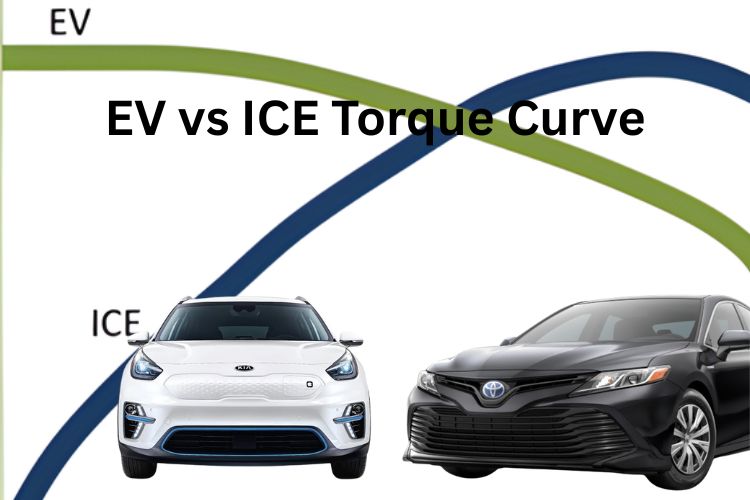
Keynote: EV vs ICE Torque Curve
The torque curve defines a vehicle’s personality. Electric motors deliver 100% torque from 0 RPM through electromagnetic induction, creating instant, seamless acceleration. Internal combustion engines must build RPM to reach peak torque, constrained by volumetric efficiency and mechanical limitations. This fundamental difference explains why EVs accelerate faster from stops despite often having less peak horsepower, and why they require only single-speed transmissions versus complex multi-speed gearboxes in gas vehicles.
Let’s Get This Out of the Way: What is “Torque” Anyway?
The Pickle Jar Problem
Forget the textbook definitions for a second. You know that massive pickle jar with the lid that won’t budge? That twisting force you’re applying with your entire hand, maybe even banging it on the counter first? That’s torque. Pure, simple twisting force.
It’s the grunt. The shove. The rotational muscle that gets heavy things moving from a dead stop. In a car, it’s what breaks the rear tires loose or pins you to your seat when the light turns green. Without torque, you’re going nowhere. You’re just revving an engine and making noise.
Torque vs Horsepower: The Real Relationship
Here’s the thing: horsepower isn’t some mysterious separate force. It’s literally torque multiplied by RPM, divided by 5,252. That’s it. That’s the whole formula. Horsepower is what happens when you apply torque over time at speed.
Think of it this way. Torque is the world-class powerlifter who can deadlift a car. Horsepower is the Olympic sprinter who can maintain top speed for 100 meters. In your car, torque gets you moving from zero. Horsepower keeps you accelerating hard at 80 mph. They’re not rivals. They’re partners, and understanding their relationship changes everything.
On a dyno chart, you’ll see two lines, torque and power. They always cross at exactly 5,252 RPM. Always. That’s not magic. That’s just math reminding you they’re two sides of the same coin.
Why This Matters More Than You Think
When someone brags about their car’s 400 horsepower, your first question should be: “At what RPM?” Because if that power only shows up at 7,000 RPM and you’re driving around town at 2,500 RPM, you’re not experiencing anywhere near 400 horses. You’re living in the low-torque wasteland, waiting for the engine to climb the mountain. The torque curve tells you where the power actually lives in the rev range. And that’s what you feel every single day.
The Gas Car “Climb”: Why Your ICE Needs to Wind Up
The Hill-Shaped Curve
Picture a smooth hill. That’s a gas engine’s torque curve. It starts low on the left at idle, climbs to a peak somewhere in the middle, then falls back down as you approach redline. This isn’t a design choice. It’s a compromise written into the physics.
At 0 RPM, your gas engine makes exactly zero torque. It’s off. At idle, around 800 RPM, it makes just enough to keep itself running. Real, usable torque doesn’t show up until somewhere between 1,500 and 2,500 RPM for most engines. Then it climbs. Peaks. Falls. The entire personality of a gas engine is trapped in this hill-shaped curve, and every other system in the car exists to work around it.
Why the Hill Exists: The Engine’s Breathing Problem
The shape of that curve comes down to one thing: breathing. An internal combustion engine is an air pump that occasionally explodes. The torque it makes is directly tied to how much air and fuel it can suck into the cylinders, compress, ignite, and expel. This is called volumetric efficiency.
At low RPM, the engine breathes terribly. The valves open and close at fixed times optimized for higher speeds, so at idle, they’re closing too early or letting exhaust leak backward into the intake. The slow-moving air doesn’t build momentum. Heat escapes to the cylinder walls instead of pushing the piston. Result? Weak torque.
As RPM climbs into the mid-range, magic happens. The valve timing hits its sweet spot. Air rushes in with real velocity. The intake manifold’s design creates helpful pressure waves. Volumetric efficiency peaks. The engine is finally breathing deep, full breaths. Torque surges. This is the power band.
But keep climbing, and the engine starts choking. At high RPM, the valves simply can’t open and close fast enough to keep up with the engine’s air demands. The intake ports act like a straw that’s too narrow. Friction skyrockets. Combustion doesn’t have time to complete before the exhaust valve opens. Torque plummets toward redline.
Why Gears Exist: The 10-Speed Bike Analogy
You can’t start a bike ride in 10th gear. Your legs would just spin uselessly. You start in 1st, build speed, shift to 2nd, keep building, shift again. That’s exactly what a transmission does for a gas engine.
The engine can only make good power in a narrow RPM window, maybe 3,000 to 6,500 RPM. But you need the car to work from 0 to 120 mph. Gears multiply the engine’s torque at low speeds so you can actually move, then swap to taller gears as speed builds to keep the engine in that sweet spot. It’s a brilliant solution to a fundamental problem: your engine is only strong in the middle third of its rev range.
Modern 8-speed, 9-speed, even 10-speed automatics exist because engineers are desperately trying to keep that engine singing in its narrow power band for as much of your driving as possible. It works. But it’s complex, heavy, and inefficient. Every shift is a moment where power drops to zero.
The EV “Tabletop”: The Secret Behind That Instant Snap
Not a Curve at All
An electric motor’s torque “curve” looks nothing like a hill. It’s a mesa. A tabletop. A flat, high plateau that starts at 0 RPM and just sits there, stable and strong, until the motor spins fast enough to hit physical limits.
This is where the magic lives. From 1 RPM to maybe 5,000 or 6,000 RPM, the motor delivers its full, rated torque. Instantly. No building. No waiting. You tap the pedal, and 100% of available twisting force hits the wheels in under 50 milliseconds. It’s not building power. The power is already there. Like starting your bike ride at the top of the mountain, in the perfect gear, every single time.
The Physics of “Instant Torque”
Here’s why this happens. An electric motor generates torque by passing current through wire coils in the stator, creating a rotating magnetic field. This field grabs the permanent magnets in the rotor and yanks them around. More current equals stronger field equals more torque.
At 0 RPM, there’s nothing opposing this process yet. The motor controller can send maximum current, creating maximum magnetic force, producing maximum torque. Right now. Not after the motor spins up. Now.
This is the fundamental difference. A gas engine needs motion to make torque. An electric motor makes torque to create motion.
The Constant Torque Region: Where EVs Live
That flat plateau on the graph, from 0 RPM to the base speed, is called the constant torque region. In this zone, the only thing limiting torque is how much electrical current the battery and motor can safely handle before overheating. As long as you’re in this region, you get full grunt.
For most EVs, base speed sits somewhere between 3,000 and 6,000 RPM. Below that, torque is flat and ferocious. This is why a 200-horsepower EV can embarrass a 300-horsepower gas car from a stoplight. The EV is dumping all 200 horses worth of torque to the pavement instantly. The gas car is still climbing its curve, waiting for the engine to rev high enough to make real power.
When the Plateau Ends: Back-EMF and Field Weakening
But the tabletop doesn’t last forever. As the motor spins faster, it starts acting like a generator, creating a voltage that opposes the battery’s voltage. This is back electromotive force, or back-EMF. The faster the motor spins, the stronger the back-EMF, and the harder it is for the controller to push current through the windings.
At the base speed, back-EMF equals the battery voltage. The system is now voltage-limited, not current-limited. To keep accelerating, the controller uses a trick called field weakening. It adjusts the timing of the currents to partially cancel out the rotor’s magnetic field, which lowers back-EMF and lets the motor spin faster. But weaker magnetic field means less torque. That’s why the curve slopes downward after base speed.
In this constant power region, torque drops but RPM rises, so power stays roughly flat. This is still wildly better than a gas engine’s narrow power band. The EV maintains strong acceleration well into triple-digit speeds.
The Single-Speed Advantage
Because that torque plateau is so wide and starts at zero, most EVs use a single fixed gear ratio. No clutch. No torque converter. No shifting. Just a simple gear reducer that slows the motor’s 18,000 RPM down to a usable wheel speed.
This is revolutionary. It’s lighter, simpler, more reliable, and more efficient than any multi-speed transmission. And when you lift off the throttle, the motor instantly becomes a generator, capturing energy through regenerative braking and sending it back to the battery. The same system that propels you forward slows you down and charges you up. Try doing that with a gas engine.
What This Actually Feels Like: The Stoplight Grand Prix
Connecting the Graph to the Pedal
Let’s get visceral. You’re sitting at a red light next to two cars. One’s a sporty gas sedan with a sweet-sounding turbocharged engine. The other’s a mid-tier EV. Light turns green. Everyone floors it. Here’s what happens in the first three seconds:
| Time | Gas Car (ICE) | Electric Car (EV) |
|---|---|---|
| 0.0 sec | Foot down. Throttle opens. | Foot down. Controller awakens. |
| 0.5 sec | Turbo spooling… engine revving… slight lag… | Already at 15 mph. You’re pushed into the seat. |
| 1.0 sec | Torque building… First gear pulling hard now. | 25 mph. Still pulling like a freight train. |
| 1.5 sec | Power surging! SHIFT TO SECOND. Brief pause. | 35 mph. Seamless. Relentless. |
| 2.5 sec | Finally hitting peak power! Wind noise building. | 50 mph. Already easing off because you’ve made your point. |
The gas car isn’t slow. It’s quick. But it’s working through a process. Revving. Shifting. Building momentum. The EV just went. The power was there before your brain finished processing the green light.
The Truth About “Faster”
Here’s what most reviews get wrong. They obsess over 0-60 times. But that number hides the real story. The EV isn’t necessarily more powerful. A Tesla Model 3 Performance has around 450 horsepower. A BMW M3 has 503. The BMW is more powerful. But the Tesla hits 60 mph a full second faster.
Why? Because the Tesla delivers its entire power budget instantly. The M3 has to work for it, climbing through gears, waiting for the turbos to spool, managing a complex dance between throttle, transmission, and traction. The Tesla’s computer just says “go” and dumps maximum current to the motors. No lag. No drama. Just physics.
This is the secret most people miss. It’s not about peak numbers. It’s about when and how that power arrives. The feeling of instant torque, that telepathic response between your right foot and the car’s motion, is the single biggest difference between driving an EV and a gas car. One feels like you’re asking permission. The other feels like you’re giving orders.
Why This Matters Every Single Day
Forget drag strips. Think about your daily drive. You’re merging onto a highway. In a gas car, you floor it, wait for the transmission to kick down a gear or two, wait for the engine to climb into its power band, then finally get the surge you needed. Total time: maybe a full second of lag.
In an EV? You floor it. You’re gone. Instantly. That one-second difference is the gap between confidently sliding into traffic and white-knuckling it because you misjudged the closing speed of the semi in the right lane. It’s the difference between passing someone on a two-lane road with ease versus committing to a sketchy maneuver because you weren’t sure you had enough power.
Instant torque isn’t a party trick. It’s a safety feature. It’s peace of mind. It’s the reason EV drivers describe their cars as “effortless.”
Head-to-Head: A Tale of Two Technologies
The Side-by-Side Reality Check
Let’s cut through the marketing and look at what these two approaches actually deliver:
| Factor | Electric Vehicle (EV) | Internal Combustion Engine (ICE) |
|---|---|---|
| Torque at 0 RPM | 100% of peak torque, instantly | Essentially zero, must build with RPM |
| Curve Shape | Flat plateau, then gradual taper | Rising hill to mid-RPM peak, then decline |
| Response Time | Under 50 milliseconds | Several hundred milliseconds |
| The “Feel” | Silent, seamless, immediate shove | Building roar, visceral crescendo, drama |
| Usable Power Band | Entire operating range (0-18,000+ RPM) | Narrow window (roughly 3,000-6,500 RPM) |
| Transmission | Single-speed reduction gear (typical) | 6 to 10-speed gearbox required |
| Efficiency | 85-90% of battery energy to motion | 20-30% of fuel energy to motion |
| Ideal For | City driving, instant passing, towing, daily ease | Traditional driving engagement, long road trips, exhaust note |
| Energy Recovery | Regenerative braking recaptures energy | Engine braking wastes energy as heat |
What the Numbers Don’t Show
That efficiency gap deserves attention. A gas engine wastes roughly 70% of the energy in gasoline as heat. Then the remaining 30% gets chewed up by the transmission, differential, and drivetrain losses. Maybe 20-25% of the fuel’s energy actually reaches the wheels.
An EV? The motor itself is 85-90% efficient. The single-speed gearbox adds maybe 5% loss. You’re putting 80-85% of the battery’s energy into motion. This is why EVs cost less per mile to operate, even if electricity isn’t free.
The Exception That Proves the Rule
Not every EV uses a single-speed transmission. The Porsche Taycan has a two-speed gearbox on the rear axle. Why? Because even with an electric motor’s wide torque band, you can still optimize further. First gear is insanely short for brutal launches. Second gear is taller for efficiency at highway speeds and a higher top speed.
It works. The Taycan is faster and more efficient than it would be with a single speed. But this is overkill for 99% of EVs. The fact that even Porsche’s engineers could only justify two speeds, not eight or ten, tells you everything about how good the electric motor’s torque curve already is.
Beyond the Test Drive: Your New Performance Checklist
Forget Just 0-60, Ask About “30-50”
Everyone obsesses over 0-60 times. But here’s the number that matters more for real-world driving: 30 to 50 mph acceleration in top gear. This is passing power. This is the “oh crap, I need to get around this truck now” power.
An EV doesn’t care what gear it’s in because it only has one. Stomp the pedal at 40 mph, and you get the same instant response you’d get at 0 mph. A gas car has to kick down, wait for the transmission to find the right gear, wait for the engine to climb back into its power band, then finally accelerate.
Next time you test drive any car, EV or gas, try this. Roll onto the highway at 40 mph in the highest gear. Floor it. Count the seconds before you feel real thrust. An EV? Zero seconds. A gas car? Maybe one or two. That delay is the torque curve making you wait.
Decode the Curve Like a Pro
When you’re looking at spec sheets, here’s what to check:
Peak torque RPM: If it says “280 lb-ft at 1,500 RPM,” that’s great for a gas engine. Low-end grunt. If it says “at 5,500 RPM,” it’s a peaky, high-revving engine that’ll be weak in daily driving.
Power curve plateau: Look for how wide the flat part of the power curve is. Wider is better. It means the engine or motor stays strong across more of its range.
Area under the curve: This is advanced, but it’s the most honest metric. A torque curve that’s tall but narrow gives you one great moment. A curve that’s moderately tall but wide gives you usable power everywhere. Wide always wins in the real world.
Listen for the Silence (or the Symphony)
When you test drive an EV, close your eyes for a moment during acceleration. What you’ll notice is what’s missing. No engine roar. No vibration. No gear changes. Just smooth, relentless, eerily quiet thrust and the sound of tires gripping pavement.
Some people find this unsettling at first. We’re conditioned to associate speed with noise. But after a week, most people describe it as relaxing. Effortless. Like the car is doing all the work and you’re just steering.
If you test drive a gas car, do the same thing. Feel the engine’s character. The rising and falling revs. The slight lurch of gear changes. The vibration through the steering wheel. For some drivers, this is feedback. Connection. Involvement. It’s the soul of driving. For others, it’s just noise and harshness they’re happy to lose.
Neither is wrong. It’s about what you value.
Translate the Marketing Speak
When a car company says “instant torque,” you now know that means 100% of rated torque from 0 RPM. When they brag about a “flat torque curve,” they mean the motor maintains peak force across a wide RPM range. When they mention “seamless acceleration,” that’s code for single-speed transmission with no shift interruptions.
You’re in on the secret now. You can read between the lines. You understand what’s happening under the hood or under the battery pack. The marketing can’t fool you anymore.
Conclusion: You’re Not Crazy. The Feeling Is the Difference.
We started with a feeling. That moment when your friend’s Tesla launched and your stomach stayed at the intersection. We traced it back through the physics, through the graphs, through the fundamental architecture of two completely different ways to convert stored energy into motion. You’re no longer confused by dyno charts. You understand that one powertrain is a hill you have to climb, over and over, thousands of times per trip. The other is a tabletop you just step onto and stay on.
It’s not about which is better in some absolute sense. They’re just different. A gas engine’s narrow power band, its need to rev and shift and work through a process, creates a driving experience that many of us genuinely love. The sound, the drama, the involvement. An EV’s instant, silent, seamless surge creates something else: confidence, ease, and that addictive telepathic connection between thought and action.
Your single, actionable first step for today: Next time you’re a passenger in any car, gas or electric, close your eyes during acceleration from a stop. Feel for the delay or the instant push. Feel for the shift points or the seamless surge. Now you know exactly what’s happening and why.
The future of performance isn’t just about getting somewhere faster. It’s about the connection between you and the machine. It’s about when the power arrives, not just how much of it there is. You’re not just a driver anymore. You’re someone who understands the language of torque, and that changes everything.
ICE vs EV Torque Curve (FAQs)
Why do electric motors produce instant torque?
Yes, from 0 RPM. Electric motors generate torque electromagnetically by passing current through wire coils, creating magnetic fields that immediately push against the rotor.
There’s no need to build rotational speed first. Maximum current at standstill equals maximum torque instantly. Gas engines need motion to generate force through combustion cycles, which is why they make zero torque when stationary.
At what RPM does an electric motor lose torque?
Typically between 3,000 and 6,000 RPM, called the “base speed.” Below this point, the motor operates in a constant torque region at full strength. Above base speed, back-EMF (the motor acting as a generator) limits how much current can flow, so torque gradually declines.
The motor enters “field weakening” mode, where power stays relatively constant but torque drops as RPM climbs.
Why can’t gas engines make torque at 0 RPM?
Simply put, they’re not running. An ICE generates torque through controlled explosions pushing pistons. No rotation means no intake stroke, no compression, no combustion, no power stroke.
Even at idle (roughly 800 RPM), most engines produce minimal torque because volumetric efficiency is terrible. Low RPM means poor airflow, bad valve timing, and incomplete combustion. They need to spin faster to breathe effectively.
How does turbocharging change ICE torque curves?
Dramatically. Turbos force more air into cylinders, increasing torque across the entire RPM range. They’re especially effective at filling in the low-RPM torque valley that naturally aspirated engines struggle with.
A good turbo can deliver near-peak torque from as low as 1,500 RPM, making the curve much flatter. However, there’s still turbo lag (time for the turbine to spool up), and you still need multiple gears to manage the power band.
What is the base speed of an EV motor?
It varies by motor design and battery voltage, but typically 3,000 to 6,000 RPM. Base speed is the point where back-EMF equals battery voltage, marking the end of the constant torque region.
Below base speed, you get full torque. Above it, torque drops but power plateaus. Tesla’s motors might have a base speed around 5,000 RPM. Porsche Taycan’s motors, with their 800-volt system, can push base speed even higher.
Do EVs feel faster than they actually are?
Yes, because of instant torque delivery. A 300-horsepower EV often feels quicker than a 400-horsepower gas car in daily driving because the EV’s power is available immediately at any speed.
No waiting for downshifts or RPM buildup. Your brain perceives this instant response as raw speed. It’s not an illusion though. From 0-40 mph, the EV usually is faster. At higher speeds, the gas car might catch up.