You’re cruising along the interstate. The pavement hums. Your mind wanders. Then a massive Rivian truck thunders past in the left lane, and for just a second, you glance at that thin metal guardrail separating the road from the ravine below. A question flickers through your mind: Would that even stop it?
That’s not paranoia. That’s your gut sensing something engineers have been quietly discovering in crash labs across Nebraska and Texas. We’ve been told EVs are the future, safer and cleaner. But now headlines scream about electric trucks tearing through guardrails like tissue paper. So what’s actually happening here? Are we trading one problem for another?
Here’s what we’re going to do. We’re going to cut through the noise together, using cold, hard data to find warm, real solutions. Because the truth isn’t scary once you understand it. It’s just the next problem we need to solve.
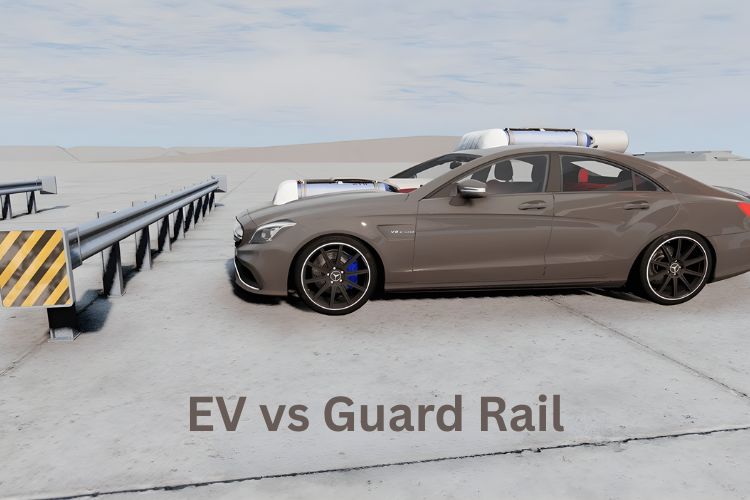
Keynote: EV vs Guard Rail
Electric vehicles weighing over 5,000 pounds exceed current guardrail design limits. Nebraska crash tests show heavy EV trucks penetrate W-beam barriers rated for lighter vehicles. The battery pack weight creates kinetic energy that overwhelms legacy steel systems. Engineers are developing updated MASH 2026 standards and reinforced barrier designs, but nationwide upgrades will require decades and billions in funding. Lighter EVs under 5,000 pounds maintain compatibility with existing infrastructure.
The Weight Problem That Changes Everything
Here’s the Shocking Truth About How Heavy EVs Really Are
Let’s talk numbers that make traffic engineers lose sleep at night.
A 2022 Rivian R1T weighs roughly 7,148 pounds. For context, a 1995 Honda Civic weighed about 2,500 pounds. That Rivian is almost three Civics stacked on wheels. A GMC Hummer EV tips the scales at over 9,000 pounds. The Ford F-150 Lightning? Between 6,015 and 6,893 pounds, compared to its gas sibling at 4,021 to 5,014 pounds.
Your brain struggles to feel that difference when you see these vehicles on the road. They look normal sized. But here’s the metaphor that makes it click: Our guardrails were built to catch a bowling ball. Now we’re throwing a wrecking ball at the same speed.
And here’s the thing most articles miss. This isn’t just about EVs. Many gas powered trucks and SUVs already approach or exceed these weights. The battery pack just accelerated a trend that was already barreling down the highway. The Ford F-Series, Chevy Silverado, and Ram trucks have been getting heavier for decades. EVs didn’t invent the problem. They just made it impossible to ignore.
Why This Matters More Than You Think
Every 1,000 additional pounds in a vehicle increases the baseline fatality probability by 47 percent. Read that again.
When a heavier vehicle hits something, whether it’s another car or a steel barrier, physics doesn’t negotiate. That extra mass translates directly into kinetic energy, the force that has to be absorbed or redirected somewhere. The formula is simple: kinetic energy equals half the mass times velocity squared. A 20 to 50 percent increase in vehicle weight means 20 to 50 percent more energy slamming into whatever’s in the way.
Our highway guardrails, those corrugated steel W-beams you’ve seen your entire driving life, were designed and tested in an era when a 5,000 pound vehicle was considered heavy. The Midwest Guardrail System that protects millions of miles of American highways was certified using standards from the 1990s. Back then, engineers upgraded barriers to handle the SUV boom. It worked. The system adapted.
But that adaptation took years and billions of dollars. This time, the vehicle fleet is changing faster than infrastructure can keep up. Much faster.
The Crash Test That Woke Everyone Up
What Happened in Nebraska
In October 2023, researchers at the University of Nebraska’s Midwest Roadside Safety Facility did something no one had done before. They crashed a real, production Rivian R1T into a standard highway guardrail at 60 miles per hour.
The Rivian weighs over 7,000 pounds. The W-beam guardrail, standing 31 inches tall and made of 12-gauge steel, is rated for vehicles up to 5,000 pounds.
The truck tore through the metal guardrail like it was paper. There was minimal deceleration. The barrier didn’t contain, didn’t redirect. It just failed. Completely. The Rivian kept going until it hit a secondary concrete barrier the researchers had wisely placed for exactly this scenario.
“Current guardrails are ill-equipped for EVs,” the University of Nebraska researchers stated plainly.
Then, in September 2023, they ran a second test. This time with a lighter vehicle, a Tesla Model 3 weighing about 4,000 pounds. Surely a mid-sized sedan wouldn’t overwhelm the barrier, right? Wrong. Different failure, same result. The Tesla’s low profile and stiff underbody structure caused it to lift the guardrail on impact and pass cleanly underneath. Engineers call this “submarining.” The vehicle essentially drove under the safety feature designed to stop it.
The Concrete Barrier Test That Made Headlines
On July 1, 2024, the team tried something different. They crashed that same 7,000 pound Rivian R1T into a portable concrete barrier at 62 miles per hour at a 25 degree angle. These are the barriers you see protecting highway work zones, each segment weighing 5,000 pounds.
The barrier contained the truck. Technically, it worked. The occupants likely would have survived. But here’s where the story gets complicated. Several concrete segments were displaced more than 10 feet. That’s 50 percent more deflection than what’s considered acceptable. If you were a road worker standing on the other side of that barrier, doing your job, you’d have been crushed by 5,000 pound concrete segments rocketing backward.
The ironic silver lining? The Rivian’s cab interior showed almost no damage. The truck protected its occupants beautifully. This highlights the paradox at the heart of this entire issue: the same mass that makes EVs safer for the people inside makes them more dangerous to everything outside.
Real-World Consequences We Can’t Ignore
This isn’t just lab speculation anymore.
In actual highway incidents, when heavy EVs have hit guardrails, first responders using extrication equipment have accidentally punctured battery packs. Steel from the guardrail pierced a Tesla’s battery during one crash, and fire followed. The battery pack, sitting low and flat beneath the vehicle, becomes vulnerable in ways engineers are still figuring out.
These aren’t theoretical edge cases. They’re happening on actual American highways right now, while most drivers have no idea the infrastructure around them is fundamentally mismatched to the vehicles they’re sharing the road with.
The Anatomy of a Mismatch: Weight, Gravity, and Yesterday’s Steel
Why EVs Hit Different (Literally)
An electric vehicle’s battery pack weighs about as much as a small gas powered car. A Tesla Model 3 battery? Roughly 1,060 pounds. Compare that to a full tank of gas at about 120 pounds. That’s nine times heavier, all concentrated in a flat pack bolted to the floor.
This creates two things that change everything about how the vehicle behaves in a crash. First, massive kinetic energy focused at the point of impact. Second, a center of gravity that sits 5 to 8 inches lower than a comparable gas vehicle. That low center of gravity is fantastic for preventing rollovers. Car reviewers love to talk about how planted and stable EVs feel in corners. That’s real.
But when an EV hits a fixed object like a guardrail, that same low center of gravity works against safety. The impact force is delivered low on the barrier at an upward angle, lifting the rail instead of engaging with it properly. The stiff underbody structure, designed to protect that expensive battery pack, doesn’t crumple and absorb energy the way a traditional front end does. It stays rigid, maintains its low profile, and either wedges under the barrier or punches straight through.
The Failure Modes Engineers Are Seeing
There are two distinct ways this incompatibility plays out.
Penetration: Heavy EV trucks simply overpower the barrier with kinetic energy. The guardrail’s posts get pulled from the ground, the steel beam ruptures, and the vehicle continues with little speed reduction. This is what happened with the Rivian in Nebraska.
Underride: Lighter EVs with low centers of force lift the rail and pass underneath. It’s like a goalie trying to stop a puck shot from an angle they weren’t trained for. The barrier is positioned at 31 inches high because that’s where engineers expected the force to hit based on 1990s era vehicle design. Modern EVs deliver that force lower, bypassing the entire system.
The center of force, not just the center of gravity, determines how a vehicle engages a barrier. This is calculated from the height and stiffness of the bumper and chassis frame rails during the actual crash event. EVs have fundamentally different crash dynamics because their structural design prioritizes battery protection over front-end energy absorption.
Legacy Standards Meet Modern Reality
The MASH standards, the guidelines that govern guardrail testing in America, were updated in the 1990s to handle SUVs and pickups. That process took years. The test vehicle specified in those standards, designated “2270P,” weighs 2,270 kilograms, or 5,000 pounds.
That was the heavy vehicle of its era. Now? The Rivian R1T is 44 percent heavier. The GMC Hummer EV exceeds 9,000 pounds. National Transportation Safety Board Chair Jennifer Homendy stated it plainly: “Our guardrails are rated up to 5,000 pounds. Many of these vehicles go up to 10,000 pounds.”
Here’s the truth most people miss. This is a weight problem, not just a powertrain problem. Gas trucks are getting heavier too. The entire American vehicle fleet has been experiencing “vehicle bloat” for decades. EVs just happen to be the category that finally broke the camel’s back, forcing engineers to confront what they’d been quietly worrying about for years.
Not All Barriers Are Created Equal: What Actually Works (and What Doesn’t)
The Simple Breakdown You’ve Been Looking For
Not all guardrails are the same. Let me give you the rundown on what researchers have discovered about different barrier types when tested against modern heavy vehicles:
| Barrier Type | EV Outcome in Tests | What It Means for You |
|---|---|---|
| W-beam guardrail | Underride or penetration with heavy EVs | The most common type needs fundamental redesign for EV mass and low center of force |
| Thrie-beam guardrail | Tesla penetrated even this stronger system | More robust than W-beam but still insufficient for heavy EVs |
| Concrete barriers (median) | Generally effective but massive deflection observed | Often work for heavy vehicles but can create backside risks |
| Cable barriers | Flexibility may help dissipate energy | Still under evaluation for specific EV crash scenarios |
The Solutions Being Tested Right Now
Research institutions aren’t sitting idle. The Texas A&M Transportation Institute and the Midwest Roadside Safety Facility are running comprehensive crash programs using actual EVs to develop new barrier designs and updated standards.
They’re testing everything. Steel posts anchored deeper into the ground. Rails mounted at different heights to better engage modern vehicle geometries. Hybrid systems that combine the flexibility of cable with the strength of steel. Thicker gauge steel that can withstand higher impact forces without rupturing.
The National Cooperative Highway Research Program launched Project 22-61 specifically to investigate the crashworthiness of roadside hardware when impacted by battery electric vehicles. The MASH 2026 update will include a new 3,000 kilogram (roughly 6,600 pound) electric pickup truck in its testing protocols. That’s the first official acknowledgment that the old standards are obsolete.
Progress is happening. It’s just happening slower than the vehicles are arriving on the roads.
But Aren’t EVs Supposed to Be Safer?
Let’s End This Confusing Debate Once and For All
Yes, EVs often earn five star safety ratings for occupants. No, that doesn’t mean our roads are ready for them. Both statements are true simultaneously, and that’s where the confusion lives.
Insurance Institute for Highway Safety data shows that EV occupants file fewer injury claims than drivers of comparable gas vehicles. That rigid structure and low center of gravity genuinely protect the people inside. In a vehicle to vehicle collision, you’d rather be in the heavier car. That’s physics.
But roadside infrastructure operates on different physics. The very features that make you safer inside make the guardrail’s job exponentially harder outside. They’re both true. They can be both true.
The Double-Edged Sword of EV Design
Let me show you exactly how this works:
| Feature | What It Means for You (Inside) | What It Means for the Guardrail (Outside) |
|---|---|---|
| Heavy Battery Pack | Low center of gravity reduces rollover risk dramatically | Creates massive kinetic energy that overwhelms barrier capacity |
| Rigid Underbody Structure | Protects occupants by maintaining safety cage integrity | Doesn’t crumple to absorb energy so the guardrail takes full force |
The Elephant in the Room: America’s Love Affair with Heavy Vehicles
Walk through any suburban parking lot. Count the massive trucks and SUVs. This isn’t new.
The Ford F-Series has been America’s best selling vehicle for over four decades. The Chevy Silverado, Ram 1500, and GMC Sierra all sell in massive numbers. Many of these gas powered trucks approach or exceed 6,000 pounds when fully loaded. Add a crew cab, the largest engine option, four wheel drive, and luxury trim, and you’re well past the 5,000 pound MASH limit.
The issue extends beyond just highway guardrails. Parking garage weight limits were calculated decades ago. Bridges have load ratings. Even potholes cause more damage when heavier vehicles hit them repeatedly. The entire transportation system, from the pavement up, is feeling the strain of vehicles that weigh 30 to 50 percent more than what engineers designed for.
EVs are part of this trend, not the sole cause. But because battery weight is concentrated in one enormous component, it pushed several vehicle categories past critical thresholds all at once.
The Road to a Fix: We’ve Been Here Before
A Playbook from the Past That Gives Us Hope
Here’s something that should make you feel better. We’ve successfully redesigned guardrails before.
In the 1990s, when SUVs and pickup trucks exploded in popularity, engineers discovered that existing barriers couldn’t handle these taller, heavier vehicles. The rails would fail, allowing trucks to roll over them or punch through. It was a genuine safety crisis.
So they went to work. They strengthened the posts. They adjusted the rail height and beam thickness. They tested new designs. They updated the standards. And over the course of about a decade, they systematically upgraded the most critical sections of America’s highway guardrail infrastructure.
We can fix this because we’ve already done it. The engineering knowledge exists. The testing facilities are operational. The political will is forming. It’s just a question of time and money.
Why Change Feels So Slow
Let me be honest with you. This is going to take years, probably decades to fully resolve.
The United States has hundreds of thousands of miles of highway guardrails. Replacing or reinforcing all of them would cost taxpayers tens of billions of dollars. There’s no sugarcoating that reality. State Departments of Transportation have limited budgets. They’re competing with bridge repairs, pothole filling, and every other infrastructure need for those same dollars.
NTSB Chair Jennifer Homendy acknowledged this challenge directly: “Our guardrails are rated up to 5,000 pounds. Many of these vehicles go up to 10,000 pounds.” She warned that updating the standards and then implementing those updates across the national highway system could take decades. During that time, the known vulnerability persists.
That’s the “vulnerability window” engineers are worried about. We know the problem exists. We know roughly what the solutions will look like. But the gap between knowing and doing is measured in years and billions of dollars.
What You Can Expect on the Horizon
The path forward involves multiple simultaneous efforts.
First, expect to see more collaboration between automakers and transportation engineers. They need to share crash data, structural specifications, and design insights to develop solutions that work for both vehicles and infrastructure. Some manufacturers are already participating in this research voluntarily.
Second, watch for pilot programs in high risk areas. Rather than attempting a nationwide replacement, states will likely identify their most dangerous corridors, bridges over deep ravines, sharp curves along cliffsides, and high speed sections near population centers, and upgrade those first. Risk based prioritization makes the problem manageable.
Third, new barrier designs will emerge. Concrete barriers in critical zones. Reinforced steel systems with deeper posts and thicker beams. Possibly even “smart” barriers that integrate with vehicle safety systems to prevent crashes before they happen, making the physical barrier a true last resort.
What This Actually Means for You, the Driver (EV or Not)
Driving Smarter in a Mixed-Weight World
Should you be scared? No. Should you be aware? Absolutely.
The vast majority of trips you take will never involve a guardrail. Most crashes happen at intersections and in parking lots at low speeds. The scenario we’re discussing, a high speed roadway departure where a vehicle strikes a barrier at 60 miles per hour, is statistically rare.
But when it does happen, the physics matters. Speed and following distance are more critical than ever because all vehicles are heavier now, not just EVs. A heavier vehicle takes longer to stop. It carries more momentum. If the car ahead brakes suddenly, your margin for error is smaller than it was when vehicles averaged 3,500 pounds.
Awareness is the new safety feature. Knowing these dynamics exist lets you adjust your behavior in subtle but important ways.
If You’re Buying an EV, Here’s Your Clarity
You’re still making a very safe choice for you and your passengers. The occupant protection in modern EVs is top tier. Five star crash ratings aren’t marketing fluff. They’re based on rigorous testing that simulates the most common collision types. Inside that cabin, you’re exceptionally well protected.
The infrastructure will catch up, just like it did before. Engineers are working the problem right now. Budgets are being allocated. Standards are being updated. It’s slower than we’d like, but the trajectory is clear.
If vehicle weight concerns you, several excellent EV options exist below the 5,000 pound threshold. The Nissan Leaf weighs about 3,500 pounds. The Chevrolet Bolt is around 3,600 pounds. The Tesla Model 3 Standard Range sits at roughly 3,600 pounds. These lighter EVs deliver the environmental and cost benefits you want while minimizing the infrastructure compatibility issue.
Conclusion: Trading Fear for Awareness
We started with that jolt of fear on the highway, watching a massive electric truck thunder past and wondering if the guardrail would even slow it down. Now you know the answer. In many cases, with current infrastructure, it wouldn’t. Not effectively.
But we also discovered this isn’t really about EVs versus guardrails. It’s about the weight of all modern vehicles, gas and electric, meeting an infrastructure system designed for a lighter era. The guardrails that line our highways were engineered brilliantly for the vehicles of the 1990s. They’re just not ready for the vehicles of the 2020s. That gap, that mismatch, is the problem.
The single, incredibly actionable first step for today: Tonight, add one extra second to your following distance. Just one. Awareness is the new safety feature, and understanding the physics of vehicle weight makes you a smarter, safer driver.
The conversation has started. The crash tests are happening. The standards are being updated. Engineers are designing the next generation of barriers right now in labs in Nebraska and Texas. And by understanding this problem beyond the scary headlines, we become advocates for the smarter, safer roads our future vehicles deserve. That anxiety you felt? It’s now informed awareness. And that’s power.
Guard Rail vs EV (FAQs)
Why can’t guardrails stop electric vehicles?
No. Standard guardrails aren’t failing completely. They’re failing with heavy electric vehicles over 5,000 pounds. The issue is kinetic energy and center of force. A 7,000-pound EV truck carries 40% more impact energy than the 5,000-pound limit guardrails were tested for. Lighter EVs like the Nissan Leaf work fine with current barriers.
How much does a typical EV weigh compared to a gas car?
EVs typically weigh 20 to 50 percent more than comparable gas vehicles. A Ford F-150 Lightning weighs 6,015 to 6,893 pounds, while the gas F-150 ranges from 4,021 to 5,014 pounds. That’s 2,000 to 3,000 pounds of additional mass, mostly from the battery pack. Compact EVs like the Nissan Leaf weigh about the same as compact gas cars.
What vehicle weight can current guardrails handle?
Current MASH standards certify guardrails for vehicles up to 5,000 pounds impacting at 60 mph. Many modern vehicles exceed this threshold. The Rivian R1T weighs 7,148 pounds.
The GMC Hummer EV tops 9,000 pounds. Even gas trucks like fully loaded F-Series models can approach 6,000 pounds. The standard is outdated for today’s fleet.
Are lighter EVs safer for guardrails?
Yes. EVs under 5,000 pounds work better with existing guardrail infrastructure. The Nissan Leaf (3,500 lbs), Chevy Bolt (3,600 lbs), and base Tesla Model 3 (3,600 lbs) all fall well under the weight threshold. These vehicles still have low centers of gravity, which can cause engagement issues, but they lack the kinetic energy to overwhelm barriers.
When will highway guardrails be upgraded for heavier vehicles?
The MASH 2026 standards will include testing with a 6,600-pound electric pickup truck. However, widespread infrastructure upgrades will take decades and cost billions. States will likely prioritize high-risk corridors first using risk-based assessments.
Full nationwide implementation may not be complete until the 2040s. This creates a known vulnerability window.