You press the accelerator in your first EV and wait for the shift that never comes.
Your foot goes down. The car surges forward in complete silence. No engine roar building through the RPM range. No jolt as the transmission hunts for second gear. Just smooth, relentless acceleration that feels like someone’s pulling you forward on an invisible rope.
Your brain keeps waiting for that familiar clunk. It never arrives.
You’ve been told EVs “don’t need transmissions,” but then you read that the Porsche Taycan has two gears. Your neighbor’s Tesla has one. Your friend’s Nissan Leaf has one. So what’s the actual truth here?
Here’s what we’re doing together: cutting through the engineering speak to reveal why most EVs feel so effortless and when extra gears actually matter. We’ll pair your gut feelings with cold data so you can finally understand what’s happening under your feet. No corporate jargon. No confusing tech babble. Just the real story of how electric cars work and why they’ve ditched one of the most fundamental components of the automobile.
Keynote: EV Direct Drive vs Transmission
Electric vehicle powertrains fundamentally differ from combustion engines. Most EVs use single-speed direct drive because electric motors deliver full torque at 0 RPM across a wide operational range. This eliminates the need for complex multi-speed transmissions required by gas engines. Multi-speed systems exist for extreme performance vehicles and commercial applications where torque multiplication and high-speed efficiency justify added complexity. Single-speed systems dominate through superior simplicity, reliability, and cost-effectiveness for typical driving conditions.
The Real Reason Your Gas Car Jerks Around (And Why It Has To)
The Bicycle Hill Problem
Think of pedaling a bike up a steep hill in high gear.
You’d stall, right? Your legs can only generate useful power within a specific range of motion and speed. Too slow, and you’re grinding to a halt. Too fast, and you’re spinning uselessly without any force.
A gas engine is exactly like your legs: it only makes strong power in one narrow RPM range, maybe 3,000 to 6,000 RPM. Below that? Weak and sluggish. Above that? It’s screaming and straining, burning fuel like crazy without giving you much more push.
That narrow sweet spot is the fundamental problem that has defined automotive engineering for over a century.
The Clunky Reality of Six, Seven, Eight Gears
Modern gas cars have so many gears because the engine’s power band is so narrow.
Think about it. You need first gear to get moving without stalling. Second gear to keep accelerating. Third, fourth, fifth to maintain momentum. Sixth, seventh, even eighth for highway cruising. Every single one of those shifts is the car frantically trying to stay in that sweet spot, keeping the engine between 3,000 and 6,000 RPM no matter what speed you’re traveling.
This is why you feel lurches, delays, and that annoying “gear hunting” on hills. The transmission is working overtime, constantly shifting up and down, searching for the right ratio to keep the engine happy. It’s exhausting just thinking about it. And honestly? It’s a brilliant solution to an inherent weakness in combustion engines.
But what if the engine didn’t have that weakness in the first place?
The Electric Motor’s Superpower: Full Force From Zero
The Sweet Plateau, Not the Sweet Spot
Here’s the truth most people miss: electric motors deliver 100% torque the instant they start spinning, at 0 RPM.
Zero. Before the wheels even begin to turn, maximum force is already there, ready to launch you forward.
Gas engines? They need to rev up to 3,000 or more RPM just to feel strong. They’re basically useless until they’re already spinning fast. EV motors maintain peak power across a massive range, often from 0 all the way up to 18,000 or even 20,000 RPM. Compare that to a gas engine’s typical operational window of 800 to maybe 7,000 RPM, and you start to see why transmissions become unnecessary.
The electric motor doesn’t have a narrow sweet spot. It has a sweet plateau that stretches across nearly its entire operating range.
What “Direct Drive” Actually Means
Let’s clear up a common misconception right now.
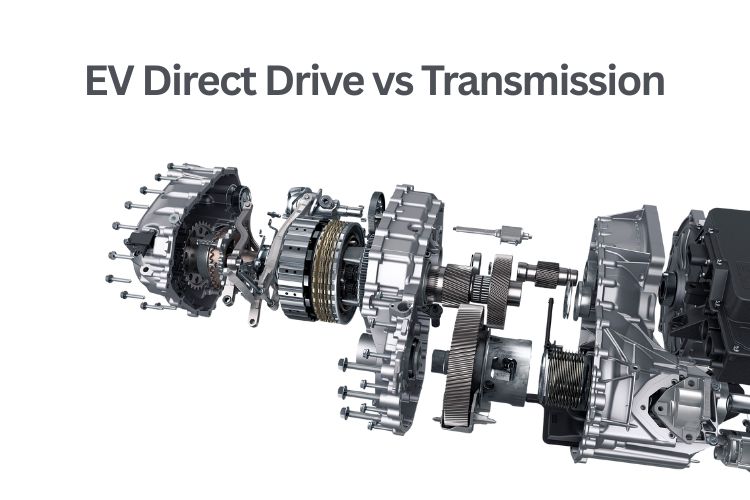
It’s not zero gears. EVs aren’t magic. They still need to translate the motor’s high-speed spinning into wheel motion. What they use is one simple reduction gear that permanently links the motor to the wheels at a fixed ratio.
Tesla uses roughly a 9:1 fixed ratio. The motor spins nine times for every one rotation of the wheels. That’s it. One gear, no shifting, ever.
The motor is so flexible, so capable across such a wide RPM range, that one single ratio handles every speed from creeping through a parking lot to flying down the highway at 120 mph. The gear’s job isn’t to change ratios based on conditions. It’s simply to multiply the motor’s torque and reduce its rotational speed to something appropriate for the wheels. Set it once at the factory, seal it up, and forget about it for the life of the vehicle.
What This Engineering Magic Feels Like Behind the Wheel
Goodbye to the Lurch
Remember that frustrating moment when your car can’t decide which gear to use?
You’re on a slight incline at 35 mph. The transmission shifts to fourth. Then the grade steepens slightly. It downshifts to third. You press the gas a bit more. It shifts back to fourth. Then drops to third again. The whole car jerks and hunts, constantly interrupting your momentum.
Gone. Forever.
Instead, you get one continuous, silky wave of power. It feels like a dimmer switch instead of a three-way bulb. Press the pedal a little, get a little acceleration. Press it more, get more. No interruptions. No waiting. No mechanical drama between your intention and the car’s response.
The “Instant Response” Everyone Raves About
You press the pedal. The car responds now.
Not in half a second after the transmission kicks down two gears. Not after a brief pause while the torque converter locks up. Now. This instant. The millisecond your foot moves, the wheels are getting torque.
This isn’t marketing hype. It’s the physical reality of electric torque delivery. There’s no mechanical translation layer between your command and the motor’s output. The power electronics respond nearly instantaneously, and because the motor makes full torque from zero RPM, there’s no waiting for it to “spool up” or “get into the powerband.”
Pull a quote from real reviewers: “swift acceleration even with one gear” isn’t just true, it’s an understatement. The acceleration is swift precisely because there’s only one gear. No shift interruptions means no momentum loss.
The Smart Exception: Why Porsche Added a Second Gear (And What It Really Means)
The 1% Use Case That Proves the 99% Rule
Porsche’s Taycan has a two-speed rear axle.
Does that mean single-speed is flawed? Not even close. Does it mean multi-speed is the future? Also no.
Here’s what it actually means: for typical driving, a well-designed single-speed system is perfect. Porsche added the second gear for extreme performance at launch and sustained speeds above 150 mph. That’s it. Those are the edge cases where a second gear provides measurable benefit.
The key stat you need to understand: “Every 1% conversion efficiency gains roughly 2% more range,” according to transmission supplier ZF. That sounds compelling until you realize those efficiency gains from a second gear only materialize during specific driving conditions. High-speed cruising above 75 mph. Sustained acceleration beyond 60 mph. Track driving where you’re constantly at full throttle.
Reality check: if you’re mostly commuting, running errands, and occasionally taking highway trips at legal speeds, that second gear is doing almost nothing for you.
When Multi-Speed Actually Makes Sense
Let’s be honest about this.
Heavy-duty applications genuinely benefit from multiple ratios. Electric trucks towing 10,000 pounds up mountain grades can use a lower gear to multiply torque without needing an absurdly large motor. Studies show a three-speed transmission can improve gradeability by 130% compared to single-speed. That’s massive when you’re hauling loads.
High-performance sports cars chasing every tenth of a second benefit too. Porsche’s Taycan uses an incredibly short first gear (about 16:1) exclusively for launches, producing nearly 12,000 Nm of wheel torque. That’s hypercar territory. Around 62 mph, it shifts to a taller second gear (8.05:1) for sustained high-speed performance and a 200+ mph top speed.
But for city commutes and normal highway driving? Single-speed wins on simplicity, weight, cost, and reliability. The Taycan’s two-speed isn’t admitting defeat for single-speed. It’s Porsche refusing to compromise on their brand promise of extreme performance in every scenario.
The Side-by-Side Reality Check: No More Guessing
Let’s end the speculation with facts.
| What Matters to You | Single-Speed Direct Drive | Multi-Speed Transmission |
|---|---|---|
| City responsiveness | Instant, seamless, zero shift events | Same off the line; shift complexity adds no benefit |
| Highway cruising | Smooth and efficient for typical speeds | Marginal efficiency gains only at very high speeds |
| Reliability | Fewer moving parts, far simpler, lower maintenance | More components, more potential failure points |
| Cost | Cheaper to build and maintain | Higher manufacturing and service costs |
| Weight impact on range | Lighter = more range per charge | Heavier = reduced efficiency |
| Real-world driver feel | One continuous power curve, no interruptions | Occasional shifts or mode changes depending on system |
The Bigger Picture: E-Axles and the Future
The industry isn’t just debating gearboxes. It’s racing toward integrated e-axles.
These compact units combine the motor, gearbox, and power electronics into one efficient package. The technology is maturing fast. The global e-axle market is projected to explode from $0.78 billion in 2025 to multiple billions by 2032, showing that both single-speed and strategic multi-speed approaches have staying power.
But here’s the trend: even as the technology advances, the single-speed architecture remains dominant. Innovation is focused on making these systems more compact, more efficient, and more powerful, not on adding complexity through additional gears. The future is about perfecting simplicity, not abandoning it.
Your Life, Your Answer: Which Drivetrain Fits Your Road
The City Slicker vs. The Highway Warrior
If your world is stop-and-go traffic and urban errands, direct drive is your blissful match.
Simple. Reliable. Instant response. You’ll never miss those shifts because you’ll realize how much they were interrupting your flow. The regenerative braking works seamlessly, capturing energy every time you slow down. Single-speed EVs excel exactly where gas cars struggle most: in the constant acceleration and deceleration of city life.
If you’re towing heavy loads, conquering steep mountain passes, or chasing track times? Multi-speed starts making real sense. The torque multiplication of a lower gear means you can use a smaller, lighter motor and still have the grunt you need for demanding tasks. The efficiency gains at sustained high speeds (think 80+ mph cruising) can genuinely extend your range when highway miles dominate your driving.
The control freak’s dream? In-wheel motors offer ultimate simplicity by eliminating even the reduction gear, putting a motor directly in each wheel. But this technology faces cost and durability hurdles, especially on rough roads where unsprung weight becomes a problem.
The Bottom Line
This isn’t about one answer being universally “right.”
It’s about understanding which engineering solution fits your daily reality. Next time you drive, pay attention. Are you mostly smooth cruising between 40 and 70 mph? Or are you constantly battling steep grades, towing trailers, or pushing performance limits?
Your routine holds the answer. And here’s the encouraging part: for the vast majority of drivers, the answer is already built into nearly every EV on the market. Single-speed works because electric motors are just that good.
Conclusion: You’re Not Losing Gears, You’re Gaining Something Better
Gas cars need complex transmissions to survive their narrow power bands. They shift constantly because the engine can’t function across a wide speed range. It’s mechanical compensation for fundamental weakness.
EVs are so torque-rich and flexible, they simply don’t need that complexity. Direct drive offers proven simplicity, instant response, and lower maintenance. It’s elegant engineering that strips away layers of mechanical complication because the motor itself is powerful enough to handle the full spectrum of driving conditions with one fixed gear.
Multi-speed transmissions are precision tools for extreme performance or demanding work, not daily necessities. The Porsche Taycan proves they can be brilliant when implemented for specific, targeted benefits. But they’re the exception that proves the rule: for most of us, one gear is all we need.
Go test drive an EV. But this time, pay attention to the smoothness. Feel that seamless, uninterrupted surge from 0 to 60 mph. Notice what’s not there: the jerks, the hunting, the lag between your command and the car’s response.
This isn’t about missing something. It’s about discovering that simpler engineering, when it’s this good, feels like the future. You’re not sacrificing capability. You’re experiencing what happens when a machine is finally strong enough to drop the complexity.
Transmission vs EV Direct Drive (FAQs)
Why do most electric cars only have one gear?
Yes, by design. Electric motors deliver maximum torque at 0 RPM and maintain strong power across an incredibly wide speed range (0 to 20,000 RPM). This eliminates the need for multiple gears to keep the motor in a narrow “sweet spot” like gas engines require. One optimized gear ratio handles everything from parking lots to highways seamlessly.
Does the Porsche Taycan’s 2-speed transmission really improve performance?
Absolutely. The Taycan uses an ultra-short first gear (16:1 ratio) exclusively for brutal launches, producing nearly 12,000 Nm of wheel torque.
It shifts to second gear around 62 mph for sustained high-speed performance and efficiency. This enables sub-2.6-second 0-60 times and a 200+ mph top speed.
But this benefit only matters for extreme performance driving, not daily commutes.
Can you add a transmission to improve EV range?
Theoretically, yes, for specific conditions. Multi-speed transmissions can improve highway efficiency by 7 to 18% at sustained high speeds (75+ mph) by keeping the motor in its peak efficiency zone. However, they add weight, cost, and complexity while potentially reducing efficiency in city driving. For most drivers, the trade-off isn’t worth it.
Why did Tesla abandon the 2-speed transmission in the Roadster?
Reliability nightmares. Tesla’s original Roadster used a two-speed manual gearbox that couldn’t handle the electric motor’s instant, extreme torque delivery and high RPM operation. It suffered repeated failures. Switching to a robust single-speed unit solved the problem and proved that one gear was not just sufficient but superior for reliability and performance.
What gear ratio is best for EV conversions?
It depends on your priorities. A 9:1 to 10:1 ratio (like Tesla uses) balances strong acceleration with efficient highway cruising for most passenger vehicles. Need more torque for a heavy vehicle or steep grades? Go shorter (11:1 to 13:1). Want higher top speed? Go taller (7:1 to 8:1). Match the ratio to your motor’s RPM range and your typical driving speeds.