It’s 10 PM. You’re in an unfamiliar part of town. Your battery’s at 2%. Your phone flashlight is scanning a dark parking lot for that charging station the app swore was here. That cold panic in your chest? That’s not range anxiety. That’s something deeper.
It’s the fear of breaking a routine you’ve known since you got your first set of keys. Gas is brain-off easy. Pull up, pump, pay, gone. Five minutes, tops. EV charging feels like relearning how to drive all over again.
Here’s what I’m going to do. We’re cutting through every myth, fear, and bad comparison with cold numbers and warm truth. By the end, you’ll see this isn’t about finding a better gas station. It’s about never thinking about refueling again.
Keynote: EV Charging Stations vs Gas Stations
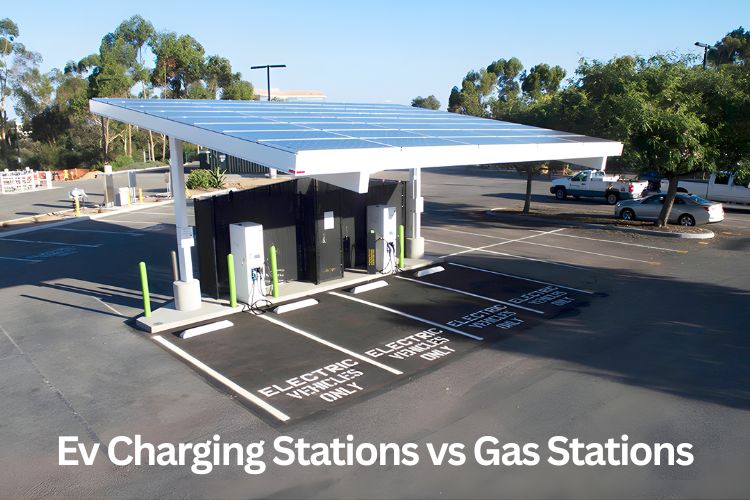
EV charging stations represent a fundamental infrastructure shift, not a direct replacement for gas stations. With 22 ports per 1,000 road miles versus 104 gas pumps, public charging serves a specialized role. Most charging happens at home. This eliminates weekly fueling errands for 80-90% of drivers. Fast charging takes 20-60 minutes but creates dwell-time commerce opportunities. Federal funding targets 500,000 ports by 2030. Nine states already exceed gas station density per area, showing regional infrastructure maturity.
The Mindset Earthquake: You’re Not Switching Fuel Sources, You’re Changing Your Entire Routine
The Gas Station Is an Active Errand You Run
Think about it. You physically go there. Wait in line behind someone buying lottery tickets. Pump. Swipe your card. Watch the dollars tick up like a slot machine you’re losing to. Leave.
It interrupts your day. It’s like making a post office run, except you do it every single week.
That routine has been hardwired into your brain since you got your license. It’s muscle memory. It’s automatic. And honestly? It’s a pain you’ve just learned to tolerate.
EV Charging Is a Background Task You Forget About
Here’s what most articles miss, and it’s the most important thing you’ll read today: you charge while sleeping, working, shopping, or eating. Exactly like charging your phone.
You don’t sit there actively waiting, staring at a progress bar, watching electrons flow. You plug in when you get home. Ten seconds. Done. You go inside, make dinner, watch TV, sleep. In the morning, your car’s ready. Full battery. Every single day.
The real comparison isn’t two minutes versus thirty minutes. It’s a 5-minute errand you run weekly versus 10 seconds of plugging in at home.
That’s the mindset earthquake. You’re not replacing gas stations with charging stations. You’re eliminating the errand entirely.
The Landscape Today: What “Everywhere” Actually Means
For Gas: The Illusion of Abundance
There are about 121,852 convenience stores selling fuel across America. They’re designed to be seen. Giant signs with glowing numbers towering over the highway. Bright lights screaming at you from every main road.
They’re destinations built for speed. In and out. Grab a Red Bull, use the restroom, back on the road.
And yeah, they really are everywhere. About 104 gas pumps for every 1,000 miles of road in this country.
For EVs: The Hidden Reality
Now here’s where it gets interesting. There are roughly 228,000 public charging ports at about 76,000 locations across the U.S. That number’s growing every single month.
But here’s the twist. They’re not screaming at you from the highway. They’re tucked in parking garages. Behind grocery stores. At the mall where you’re already shopping. In the hotel parking lot where you’re sleeping anyway.
They’re not destinations. They’re embedded in places you already go.
When you break it down, that’s about 22 EV charging ports per 1,000 road miles. Yeah, that’s a fifth of what gas offers. But remember what we just talked about? You’re not using these the same way.
What That Gap Feels Like on the Road
Here’s a stat that might surprise you: 64% of Americans live within 2 miles of a public charger. Ninety-five percent live in a county with at least one.
So why does it feel so different? Because one system screams for your attention with 20-foot signs, and the other quietly waits where you already are.
Gas stations are loud about their ubiquity. Charging stations are the wallflowers at the party. They’re there. You just have to look differently.
Speed Reality Check: Two Minutes vs. Twenty to Forty (And Why That’s the Wrong Question)
The Numbers Everyone Quotes
Let’s end the debate right here with actual numbers.
| Refuel Method | Time to “Full” | Range Added | When It Makes Sense |
|---|---|---|---|
| Gas Station | ~2 minutes (plus queue) | 300-400 miles | Always, it’s the only option |
| Home Charging (Overnight) | 8 hours | 200-300 miles | Daily life, 90% of the time |
| DC Fast Charging | 20-60 minutes for 10-80% | 150-250 miles | Road trips, emergencies |
Your average gas fill takes about two minutes at the pump. Maybe three if you’re also grabbing windshield wiper fluid.
DC fast charging typically takes 20 to 60 minutes to go from 10% to 80% battery. In real-world conditions on modern networks like Tesla Superchargers or Electrify America? You’re looking at 38 to 45 minutes.
But Here’s the Reframe Most People Miss
That 30-minute charge stop on a road trip isn’t dead time. It’s a forced coffee break. It’s a chance to actually stretch your legs, not just a quick dash to the restroom. Check emails. Grab real food instead of gas station hot dogs.
I stopped resenting the wait when I realized I needed the break more than my car did.
You plan your stops around meals or interesting attractions, not just a plug. The charging becomes secondary. The destination becomes the point.
And for everything else? For your daily commute, your grocery runs, your kid’s soccer practice? You’re charging while you sleep. The time comparison becomes completely meaningless.
You wouldn’t compare the “time” it takes to charge your phone overnight to driving to a phone charging station, would you? That’s essentially what we’re doing here.
Reliability: The Stat Everyone Quotes and The Truth No One Tracks
The Official Number vs. The Street Truth
You’ll hear that 97% uptime is required for any charging station getting federal NEVI funding. Sounds great, right?
But here’s the thing. Uptime doesn’t equal success.
A charging port can technically be “up” but still broken. The screen’s glitching. The cable’s damaged. The payment system’s having a bad day. The port thinks it’s working, but you’re standing there unable to charge.
Despite all the infrastructure growth, driver satisfaction with public fast charging actually fell in 2025. That tells you everything about the gap between the numbers on paper and the experience on the ground.
What Really Matters: Successful Sessions Per Attempt
Field reality check: charging attempts fail more often as stations age. And you’re juggling multiple apps on your phone. Electrify America. ChargePoint. EVgo. You’re hoping one of them actually works.
The invisible frustration nobody talks about. You drove here specifically to charge. The app says the station’s available. You plug in. Nothing happens. You unplug, try another port. Still nothing. Now you’re stressed, watching your battery percentage like it’s a countdown timer.
Gas stations win on brainless simplicity. Walk up. Pump works. Pay. Done.
The Dream vs. The Reality Right Now
The good news? “Plug and Charge” is coming. It’s already here on some networks. The car and station talk directly. No app needed. No payment fumbling. You just plug in and walk away.
But today, for most drivers on most networks, the experience feels like a tech problem, not a car problem.
This is improving fast. Really fast. But let’s be honest about where we are right now. The experience isn’t seamless yet. And that matters.
Cost Per Mile: Your Wallet Tells the Real Story
Why EVs Often Win Big
Let’s talk money. Real money. Your money.
Electricity is cheaper than gasoline per mile. Way cheaper, especially with home charging.
Quick math that anyone can follow: A car using 29 kWh per 100 miles at the national average of $0.13 per kWh costs about $3.77 per 100 miles. A gas car at 30 mpg and $3.50 per gallon costs about $11.67 per 100 miles.
That’s a third of the cost. Every single day you drive.
But Public DC Fast Charging Narrows the Gap
Here’s where it gets complicated. Public fast charging is expensive. Sometimes really expensive. Location matters. Time of day matters. Some fast chargers cost nearly as much per mile as gas.
| Vehicle Type | Avg. Cost per “Fill-Up” | Avg. Cost per Mile |
|---|---|---|
| Gas Car (15-gal tank) | $50-$70 | $0.12-$0.18 |
| EV (Home Charge) | $9-$15 | $0.03-$0.05 |
| EV (DC Fast Charge) | $20-$30 | $0.10-$0.15 |
See that? If you’re relying only on public fast charging, your advantage over gas shrinks dramatically. You’re still saving, but not the huge amounts you might expect.
The Invisible Savings
But here’s the beautiful part about home charging. It melts into your monthly electric bill. You don’t see a separate line item. It doesn’t feel like you’re “buying fuel.” Even though you are.
It feels almost free. Which makes the pain of watching those gas pump numbers climb feel like a distant memory.
Imagine never budgeting for oil changes, transmission fluid, or that sinking feeling at the pump when prices spike. That’s the EV promise. And for most people who can charge at home, it delivers.
Coverage and Convenience: Not All Plugs Are Created Equal
The Map Inside Your Head vs. The Map on Your Phone
Open any EV charging app right now. You’ll see dots everywhere. Chargers within 2 miles. Looks great.
But “nearby” doesn’t mean “useful.”
That charger 2 miles away might be a slow Level 2 plug at a parking garage with no weather cover, a 30-minute wait, and gates that close at 6 PM. Not all plugs are pizza ovens. Some are toasters.
What actually matters? Power level. Real-time queue data. Amenities like Wi-Fi, seating, actual bathrooms. And 24/7 access so you’re not scrambling at midnight.
The Stress Test: EVs Per Charger
In some places, demand is crushing supply. New Jersey has over 17 EVs for every single public charging port. That’s not a recipe for a relaxed road trip. That’s a recipe for frustration.
| State Reality | EVs per Charger (High = Stress) | Chargers per Capita (High = Access) |
|---|---|---|
| Most Stressed | New Jersey, Hawaii, Washington | Lower access overall |
| Best Access | Moderate ratios | Vermont, D.C., California, Colorado |
| Most Improved | Varies | Northeast region saw largest recent increases |
If you live in a well-served state, the experience is genuinely great. If you don’t, you’re a pioneer dealing with pioneer problems.
And here’s the equity issue nobody wants to talk about: if you can’t charge at home, if you’re in an apartment or don’t have a garage, you’re forced to use expensive public charging for everything. The cost advantage of an EV basically evaporates.
The Station Experience: Snacks, Safety, and Time Worth Spending
Gas stations are optimized for speed. Bright lights. Quick snacks. Clean restrooms (sometimes). Five minutes max.
EV charging needs something different. If I’m going to be here for 30 minutes, I want comfortable seating. Real food, not just Doritos. Wi-Fi that actually works. Weather protection because standing in the rain watching a progress bar is miserable.
The best charging stations get this. They’re at grocery stores where you’re shopping anyway. Restaurants where you’re eating. Hotels where you’re sleeping.
A 30-minute charge feels fine when the stop feels human. When there’s a reason you wanted to be here anyway.
The Billion-Dollar Shift: New Jobs, New Towns, New Roads
The Economic Ripple Effect You’re Not Seeing
Here’s what’s wild. An EV driver stopping for 20 to 30 minutes isn’t just charging. They’re a customer.
They’re buying coffee. Browsing stores. Eating lunch. Spending money they would have never spent during a 5-minute gas stop.
This is a powerful economic development tool, especially for small towns along highway corridors. A charging hub can bring consistent foot traffic to local businesses in a way a gas station never could.
Gas stations brought drive-thru culture. Quick, transactional, gone. EV charging is bringing dwell-time commerce. Slower, more intentional spending.
The Jobs Are Already Here
The EV sector is a job engine. Thousands of new positions even when the broader auto industry is shrinking.
Battery plants opening across the heartland. Charger manufacturing. Installation jobs. A whole new workforce of certified electricians who specialize in EV infrastructure. Sales specialists who actually understand the tech.
These aren’t just coastal jobs. These are Midwest jobs. Southern jobs. Rural jobs.
What This Means for Your Town
Watch for the new construction. Charging hubs with cafes. Coworking spaces. Play areas for kids.
The next generation of road infrastructure is being built right now. And it looks nothing like a gas station.
It looks like a place you’d actually want to spend time.
Conclusion: Stop Looking for a Better Gas Station
We started with that 2% battery panic in a dark parking lot. We walked through every fear, every stat, every comparison. And here’s the truth: this isn’t about trading a 5-minute stop for a 30-minute one.
It’s about trading a weekly errand for 10 seconds of plugging in at home. It’s about never watching dollars tick up on a pump screen again. It’s about road trips that include real breaks, not just fuel stops. It’s about waking up every morning to a “full tank” without ever thinking about it. The infrastructure isn’t perfect yet. But it’s closer than you think. And it’s improving faster than most people realize.
Your one actionable first step for today: Download PlugShare right now. Don’t filter anything. Just look at the map of your town. You’ll be stunned by how many chargers are already hiding in plain sight.
The goal isn’t to replace gas stations. The goal is to make refueling something you never have to think about again. And that future? It’s closer than you think.
Gas Stations vs EV Charging Stations (FAQs)
How many EV charging stations are there versus gas pumps in the US?
Yes, there’s still a significant gap. The U.S. has roughly 150,000 gas stations compared to about 70,000 EV charging locations. But here’s the key difference: that’s about 104 gas pumps per 1,000 road miles versus 22 EV charging ports.
However, most EV charging happens at home overnight, so the public infrastructure serves a fundamentally different purpose than gas stations. You’re not replacing every gas station with a charging station because you don’t need to. Home charging handles 80-90% of your needs.
Which states have better EV charging density than gas stations?
Yes, nine states have already crossed this threshold. Massachusetts leads with 31.4 EV ports per 100 square miles compared to 18.4 gas stations. Other states in this category include Rhode Island, Connecticut, and parts of California. These are typically smaller, densely populated states where the higher concentration of EV adoption and strategic infrastructure investment have created robust charging networks.
However, density per square mile doesn’t tell the whole story. What matters more is whether you can find a charger when and where you need one.
How long does it take to charge an EV at a public fast charger vs filling a gas tank?
No, it’s not equal yet, but it’s not as bad as you think. A gas tank takes about 2 minutes to fill completely. A DC fast charger can get you from 10% to 80% battery in 20 to 60 minutes, typically around 30-45 minutes on modern networks.
But here’s the thing: you’re not sitting in your car actively pumping. You’re grabbing food, shopping, working, or stretching your legs. The time passes differently. And for daily driving, you charge overnight at home, which takes zero active time from your day. The comparison only matters on road trips.
Will EV charging stations outnumber gas stations?
Eventually, yes, but not in the way you think. The federal government aims for 500,000 charging ports by 2030. That’s a massive increase from today’s 200,000+ ports. However, the goal isn’t to create a one-to-one replacement. Gas vehicles need 100% public fueling.
EVs only need about 4% public charging because the rest happens at home and work. So even when public charging becomes ubiquitous, you’ll likely still see fewer charging locations than gas stations. But you won’t need them as often.
Can gas stations make money by adding EV chargers?
Yes, absolutely, but the business model is completely different. Gas stations make 1-2% profit margins on fuel sales. They actually make 70% of their profits from in-store convenience items. Adding EV chargers can drive 10-30% profit margins, but only if utilization rates hit at least 15%. The key is the dwell-time economy.
When drivers spend 20-30 minutes charging, they’re much more likely to come inside, buy food, and spend money. Some studies show that co-locating chargers with dining and grocery stores increases charging events by 2.7 to 5.2 times. Gas stations that adapt early will capture this new customer segment.