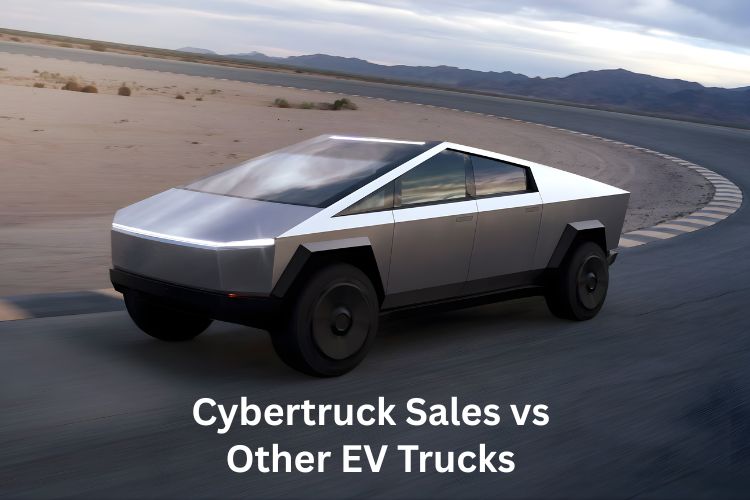
You see them everywhere on your feed. Stainless steel beasts that look like they rolled off a sci-fi set, turning heads at every stoplight. The Cybertruck feels like the electric truck everyone’s talking about, the one rewriting all the rules.
But then you catch a headline: “Cybertruck sales plunge 63%.” Or “Ford F-150 Lightning dominates EV truck market.” And suddenly, the story doesn’t add up. How can something that seems so omnipresent be losing?
Here’s what most articles won’t tell you: both things are true, and the gap between them reveals something fascinating about hype versus habit in the truck world. We’re going to cut through the noise together, using cold, hard data to understand what’s really happening when America shops for electric trucks.
Your path forward: the actual Q3 2025 scoreboard, the story behind the Cybertruck’s stumble, why Ford quietly built a winning machine, and what all of this means if you’re making a decision today.
Keynote: Cybertruck Sales vs Other EV Trucks
Cybertruck sales versus other EV trucks reveal a critical truth about American automotive preferences in 2025. Traditional manufacturers leveraging proven platforms dominate volume sales. Ford’s F-150 Lightning leads with 40% market share by honoring truck culture. GM’s portfolio strategy attacks multiple segments simultaneously. Tesla’s radical design captured niche enthusiasm but failed mass adoption. Registration data shows evolutionary approaches outselling revolutionary ones decisively. Price positioning, service networks, and quality reliability determine winners. The segment expanded 83% in early 2025 before tax credit expiration distorted Q3 demand patterns. Real-world utility beats social media visibility.
The Scoreboard That Ends the Debate
Q3 2025: The Numbers Without the Spin
The third quarter of 2025 delivered a verdict that contradicts every Instagram comment section. Ford F-150 Lightning crushed the competition with 10,005 units sold, capturing a commanding 40% market share. That’s not just winning. That’s domination.
The Cybertruck? It landed at 5,385 units. Down 63% year-over-year from its Q3 2024 peak.
Chevy Silverado EV moved 3,940 trucks, nearly doubling its year-ago performance. GMC Sierra EV delivered 3,374 units, exploding with 772% growth from its launch baseline. And Rivian R1T, playing its own premium game, sold 2,378 units in the adventure truck niche.
Here’s what stings: this happened during a record quarter for EV sales overall. The expiration of the $7,500 federal tax credit on September 30 created a buying frenzy across the entire electric vehicle segment. Every manufacturer rode that wave. Except the Cybertruck actually fell off it.
The Year-to-Date Reality Check
Zoom out to the full nine months of 2025, and the picture sharpens even more. Lightning has sold 23,024 units year-to-date. Steady. Reliable. Up nearly 40% from 2024 in Q3 alone.
Cybertruck sits at 16,097 units for the year. Down 38% compared to last year’s first nine months. That’s not a bad quarter. That’s a trajectory crisis.
Translation: Lightning outsold Cybertruck by 86% in Q3 alone. And while the Cybertruck still holds the number two spot in total volume for 2025, it’s falling fast. That second-place position is only there because of stronger momentum from 2024 carrying over.
Context matters here. The electric pickup truck segment grew overall in 2025. When your competitors are growing and you’re shrinking by double digits, the market isn’t the problem. Your product is.
What These Figures Actually Reveal
Ford commands 35% of the electric pickup market currently. GM’s combined portfolio (Silverado, Sierra, Hummer) has climbed to nearly 39% when you add up all three trucks. Tesla’s Cybertruck? It’s hovering around 22% and dropping.
The pre-order dam broke in 2024. All those hundreds of thousands of reservations converted. Now we’re seeing real demand, the kind that happens when people walk into showrooms or browse dealer lots without a four-year hype cycle behind them.
Here’s the one insight that changes everything: Social visibility does not equal sales velocity. The Cybertruck generates ten times the social media impressions per unit sold compared to the Lightning. But impressions don’t pay factory workers. Volume does.
Why the Cybertruck Feels Everywhere But Isn’t
The Hype Machine vs The Sales Machine
Think of it like this: the Cybertruck is a movie premiere, complete with red carpets and camera flashes. The F-150 Lightning is a daily commuter that just keeps showing up, doing the work, going home.
Every Cybertruck on the road becomes content. People film it at charging stations. They post photos when they spot one at Target. It’s designed to be photographed, talked about, debated in comment sections at 2am.
Meanwhile, the Lightning quietly racks up fleet sales to utility companies and construction contractors without generating a single viral tweet. Ford sells work trucks to people who need work trucks. Tesla sells statement pieces to people who want to make statements.
You notice the unusual, not the familiar and functional. That’s just how human brains work.
The Hidden Truth: We Only Know Cybertruck Numbers From Recalls
Here’s something that’ll surprise you. Tesla doesn’t report Cybertruck sales numbers like Ford publishes quarterly deliveries for the Lightning. They lump it into their overall production figures, keeping the actual sales data locked down tight.
The only reason we know Tesla has built 63,619 Cybertrucks as of October 2025? A recall notice. When the National Highway Traffic Safety Administration issues a recall, they list how many vehicles are affected. That’s literally the only hard number we have for total production.
This opacity lets perception run wild without hard correction. When there’s no official scoreboard, everyone gets to declare themselves the winner. Most comparison articles you read online are actually using estimates, educated guesses, or registration data that trickles in months later.
Two Different Markets, Two Different Missions
Stop comparing apples to spaceships. Most Cybertruck buyers aren’t traditional F-150 owners switching brands. They’re tech enthusiasts, statement-makers, and first-time truck buyers creating a parallel market.
Ford sells to actual working truck owners replacing aging vehicles. The person trading in a 2018 F-150 with 120,000 miles for a Lightning isn’t cross-shopping a Cybertruck. They’re loyal to the F-Series because it’s been America’s best-selling truck for 47 consecutive years for a reason.
Tesla captured a new audience. That’s not failure, that’s just a different mission. The problem for Tesla is that this new audience is much, much smaller than the mainstream truck market Ford already owned.
This explains why both can “succeed” while one sells significantly less. They’re not actually fighting for the same customers.
The Cybertruck’s Stumble: From $40K Promise to $80K Reality
The Price That Broke Trust
Remember 2019? Elon Musk stood on that stage and promised a starting price of $39,900 for the single-motor Cybertruck. That number echoed across the internet for years. It felt revolutionary because it was attainable.
Then launch day arrived in late 2023. The actual starting price? $100,000 for the Foundation Series. The cheapest Cybertruck you could buy cost more than twice what was promised. That’s not adjusting for inflation or market conditions. That’s a completely different product.
Today, the base Cybertruck starts at $79,990. Tesla scrapped the $70,000 version they initially planned. Compare that to Ford Lightning, which starts around $50,000 with available incentives. That’s a $30,000 gap in entry price.
When you promise revolution at Camry prices and deliver luxury at luxury prices, you lose the mass market before you even start.
The Quality Crisis That Wouldn’t Stop
Eight recalls in under 12 months. Let that number sink in for a second.
The accelerator pedal could get stuck. The wiper motor failed in the rain. Exterior trim pieces literally fell off while driving. Each recall notice from the NHTSA landed like a hammer blow to the “apocalypse-proof” narrative Tesla built around the stainless steel exoskeleton.
| Recall Issue | Units Affected | Impact |
|---|---|---|
| Accelerator pedal pad detachment | ~3,900 | Safety-critical, immediate fix required |
| Rearview camera delay | All early units | Reduced visibility, driver confidence |
| Windshield wiper motor failure | Widespread reports | Dangerous in rain conditions |
| Trim panel detachment | All units sold | Embarrassing quality perception |
Real buyers prioritize reliability over radical when spending six figures. Every headline about another Cybertruck recall amplified in the 24-hour news cycle, compounding perception damage even if the fixes were simple.
You can’t build trust in the truck market with a track record like that. Traditional truck buyers are loyal to their brands for 47+ years because those brands don’t fail them.
Form Alienated Function
The high pyramidal bed sides that look so distinctive? They make loading equipment genuinely difficult. Try throwing a toolbox or lumber over those tall, slanted walls. It’s awkward at best, impossible at worst.
The stainless steel aesthetic polarized where F-150 evolution felt safe. A survey shortly after the Cybertruck unveiling found that 44% of Americans who knew about it reacted negatively. Another 27% were indifferent or unsure. Only 29% gave it an outright positive reception.
When less than one-third of your potential market actually likes your design, you’ve built a niche product whether you intended to or not.
And then there’s the politics. Elon Musk’s increasingly polarizing public persona became product liability for some buyers. People who might’ve considered a Tesla suddenly didn’t want to be associated with the brand. That’s a real factor in 2025, whether anyone wants to admit it.
The Momentum Math
Watch how quickly the fall happened. Q1 2025 started with 7,000 to 8,000 units, showing early wobble but nothing catastrophic. Q2 2025 dropped to 4,306 units, down 50% from the previous year’s quarter. That’s when alarm bells should’ve been ringing inside Gigafactory Texas.
Q3 2025 showed slight recovery to 5,385 units, but only because the entire market surged with the tax credit expiration. While competitors rode a wave of demand, Cybertruck was still down 63% year-over-year.
Tesla is hitting just 6.4% of Elon Musk’s promised 250,000 annual production target. That’s not missing the mark. That’s missing the planet.
Reports emerged in mid-2025 that Tesla was slowing Cybertruck production, reassigning factory workers from the Cybertruck line back to the far more successful Model Y. When a company quietly pulls resources away from a product, the market has already delivered its verdict.
How Ford Built the Winning Playbook (Quietly)
They Understood the Assignment From Day One
Ford looked at the electric truck challenge and asked the right question: What do truck buyers actually need? Not what would look cool on Instagram. Not what would generate press coverage. What would get the job done?
The F-150 Lightning looks like an F-150 because that actually works. It’s not cowardice or lack of imagination. It’s understanding that America’s best-selling truck for 47 consecutive years earned that loyalty by being familiar, dependable, and functional.
Evolution strategy honored truck culture instead of fighting it. The Lightning maintained proper truck bed access with a traditional tailgate. It kept real towing capacity that actually matches the specs without massive range degradation. It preserved the interior layout that millions of owners already knew how to use.
This wasn’t about revolutionizing the truck. This was about electrifying the revolution that already happened decades ago when the F-150 became the backbone of working America.
The Trust Flywheel That Compounds
Lightning topped Q3 2025 for reasons beyond just product:
Ford’s established dealer network provides service infrastructure. When your Lightning needs service, you’ve got 2,000+ Ford dealers across America. Compare that to Tesla’s spotty service center coverage, where you might drive two hours for an appointment three weeks out.
Consistent quarterly reporting builds credibility with real truck buyers. Ford doesn’t hide the numbers. They publish detailed sales figures, break down trim levels, and own both the wins and the struggles publicly. That transparency matters when someone’s making a $50,000 to $70,000 purchase decision.
New trims and disciplined pricing kept demand warm through quarters. Ford didn’t slash prices dramatically or panic with discounts. They added value through trim packages and maintained the brand positioning that says “this is a premium product worth the investment.”
“America’s best-selling EV pickup” claim repeated because it’s verifiable. No estimates required. No parsing recall documents for production figures. Just clean, clear, third-party registration data showing Ford on top.
The Total Cost Reality
Lightning qualifies for more federal and state incentives currently. In many states, buyers stack federal credits with local rebates that can reach $2,000 to $5,000 additional savings. That’s real money that changes monthly payment calculations.
Lower entry price accessible to working truck buyers needing utility. A fleet manager buying ten trucks for a construction company can’t swing $80,000 per unit. They can budget $50,000. That’s the difference between getting the contract and watching it go to your competitor.
| Factor | F-150 Lightning | Cybertruck |
|---|---|---|
| Starting MSRP | ~$50,000 | $79,990 |
| Average incentives available | $7,500+ federal, state varies | $7,500 federal (as of Jan 2025) |
| Effective starting price | ~$42,500 | ~$72,490 |
| Used value retention (1 year) | Stable, modest depreciation | Down 55% year-over-year |
| Service network accessibility | 2,000+ Ford dealers nationwide | Limited Tesla service centers |
Used Cybertruck values fell 55% year-over-year versus Lightning stability. When you buy a Lightning, you can reasonably predict what it’ll be worth in three years. When you buy a Cybertruck right now, you’re gambling on resale in a market that’s still figuring out what these trucks are actually worth.
Fleet buyers choosing Lightning for predictable ownership costs at scale. This is the silent majority of truck sales that never makes headlines but pays the bills at Ford.
GM’s Twin Engines and Rivian’s Different Game
Silverado EV and Sierra EV: The Climbing Underdogs
GM looked at the electric truck market and decided to attack from multiple angles simultaneously. Chevrolet Silverado EV targets the mainstream buyer, GMC Sierra EV goes after the premium segment, and GMC Hummer EV owns the ultra-premium, off-road lifestyle space.
Combined Q3 2025 performance tells the story: 3,940 Silverado units plus 3,374 Sierra units. That’s 7,314 trucks from just these two models, putting GM within striking distance of Ford’s Lightning volume when you look at the portfolio as a whole.
GMC Sierra EV exploded with 771% year-over-year growth from a low launch baseline. That’s not just good marketing. That’s product-market fit clicking into place. GM set company records for EV sales in Q3 2025, and the trucks led the charge.
Here’s the smart part: GM delayed full production ramp-up at its Orion Assembly plant from late 2024 to mid-2026. Company officials framed it as “better managing capital investment while aligning with evolving EV demand.” Translation: they watched Tesla build inventory nobody wanted and decided not to make the same mistake.
Rivian R1T: Loved By Few, Built For Purpose
“Brand love doesn’t equal mass-market volumes yet.”
Rivian’s Q3 sales hit just 2,378 units, landing them in last place among major competitors. Year-to-date sits at 5,857 units, down 32.5% from 2024. In a growing segment, that’s the wrong direction to be moving.
The company has revised its full-year delivery forecast downward multiple times throughout 2025. They now project 41,500 to 43,500 total vehicles (including the R1S SUV), which is below their delivery totals for both 2023 and 2024. For a startup trying to scale, going backward on volume is existential.
But here’s what’s fascinating: the R1T itself is genuinely excellent. Critics rave about the gear tunnel, the camp kitchen, the genuine off-road capability that rivals dedicated adventure vehicles. Long-term reliability tests show it’s largely trouble-free. Owners love their trucks.
Rivian’s challenge isn’t making a good product. It’s making a good product profitably at scale while competing against companies with 100+ years of manufacturing experience and dealer networks spanning continents.
Why “Losing” the Numbers Game Can Still Mean Winning
Different success metrics for different missions. Rivian isn’t trying to sell 100,000 trucks next year. They’re building brand trust in a premium niche where Tesla destroyed it through poor execution.
Features-first approach with genuine innovation. The gear tunnel isn’t a gimmick. It’s thoughtful design solving real problems for adventure-focused truck buyers. The camp kitchen and built-in air compressor show a company that actually understands its target customer.
Amazon partnership proves commercial viability beyond consumer pickup sales. Rivian’s electric delivery vans are rolling out by the thousands, providing steady revenue and production learning while the R1T builds its market.
They’re learning to scale production while maintaining quality versus rushing volume. That’s the opposite of what happened with the Cybertruck’s eight recalls in twelve months. Slow and steady might actually win this particular race if they can survive long enough to prove it.
What This Actually Means If You’re Shopping Today
The Clear Winner for Most Real Truck Buyers
If you’re a traditional truck user needing electric, the Lightning wins on practicality and price. It’s not even close.
Network of 2,000+ Ford dealers beats Tesla’s limited service locations when you need warranty work or have questions about your truck. Drive time to service matters when you’re running a business or living in rural America.
Proven towing capacity for work without disappointing real-world range drop. Yes, all electric trucks lose range when towing. But the Lightning’s range estimates are conservative and realistic, not optimistic promises that disappoint in the real world.
Qualifies for tax incentives that meaningfully reduce total ownership cost. Depending on your state, you could stack $10,000+ in combined federal and state incentives. That changes the entire value equation.
When Cybertruck Still Makes Sense (Be Honest)
Tech enthusiasts treating it as statement piece, not primary work tool. If you want the most distinctive vehicle on the road and you’re comfortable being an early adopter of unproven technology, the Cybertruck delivers that better than anything else.
Those genuinely unconcerned with resale value or public perception volatility. If you plan to keep this truck for ten years and drive it into the ground, short-term depreciation doesn’t matter.
Buyers already deep in Tesla ecosystem valuing software integration. If you’ve got two Teslas and a Powerwall already, the seamless integration across the ecosystem has real value.
Understanding you’re paying premium for uniqueness, not utility leadership. The Cybertruck isn’t the most practical truck. It’s not the best value. It’s not the most reliable. But it’s definitely the most unique, and for some buyers, that’s worth the premium and the trade-offs.
The Trends Worth Watching Before You Buy
Cybertruck discounts emerging as Tesla sits on roughly $800 million in unsold inventory by some analyst estimates. If you’re considering one, wait. Prices will come down as Tesla works through the backlog.
Lightning production challenges from supplier issues causing temporary pauses occasionally. Ford isn’t immune to supply chain problems. Monitor inventory levels and wait times before committing.
GM ramping capacity and incentive mix to steer Silverado and Sierra gains. The combined GM portfolio could overtake Ford by mid-2026 if current growth trajectories hold.
Federal credits didn’t return after September 30 expiration. The landscape shifted dramatically. Expect softer overall segment performance in Q4 2025 as the market experiences “payback” from pulled-forward demand in Q3.
The Practical Comparison That Actually Helps You Decide
| Feature | Lightning | Cybertruck | Silverado EV |
|---|---|---|---|
| Price Range | $50K-$70K | $80K-$100K | $50K-$75K |
| Real-World Range | 240-320 miles | 250-340 miles | 400+ miles (class-leading) |
| Payload Capacity | 2,000 lbs | 2,500 lbs | 1,300 lbs |
| Service Network | 2,000+ Ford dealers | Limited Tesla centers | 4,000+ GM dealers |
| Resale Confidence | Stable, proven | Falling 55% YoY | New, unproven |
| Best For | Working truck owners | Tech enthusiasts | Range-focused buyers |
The table doesn’t lie. Match your actual needs to the truck that delivers them.
Conclusion: When Reality Cuts Through the Noise
You’ve traveled from the hype confusion to the hard scoreboard, from broken promises to winning strategies. The Lightning leads because Ford understood that truck buyers value trust over transformation. The Cybertruck’s 63% Q3 collapse isn’t mysterious when you map the price jumps, quality stumbles, and cultural polarization against America’s deep truck loyalty.
GM’s twins are climbing by respecting the market. Rivian plays a craft game for adventure seekers. And the Cybertruck found a niche, just not the revolution it promised. The numbers don’t lie: in 2025’s real market test without the pre-order cushion, traditional brands are winning by honoring what truck buyers actually need.
Do this today: Shortlist two models that match your actual use case, not your Instagram aesthetic. Book back-to-back test drives this week. Feel the bed height, test the charging experience, talk to real owners at the lot. Let your hands and your budget vote, not the headlines.
And remember this: The loudest truck on social media isn’t always the smartest choice in your driveway. Momentum changes, but your needs for range, payload, and reliable service stay constant. Choose the truck that works for your life, not the one that works for someone else’s feed.
Cybertruck vs Other EV Truck Sales (FAQs)
Which electric truck is the best seller?
Yes, the Ford F-150 Lightning is currently the best-selling electric truck. It sold 10,005 units in Q3 2025, capturing 40% market share and leading all competitors by a significant margin.
How many Cybertrucks are sold per month?
Roughly 1,800 to 2,400 Cybertrucks per month based on Q3 2025 quarterly data. That’s down significantly from mid-2024 peaks, reflecting the 63% year-over-year sales decline Tesla is experiencing.
Does the Cybertruck qualify for the $7,500 tax credit?
Yes, as of January 2025, both the dual-motor and single-motor Cybertruck configurations qualify for the full $7,500 federal tax credit. This closes the effective price gap with competitors significantly.
Why did F-150 Lightning sales overtake Cybertruck?
Lightning maintained conventional truck functionality that traditional buyers trust while Cybertruck’s radical design, quality issues, and price increases alienated mainstream truck shoppers. Ford’s 2,000+ dealer network also provides service access Tesla can’t match.
What is the cheapest electric pickup truck?
The Ford F-150 Lightning and Chevrolet Silverado EV both start around $50,000 before incentives. With federal and state tax credits combined, effective starting prices can drop to around $42,500, making them the most accessible electric trucks.