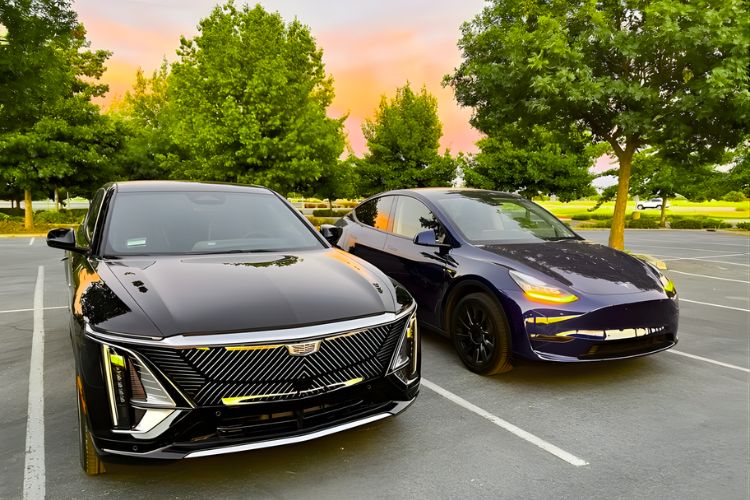
You’re standing in your driveway, keys in hand, staring at your gas guzzler. The needle’s hovering near empty again. You know it’s time to go electric, but you’re frozen. Not from indecision about whether to switch, but about which path to take.
Forty-seven articles later, you’re more confused than when you started. Half the internet swears Tesla is the future. The other half whispers that Cadillac is quietly winning. One feels like a tech experiment you’re beta testing. The other feels like, well, Cadillac. Leather. Buttons. Actual customer service.
Here’s the thing: Do I pick the software-first disruptor or the serenity-first luxury brand? And why does this feel less like buying a car and more like choosing an identity?
We’ll cut through the hype using cold, hard data and warm, real feelings to find which one actually belongs in your life. Because 52% of Americans now own or would consider an EV, yet the choice has never felt more paralyzing.
Keynote: Cadillac EV vs Tesla
Cadillac’s Ultium-powered LYRIQ and Tesla’s Model Y represent fundamentally different luxury philosophies in 2025. The LYRIQ delivers traditional craftsmanship with Super Cruise hands-free driving and comprehensive standard features at $58,595. The Model Y starts cheaper but requires expensive add-ons for comparable equipment. Both offer similar range (310-330 miles) and now share Supercharger access via NACS adapters. Choose Cadillac for interior quality and service accessibility. Choose Tesla for software innovation and minimal design.
The Exodus Nobody’s Talking About
The Escape Hatch Phenomenon
Here’s a stat that should make you sit up: 25% of Cadillac LYRIQ buyers are former Tesla owners. Not cross-shoppers. Not tire kickers. Former believers who owned a Tesla and deliberately chose to leave.
They’re not comparing anymore. They’re fleeing. And this exodus means something crucial for your decision right now. When a quarter of your customer base comes from the competition, that’s not marketing. That’s a referendum.
The Identity Crisis of Owning Tesla in 2025
Let’s address the elephant charging in the room. It’s not just about the car anymore. You wanted innovation, not a rolling political billboard. You wanted to feel good about your environmental choice, not defensive at dinner parties.
The validation you’re feeling right now? It’s real. As Joseph Yoon, an Edmunds analyst, puts it: “If your priority is to get out of the Tesla ASAP, then they’re not, technically, cross-shopping.” They’re escaping.
The new luxury move in 2025 is quiet confidence over loud disruption. It’s choosing the vehicle that whispers rather than shouts.
The Money Truth: What You’re Actually Paying For
The Sticker Shock Reality Check
Let’s lay out what your money actually buys:
| Model | Starting MSRP | What’s Actually Included |
|---|---|---|
| Cadillac LYRIQ | $58,595 | Super Cruise hands-free driving, 33-inch curved display, home charging cord, AKG premium audio, real luxury materials |
| Cadillac OPTIQ | $54,390 | Full AWD capability, Super Cruise standard, premium interior, tax credit eligible |
| Tesla Model Y | $46,380 | Base features only. Self-driving costs $8,000 extra. Premium paint adds $2,000. Tow hitch is another add-on. |
| Tesla Model X | $84,990 | Nearly $25,000 more than LYRIQ for similar luxury positioning |
The Hidden Paywall Problem
That “cheaper” Tesla starts to look expensive fast. You want Autopilot that’s actually useful? Add $8,000 for Full Self-Driving. You don’t want boring white paint? That’s $2,000. You need to tow your boat? More money.
By the time you configure the Tesla you actually want, you’ve paid premium prices for a cabin that still feels like a minimalist lab. The LYRIQ includes Super Cruise as standard. The 33-inch display comes in the box. The premium audio system doesn’t cost extra. The charging equipment arrives with the car.
Calculate the real math. A comparably equipped Tesla Model Y Long Range with FSD capability runs you north of $54,000. You’re already in LYRIQ territory, except one has massage seats and the other has vinyl.
The Service Cost Nobody Warns You About
Picture this: Your EV develops a problem the week of your daughter’s wedding. You’re the one driving everyone to the venue. Who answers the phone?
Cadillac has over 900 dealerships across North America. You can get a service appointment within days, sometimes same-day for urgent issues. Mobile service is expanding. Your local dealer has technicians who’ve been working on cars for decades.
Tesla? You’re booking weeks out. Maybe a mobile ranger shows up, maybe not. The nearest service center might be 90 miles away. You’re in a queue with thousands of other owners, all competing for limited appointment slots.
This is the 120-year advantage playing out in real time. When something breaks, infrastructure matters more than over-the-air updates.
The Living Room Test: Warmth vs. The Waiting Room
Inside Tesla: Clean or Cold?
Let’s get honest about what you’re sitting in. Tesla calls it “clean design.” Most people who aren’t in the cult call it sparse. Austere. Cold.
It’s one giant screen dominating a dashboard. The seats are covered in synthetic leather that doesn’t age well. You want to adjust the wipers? Touch the screen. You want to open the glovebox? Touch the screen. You want to feel like you’re in a $50,000 luxury vehicle and not a tech demo? You’re in the wrong car.
And those panel gaps everyone jokes about? They’re real. Consumer Reports consistently flags Tesla’s build quality as below average for the luxury segment. The doors don’t close with that satisfying thunk. Trim pieces don’t quite line up. It’s the kind of fit and finish that traditional luxury brands would never allow out the factory door.
Inside Cadillac: The Sensory Sanctuary
Now step into the LYRIQ. Real wood trim, not fake applique. Metallic accents that feel substantial under your fingers. Premium leather that actually smells like leather. And that 126-color ambient lighting system? It’s not a gimmick. It’s choreographed to match the time of day, creating what Cadillac calls a “Symphony of Serenity.”
That 33-inch curved OLED display wraps around you like a private theater, not a spreadsheet. The interface is powered by Google Built-In, so it actually works like your phone instead of fighting you. Wireless Apple CarPlay and Android Auto come standard because Cadillac understands you have a tech life outside their ecosystem.
The artful spaciousness of the cabin makes it feel bigger than the specs suggest. This is the exhale interior. You sink into the seat after a hard day and feel your shoulders drop.
The Ride Quality That Changes Everything
Here’s what most guides get wrong: Comfort reduces range anxiety. When you’re not being jostled over every expansion joint, when road noise isn’t booming through the cabin, when the suspension actually absorbs bumps instead of transmitting them directly to your spine, you arrive less stressed. Less fatigued.
The Model Y has what automotive journalists politely call a “firm, sporty ride.” Owners are more direct: It’s jittery and uneven, especially on rough pavement. The cabin gets boomy at highway speeds because there’s minimal sound deadening. Tesla prioritized performance over refinement.
The LYRIQ rides like a magic carpet. GM’s engineers spent decades perfecting suspension tuning. That expertise shows. It’s the difference between a Swiss watch and an iPhone, between a luxury lounge and a minimalist lab.
Range & Charging: The Advantage That Just Evaporated
The Range Reality Check
Let’s kill the myth that Tesla has some magical range advantage:
EPA-Estimated Ranges:
- Tesla Model Y Long Range AWD: 311-337 miles
- Cadillac LYRIQ RWD: 326 miles
- Cadillac LYRIQ AWD Sport: 319 miles
- Cadillac OPTIQ: 302 miles (but Edmunds achieved 339 miles in real-world testing)
- Cadillac Escalade IQ: 460 miles with its massive 200-kWh pack
The LYRIQ’s 102-kWh Ultium battery delivers real-world range that matches or exceeds the Model Y for most drivers. And if you need more, the Escalade IQ offers range that embarrasses almost everything on the market.
The Charging Network Game-Changer
The script just flipped. GM and Cadillac EVs gained access to Tesla’s Supercharger network in 2024 with an approved adapter. That’s 17,500+ additional fast charging locations.
Starting with the 2026 Cadillac OPTIQ, new models will come with native NACS ports built in. No adapter needed. You’ll plug directly into Superchargers just like a Tesla.
Tesla’s ultimate advantage just disappeared. Now you choose based on the car you want to sit in, not the plugs you have access to. The charging infrastructure moat has been breached, and Cadillac walked right through.
The Fast Charging Reality
With DC fast charging, the LYRIQ adds 86 miles of range in just 10 minutes. That’s a coffee break, not a lunch break. You’re looking at roughly 25-26 minutes to go from 10% to 80% charge on a capable DC fast charger.
Tesla still has an edge with 250-kW peak charging on many Supercharger sites. But here’s what they don’t advertise: Both brands intentionally slow charging beyond 80% to protect battery longevity. That final 20% can take as long as the first 60%. Plan your road trips around 80% charges, and the difference becomes negligible.
The LYRIQ’s 19.2-kW home charging capability means you’re adding 51 miles of range per hour on a Level 2 home charger. That’s a full charge overnight, every night, without thinking about it.
Technology: The Highway Serenity Versus the Beta Experiment
Super Cruise vs. Autopilot: The Hands-Free Truth
| Feature | Cadillac Super Cruise | Tesla FSD (Supervised) |
|---|---|---|
| Truly Hands-Free? | Yes, on 400,000+ miles of pre-mapped highways | No, requires “occasional steering input” per Tesla’s own warnings |
| Driver Monitoring | Advanced driver-facing camera system | Driver-facing camera |
| Works On | Pre-mapped divided highways only | City streets and highways |
| Regulatory Status | Approved hands-free system | Under investigation for traffic violations and safety concerns |
| The Vibe | Seasoned chauffeur on roads they know perfectly | Brilliant but erratic intern you must supervise constantly |
Super Cruise is truly hands-free on its mapped highways. You can take your hands off the wheel and relax. The system monitors your eyes to ensure you’re paying attention, but your hands can rest. It’s the definition of highway serenity.
Tesla’s Full Self-Driving (Supervised) requires your hands on the wheel “at all times” according to their own manual. It’s more capable in some ways, handling city streets and complex intersections. But you’re supervising a beta test. Every drive is an experiment.
If highway serenity is your jam, Super Cruise feels simpler and calmer. If you want to be on the bleeding edge of autonomous driving development, FSD is more ambitious. Just know what you’re signing up for.
The Software Philosophy Fork
Tesla’s strength is undeniable: Industry-leading over-the-air updates. Your car genuinely improves over time with new features dropping regularly. It’s exciting if you’re a tech enthusiast.
But here’s the question: Do you want a car that’s constantly changing, or one that works perfectly from day one? Tesla treats your vehicle like a software product in perpetual beta. Cadillac treats it like a finished luxury product with steady refinement.
The LYRIQ gets OTA updates too. Google Built-In means your infotainment stays current. But the core driving experience is stable, polished, complete. You’re not a beta tester. You’re a customer.
The Ecosystem Lock-In Reality
Tesla’s ecosystem is a walled garden. No Apple CarPlay. No Android Auto. You use their interface, their maps, their apps, or nothing. If you’ve invested years in building your digital life around Apple or Google, you’re starting over.
Cadillac’s openness means seamless integration with your existing tech life. Your music, your contacts, your navigation preferences, all carried over wirelessly. It’s the difference between joining a new platform and bringing your life with you.
The Decision Framework: Which Car Is Actually Yours?
Choose Cadillac LYRIQ If…
You value traditional luxury and want to feel pampered, not productive. Every surface in the cabin matters to you. You touch the steering wheel and want to feel quality.
Service anxiety keeps you up at night. You want a local dealer who knows your name, not a distant service center with a three-week wait.
You’re tired of defending your car purchase at dinner parties. You want to drive something that doesn’t come with cultural baggage.
Build quality and tactile materials matter more than 0-to-60 bragging rights. You’d rather have massage seats than shave half a second off a sprint you’ll never actually do.
Choose Tesla Model Y If…
You genuinely love minimalist aesthetics and don’t mind sparse interiors. Less is actually more for you, not a cost-cutting measure you’re rationalizing.
You’re a true tech enthusiast who wants the latest software experiments. You enjoy being on the cutting edge even when edges are rough.
You don’t mind waiting weeks for service appointments. You’re patient and plan ahead.
The Supercharger network still feels essential, even though Cadillac now has access. The native integration matters to you.
The Wild Card Options
The Road-Trip Pragmatist should consider the LYRIQ RWD. Maximum range, Super Cruise for highway serenity, NACS adapter for Supercharger access. Low-stress long-distance travel solved.
The Luxury Maximalist wants the Escalade IQ. If you need extreme range (460 miles), massive space, and a 200-kWh battery tech showcase, this is your answer.
The New-School Value Player should look at the OPTIQ. Mid-$50,000s pricing, standard Super Cruise, comfortable interior, and the 2026 models get native NACS ports. It’s the complete package.
Warranty & Peace of Mind: Who Stands Behind You?
The Coverage Reality
Warranty at a Glance:
- Cadillac: 4 years/50,000 miles bumper-to-bumper; battery 8 years/100,000 miles; drivetrain 6 years/70,000 miles
- Tesla Model Y: 4 years/50,000 miles basic; battery 8 years/120,000 miles (Long Range/Performance) or 8 years/100,000 miles (base)
- Both guarantee roughly 70% battery capacity minimum during warranty term
Tesla edges ahead on battery warranty duration. But here’s what matters more: When you need to use that warranty, who answers?
Cadillac’s dealer network means warranty work gets done locally. Tesla’s service capacity constraints mean you’re competing with everyone else for appointments. A better warranty on paper doesn’t help if you can’t access the service.
The Recall and Reliability Signals
Tesla’s track record includes frequent over-the-air updates, which is great. It also includes headline-grabbing recalls for power loss, steering issues, and Full Self-Driving problems. The company moves fast and sometimes breaks things.
Cadillac’s approach is slower and more deliberate. The UX evolves calmly. Super Cruise is expanding globally, now launching in South Korea. It’s not exciting in the same way. It’s just stable.
Ask yourself: Do you prefer rapid iteration or stability? There’s no wrong answer, but there is an answer that’s right for you.
Conclusion: Your New Reality With an EV That Fits Your Soul
You’ve learned that 25% of LYRIQ buyers are fleeing Tesla. That charging anxiety is over because Cadillac has Supercharger access now. That the “cheaper” Tesla has hidden costs lurking behind every option code. That Super Cruise offers true hands-free serenity while FSD requires constant supervision.
The warranty numbers are close enough not to matter. The range is equivalent. The charging infrastructure advantage just evaporated. What’s left is the actual car. The materials. The service. The feeling.
Your one action today: Schedule test drives within 48 hours of each other. Sit in both interiors for 10 minutes without driving. Touch the materials. Work the screens. Close the doors. Your gut will know which one makes you smile.
The best EV isn’t the one that wins on a spreadsheet. It’s the one that makes you feel the way you want to feel every single morning when you walk to your driveway. And that feeling? Nobody else can tell you which car delivers it.
You’re no longer frozen. You know what each car is really offering. Now go feel them.
Tesla vs Cadillac EV (FAQs)
Does Cadillac LYRIQ qualify for the federal EV tax credit?
Yes, but act fast. Vehicles acquired before September 30, 2025, can still claim up to $7,500 using IRS Form 8936. After that date, the credit expires completely. The LYRIQ meets the MSRP cap ($80,000 for SUVs) and assembly requirements. Your modified adjusted gross income must be under $300,000 (joint filers) to qualify.
How does Cadillac Super Cruise compare to Tesla Autopilot?
Super Cruise is truly hands-free on pre-mapped highways, using driver-facing cameras to monitor attention. Tesla’s FSD (Supervised) requires hands on the wheel at all times and works on more road types.
Super Cruise feels like a polished chauffeur on roads it knows. FSD feels like supervising a brilliant intern who’s still learning. Choose based on whether you value serenity or experimentation.
What is the real-world charging time for LYRIQ vs Model Y?
Both take roughly 25-30 minutes to charge from 10% to 80% on DC fast chargers. The LYRIQ adds 86 miles in 10 minutes. The Model Y can peak at 250 kW on Superchargers, giving it a slight edge. For home charging, the LYRIQ’s 19.2-kW capability adds 51 miles per hour, meaning overnight charging covers most people’s daily needs completely.
Can Cadillac EVs use Tesla Superchargers in 2025?
Absolutely. GM-approved NACS adapters became available in 2024, giving current LYRIQ owners access to 17,500+ Tesla Superchargers. Starting with the 2026 OPTIQ and future models, Cadillac EVs will have native NACS ports built in. No adapter needed. The charging infrastructure advantage Tesla held for years has been completely neutralized.
Which has better warranty coverage, Cadillac or Tesla?
Tesla’s battery warranty is longer (8 years/120,000 miles vs 8 years/100,000 miles), but Cadillac offers a stronger drivetrain warranty (6 years/70,000 miles vs none separately stated for Tesla).
The real difference is service access. Cadillac’s 900+ dealer network means local warranty work. Tesla’s limited service centers mean longer waits. A better warranty matters less if you can’t use it conveniently.