You’re lying awake, phone glowing in the dark, comparing quotes that range from $880 to $4,500 for what looks like the exact same thing. Your neighbor swears they paid “basically nothing,” but the licensed electrician you called today quoted $2,800 and mentioned something about your switchboard from 1987 needing work. Meanwhile, your shiny new EV sits in the driveway, plugged into a regular power point that’s taking sixteen hours to add enough range for tomorrow’s commute.
Here’s what nobody tells you upfront: the confusion isn’t your fault. Melbourne’s EV charging landscape is a mess of outdated information, disappeared government rebates, and installers who either lowball to win your business or pad quotes with unnecessary upgrades. But underneath all that noise, there’s a clear path to getting a safe, affordable home charger that actually fits your life.
Let’s cut through this together. We’ll decode what fair pricing looks like in Melbourne right now, figure out which charging speed you actually need, spot the red flags in quotes, and get you to that first morning where you wake up to a fully charged car without the bill shock or installer regret.
Keynote: Affordable Home EV Charger Installation Melbourne
Affordable home EV charger installation in Melbourne costs $1,500 to $3,000 for licensed electrician installation of Level 2 charging stations with Victorian compliance. Single-phase 7kW chargers suit most daily drivers, while switchboard upgrades add $1,000 to $3,000 for older homes. Smart solar integration and off-peak charging maximize long-term savings for Melbourne EV owners.
The Number Everyone Quotes Is Wrong (Here’s What You’ll Really Pay)
Your Actual Cost Window for Melbourne in 2025
The installer who quoted you $880 wasn’t lying, but they probably weren’t telling you the whole story either. That’s the rock-bottom price for a simple ground-level install with a short cable run and a modern switchboard that doesn’t need any work. It’s real, but it’s rare.
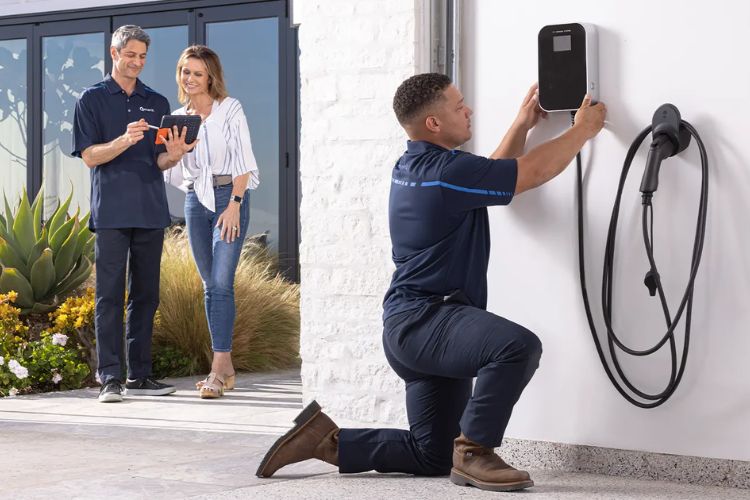
Most Melbourne homeowners installing a Level 2 EV charger end up paying between $1,500 and $3,000 when everything’s done. The sweet spot for a quality 7kW charging station setup lands around $2,100 to $2,400. That includes a reliable charger, professional installation by a licensed electrician, all the safety switches and circuit breakers, and the Certificate of Electrical Safety you legally need in Victoria.
The lower end becomes possible when you’ve got a short cable run from your switchboard to your parking spot and a relatively new electrical panel with spare capacity. The higher bills kick in when you need long cable runs, switchboard upgrades, or you’re chasing that three-phase conversion dream.
Where Your Money Actually Disappears To
Let me break down where your dollars actually go, because understanding this stops installers from padding quotes with mysterious “additional fees.”
Hardware costs run $780 to $1,600 depending on the smart features you choose. A basic Tesla Wall Connector sits at the budget end. A solar-smart Zappi charger with all the bells and whistles hits the higher range.
Labor costs from a certified A-grade electrician typically land between $800 and $1,500. This covers the actual installation work, testing, and compliance paperwork. Melbourne rates vary by suburb, but you’re looking at 4 to 6 hours of skilled electrical work.
Protection devices, circuit breakers, and that Certificate of Electrical Safety paperwork add another $200 to $400. These aren’t optional extras. They’re mandatory under Victorian electrical standards and Energy Safe Victoria requirements.
Cable runs beyond ten meters start increasing costs by $10 to $15 per meter. If your switchboard lives on the opposite side of your house from where you park, this adds up fast. One of my colleagues in Doncaster paid an extra $350 just for the cable run to reach his carport.
The Rebate Reality That Will Disappoint You
I need to be straight with you about something that’ll save you hours of searching: Victoria’s generous $3,000 EV subsidy ended on June 30, 2023, and it’s not coming back. Every article still promoting that rebate is outdated.
The federal government offers up to $1,000 for hardware and installation combined, but qualifying criteria are strict. You’ll need to check current eligibility rather than counting on it.
There’s still a $100 annual registration discount available until January 2026, but that’s it. Your real savings with affordable home EV charger installation in Melbourne come from off-peak charging rates, not government handouts. Smart charging during the 10pm to 5am window at $0.20 to $0.25 per kilowatt-hour instead of peak rates at $0.60 adds up to serious money over time.
The Hidden Switchboard Ambush
Here’s where quotes get messy and trust breaks down. Many installers won’t mention switchboard work until they’re already at your place.
Older Melbourne homes, especially those built between the 1920s and 1980s, often need RCD protection or capacity upgrades. If your electrician opens your switchboard and sees ceramic fuses, you’re guaranteed to pay an extra $1,000 to $3,000 for mandatory safety updates. It’s not a scam. It’s physics and Victorian law working against your 1970s wiring.
Modern switchboards with spare circuit ways and adequate capacity let you skip this expense entirely. Most EV chargers need a dedicated 32-amp circuit. If your board doesn’t have the space or the amp capacity to support that load safely, it needs work before any charger goes in.
Smart move: ask for two separate quotes upfront. One for the minimum safe install, and another for a future-proofed setup that won’t require more work when you buy your second EV or upgrade your solar system.
Single Phase vs Three Phase: Stop Overthinking This Decision
What These Terms Mean in Actual Human Language
Let me translate the technical jargon into something that makes sense. Single-phase power is like having one garden hose filling your pool. Three-phase power is like having three hoses working together. Both get the job done, but one’s faster.
Most Australian homes run on single-phase 240V supply. It’s perfectly fine for overnight charging. You’ll wake up to a full battery every morning without spending thousands on electrical upgrades.
Three-phase charging delivers faster speeds, but here’s the thing nobody mentions: most daily drivers rarely need it. If you’re driving under 100 kilometers daily, single-phase handles it easily while you sleep.
The Charging Speed Reality Check
Let’s talk actual kilometers added per hour, because that’s what matters when you’re planning your routine.
Level 1 charging through a regular household outlet adds 10 to 20 kilometers of range per hour. It’s painfully slow and ties up an outlet you probably need for other things.
Level 2 single-phase charging adds 30 to 50 kilometers per hour. That’s the sweet spot for most Melbourne EV owners. Plug in at 10pm, wake up at 6am, you’ve added 240 to 400 kilometers of range. Unless you’re driving to Sydney daily, you’re sorted.
Level 2 three-phase charging adds 60 to 80 kilometers per hour. Fast, impressive, and completely unnecessary for most people.
DC fast charging at home costs thousands to install and you probably don’t need it. Save that for road trip stops.
When Upgrading to Three Phase Actually Makes Sense
Don’t let me talk you out of three-phase if you genuinely need it. Some Melbourne homeowners do.
You’re a solid candidate if you drive over 150 kilometers daily and need rapid turnaround charging times. Rideshare drivers, sales reps covering regional Victoria, or anyone doing back-to-back long trips benefits from that speed.
You’re also set if you’re running a business with multiple EVs sharing one charging point. Three-phase with load management lets you charge two vehicles simultaneously without waiting.
If your home already has three-phase power for pool equipment, workshop machinery, or because it was built that way, the upgrade cost drops significantly. You’re just tapping into existing infrastructure.
Finally, if you want future-proofing and you’re comfortable paying the $1,500 to $2,500 premium for the electrical upgrade plus the three-phase compatible charger, go for it. Just know what you’re buying and why.
Choosing Your Charger: The Brands Melbourne Electricians Actually Recommend
The Tesla Wall Connector: Cheap and Surprisingly Universal
I know what you’re thinking. Tesla charger for a non-Tesla? Sounds wrong, but it’s actually the secret weapon of budget-conscious Melbourne EV owners.
The Tesla Wall Connector costs just $780 to $800, making it Australia’s cheapest quality Level 2 EV charger. Despite the confusing brand marketing, it works with all EVs through the standard Type 2 connector. You’re not locked into Tesla vehicles forever.
Australian electricians voted it their second choice for their own homes in a 2025 industry survey. That tells you everything about reliability and value. It includes power-sharing capability so you can eventually add a second charger, and app control for scheduling without ridiculous monthly subscription fees.
The main trade-off? No built-in solar integration. If you’ve got rooftop panels or plan to add them soon, keep reading.
Zappi: The Solar Power Champion
The MyEnergi Zappi costs more upfront at $1,345 to $1,695 depending on whether you need single-phase or three-phase versions. But if you’ve got solar panels already or you’re planning to install them, this charger pays for itself.
Built-in smart solar charging automatically uses excess rooftop solar first before pulling from the grid. On sunny Melbourne days, that effectively charges your car for free using surplus solar energy you’d otherwise export for a measly 5 to 10 cents per kilowatt-hour.
A colleague in Brighton with a 6.6kW solar system told me his Zappi charged his EV purely from solar about 60% of the time during summer months. That’s real money staying in his pocket instead of going to his electricity retailer.
Best for homes with solar already installed, or anyone planning to add panels within the next year or two.
Other Solid Options Without the Marketing Hype
The Fronius Wattpilot topped the list when Australian electricians were asked which charger they’d install in their own homes. It’s got excellent build quality, intuitive controls, and strong local support networks.
Wallbox Pulsar Plus and Ohme offer smart app control if you like managing everything digitally. Schedule charging times, monitor energy usage, and adjust settings from your phone.
Ocular provides locally-made options with good Australian support. When something breaks, you’re dealing with Melbourne-based customer service, not emailing overseas and waiting weeks.
Skip the cheapest Chinese brands your installer hasn’t heard of or serviced before. The $200 you save disappears fast when the charger fails after six months and nobody knows how to fix it.
Smart Features Worth Paying Extra For (And Which Ones Aren’t)
WiFi scheduling captures off-peak electricity rates, saving you $0.30 to $0.40 per kilowatt-hour compared to peak charging. That’s worth the extra $150 to $200 for smart capability.
Load management prevents tripping circuit breakers when you’re running the oven, air conditioner, and charging your car simultaneously. Essential if you’ve got an older switchboard running near capacity.
Go with a basic tethered charger if budget’s tight and your usage pattern stays predictable. Plug in every night at the same time, set it, forget it.
Skip fancy color touchscreens and ongoing subscription services. Choose features matching your actual daily routines, not the ones that look impressive in marketing videos.
Finding an Installer Who Won’t Rip You Off or Disappear
Red Flags That Scream Run Away Right Now
They quote over the phone without seeing your home’s actual electrical setup first. Every Melbourne property is different. Switchboard configurations, cable run distances, and existing infrastructure matter. Anyone promising firm pricing without inspecting your site is guessing or planning to hit you with change orders later.
Pressure tactics with fake “today only” discount sales pitches. Legitimate installers book weeks ahead right now. They don’t need desperate closing techniques.
No ABN, no license number displayed clearly, or vague responses about insurance coverage details. Licensed electricians carry public liability insurance and aren’t shy about proving it.
They badmouth every other installer in Melbourne as their primary sales technique. Professionals respect their competition. Cowboys tear everyone down to make themselves look better.
What Licensed A-Grade Electricians Actually Do Differently
Licensed A-grade electricians in Victoria comply with AS/NZS 3000 wiring standards and carry proper public liability insurance. That’s not marketing fluff. That’s what protects you legally and financially if something goes wrong.
They assess your switchboard capacity before quoting and explain upgrade requirements honestly. Good installers tell you upfront: “Your 1960s board needs $1,200 in safety work before we can touch a charger.” Bad installers discover that after they’ve got your deposit.
Certified installers follow manufacturer installation recommendations strictly and meet Victorian electrical standards. They pull proper permits, arrange Energy Safe Victoria inspections, and stand behind their work with real warranties you can actually enforce.
The Quote Breakdown You Won’t Compromise On
Demand line-item breakdowns. Charger model and exact specifications, cable length and type, protection devices (RCD, circuit breakers), labor hours, Certificate of Electrical Safety, and any additional components.
Ask explicitly if the price includes switchboard work, wall penetration and patching, trenching if needed, and rubble removal. These “extras” add hundreds of dollars fast.
Confirm separate warranties on hardware (usually manufacturer-backed for 2 to 3 years) and installation workmanship (typically 12 months minimum from reputable installers).
Reject anything vague like “complete EV charger package” with no clear specifics listed. That’s not a quote. That’s a placeholder for whatever they decide to charge you later.
Questions to Ask Before Handing Over Your Deposit
How many EV chargers have you personally installed in the last twelve months? You want someone who’s done at least 20 to 30 residential installations, not someone learning on your switchboard.
Can you provide three recent customer references I can actually call today? Real installers have happy customers willing to vouch for them.
What’s included in your quote and what would trigger additional charges? Get the scope crystal clear before signing anything.
Do you warranty installation workmanship separately from hardware, and what’s the term? Charger might be warranted for three years, but installation should be backed for at least twelve months.
The Mistakes That Cost Melbourne Owners Thousands (Learn From Their Pain)
The DIY Disaster: Why This Isn’t a Weekend Project
I’ve seen the YouTube videos too. Bloke in his garage running cable, mounting a charger, acting like it’s assembling IKEA furniture. Don’t fall for it.
Older Melbourne homes often lack the electrical capacity for EV chargers without proper upgrades. You might think your switchboard looks fine. An inspector will see missing RCD protection, inadequate circuit sizing, and outdated wiring methods that violate current Victorian standards.
DIY installations risk power surges, improper grounding, fire hazards, and instantly voided warranties. The Tesla Wall Connector warranty is void if not installed by a licensed electrician. Same with Zappi, Wallbox, and every other reputable brand.
Energy Safe Victoria inspectors told me the most common failure they see in DIY attempts is missing GFCI protection on garage outlets. That’s the difference between a minor fault and a house fire.
Saving $800 on professional labor isn’t worth risking your house burning down overnight or getting hit with insurance exclusions when you try to claim.
Buying the Wrong Charger for Your Actual Needs
Many people overinvest in three-phase charging speed they’ll never actually use daily. You’re spending an extra $2,000 to $4,000 for capability that sits idle because your driving patterns don’t require 22kW charging speeds.
Others cheap out on basic chargers and regret it when their circumstances change. You take a new job with a longer commute, or you buy a second EV, or electricity rates spike and suddenly you desperately want smart scheduling you don’t have.
Not choosing Type 2 connector compatibility locks you into specific vehicle brands. Most new EVs use Type 2 Mennekes connectors as standard, but double-check before committing.
Think about your next car purchase now. You might drive a Tesla today, but in three years you’re eyeing that electric Kia or BYD. Universal compatibility keeps your options open.
Installation Location Blunders That Haunt You Daily
Installing too far from your regular parking spot creates tangled charging cables and daily frustration. You’re tripping over cords, driving rain soaks the connector, and you’re swearing every time you plug in.
Forgetting to account for cable length when positioning your charger means buying expensive extension cables later. Most chargers come with 5 to 7.5 meter tethered cables. Measure your actual parking position to the proposed charger location before finalizing placement.
Outdoor installations need proper weatherproof enclosures rated IP65 or higher. Cheap shortcuts fail within two years when Melbourne weather gets into the electronics.
Garage door clearance issues nobody thinks about until the charger’s already mounted permanently. Suddenly your garage door won’t open fully or the cable drapes across your car awkwardly every single time.
Smart Charging: How to Slash Your Electricity Bill Even Further
Why Charging During Peak Hours Lights Money on Fire
Melbourne’s time-of-use electricity tariffs are brutal during peak periods. Charging between 4pm and 10pm can cost you ten times more than doing the exact same thing six hours later.
Off-peak charging from 10pm to 5am typically costs $0.20 to $0.25 per kilowatt-hour with most Victorian electricity retailers. That’s reasonable and sustainable for daily EV charging.
Peak rates during summer evenings hit $0.60 per kilowatt-hour or higher when the grid’s under maximum load. That’s equivalent to paying public DC fast charging prices at home, which defeats the entire point of installing a home charging station.
Smart chargers automatically schedule charging during the cheapest rate periods overnight. Set it once, forget it, save thousands over the life of your vehicle.
Solar Integration: The Game Changer for Daytime Charging
If you’ve got rooftop solar panels in Melbourne, this is where affordable home EV charger installation gets seriously interesting.
Smart chargers with solar integration monitor your solar system’s output using CT clamps and use that energy first automatically. When your panels are generating 6kW and your house is only using 2kW, that surplus 4kW goes straight into your EV battery instead of getting exported to the grid for cents.
Surplus solar during daytime hours becomes free car fuel instead of selling it back to your retailer for 5 to 10 cents per kilowatt-hour. The economics flip dramatically in your favor.
This requires proper CT clamp installation (additional $150 to $300 depending on your solar inverter setup) and not all electricians understand solar integration properly. Ask specifically about their experience with Fronius, SolarEdge, or Enphase systems before hiring.
Payback period on solar-smart chargers shortens dramatically when you’re replacing grid electricity purchases with free rooftop solar. A colleague with a Zappi and 8kW solar system calculated his charger premium paid for itself in under eighteen months.
Setting Up Charging Schedules You’ll Actually Use
Program your charger to start automatically at 10:30pm when off-peak rates begin with your retailer. Most Victorian plans switch to off-peak at 10pm or 11pm depending on your distributor (CitiPower, Jemena, Powercor, United Energy, or AusNet Services).
Most EVs have built-in charging schedules through their apps, but charger-level control offers more flexibility and works regardless of which vehicle you’re driving.
Create separate schedules for weekdays versus weekends based on your real driving routines. Maybe you need a full charge Monday through Friday, but weekends you can take advantage of daytime solar charging instead.
Override options matter when you unexpectedly need a rapid charge for tomorrow’s road trip to the Mornington Peninsula. Smart scheduling shouldn’t lock you into rigid patterns you can’t adjust.
Special Cases: Apartments, Rentals, and Melbourne’s Tricky Situations
Strata and Apartments: Avoiding the Committee Headache
Installing an EV charger in a Melbourne apartment or townhouse complex requires body corporate approval. That’s where things get political and slow.
Start by explaining your need clearly in writing to the strata committee. Include a professional load assessment from a licensed electrician showing your proposed charger won’t overload the building’s shared electrical infrastructure.
Suggest proposing shared backbone infrastructure with individual user billing options. This positions you as solving a problem for the whole building, not just grabbing resources for yourself. Other EV owners in your complex will appreciate the groundwork you’re laying.
Reference Victorian guidance on EV-ready buildings as leverage. The state government encourages apartment buildings to plan for EV charging infrastructure, so you’re aligned with policy direction.
Patience wins here. Document everything, communicate respectfully, and avoid emotional email battles that backfire. Most strata committees approve reasonable requests eventually if you make it easy for them to say yes.
Renting in Melbourne: Charging Without Owning the Wall
Renters face unique challenges with affordable home EV charger installation in Melbourne, but you’ve got options.
Portable 10A or 15A charging units work with standard outlets and require just landlord permission for regular use. They’re slower than hardwired Level 2 chargers but better than nothing.
Negotiate with your landlord about sharing costs for a fixed charger installation as a property upgrade that benefits both of you. You get reliable charging, they get an EV-ready property that’s more attractive to future tenants. Split the cost 50/50 or propose covering installation if they cover hardware.
Whatever you do, never run daisy-chained extension cords snaking through wet courtyards or across footpaths. That’s dangerous, illegal, and a guaranteed way to void your rental insurance if something goes wrong.
You deserve reliable, safe charging even when renting. Just approach it strategically rather than hoping your landlord volunteers to help.
No Driveway, Tight Street: Emerging Community Options
I know the stress of street parking with no obvious charging solution. You’re watching neighbors install home chargers while you’re stuck choosing between expensive public charging or workplace dependency.
Melbourne councils are running kerbside charging trials in some suburbs. These emerging programs install chargers on residential streets for shared community use. Check with your local council about current or planned programs in Box Hill, Doncaster, Brighton, Hawthorn, or other inner and middle-ring suburbs.
Community charging hubs at shopping centers and council car parks offer another option. They’re not as convenient as home charging, but they’re improving.
In the meantime, mix workplace charging, occasional public DC fast charging for top-ups, and overnight stays at locations with chargers when needed. It’s not ideal, but treat this as a transition phase rather than a permanent barrier to owning an electric vehicle.
Infrastructure is expanding. Your street parking situation won’t be a deal-breaker forever.
Your Melbourne Home Charger Game Plan: Simple, Actionable Steps
Step One: Map Your Real Life, Not the Brochure
Grab a notebook and write down your actual weekly driving kilometers honestly. Not what you think sounds impressive, what your odometer actually shows.
Note where you park (garage, carport, driveway, street), where your switchboard lives, and whether you’ve got solar panels already or plans to install them within two years.
Decide if you genuinely need fast overnight charging or if steady top-ups work fine for your routine. Most Melbourne EV owners discover they need far less charging speed than they initially assumed.
Let your lifestyle, not fear or FOMO, decide between 7kW single-phase and higher power options. This is a tailored investment matching your needs, not a status symbol.
Step Two: Choose Three Realistic Charger Options
Shortlist reputable brands actually supported in Australia with local service networks. Tesla Wall Connector, Zappi, Fronius Wattpilot, Wallbox Pulsar Plus, or Ocular all qualify.
Match features to your needs only: smart scheduling for off-peak rates, solar integration if you’ve got panels, load management if your switchboard runs near capacity.
Avoid paying extra for flashy color screens, premium app interfaces, or ongoing subscription services you won’t use. Basic functionality done well beats fancy features done poorly.
Write down exact model numbers you’re comfortable approving in installer quotes. This prevents bait-and-switch tactics where quotes list generic “7kW charger” then install whatever they’ve got in the van.
Step Three: Brief, Compare, Then Say Yes With Confidence
Send the same written brief with photos of your switchboard, parking spot, and meter box to three Melbourne licensed electricians who specialize in EV charger installation.
Ask them to flag potential safety issues and future-proofing opportunities clearly upfront. Good installers tell you about your 1970s switchboard needing work before you ask.
Compare quotes calmly using the line-item breakdown you demanded, not your mounting anxiety about making the wrong choice.
Choose the installer who explains technical details clearly, respects all your questions patiently, and demonstrates genuine expertise through past installations and customer references you’ve actually called.
Conclusion: Your New Reality With Affordable Home EV Charger Installation Melbourne
You started this journey wondering if every quote was a trap and if “affordable” secretly meant compromised or dangerous. Now you understand the whole picture: what fair Melbourne pricing looks like in 2025 ($1,500 to $3,000 for quality installations), which charger power actually matches your daily driving life, how Victorian electrical standards and licensed installers protect you long term, and how to read quotes without getting pushed around by aggressive sales tactics.
Over 72,000 EVs were sold in Australia in just the first half of 2025. About 80% of those owners charge at home at least twice weekly. They’re waking up to fully charged cars every morning, saving over $5,000 compared to public charging over eight years, and never visiting a petrol station again. That’s the reality waiting for you once you get past this installation decision.
Your one simple first step today: grab your phone, take three clear photos of your switchboard showing the internal circuit breakers and labels, your regular parking spot from the angle showing distance to your meter box, and your meter box itself. Send those photos with a brief written request to three licensed Melbourne electricians asking for itemized quotes based on what you now know about single-phase versus three-phase, smart charging features, and switchboard assessment requirements.
You’re not hoping for a good deal anymore. You’re the calm, informed EV owner who knows exactly what an affordable, future-ready home charger installation in Melbourne should look like. That 2am panic Google search is behind you now.
Best EV Charging Station Installer Melbourne (FAQs)
How much does it cost to install an EV charger at home in Melbourne?
Yes, most Melbourne installations cost between $1,500 and $3,000 total. The sweet spot for quality setups sits around $2,100 to $2,400 including a 7kW Level 2 charger, licensed electrician installation, safety devices, and Victorian compliance certificates. Budget $880 to $1,200 for simple installs with modern switchboards and short cable runs. Expect $2,500 to $3,500 if you need switchboard upgrades for older homes with ceramic fuses or insufficient circuit capacity.
Do I need to upgrade my switchboard for an EV charger?
It depends on your existing electrical infrastructure and home age. Melbourne homes built between 1920 and 1980 often require switchboard upgrades costing $1,000 to $3,000 additional. Signs you’ll need work include ceramic fuses instead of circuit breakers, lack of RCD safety switches, or insufficient spare circuit ways for the dedicated 32-amp circuit most EV chargers require. Modern switchboards with adequate amp capacity usually avoid this expense entirely.
What’s the difference between single-phase and three-phase EV charging?
Single-phase charging adds 30 to 50 kilometers of range per hour, perfect for overnight charging if you drive under 100 kilometers daily. Three-phase charging delivers 60 to 80 kilometers per hour but costs $1,500 to $2,500 more for electrical upgrades plus premium charger hardware. Most Melbourne EV owners don’t need three-phase speed unless driving over 150 kilometers daily or running multiple vehicles. Your existing home likely has single-phase power already, making it the affordable choice.
Can I charge my EV using solar panels in Melbourne?
Yes, absolutely, and it’s one of the smartest financial moves for Melbourne EV owners with rooftop solar. Solar-smart chargers like the Zappi or Fronius Wattpilot monitor your solar system output and automatically use surplus solar energy first before pulling from the grid. This charges your car for free during sunny daytime hours instead of exporting excess solar for just 5 to 10 cents per kilowatt-hour. Requires CT clamp installation and compatible solar inverter setup, adding $150 to $300 to installation costs.
Which EV charger brands offer best value in Australia?
The Tesla Wall Connector delivers exceptional value at $780 to $800 for a reliable 7kW charger working with all EV brands despite the Tesla branding. For solar integration, the MyEnergi Zappi at $1,345 to $1,695 pays for itself through free solar charging. Fronius Wattpilot ranked top choice among Australian electricians for their own homes. Wallbox Pulsar Plus and Ocular offer solid alternatives with good local support networks. Avoid ultra-cheap Chinese brands lacking Australian service infrastructure.