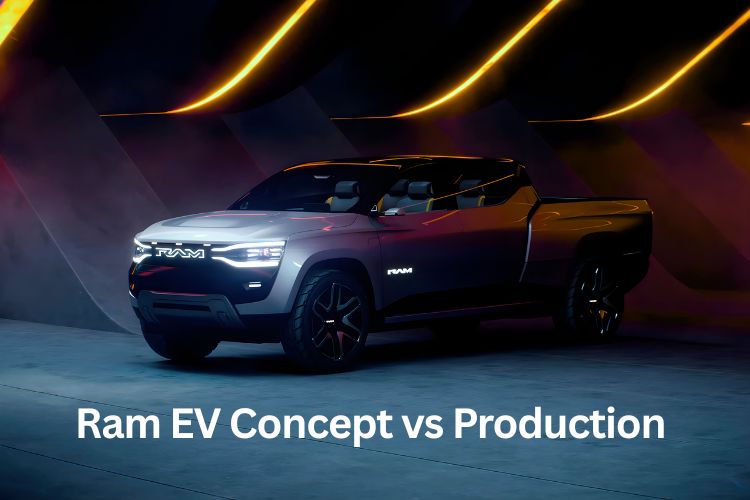
January 2023. You’re scrolling through CES coverage, and suddenly there it is. The Ram 1500 Revolution concept, glowing on that Vegas show floor like some sort of electric prophet. Suicide doors swinging open like a luxury lounge. A glass roof stretching forever. Third-row jump seats in a pickup truck. Your jaw hits the floor.
Then Super Bowl Sunday rolls around. Ram drops their production truck in a “Premature Electrification” commercial, and the forums absolutely explode. Because the truck they just showed you? It looks like… well, like every other Ram 1500 you’ve seen at the gas station. Same body. Same cab. Same bed. The spaceship became a sedan.
Fast forward to today, and the confusion has only multiplied. We’ve got delays stacking on delays, a massive battery pack getting quietly cancelled, name changes nobody asked for, and now Ram’s pivoting to a range-extender strategy while calling it an electric truck. Reservation holders are furious. Competitors are shipping. And the question everyone’s asking is simple: what the hell happened?
Here’s the truth we’re unpacking together. We’re going to use cold specifications, production timelines, and market realities to understand exactly what changed between that jaw-dropping concept and the truck that may actually show up in your driveway. If it shows up at all.
Keynote: Ram EV Concept vs Production
The Ram 1500 Revolution concept represented an ambitious vision for electric truck innovation. The production REV delivers a pragmatic range-extended solution addressing real-world towing and range concerns traditional truck buyers actually have. Ram traded revolutionary design for proven capability, betting that 690 miles of total range matters more than suicide doors or zero emissions. Whether that gamble pays off depends entirely on market readiness for electrification compromise versus pure EV commitment. The delays and cancellations reveal an industry still figuring out what electric truck buyers truly want.
The Concept That Made Us All Believers
What Made the Revolution Concept Feel Like the Future
Picture this. You walk up to the truck, and both rear doors swing open backward. No center pillar blocking your view. The entire side of the cab opens like a grand entrance to some billionaire’s private lounge, not a work truck. That’s the power of suicide doors, and Ram knew it would stop people in their tracks.
But the drama didn’t end there. Inside, you’d find optional third-row jump seats that could pop up from the floor, transforming this half-ton pickup into a legitimate six-passenger family hauler. Not a cramped afterthought. Real seats, mounted to a powered midgate that could lower flat to extend your cargo bay.
And that glass roof. It wasn’t some little sunroof panel. This thing stretched from the windshield all the way back, flooding the entire cabin with natural light. Combined with that bumper-to-bumper pass-through tunnel when you dropped the midgate, you could slide 18 feet of lumber through the truck without breaking a sweat. From the front trunk, through the cabin, and out the tailgate. One continuous workspace.
The Tech That Felt Like Science Fiction
The dashboard was dominated by 28 inches of touchscreen. Not buttons. Not knobs. Pure glass and pixels, making even Tesla’s minimalist setup look conservative. The lower screen could detach and work as a tablet anywhere around the vehicle.
Then there was the styling. That sleek, low-slung roofline with sharp, aggressive angles that looked like it drove straight out of 2030. The illuminated “R-A-M” badge glowing on the front fascia. Those iconic tuning-fork LED headlights integrated into the bumper flares, instantly recognizable from three blocks away.
Ram teased something called “Shadow Mode” where the truck would autonomously follow you around a job site like a loyal dog. The steering wheel would retract into the dashboard during Level 3 autonomous driving. The truck would recognize you approaching with biometric sensors and automatically open the doors. This wasn’t just a concept. This was science fiction with a Ram badge.
The Promise That Hooked Everyone
Here’s what really got people to open their wallets and drop reservation deposits. Ram promised 500 miles of range from a monstrous 229 kWh battery pack. That would obliterate every electric truck on the market and finally end range anxiety forever.
Fast charging? They claimed you’d add roughly 110 miles in about 10 minutes using 350 kW DC fast charging with 800-volt architecture. Pull up, grab coffee, and leave with enough juice for another two hours of highway driving.
Ram’s own press release called it standing on the “precipice of something extraordinary.” And you know what? It felt believable. This represented a genuine leap forward. Not evolutionary. Revolutionary. The name wasn’t just marketing. It was a promise.
The Production Reality Check: What Actually Showed Up
The Super Bowl Surprise Nobody Wanted
February 2023. The Super Bowl commercial drops during a break. You’re expecting to see that gorgeous concept again. Instead, Ram shows you their production truck in an ad literally called “Premature Electrification.”
The forums erupted instantly. “It’s just a Ram with an electric drivetrain, pretty disappointing.” That’s a real quote from the day one thread. Because side by side, the production REV looks about 90% identical to the traditional Ram 1500. Same body. Same cab. Same bed. The only people who wouldn’t notice the difference are the ones not looking for it.
That sinking feeling hit hard. The spaceship became a minivan. They really did a bait and switch.
What Survived the Translation
Before we get too doom and gloom, let’s acknowledge what made it through. Those distinctive tuning-fork LED headlights carried over from the concept, becoming the visual signature that separates the REV from its gas-powered siblings. The angular taillights with that unique brow extending onto the tailgate kept some of the concept’s DNA alive.
The functional frunk survived too. You get 15 cubic feet of weatherproof storage up front with built-in power outlets capable of delivering 3.6 kW for your tools or tailgate gear. That’s genuinely useful.
Performance stayed impressive on paper. 654 horsepower (later updated to 647 hp), 610 lb-ft of torque, and a 0-60 time around 4.5 seconds. The towing capacity hit 14,000 pounds, which beats the Ford F-150 Lightning’s 10,000-lb limit by a massive margin. These aren’t minor specs. These are the numbers that matter when you’re pulling a horse trailer through the mountains.
What Got Left on the Cutting Room Floor
Everything else? Gone.
The suicide doors vanished, replaced with conventional crew cab configuration. That means the lounge vibe, the grand entrance, the entire theatrical experience of the concept just doesn’t exist in production. You open four normal doors like every other truck.
Third-row jump seats? Completely absent. No six-passenger capability. No flexibility for hauling the whole family plus gear.
That flowing, futuristic silhouette with the low roofline? Replaced with the traditional three-block truck layout everyone already knows. The glass roof disappeared. The pass-through tunnel disappeared. The powered midgate disappeared. Every single element that made the concept feel revolutionary got sacrificed to reality.
The interior simplified from that touchscreen paradise down to a familiar Ram cabin with updates. Still nice. Still luxurious in the higher trims. But recognizable. Safe. Normal.
The Delays That Turned Excitement Into Exhaustion
The Original Promise and the First Cracks
Ram’s initial plan featured two battery packs. The standard 168 kWh pack would target around 350 miles of range. The massive 229 kWh pack would deliver that promised 500-mile capability, ending range anxiety and making this the electric truck to beat.
Originally slated for Q4 2024 as a 2025 model year vehicle, reservations opened with $100 refundable deposits. Hope ran high. Ram’s website confidently displayed “coming Q4 of 2024” well into December 2024. People were setting calendar reminders.
The Reality of Production Hell
November 2024. First delay announced. The launch pushed to the first half of 2025 for “quality validation.” Okay, fine. Better to get it right.
Then January 2025 dropped a bombshell. Ram quietly cancelled the 500-mile, 229 kWh battery option entirely. Not delayed. Cancelled. Gone. The entire value proposition of the truck just evaporated.
February 2025 brought the second official delay. Now the truck’s targeting late 2026 as a possible 2028 model year vehicle. Current whispers push the full battery-electric REV to summer 2027. That’s a full three years behind the original schedule. From February 2023 reveal to September 2025 battery cancellation, we’re talking 30 months of broken promises.
Why the Delays Keep Coming
Stellantis is juggling a “significant workload” across multiple EV launches on the STLA Frame platform. Resources are stretched thin.
Battery economics remain brutal. At $100 per kilowatt-hour, that 229 kWh pack costs $17,000 just for the cells alone before you add assembly, cooling systems, and installation. The math doesn’t work at competitive price points.
Quality concerns are legitimate. The Dodge Charger Daytona experienced charging problems right at launch, validating Ram’s cautious approach. Nobody wants to repeat that disaster with a truck.
But here’s the uncomfortable truth. EV truck demand cooled significantly through 2024 and 2025. Stellantis watched Ford struggle to meet ambitious F-150 Lightning forecasts. They watched GM’s sluggish Silverado EV rollout. The market simply wasn’t ready for what Ram promised. Corporate priorities shifted accordingly.
The Plot Twist Nobody Saw Coming: The All-Electric REV Is Dead
September 12, 2025: The Day Ram Changed Everything
Stellantis officially halted the all-electric Ram 1500 REV program entirely. Not delayed. Halted. The cancellation shocked the industry because Ram didn’t just push dates. They killed the truck.
Corporate reasoning cited “slowing demand” for big, expensive, pure-electric trucks in the marketplace. Translation: nobody’s buying enough of these things to justify the massive development costs.
The REV name survives. But the truck underneath became something completely different. This wasn’t a delay. This was an execution.
Meet the New “REV”: Range-Extended Reality
Ram pivoted to lead with a generator-equipped, range-extended electric pickup. What was formerly called the Ramcharger is now being marketed as the REV, a “range-extended electric truck.”
Here’s how it works. Electric motors handle all the driving. But a 3.6-liter Pentastar V6 gas engine sits under the hood acting as an onboard generator. Think of the Chevy Volt strategy applied to a full-size truck. The engine never directly powers the wheels. It just burns gas to make electricity that either charges the 92 kWh battery or powers the motors directly.
Target range: 690 miles total. That’s 145 miles of pure electric driving, then the generator kicks in for 545 additional miles. You get electric torque and quiet operation with the safety net of gas stations everywhere.
Why This Pivot Makes Brutal Sense
Truck buyers tow heavy loads. When you hook up a horse trailer or a boat, pure EV range craters to under 100 miles. You’re hauling two bathtubs full of bricks up a hill. Big batteries help, but physics is unforgiving.
Range anxiety doubles when you’re 200 miles from home with a trailer behind you and the nearest DC fast charger is 50 miles away. That’s not theoretical. That’s the reality truck owners live with.
The generator eliminates “where’s the next charger?” panic while keeping all the benefits of electric torque, instant response, and potential all-electric daily commuting. For truck buyers who actually use their trucks like trucks, this might be the smarter play.
Market and incentive structures shifted. The pure-EV math stopped adding up for Stellantis. The REEV hedge lets them serve customers not ready for full electrification while keeping a foot in the electric game.
Side-by-Side: The Full Story in One Simple View
Concept vs First Production Plan vs Today’s Reality
| Feature | Revolution Concept | Initial REV Plan (BEV) | Current “REV” Reality (REEV) |
|---|---|---|---|
| Body & Doors | Saloon suicide doors, no B-pillar | Conventional crew cab doors | Conventional crew cab doors |
| Interior Seating | Optional third-row jump seats | Standard 5-seat crew cab | Standard 5-seat crew cab |
| Midgate/Pass-Through | Powered midgate, bed extension | Standard separate bed | Standard separate bed |
| Powertrain | Pure BEV vision, 800V | BEV with 168-229 kWh targets | Range-extended with V6 generator |
| Range Target | 500+ miles (concept claim) | 350-500 miles (battery only) | 690 miles total (145 EV + 545 generator) |
| Charging Speed | 350 kW, 800V architecture | 350 kW capability on paper | 145 kW max (400V, smaller battery) |
| Launch Status | CES 2023 concept sparkle | Delayed BEV, 229 kWh canceled | BEV canceled, REEV prioritized for 2026 |
| Towing Capacity | Conceptual (not rated) | 14,000 lbs claimed | 14,000 lbs claimed |
Why the Dream Shrunk: The Uncomfortable Truths
The Economics of Building a Fantasy
Hand-built concepts can cost millions of dollars to create. Production trucks must hit price points actual humans can afford while generating profit margins that keep shareholders happy.
Powered suicide doors require motors, sensors, fail-safes, and complex mechanisms that add weight, cost hundreds of pounds, and create countless potential breakdown points. Every moving part is a warranty claim waiting to happen.
Third-row seats in pickup beds create massive liability concerns. Federal Motor Vehicle Safety Standards weren’t written with jump seats in truck beds in mind. The engineering and legal gymnastics required to certify that feature would be nightmarish.
That 229 kWh battery pack? It would weigh over 3,000 pounds and cost more than $23,000 just for the cells before you add the battery management system, cooling, casing, and installation. At scale, that’s an economic anchor around the truck’s neck.
The Safety and Regulation Wall
Concept cars sidestep crash testing because they’re never sold to consumers. Production trucks must pass side-impact tests, rollover tests, and roof crush tests. Every single one.
No B-pillar means no structural support in a T-bone collision. That center pillar is critical for protecting occupants during side impacts. Engineering around it requires massive reinforcement throughout the frame and roof, adding weight and cost while compromising the clean, open aesthetic that made the concept special in the first place.
Mirrors, proper door handles, side-impact beams, curtain airbags, and crumple zones all add bulk that ruins sleek proportions. Reality doesn’t care how cool your concept looks. Physics and lawyers have final say.
The Strategy Ram Actually Chose
Ram followed Ford’s F-150 Lightning playbook. Familiar exterior, electric guts, don’t scare the loyal buyers. Keep the existing fanbase comfortable instead of chasing Tesla fanboys who may never buy a truck anyway.
When the pure-EV bet looked shaky, Ram pivoted to the range-extender to hedge all bets. It’s the safe play over the hero play. Conservative over revolutionary. Pragmatic over aspirational.
This strategy prioritizes customer retention over market disruption. Ram chose to evolve its brand rather than reinvent it, betting that most truck buyers would prefer a comfortable transition to electrification over a jarring leap into the unknown.
What You Can Still Count On (and What You Can’t)
Features That Survived to Production
Premium trims like “Tungsten” deliver heated and cooled massage seats with 24-way power adjustment wrapped in quilted leather. This is genuine luxury, positioning the REV Tungsten as the most premium offering in the entire half-ton pickup segment.
Over 24 inches of total digital display real estate across the instrument cluster, center touchscreen, and available passenger display. The tech experience remains impressive and competitive, even if it’s not as revolutionary as promised.
Frunk storage with weatherproof design, built-in outlets delivering 3.6 kW, and tie-down points. This is practical utility that survived the translation from concept to reality.
RamBox integrated bed storage system remains available and class-exclusive among electric trucks. These lockable, weatherproof bins built into the bed sides are beloved by Ram loyalists for good reason.
Home energy backup capability lets you power your house for up to 30 days during outages using the truck’s battery. That’s genuinely game-changing for anyone in areas prone to storms or grid failures.
What’s Coming with the Range-Extended “REV”
The range-extended architecture headlines Ram’s near-term electrification play, targeting a Q1 2026 launch. That’s the current timeline, though given the track record, take it with appropriate skepticism.
Same 14,000-pound towing capacity with 2,625-pound payload, claiming best-in-class status among electric trucks. If you tow frequently, these numbers matter more than any styling element.
690 miles of total range addresses the core fear most truck buyers have about going electric. You can pull a trailer across three states without ever touching a public charger.
Price remains unknown but likely starts “slightly above” the $65,000 Ramcharger starting point. Expect the Tungsten trim to push toward $90,000, putting it in luxury SUV territory.
What You Should Stop Expecting
Any near-term pure-electric Ram 1500 BEV. That program is officially dead, cancelled, buried. Stellantis isn’t building it.
The 500-mile, 229 kWh battery pack. Cancelled in January 2025, never returning. That dream is over.
Concept-like revolutionary design elements including suicide doors, third-row seating, powered midgates, or pass-through cargo tunnels. Ram chose evolution, not revolution.
A 2025 or even 2026 delivery of a pure-electric truck. The calendar has moved to 2027 or 2028 at best for anything resembling the original BEV vision, and even that’s uncertain given the program cancellation.
The Competitive Lens: Where This Leaves Ram vs. Rivals
The Electric Truck Battlefield Today
Ford F-150 Lightning sits on dealer lots right now. Second-generation development is underway. Proven real-world reliability with thousands of trucks in customer hands. Ford moved first and captured significant market share.
Chevy Silverado EV ships today with the midgate feature Ram abandoned, delivering 440+ miles of range. It’s radical in design but functional in execution, representing GM’s bet on revolutionary rather than evolutionary design.
Rivian R1T established itself as the adventure truck with loyal fanbase and proven capability. It’s expensive but delivers on promises, building brand credibility in the EV truck space.
Tesla Cybertruck delivers despite its own compromises and controversial design. It dominates headlines and reservation lists, proving there’s appetite for radical departure from traditional truck aesthetics among certain buyers.
Ram’s Unique Position (For Better or Worse)
Ram is the only major truck maker pivoting away from pure EV toward a range-extended hybrid strategy as their primary electrification play. That’s either brilliant or disastrous depending on how the market evolves.
If you tow far or often, the REEV approach may fit your real-world day-to-day better than any pure EV. No range anxiety. No charging infrastructure concerns. Just fill up with gas when the battery runs low.
If you want zero tailpipe emissions and the simplicity of home charging without any gas engine maintenance, Ram just left you without an option. You’ll need to look elsewhere.
The competition isn’t waiting. Every delay, every cancellation, every pivot hands market share to rivals already delivering trucks. First-mover advantage matters in emerging segments.
The Wild Card: The Ramcharger Advantage
The Ramcharger (now badged as REV) arrives before any pure-electric Ram, targeting Q1 2026 versus late 2026 or beyond for anything else. Availability beats promises.
Same 690-mile range, same towing, same electric driving experience, but without pure-EV limitations. You get electric torque with gas-powered peace of mind.
This may be the truck Ram should have led with from the beginning, directly addressing real customer fears instead of chasing revolutionary concepts that couldn’t survive production realities.
Could become the unexpected winner if buyers decide range matters more than zero emissions. The market will determine if Ram made the right strategic bet or missed the electrification wave entirely.
Conclusion: Your New Reality With Ram’s Electric Future
We started at CES 2023 with goosebumps and ended at a corporate press release in September 2025 announcing a cancellation. We went from a moon-shot concept with suicide doors and third-row seating to a more pragmatic, generator-backed truck that looks like every other Ram on the road. The 500-mile pure-electric dream became a 690-mile hybrid reality, and honestly? For truck buyers who actually tow and haul, that might be the smarter play.
Here’s what matters now. The spec sheet was always a promise, but the driveway is the truth. Ram bet that most truck buyers would choose 690 miles of total range over the purity of zero emissions. Time will tell if they were right, but the pivot reveals a company reading market signals and adapting in real time rather than stubbornly pursuing an aspirational vision the market wasn’t ready to buy.
Your first step today: Decide your use case with brutal honesty. If you tow heavy and often, the range-extended REV arriving in 2026 might solve problems the pure-EV never could. If you want zero tailpipe emissions and you can live with 300-350 miles of range, the F-150 Lightning or Silverado EV are on dealer lots today, not in some distant 2027 future. Don’t wait for a truck that might never come in the form you’re hoping for.
Final thought: Remember that initial buzz when you first saw the Revolution concept? That feeling wasn’t a lie. It showed us what’s theoretically possible when designers dream without limits. The production reality shows us what’s actually buildable when accountants, engineers, and safety regulators enter the room. Sometimes the dream has to shrink to fit through the factory door. That’s not betrayal. That’s just how trucks get built.
Ram EV Concept Production (FAQs)
Why does the Ram 1500 REV look so different from the concept?
Yes, dramatically different. Ram followed Ford’s conservative F-150 Lightning strategy instead of GM’s radical Silverado EV approach. The suicide doors, third-row seats, and glass roof required engineering and safety solutions that would cost millions to certify for mass production. Ram chose familiar aesthetics to keep loyal customers comfortable with electrification rather than risk alienating them with polarizing design.
What happened to the Ram Revolution concept features?
They were cancelled due to cost, complexity, and safety regulations. The B-pillarless suicide doors created structural nightmares for side-impact protection. Third-row jump seats raised massive liability concerns under Federal Motor Vehicle Safety Standards. The powered midgate and 18-foot pass-through would have added hundreds of failure points and thousands in manufacturing costs. Reality killed the revolution.
Is the Ram 1500 REV worth waiting for vs competitors?
Depends entirely on your use case. If you tow heavy loads frequently or drive through areas with sparse charging infrastructure, the REV’s 690-mile total range and 14,000-pound towing capacity might justify the wait. If you want a pure electric truck with zero emissions and simpler maintenance, the F-150 Lightning and Silverado EV are available now. Waiting until late 2026 or 2027 means competitors gain years of real-world experience and customer loyalty.
Will Ram bring back any Revolution concept features in future trims?
Extremely unlikely. Ram officially cancelled the pure BEV program and pivoted entirely to the range-extended strategy. The suicide doors, third-row seating, and powered midgate were concept-only features that never made business sense for production. The current REEV architecture doesn’t support the radical interior reconfiguration the concept promised. What you see in the current REV is what you’ll get.
How much will the Ram 1500 REV actually cost?
Ram hasn’t announced official pricing, but expect the base model to start “slightly above” $65,000 based on Ramcharger positioning. The premium Tungsten trim could approach $90,000 with its 24-way massage seats, 23-speaker Klipsch audio system, and luxury materials. That puts it in luxury SUV territory, banking on buyers who want the most premium truck experience available regardless of powertrain.