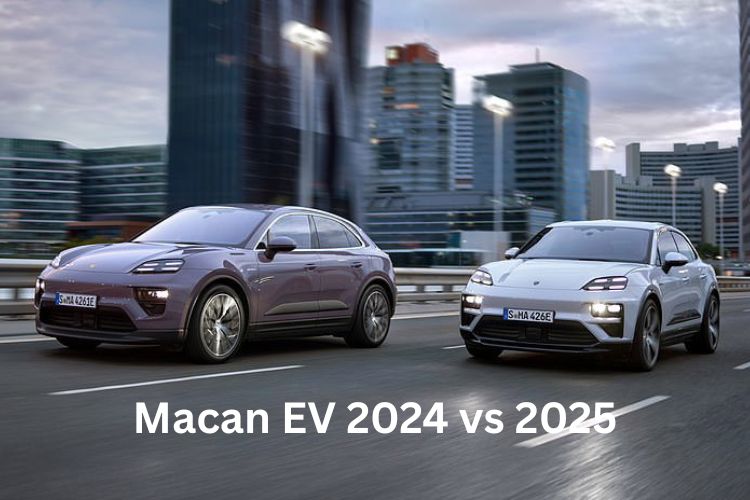
You’ve configured this car seventeen times. Toggled between Dolomite Silver and Chalk. Added and removed the $1,800 air suspension. But here’s the truth: none of that matters if you’re picking the wrong model year for your $80,000-plus investment.
And you’re confused. Rightfully so.
You’re finding articles that say “2024 Macan EV” launched globally, but dealers are selling “MY2025” cars in the U.S. Forum posts are screaming about PCM black screens. One reviewer raves about 352-mile range while an owner reports 240 miles in winter. What’s actually real?
Here’s what we’re going to do. We’ll decode the calendar-year-versus-model-year confusion first. Then dig into what genuinely changed between launch and now. Most importantly, we’ll face the brutal early-adopter reality no press release mentions, pair it with the hard data, and give you the clarity to hit “order” without that 3 AM regret.
Keynote: Macan EV 2024 vs 2025
The Macan EV 2024 vs 2025 comparison centers on trim expansion, not platform changes. Both share the PPE 800-volt architecture and 95 kWh battery. MY2025 added base RWD and 4S trims, creating a complete four-tier lineup from $75,300 to $105,300. Choose based on drivetrain needs and budget, not model year.
First, Let’s Kill the Model-Year Monster
Why This Feels Like a Mess
The Macan EV launched globally in calendar year 2024. That’s when Porsche threw the big party, unveiled the car to the world, started deliveries in Europe.
But U.S. dealers? They’re selling it as MY2025.
Most “2024 vs 2025” debates you’re reading are actually launch-spec versus first full U.S. model year discussions. Translation: Think “2024” as the birthday party, “MY2025” as the guest list that actually showed up. Same platform, same battery, same 800-volt architecture. The confusion isn’t about the car changing. It’s about Porsche’s rollout strategy and how American model-year designations work.
What MY2025 Actually Added
MY2025 brought two new trims to U.S. buyers. The base RWD Macan Electric at $75,300 and the performance-focused 4S at $84,900.
Launch coverage centered on Macan 4 and Turbo. Those were the heroes, the proof-of-concept models designed to show the world that an electric Porsche SUV could still be a proper Porsche. Base and 4S? They’re the 2025 headlines, filling out a complete four-tier lineup.
EPA ranges finally got published by trim for the U.S. market: 315 miles for the base Electric, 308 miles for the 4, and 288 miles for both the 4S and Turbo. Real numbers you can actually plan around.
The One-Line Verdict
“If someone’s selling you a ‘U.S. 2024 Macan EV,’ they’re confused or you’re looking at leftover global-spec cars.”
The models are designated MY2025 for American buyers. Period.
The Bedrock That Never Changed (Why This Matters More)
The 800-Volt Express Lane
Every trim rides Porsche’s new Premium Platform Electric with 800-volt architecture. Up to 270 kW DC fast charging across the board.
Real-world translation? Ten to eighty percent charge in roughly 21 minutes under ideal conditions. Not theoretical lab numbers. Actual owners documenting this at Electrify America stations when everything goes right.
This is the foundation. Paint colors and model years come and go. Fast charging is forever. Or at least for the seven to ten years you’ll own this thing.
Battery Reality: The Number Dealers Won’t Clarify
Gross battery capacity: 100 kWh. Net usable: approximately 95 kWh across all trims.
No silent upgrade between launch and MY2025. Same battery chemistry. Same cells. Same thermal management system. The only variance in range comes from motor configuration and weight, not some secret battery swap.
Why You Should Care More About This Than Model Years
Shorter charging stops mean less planning anxiety on road trips. You’re not mapping out 45-minute lunch breaks to hit 90%. You’re grabbing coffee, stretching your legs for 20 minutes, and rolling.
The PPE platform is shared with Audi’s Q6 e-tron. That means development costs spread across multiple vehicles, economies of scale, and a higher likelihood Porsche keeps supporting this architecture with software updates for years.
Here’s the thing: Porsche’s over-the-air updates mean your 2024 launch car gets the same software fixes and feature improvements as a 2025 build. The hardware underneath doesn’t care about the model year badge.
What Actually Expanded in MY2025 (The Trim Ladder That Changed the Game)
The Lineup at a Glance
| Trim | Power | 0-60 mph | Drivetrain | EPA Range | Price |
|---|---|---|---|---|---|
| Electric (RWD) | 355 hp | 5.4 sec | Single motor | 315 mi | $75,300 |
| Macan 4 | 402 hp | 4.9 sec | Dual motor AWD | 308 mi | $78,800 |
| Macan 4S | 509 hp | 3.9 sec | Dual motor AWD | 288 mi | $84,900 |
| Turbo | 630 hp | 3.1 sec | Dual motor AWD | 288 mi | $105,300 |
All prices before the $1,995 destination charge that’ll show up on your final paperwork.
The Sweet Spot Nobody Expected
The 4S gives you seventy percent of Turbo performance for sixty percent of the price. And honestly? That math matters.
Dual motors mean confidence in winter without Turbo-level overkill for daily driving. You’re getting 509 horsepower, a 3.9-second sprint to 60 mph, and the satisfaction of knowing you didn’t spend an extra $20,000 just to shave off eight-tenths of a second that you’ll use twice a year.
If you want bragging rights: Turbo. If you want balance without sacrifice: 4S. If you want the best range: base RWD. If you want all-weather capability without breaking six figures: Macan 4.
The Timeline Truth
Global launch in 2024 featured Macan 4 and Turbo as the hero trims. These were the statement pieces, the models that needed to prove electric Porsches could still deliver that visceral, grin-inducing driving experience.
MY2025 U.S. rollout added the accessible RWD base and performance-value 4S. This transformed the lineup from a limited offering into a complete product range that addresses different buyers with different priorities.
Future? Porsche already confirmed GTS variants coming for 2026. Because of course they did. The Porsche playbook always includes a GTS.
The Brutal Truths Early Owners Are Living (What $100K Doesn’t Buy)
The PCM Black Screen Problem Is Real
| Issue | Frequency in Forums | Impact |
|---|---|---|
| PCM total system failure | Multiple reports in first weeks | Car unusable until reset |
| Charging randomly stops | Common complaint | Requires constant monitoring |
| Cars dying overnight in driveway | Several documented cases | Complete power loss |
| Bose audio rattling door pockets | Owner-reported | Quality perception hit |
These aren’t isolated incidents. Early adopters are beta testers whether they signed up for it or not.
The “It’s Nearly Six Figures” Disappointment List
No rear wiper standard. It’s a $370 option. Yes, really. On a Porsche.
Non-extendable sun visors in a luxury SUV. The kind of detail that makes you wonder what happened during cost-cutting meetings.
Hard plastics in places where a Tesla Model Y uses soft-touch materials. And the Model Y costs $30,000 less.
These aren’t deal-breakers. But they sting at $80,000-plus as-tested. You expect better material quality when you’re writing a check this size.
The Performance Reality Check
Macan 4: 4.9 seconds to 60 mph, roughly $99,000 as-tested with options you’ll actually want.
Genesis GV70 Electrified: 4.1 seconds, $30,000 less.
Hyundai Ioniq 5 N: faster still, and cheaper.
You’re not buying a spec-sheet winner. You’re buying a Porsche. The crest on the hood. The steering feel. The chassis dynamics that make a Costco run feel like a backroad adventure. Own that decision, because the spreadsheet won’t justify it.
The Efficiency Mystery Nobody Can Explain Yet
Some 2025 Loaners Are Showing Shockingly Better Numbers
Certain MY2025 test units consuming 22 to 24 kWh per 100 km versus 28 to 30 kWh in earlier cars.
Same battery. Same motors. Same Premium Platform Electric architecture. Porsche hasn’t officially acknowledged this difference, which makes it even more frustrating if you’re an early owner watching newer cars achieve better efficiency.
Could be software tuning. Could be tire spec changes. Could be production refinements as the factory line matures. We don’t know, and Porsche isn’t saying.
Real-World Range: The Honesty You Deserve
EPA says 308 miles for Macan 4. That’s the official number.
Edmunds tested a Macan 4 and impressively hit 352 miles. Their test blends city and highway driving in mild weather conditions.
Real owners report 220 to 240 miles in winter highway driving at 75 mph with the heat cranked. Summer mixed driving? More like 260 to 280 miles.
BMW iX still wins for consistent 300-plus-mile reality if range is your absolute top priority. The Macan trades some of that range ceiling for faster charging and sharper driving dynamics.
The Trade-Off Worth Making
Fast charging speed matters more than raw range for road trips. Twenty-one minutes from 10% to 80% changes the game.
You’ll stop for coffee anyway. The 800-volt system keeps your day moving without those anxiety-inducing 45-minute charging sessions.
Plan around 20-minute breaks, not 250-mile sprints, and the range anxiety melts. This is where Porsche’s engineering philosophy shines. They prioritized charging speed over maximum range because they know how people actually use these vehicles.
The MY2025 Tech Updates That Might Actually Matter
Digital Life Gets Easier
| Feature | Launch Spec | MY2025 Addition |
|---|---|---|
| Digital Key | Not available | Standard for iPhone/Android |
| Voice Assistant | Standard | AI-enhanced with new models |
| Parking Assist | Available | Adds Trained Parking & Reversing Assist |
| In-Car Gaming | Available | Expanded titles via AirConsole |
| Towing Capacity (AWD) | ~4,400 lbs | 5,500 lbs |
Digital Key is standard now. You already carry your phone everywhere. One less thing in your pocket.
Do These Upgrades Justify Waiting?
Digital Key is convenient, not revolutionary. Nice to have, but not a reason to hold off if you found the right deal on an earlier build.
AI voice and trained parking are nice-to-haves unless you have a nightmare garage with tight clearances. Then trained parking becomes genuinely valuable.
Towing bump to 5,500 pounds is meaningful if you haul a boat or trailer. Irrelevant otherwise. Know your use case.
The Software Safety Net
Over-the-air updates mean your launch-spec car gets critical software fixes as they’re released. You’re not locked into the tech package you buy on delivery day.
The platform and charging capability are the constants that matter long-term. Software evolves. Hardware doesn’t, unless you’re buying a whole new car.
Price and Value: Where Your Dollars Actually Go
The 2025 Entry Advantage
MY2025 base RWD saves you $3,500 versus the cheapest 2024 launch option, the Macan 4.
You still get the 100 kWh battery, just single motor and 355 horsepower. For daily driving, 355 hp is plenty. You don’t need 630 hp for Costco runs or the school pickup line.
The base RWD also delivers the longest EPA range at 315 miles, making it the practical choice for buyers prioritizing efficiency over outright acceleration.
The Launch-Spec Discount Window
Dealers are motivated to move 2024 calendar-year inventory now. The 2025 models are arriving, and showroom space is finite.
Potential for $5,000 to $10,000 off MSRP if you negotiate hard in early 2025. Maybe more if the dealer is desperate and you’re financing through them.
Certified pre-owned 2024s with under 2,000 miles already selling below new. Early adopters who got cold feet or encountered those PCM issues are bailing, creating opportunity for savvy buyers.
The Hidden Truth About Resale
Later production units potentially more refined as Porsche works out early bugs. Manufacturing quality improves as the line matures.
Tech features like Digital Key could help 2025 models hold value slightly better. But in two years? Model year won’t matter. Build quality and your specific options will determine resale far more than whether the VIN says 2024 or 2025.
The Decision Framework That Ends the Debate
You’re Choosing 2024 Launch Spec If…
Choose a 2024 calendar-year build if:
- You can negotiate a significant discount right now, aim for $5,000 to $10,000 off MSRP
- You want it in your garage this month, not in six months when your factory order arrives
- You’re comfortable with early-adopter risks and have a good dealer relationship for warranty work
- You found a certified pre-owned with your exact spec at $15,000 to $20,000 savings
Choose MY2025 if:
- You want the entry-level RWD to save $3,500 at MSRP and maximize range
- You need the 4S power sweet spot, or the tech upgrades like Digital Key matter to your daily life
- You can wait three to six months for a factory build slot with your exact color and options
- You believe later production equals fewer software gremlins, which is probably true based on forum reports
The Third Option Smart Buyers Consider
Wait until mid-2025 and buy a lightly used 2024 for $15,000 to $20,000 off MSRP.
Let someone else absorb the steepest depreciation curve. Let them work out the PCM bugs and discover which options actually matter in daily use.
Use that savings for the options that actually enhance daily joy: air suspension, glass panoramic roof, upgraded wheels. The stuff you’ll interact with every single drive.
Conclusion: Your New Reality With the Macan EV
The real leap happened at the global launch in calendar 2024. The clarity came with MY2025’s broader U.S. trim lineup and published EPA ranges. The platform, the battery size, the 21-minute charging capability?
Those are your bedrock across every conversation about model years. Whether you choose a launch-spec car or wait for a MY2025 build, you’re not buying a spec-sheet champion. You’re buying driving dynamics that make a grocery run feel like a backroad adventure. You’re accepting some early-adopter quirks and Porsche’s occasional cost-cutting. But you’re getting a vehicle that turns heads and makes you grin every single time you press start.
Call three dealers. Get real numbers on 2024 inventory discounts and MY2025 build slots. Compare what you’d actually pay, not MSRP fairy tales. Then test drive both the base 4 and the 4S if possible. Your gut will tell you if the power difference matters.
Once you’ve done one 21-minute coffee stop and gone from 10% to 80% while scrolling your phone, you’ll wonder why you ever stressed about calendar years versus model years. The Macan EV isn’t perfect. But it’s perfectly Porsche, and that’s what you’re really paying for.
Macan EV 2025 vs 2024 (FAQs)
What’s actually new on the 2025 Porsche Macan EV?
Yes, two new trims. The 2025 model year added the base RWD at $75,300 and the 4S at $84,900. Digital Key became standard. Towing capacity increased to 5,500 pounds on AWD models. The platform and battery remained identical to the 2024 launch.
Does the 2024 Macan EV have the same battery as 2025?
Yes, identical battery. Both use a 100 kWh gross capacity battery with 95 kWh usable. Same 800-volt architecture, same DC fast-charging capability up to 270 kW. The battery chemistry and cells never changed between model years.
Which Macan EV trim has the longest range?
The base RWD model wins. It achieves 315 miles EPA-estimated range due to its single-motor configuration and lighter weight. The Macan 4 gets 308 miles, while the 4S and Turbo both achieve 288 miles due to their more powerful dual-motor setups.
Is the 2025 Macan 4S worth the upgrade over the 4?
Yes, if you value performance. The 4S delivers 509 hp versus 402 hp, cutting the 0-60 time to 3.9 seconds from 4.9 seconds. That’s a full second faster for a $6,100 price increase. It’s the sweet spot for driving enthusiasts.
How fast does the Macan EV charge on a Tesla Supercharger?
Not applicable yet. The Macan uses CCS Combo 1 charging standard. Porsche will offer a NACS adapter for Tesla Supercharger access in the future, but it’s not currently available. At 800-volt DC fast chargers, expect 10-80% in 21 minutes.