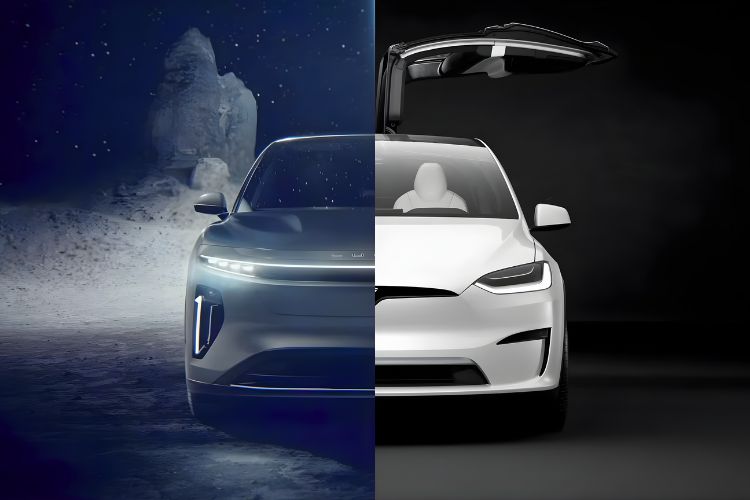
You’ve been staring at your brokerage account again, haven’t you?
Tesla already minted fortunes for the early believers. You weren’t one of them. Now Lucid is trading at a fraction of its peak, and that voice in your head keeps whispering, “Is this your second chance, or are you about to torch your money?”
Here’s what nobody wants to admit: most comparison articles throw charts at you and say “do your research,” but they never acknowledge the knot in your stomach. The FOMO of missing another Tesla run. The fear of backing a startup that burns cash like kindling.
We’re going to walk through this together, using real numbers from Q3 2025 and beyond. No corporate jargon. No pretending there’s a “safe” choice when both options come with serious baggage. By the end, you’ll know which stock (if either) deserves your hard-earned dollars.
Keynote: Lucid vs Tesla EV Stock Comparison
The Lucid vs Tesla stock comparison reveals a fundamental choice between proven profitability and speculative potential. Tesla dominates with 497,099 Q3 2025 deliveries, $97.7 billion in 2024 revenue, and consistent profitability, trading at 254x earnings. Lucid burns $7.4 million daily, delivered just 4,078 vehicles in Q3, and loses $160,000 per car despite industry-leading 516-mile range technology. Your decision hinges on risk tolerance, not which company is “better.”
The Actual Question Keeping You Up at Night
Before we dive into deliveries and balance sheets, let’s get honest about what you’re really trying to figure out.
Are you buying proven scale and current cash flow, or are you betting on early-stage upside with a deep-pocketed backer? Tesla manufactures half a million vehicles per quarter. Lucid is still trying to crack 5,000.
How much execution risk can your stomach handle over the next 12 to 24 months? One wrong product launch could crater Lucid. One margin miss could punish Tesla’s nose-bleed valuation.
Would you rather own a profit engine today or buy optionality on tomorrow’s model launches? Tesla prints money quarterly with $7.1 billion in net income for 2024. Lucid loses over $160,000 on every car it sells, a brutal reality that should make any investor pause.
Can you watch $7.4 million evaporate daily without flinching? That’s Lucid’s 2024 burn rate, and it should scare you.
We’ll anchor every answer to fresh delivery numbers, revenue figures, margin trends, and balance sheet reality. No hand-waving allowed.
Strip Away the Noise: The Numbers That Actually Matter Right Now
Let’s cut through the fanboy debates and look at where both companies stood in Q3 2025.
Tesla delivered a record 497,099 vehicles in Q3 2025, a 7% year-over-year increase that crushed analyst expectations. The company generated roughly $97.7 billion in revenue for full year 2024 with $7.1 billion in GAAP net income. Market cap hovers around $864 billion to $1.4 trillion depending on the week, a staggering valuation that reflects both its current dominance and future ambitions.
The stock trades at a forward P/E of 254x versus the S&P 500 average of around 30x. That premium isn’t an accident. It’s the market pricing in Tesla’s expansion beyond cars into artificial intelligence, energy storage, and autonomous mobility.
Lucid delivered just 4,078 vehicles in Q3 2025, marking its seventh consecutive quarterly record but still falling short of analyst expectations. For the first nine months of 2025, cumulative deliveries reached only 10,496 vehicles. The company posted a $992 million loss on just $200 million in sales back in Q3 2024, a ratio that tells you everything about their current economics.
Market cap sits at roughly $6 to $9 billion, trading at around 6x sales versus the auto industry average of 1.3x. Backed by Saudi Arabia’s Public Investment Fund, which owns over 60% of shares and recently injected $1.75 billion, Lucid has a lifeline. But lifelines don’t last forever.
Here’s the scale gap in perspective:
| Metric | Tesla | Lucid |
|---|---|---|
| Q3 2025 Deliveries | 497,099 vehicles | 4,078 vehicles |
| 2024 Annual Revenue | $97.7 billion | $808 million |
| 2024 Net Income | $7.1 billion profit | $3.06 billion loss |
| Market Cap | $864B to $1.4T | $6B to $9B |
| Profitability Status | Consistently profitable | Deeply unprofitable |
| Total Liquidity (Q2 2025) | $36.8 billion | $4.86 billion |
What this actually means: Tesla is a giant with an expensive price tag. Lucid is a startup with Saudi life support and a brutal path to profitability.
The Tale of Two Business Models: Factories vs. Dreams
Here’s where the emotional tug-of-war really kicks in. You’re not just comparing two stocks. You’re choosing between two completely different bets on the future.
Tesla’s Busy Highway
Tesla operates as a vertically integrated sustainable energy company, not just an automaker. Its automotive segment generated $72.48 billion in 2024, but the Energy Generation and Storage division contributed another $10.09 billion and is growing explosively. In Q3 2025 alone, Tesla deployed 12.5 GWh of energy storage products, nearly double the 6.9 GWh from the year prior.
The model lineup is diversified across Model 3, Model Y (the world’s best-selling car), the Cybertruck, and luxury Model S and X variants. Tesla’s manufacturing network spans five massive Gigafactories across three continents: Fremont, Austin, Shanghai, Berlin, and Sparks. Current installed capacity stands at 2.35 million vehicles annually, with plans to expand toward 3 million and an audacious long-term goal of 20 million by 2030.
Near-term catalysts include the planned launch of a sub-$30,000 EV platform and the Full Self-Driving robotaxi service, which analysts project could generate $1 billion in 2026 scaling to $75 billion by 2030. The FSD software alone generated $326 million in Q3 2025, a high-margin revenue stream that traditional automakers can’t match.
The pitch: You pay a premium for scale, profitability, and an ecosystem that includes the largest Supercharger network on earth, proven manufacturing excellence, and a data advantage in autonomous driving with millions of vehicles collecting real-world driving data daily.
The risk: That 254x P/E ratio assumes near-perfect execution on AI, energy, and keeping auto margins from collapsing further under competitive pressure.
Lucid’s Steep Switchback
Lucid is a pure-play luxury EV manufacturer focused on establishing a brand synonymous with cutting-edge technology and superior efficiency. Its primary business is the Lucid Air sedan, priced from $71,400 to a staggering $250,500 for the ultra-high-performance Sapphire edition. The upcoming Gravity SUV, a three-row luxury vehicle with an EPA-estimated 450-mile range and NACS compatibility for Tesla’s Supercharger network, represents the company’s make-or-break moment.
Lucid’s efficiency technology is genuinely industry-leading. The Air Grand Touring achieves an EPA-estimated 516 miles on a single charge, no other EV comes close. This isn’t marketing spin. It’s real engineering excellence built on an advanced 900-volt electrical architecture, compact in-house motors, and superior powertrain integration. In real-world tests, the Lucid Air recharges approximately 20% faster than a comparable Tesla Model S.
The company is also leveraging its acclaimed technology through licensing, highlighted by a significant supply agreement with Aston Martin that validates the technical prowess. A robotaxi partnership with Uber and Nuro includes plans to deploy at least 20,000 Lucid vehicles equipped with autonomous driving technology, opening a new B2B revenue stream.
Manufacturing capacity is expanding. The Arizona AMP-1 facility recently added 3 million square feet to prepare for Gravity production, increasing theoretical annual capacity from 34,000 to 90,000 vehicles. The new AMP-2 plant in Saudi Arabia, backed by $3.4 billion in financing and incentives from the PIF, is assembling 5,000 vehicles per year from semi-knocked-down kits, with plans to reach 155,000 annual capacity. Combined, Lucid targets 500,000 global production capacity by mid-decade.
Company claims Gravity has a “substantial order backlog” with projections that demand could be six times that of the Lucid Air. The vehicle targets the highly popular and profitable three-row luxury SUV segment. A successful launch is non-negotiable for survival.
The pitch: Lucid’s efficiency tech is industry-leading, and you’re betting they become the “Ferrari of EVs” before cash runs out. The Saudi backing provides a strategic safety net that traditional startups don’t have, including a landmark agreement for the Saudi government to purchase up to 100,000 vehicles over ten years.
The risk: They need to roughly double production to hit year-end goals, reverse deeply negative gross margins through dramatic cost reductions, and one stumble could mean more dilutive capital raises or worse.
If you need near-term earnings and sleep at night, Trail A feels safer. If you want asymmetry from a model-launch inflection and can stomach watching money burn, Trail B is your lottery ticket.
The Money Talk Nobody Wants to Have Out Loud
Let’s talk about what actually moves stock prices: revenue mix, margins, and whether the lights stay on.
Tesla’s Profit Engine (With Cracks Showing):
Tesla generated $97.7 billion in total revenue for 2024, with automotive contributing the lion’s share at $72.48 billion. But what sets it apart from traditional automakers is diversification. The Energy Generation and Storage segment contributed $10.09 billion and is growing at triple-digit rates. Services and other revenue streams add further stability.
Net income for 2024 reached $7.1 billion, proving the company has achieved sustained profitability at massive scale. Q3 2025 showed GAAP net income of roughly $1.4 billion on $28.1 billion in revenue. However, investors are sweating the compressed auto gross margins, which came in at 17.2% in Q2 2025, down from historical highs above 25%. The company’s aggressive pricing strategy to defend market share and drive volume is working, but at a cost.
Cash position is fortress-strong at roughly $36.8 billion in cash, cash equivalents, and investments as of Q2 2025, with a debt-to-equity ratio of just 0.17. Free cash flow generation remains robust. This financial strength gives Tesla room to invest heavily in next-generation products, expand manufacturing capacity, and weather competitive storms.
Translation: Tesla equals earnings sensitivity to pricing power and whether the AI and energy bets pay off. The business model is proven, but maintaining premium valuation requires flawless execution.
Lucid’s Cash Bonfire
Lucid generated $808 million in revenue for full year 2024 while posting a net loss of $3.06 billion. That’s not a typo. The company is losing nearly four dollars for every dollar it brings in.
The math is brutal. In Q2 2025, Lucid reported a GAAP negative gross margin of approximately 105%. This means that for every dollar of revenue, the company spent more than two dollars on the cost of goods sold, even before accounting for research and development or sales and administrative expenses. Every car deepens the hole by over $160,000.
Current liquidity of $4.86 billion as of Q2 2025 sounds okay, but at a burn rate of roughly $7.4 million per day based on 2024 losses of $2.7 billion, the clock is ticking. The company has raised $1.67 billion through secondary stock offerings, each round diluting existing shareholders. Saudi Arabia’s PIF ownership (over 60%) provides a safety net through ongoing capital support, but it comes at a price.
Analysts project 200% sales growth over the next 24 months, primarily driven by the Gravity launch. But remember: Lucid once claimed it would hit 500,000 vehicles by 2025. Reality delivered around 20,000. Execution has been the company’s Achilles heel.
The path to profitability is long. Management doesn’t project reaching gross margin breakeven until 2027 at the earliest, and that assumes successful Gravity ramp, achievement of manufacturing scale, and dramatic cost reductions. There’s no room for error.
Translation: Lucid equals financing risk plus ramp execution risk. You’re betting Saudi Arabia keeps writing checks, that Gravity actually delivers on its “substantial backlog,” and that the company can fundamentally transform its unit economics before liquidity runs dry.
Here’s the uncomfortable truth: Lucid burns $7.4 million every single day. That’s not exaggeration. That’s the cost of trying to compete with Tesla.
What Could Break Your Thesis (And Why You Need to Know Now)
Most guides skip this part because nobody wants to hear about downside. But this is where smart investors separate from gamblers.
What Could Sink Tesla
Valuation compression. A P/E over 250x leaves zero room for error. The stock trades at a price-to-sales ratio of 16.66x versus the automotive industry average of 1.3x, a premium that’s more characteristic of a high-growth software company than a vehicle manufacturer. One bad quarter on margins or deliveries, and the stock could crater 20% overnight. Wall Street analysts are deeply divided, with 12-month price targets spanning from $120 to $600, illustrating the massive uncertainty around fair value.
The Musk factor. Elon’s unpredictability is both an asset and a liability. His divided attention across Tesla, X (formerly Twitter), SpaceX, and other ventures creates key person risk. Political controversies and public antics have real consequences for brand perception, particularly as the EV market becomes more competitive and buyers have alternatives.
Competition closing in. The EV market is projected to grow 25% annually, but everyone from Ford and General Motors to Chinese manufacturers like BYD are gunning for Tesla’s lunch. The company has responded with aggressive price cuts to defend market share, a strategy that’s working for volume but compressing margins. Legacy automakers with deeper pockets and established dealer networks are investing hundreds of billions to electrify their lineups.
Macro headwinds. The expiration of the $7,500 federal EV tax credit on September 30, 2025 creates a near-term demand cliff. Management has warned of “a few rough quarters” ahead as the pull-forward effect of Q3’s record deliveries reverses. Rising interest rates make expensive vehicles less affordable. A broader market selloff hits high-multiple stocks first and hardest.
Regulatory scrutiny. The ongoing federal investigation into 2.88 million vehicles related to the Full Self-Driving system is a significant overhang. A negative outcome, such as a forced recall, operational limitations, or marketing restrictions could damage the brand and undermine a key pillar of the company’s premium valuation.
What Could Kill Lucid
The Gravity flop. If the SUV launch stumbles, if the “substantial backlog” evaporates, if quality issues emerge, or if production targets are missed, the stock could go to zero. This is not hyperbole. The company’s entire turnaround thesis rests on this single product. There’s no Plan B if Gravity fails.
Cash runway math. Even with Saudi backing, there’s a limit to how many dilutive raises shareholders will tolerate. The stock has already plummeted from its 2021 highs, falling 82% in 2022, 38% in 2023, 28% in 2024, and another 35% year-to-date in 2025. Analyst price targets average just $2.68 when the stock trades around $2.44, implying limited upside even in bullish scenarios. Further dilution from capital raises could accelerate the death spiral.
Production hell. Tesla barely survived its Model 3 production ramp with Elon’s cult of personality and relentless drive. Lucid doesn’t have that luxury. The company has consistently missed production targets. Q3 2025 deliveries of 4,078 fell short of Bloomberg’s forecast of 5,621 units, raising serious doubts about hitting full-year guidance of 18,000 to 20,000 vehicles. Missing targets even once more could spook investors and close capital markets permanently.
Limited brand awareness. Despite having a technologically superior product in many respects, Lucid suffers from low brand recognition compared to Tesla and established luxury automakers like BMW, Mercedes, and Porsche. Building a premium brand requires sustained marketing investment, something the company can ill afford given its cash burn. The small sales and service network compared to competitors creates a chicken-and-egg problem.
Technology lag in autonomy. While Lucid leads in powertrain efficiency, its DreamDrive ADAS lags significantly behind Tesla’s FSD. User reviews consistently report that the system can be unpredictable, it’s not always clear when features are engaged, and it struggles with certain road conditions. As software-defined vehicles become the norm, this gap could widen.
The subsidy cliff. Lucid’s luxury positioning makes it particularly vulnerable to the expiration of EV tax credits. Without the $7,500 incentive, convincing consumers to pay $70,000 to $250,000 for a vehicle from a relatively unknown brand becomes exponentially harder. Industry experts are warning of potentially “dreadful” market conditions in 2026 as the subsidy-driven demand boost reverses.
Honest take: Both stocks carry real risk of permanent capital loss. If you can’t afford to lose your entire investment in Lucid, don’t make the bet. If you can’t stomach a 30% to 50% drawdown in Tesla during a correction, stay away.
The Mirror Test: Which Investor Are You Actually Willing to Be?
Stop trying to find the “right” answer. There isn’t one. The real question is: which risk profile matches your actual behavior when the market turns ugly?
| Your Reality Check | Tesla Fit | Lucid Fit |
|---|---|---|
| Can you lose 100% of this investment? | Not required | Mandatory mindset |
| Do you need to see quarterly profits? | Yes, it’s profitable now | No, years away |
| Can you wait 3 to 5 years minimum? | Helps, not required | Absolutely required |
| Comfortable with sky-high valuations? | Must be, priced for perfection | Less extreme, but still rich |
| Can you handle CEO drama and volatility? | Musk is a feature, not a bug | Different risks, Saudi influence |
| Do you believe in hardware or software advantage? | Software, data, ecosystem | Hardware, engineering excellence |
If You’re Considering Tesla
You believe the company is more than cars and that the AI, energy, and robotics bets justify a massive premium. You can stomach watching the stock swing 15% in a week based on a tweet or earnings miss. You’re betting on the strength of the ecosystem (Supercharger network with 50,000+ locations, brand power that’s synonymous with EVs, manufacturing scale that no competitor can match) to outlast competition. You accept that you’re paying today’s dollars for tomorrow’s potential, and you trust that Tesla’s track record of defying skeptics will continue.
If You’re Considering Lucid
You’re comfortable with pure speculation and the real possibility of a total loss. You believe their technology edge (516-mile range, 900-volt architecture, engineering talent led by former Tesla VP Peter Rawlinson) can translate to the “Ferrari of EVs” before money runs out. You trust that Saudi Arabia’s strategic interest, evidenced by $3.4 billion in financing for the new factory and a commitment to purchase 100,000 vehicles, keeps the funding spigot open even through more pain. You’re betting that demand for the Gravity will be six times that of the Air and that this inflection point changes everything.
You also recognize that Lucid has something Tesla doesn’t: an undeniable lead in core EV hardware efficiency. If you believe the future values range, charging speed, and engineering purity over software and network effects, this might be your play.
The Uncomfortable Alternative
Maybe neither deserves your money right now. The EV space is crowded, valuations are stretched across the board, and there’s no law saying you have to pick between these two. Tesla trades at nosebleed multiples that assume everything goes right. Lucid is hemorrhaging cash with no clear path to profitability visible yet.
Sometimes the best decision is having the discipline to choose neither and wait for a better setup. Wait for Tesla’s margins to stabilize or for a broader market correction to compress that valuation. Wait for Lucid to prove it can actually ramp Gravity production and hit its targets for once. The market will still be here in three months, and a better entry point might be too.
Conclusion: Your Calm, Clear Path Forward
Here’s what you know now that you didn’t know fifteen minutes ago: Tesla is a profitable giant trading at a nose-bleed valuation of 254x earnings that assumes everything goes right with AI, energy storage, and maintaining margin power in an increasingly competitive market. Lucid is hemorrhaging over $160,000 per car, burning $7.4 million daily, relying on Saudi support, and betting its entire future on the Gravity SUV not stumbling out of the gate.
Neither is “safe.” Both require strong stomachs. The difference is what kind of risk makes you lie awake at night.
Your one action for today: Open a spreadsheet. Write down exactly how much money you could lose completely without it changing your life in any meaningful way. That number should make you uncomfortable but not devastated.
Only invest that amount. Put it in Tesla if you’re paying a premium for less existential risk, current profitability, and a diversified business model with proven execution. Put it in Lucid if you’re chasing a moonshot, believe in their engineering superiority, and can genuinely afford to watch it go to zero.
Or, and here’s the option most guides won’t give you: put it in neither. Wait for the next earnings release. Watch what happens with Gravity deliveries in Q4 and early 2026. See if Tesla’s margins stabilize or crater further as competition intensifies. See if Lucid can actually hit production targets for once. The market will still be here in three months, and a better entry point might be too.
You’re not chasing hype anymore. You’re running a process. That’s the only way to win.
Tesla vs Lucid EV Stock Comparison (FAQs)
Is Lucid a better investment than Tesla?
No, not for most investors. Lucid is a speculative bet with significant risk of total capital loss. The company burns $7.4 million daily, loses over $160,000 per vehicle sold, and depends entirely on Saudi Arabia’s continued financial support.
Tesla is profitable, generates billions in free cash flow, and has a proven track record. Lucid might offer higher percentage returns if everything goes right, but the probability of failure is substantially higher. Only invest in Lucid with money you can afford to lose completely.
How does Lucid stock compare to Tesla stock in terms of valuation?
Tesla trades at a P/E ratio of 254x and a price-to-sales ratio of 16.66x, reflecting its premium as a profitable, diversified technology company. Lucid has a negative P/E ratio because it’s unprofitable, but trades at roughly 6x sales versus the auto industry average of 1.3x.
Both valuations are rich, but Tesla’s premium is justified by current profitability and scale. Lucid’s valuation is entirely speculative, betting on future growth and profitability that hasn’t materialized yet.
What is Tesla’s P/E ratio compared to Lucid?
Tesla’s trailing P/E ratio is approximately 254x as of October 2025, meaning investors pay $254 for every $1 of earnings. The forward P/E is around 222x. Lucid doesn’t have a meaningful P/E ratio because the company is deeply unprofitable, posting $3.06 billion in losses on $808 million in revenue for 2024.
Comparing P/E ratios between a profitable company and an unprofitable one isn’t particularly useful. The real comparison is between proven execution and scale versus speculative potential.
When will Lucid Group become profitable?
Management doesn’t project reaching gross margin breakeven until 2027 at the earliest, and that’s assuming successful Gravity ramp, achievement of manufacturing scale above 50,000 annual units, and dramatic cost reductions. Net profitability would come even later, likely 2028 or beyond if everything goes perfectly.
The company currently loses over $160,000 per vehicle and burns $7.4 million daily. There’s significant execution risk. Many startups never reach profitability before running out of cash or investor patience.
Can Lucid compete with Tesla’s market dominance?
Not in scale or profitability, at least not for many years. Tesla delivered 497,099 vehicles in Q3 2025 alone. Lucid delivered 4,078. Tesla has five Gigafactories producing 2.35 million vehicles annually.
Lucid has one operational factory producing roughly 20,000 vehicles annually. However, Lucid leads in core EV efficiency technology, achieving 516 miles of EPA-estimated range versus Tesla’s 410 miles.
Lucid’s competitive strategy isn’t to beat Tesla on volume but to establish itself as the premium luxury alternative, similar to how Porsche competes against mass-market brands. Success means capturing 1-2% of the luxury EV market, not overtaking Tesla.
Should I buy Tesla or Lucid stock for long-term investment?
That depends entirely on your risk tolerance and investment goals. Buy Tesla if you want exposure to a profitable, scaled EV leader with diversified revenue streams and can stomach a premium valuation that requires continued perfect execution.
Buy Lucid only if you’re comfortable with venture capital-style risk, can afford to lose 100% of your investment, and believe their engineering excellence will overcome massive operational and financial challenges.
For most long-term investors seeking reasonable risk-adjusted returns, Tesla is the more appropriate choice despite its high valuation. Lucid is a speculative position at best.