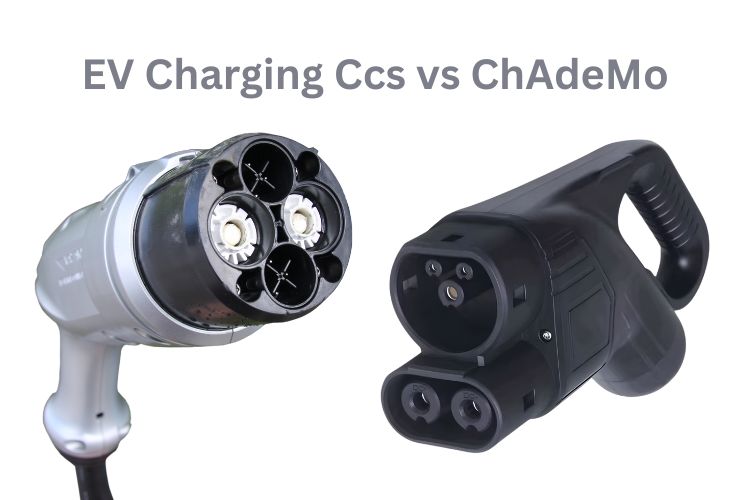
You’re on a road trip. Battery’s at 12%. The charging station sign ahead feels like salvation.
Then you pull in. Two different plug shapes stare back at you. One’s round and chunky. The other’s got this weird combo design. Your heart sinks. Did I buy the wrong car?
You’ve heard the noise. “CCS is faster.” “CHAdeMO is dead.” “NACS changes everything.” Your neighbor swears by one. The internet argues about another. And you’re standing there, low on battery, just wanting to know which voices to trust.
Here’s the thing: we’re going to cut through the confusion together. Using real numbers and market reality, not marketing hype. In five minutes, you’ll know exactly what matters. No more plug anxiety. No more second-guessing your purchase. Just clarity and confidence for every charging stop ahead.
Keynote: EV Charging CCS vs CHAdeMO
EV charging standards shape the electric vehicle experience. CCS dominates globally with 350 kW capability and broad automaker support. CHAdeMO pioneered DC fast charging but declined due to limited manufacturer adoption. NACS is disrupting North America through Tesla’s reliable network. Choose CCS or NACS for new purchases. Infrastructure availability matters more than theoretical specs. Plan routes using real-time apps like PlugShare for hassle-free charging.
What We’re Actually Comparing: Two Plugs, One Goal
The 10-Second Explainer
Think of CHAdeMO and CCS like Apple’s Lightning versus USB-C. Different shapes, same electricity flowing through.
Both are DC fast-charging connectors that do the same job, just with different physical designs and industry backing. That’s it. Not magic. Not rocket science. Just two competing ways to pump electrons into your battery quickly.
CHAdeMO: The Original Player
CHAdeMO is the physically larger plug pushed early by Japanese automakers, mainly Nissan and Mitsubishi.
It stands for “CHArge de MOve,” which is a bit clunky, right? There’s also a clever Japanese pun hidden in there about having tea while you charge. The idea was that fast charging could be as quick and routine as a short coffee break.
It was the first mover. The pioneer. And for a while, it was the only game in town for DC fast charging.
CCS: The Industry Consensus
The Combined Charging System is what American and European carmakers all agreed to adopt. Think Volkswagen, Ford, GM, BMW, Mercedes. The big guns.
The smart “combo” design uses one port for both slow AC charging and fast DC charging. No need for two separate holes on your car. It’s elegant. It’s efficient. And it won the design battle because of that simplicity.
Speed and Power: How Fast Will You Actually Charge?
The Numbers That Change Your Coffee Break
Most public CHAdeMO stations sit around 50 kW in the real world today. Some newer ones hit 100 kW if you’re lucky.
CCS sites commonly reach 150 to 350 kW at major networks like Electrify America and IONITY.
Translation: CHAdeMO is a longer coffee stop. You’ll sit there for 30 to 40 minutes to get from 20% to 80%. CCS is a quick snack break. Grab a protein bar, use the restroom, and you’re back on the road in 15 to 20 minutes.
The Paper Specs Versus Reality
CHAdeMO’s “ChaoJi” future version targets 500 to 900 kW on paper. Sounds impressive, right?
But that’s not what you’ll find curbside today. Or next year. Most CHAdeMO chargers you’ll actually encounter are rated at 50 kW, with occasional 100 kW stations sprinkled around.
Your actual charging speed depends on your car’s maximum rate and battery state, not just the station’s advertised number. A hot battery charges slower. A cold one does too. And once you hit 80%, the power tapers dramatically on any standard.
Most EVs on the market today use CCS for DC fast charging. That tells you where the industry placed its bet.
Infrastructure Reality: What You’ll Find When You Roll Up
The Map Test: Numbers Don’t Lie
As of mid-2024, the US has over 16,900 CCS fast-charging ports installed and growing.
CHAdeMO? Only about 8,600 ports, and that number is shrinking as networks invest elsewhere. Europe tells an even starker story. Around 79,000 CCS charging points versus roughly 31,600 CHAdeMO stations, and the gap widens every month.
Here’s what that means for you: if you’re driving a CHAdeMO car, your charging options are getting smaller, not bigger.
The Charging Network’s Vote
| Standard | Typical Site Power | Network Presence | Growth Trend |
|---|---|---|---|
| CHAdeMO | ~50 kW | Small and shrinking | Declining |
| CCS | 150-350 kW | Dominant and expanding | Strong growth |
| NACS (J3400) | Up to 250 kW | Tesla network + coming adoption | Rising fast |
If you road-trip often, bet on CCS access today and NACS compatibility tomorrow.
Major networks like Electrify America stopped installing new CHAdeMO plugs in 2022. They’re focusing all new installations on CCS. EVgo and ChargePoint are following the same playbook.
This isn’t speculation. It’s their public business strategy. CHAdeMO is becoming harder to find, not easier.
Car Compatibility: Which Plug Does Your EV Want?
The Current Lineup
Nissan Leaf (current and older models) equals CHAdeMO. And that’s basically it for new cars sold in North America today.
The 2024 Mitsubishi Outlander PHEV still has a CHAdeMO port. But even that’s likely living on borrowed time.
Ford, GM, Volkswagen, Rivian, Hyundai, Kia, Polestar, BMW, Mercedes, and nearly everyone else? They all chose CCS. The coalition was too powerful. The industrial weight too massive.
The Plot Twist From CHAdeMO’s Biggest Champion
Here’s the moment that tells you everything: Nissan, CHAdeMO’s creator and biggest supporter, switched their new flagship EV (the Ariya) to CCS.
Read that again. The company that invented the standard abandoned it for their next-generation vehicle.
When the technology’s number one proponent walks away, the writing is on the wall. It’s over.
Next-generation Leaf models are moving toward Tesla-compatible NACS charging in North America. Even the last holdout is pivoting. The 2026 Leaf will reportedly arrive with a NACS port, not CHAdeMO.
The Adapter Question Everyone Asks
“Can’t I just buy an adapter?” Short answer: it’s complicated and not a reliable solution.
Adapters do exist, but they’re not simple pieces of plastic. A CCS-to-CHAdeMO adapter requires a battery-powered microcontroller. It’s literally a tiny computer in the cable, translating between two languages (CAN bus protocol and power line communication) in real time.
That makes them expensive. We’re talking $729 to $999, not $45. And they’re heavy. Over five pounds. Plus, they require firmware updates and aren’t compatible with every charging station.
Don’t buy a CHAdeMO car expecting adapters to solve your charging access problems going forward. They’re a band-aid, not a cure.
The Trendline: Why Tomorrow Matters More Than Yesterday
The NACS Wildcard That Changes Everything
There’s a third player: Tesla’s NACS (North American Charging Standard), now standardized as SAE J3400.
2024 brought the official SAE J3400 recommended practice. 2025 is when automakers start shipping native NACS ports on their new models.
Ford, GM, Rivian, Honda, Nissan, Hyundai, Kia, BMW, Mercedes, and others are adopting NACS. That promises simpler access to Tesla’s 15,000+ Supercharger locations across North America.
Why did everyone switch? Because Tesla’s network has 99.95% uptime. Public CCS networks average closer to 75% to 85%. Reliability wins.
Here’s What This Means for CCS
Good news: these manufacturers will connect to Tesla’s network using official CCS-to-NACS adapters.
That means your CCS car becomes your key to both kingdoms. The entire Electrify America network plus the entire Tesla Supercharger network. That’s powerful.
The industry is consolidating around CCS as the dominant global standard outside Japan and China, with CHAdeMO’s market share in clear decline. Europe mandated CCS2. China uses GB/T. North America is transitioning to NACS.
Translation in plain English: CCS is today’s default, NACS is tomorrow’s default in North America, CHAdeMO is becoming a niche historical footnote.
Your Personal Charging Strategy: What to Do Right Now
“I Drive a Nissan Leaf”: The CHAdeMO Owner’s Reality Check
Your best move: consider carrying a CCS-to-CHAdeMO adapter to expand your charging options. But understand its limitations.
Use apps like PlugShare to check real-time CHAdeMO availability before you leave. Not every station will have your plug anymore. Filter by connector type. Read recent reviews. Plan your route around confirmed working stations.
Accept that your charging stops will take longer on average, so factor that into trip planning. Add 10 to 15 extra minutes per stop compared to what CCS drivers experience.
“I’m Shopping for a New EV”: The Future-Proof Checklist
Be direct: for any new car purchase in 2025, CCS or native NACS is the only choice for long-term convenience and network access.
When you look at the charging port, if you see the CCS “combo” plug with AC pins on top and two big DC pins below, you’re 100% future-proof for years. If you see the sleek NACS connector, even better for North America.
Avoid buying a new CHAdeMO-only vehicle unless you have very specific circumstances. Maybe you live in Japan. Maybe you never road-trip. But for 99% of buyers, it’s the wrong choice in 2025.
Real-World Minutes: What Your Charging Stop Actually Feels Like
CHAdeMO at 50 kW: you hear the relay click, plug in, and settle in for a longer coffee break. You’ll be there 35 to 45 minutes to go from 20% to 80%.
CCS at 150 to 350 kW: battery warms, power ramps up quickly, and you barely finish your snack before hitting the road. You’re looking at 15 to 25 minutes for that same 20% to 80% charge.
Peak charging speed depends on your specific car’s capabilities and current battery level, not just the station sign. A Porsche Taycan on a 350 kW Electrify America charger? Blazing fast. A Chevy Bolt on that same charger? Still maxes out at 55 kW because that’s the car’s limit.
The Non-Negotiable Apps Every EV Driver Needs
Download PlugShare to check connector availability, real-time status, and user reviews before you roll up.
Filter searches by your specific plug type. See photos of actual stations. Read comments from drivers who were just there yesterday. This eliminates guesswork and prevents the nightmare of arriving at a “fast charger” only to discover it’s broken or doesn’t have your connector.
A Better Route Planner (ABRP) is another must-have. It factors in your car’s specific charging curve, current weather, elevation changes, and real-time station availability. It’s like having a charging expert riding shotgun.
Conclusion: From Plug Anxiety to Road Trip Confidence
You started confused about which charging standard to trust, worried about buying the “Betamax” of electric cars. Now you know the truth: the industry war is over, CCS won globally, NACS is rising in North America, and CHAdeMO is fading fast outside Japan. The path forward is clearer than the marketing noise suggested.
CCS gives you speed and infrastructure today. NACS gives you reliability and access tomorrow. CHAdeMO? It served its purpose as the pioneer, but it’s no longer the future unless you’re in Japan or driving a legacy Leaf.
Your one incredibly actionable first step for today: Go look at your car’s charging port right now (or the spec sheet if you’re shopping). Identify your connector type, then bookmark PlugShare and filter it to show your plug. That’s it. You’re equipped.
The road ahead is becoming simpler, not more complicated. With this knowledge, you’re not just a driver wondering if you made the right choice. You’re a confident navigator of the electric future, ready to plug in anywhere without that sinking feeling in your stomach.
CHAdeMO vs EV Charging CCS (FAQs)
Why is CHAdeMO disappearing from charging stations?
Yes, it’s declining fast. Networks like Electrify America stopped installing CHAdeMO in 2022 because usage dropped below 15% of sessions. The business case vanished when automakers switched to CCS. Operators focus investment where the cars are, and new EVs overwhelmingly use CCS or NACS now.
Can you use an adapter to charge CHAdeMO cars at CCS stations?
Yes, but it’s expensive and complex. CCS-to-CHAdeMO adapters cost $729 to $999 because they need a battery-powered computer to translate between incompatible communication protocols. They’re not simple plug converters. Plus, they require firmware updates and don’t work at all stations. It’s a last-resort solution, not a convenient fix.
Which charging standard is faster CCS or CHAdeMO?
CCS is significantly faster today. Most public CHAdeMO stations max out at 50 kW, while CCS sites commonly offer 150 to 350 kW. That translates to 15 to 20 minutes versus 35 to 45 minutes for a typical charge session. CHAdeMO 3.0 promises 500+ kW on paper, but those chargers don’t exist in the real world yet.
Do new Nissan Leafs still use CHAdeMO or CCS?
The 2024 Leaf still uses CHAdeMO, making it one of the last holdouts. But Nissan’s newer Ariya SUV switched to CCS, signaling the company’s pivot away from its own standard. The 2026 Leaf is expected to adopt NACS for North America. Even CHAdeMO’s creator is moving on.
Is it worth buying a CHAdeMO adapter for $999?
Probably not for most drivers. The high cost, weight (over 5 lbs), compatibility issues, and firmware headaches make it hard to justify. You’re better off planning routes around existing CHAdeMO stations using PlugShare.
If you road-trip constantly and can’t find CHAdeMO chargers in your region, consider trading for a CCS or NACS vehicle instead.