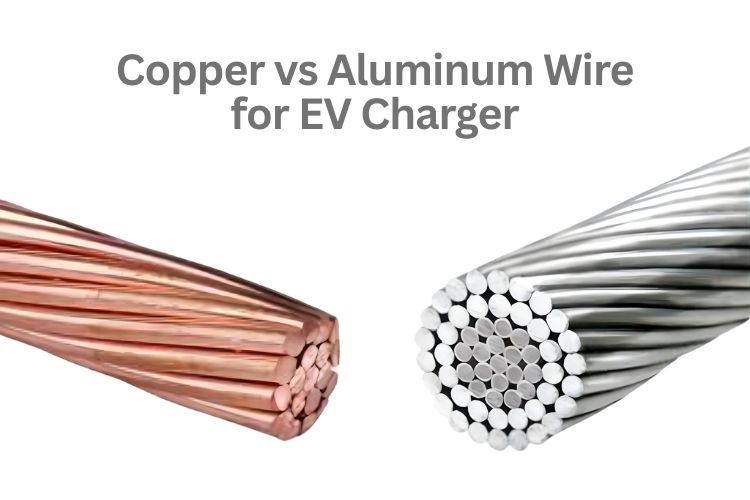
You just dropped serious money on your dream EV. The guilt-free acceleration, the quiet morning departures, the smug feeling every time you drive past a gas station. It’s all perfect.
Then the electrician’s quote lands in your inbox. And suddenly you’re staring at a line item that reads like a small car payment, drowning in wire gauge numbers you never asked to understand. Your brother-in-law mentions aluminum is “way cheaper.” Your neighbor swears copper is the only safe choice. Google serves up horror stories from the 1970s about house fires. Now you’re stuck, paralyzed between fear and your budget.
Here’s what nobody tells you: This isn’t really about wire. It’s about trust. You need to know that the invisible system feeding thousands of dollars of technology in your driveway won’t become a safety hazard while you sleep.
We’re going to match your very real feelings with cold, hard electrical code facts. By the end, you’ll know exactly what to ask for, why the answer actually matters, and how to sleep soundly knowing you made the right call.
Keynote: Copper vs Aluminum Wire for EV Charger
Copper remains the gold standard for residential EV charger installations under 50 feet due to superior conductivity, universal compatibility, and straightforward installation. Aluminum offers legitimate cost savings on longer runs but demands AA-8000 series alloy, AL/CU-rated terminals, antioxidant compounds, and torque-to-spec connections at every termination point. The hybrid approach, aluminum feeders transitioning to copper pigtails at a disconnect or subpanel combines economic efficiency with safety compliance when executed by qualified electricians following NEC Article 625 continuous load requirements.
The Real Question Behind the Question: Safety or Savings?
The Price Gap You Can’t Ignore
Let’s name the elephant in the room. Aluminum wire can run 30-50% less than copper for the same electrical job. On paper, that’s a difference of $1.06 per foot for 6-gauge copper versus $0.60 per foot for 4-gauge aluminum. Multiply that across a 75-foot run to your detached garage, and you’re looking at real money. Sometimes over $100 saved on wire alone.
This isn’t about being cheap. You just spent $45,000 on a car. This is about being smart with a budget that’s already stretched thin between the vehicle payment, potential panel upgrades, and the charger itself.
The Fear That’s Keeping You Up at Night
Here’s the truth most people won’t say outright: You’re not really worried about wire gauge tables. You’re worried about fire. About damaging your expensive EV. About making a decision you can’t undo that puts your family at risk.
That fear is completely valid. The question is whether it’s based on outdated myths or current reality. And whether the person holding the wire cutters actually knows the difference.
Let’s Clear the Air: The Aluminum Wire Fire Myth vs. Modern Reality
Why Your Parents Warned You About Aluminum
Quick history lesson. In the 1960s and 70s, builders installed millions of feet of solid-core aluminum branch circuit wiring in American homes. Copper prices had skyrocketed, and aluminum looked like the budget-friendly solution.
Then houses started burning down. The Consumer Product Safety Commission eventually found that homes wired with that old aluminum had a fire risk 55 times higher than copper-wired homes. Lawsuits flew. Insurance companies panicked. An entire generation learned to fear aluminum wiring.
But here’s what changed.
What Changed and What Didn’t
Today’s aluminum is a completely different animal. The National Electrical Code now requires AA-8000 series aluminum alloy for residential electrical work. This modern formulation has dramatically improved creep resistance and elongation properties that make it far more stable under thermal cycling than the old AA-1350 series that caused the problems.
But here’s what didn’t change: aluminum still oxidizes instantly when exposed to air, creating a thin, invisible layer of aluminum oxide. And that oxide layer is an electrical insulator. If it forms between your wire and the terminal, you get a high-resistance connection. High resistance generates heat. Heat accelerates oxidation. It’s a vicious cycle that ends badly.
The wire itself isn’t inherently dangerous anymore. Bad connections absolutely are.
The Non-Negotiable Installation Rules
Both copper and aluminum are perfectly safe when sized correctly and landed on the right hardware. No exceptions, no shortcuts.
But aluminum demands a specific, multi-step ritual at every single connection point:
The wire must be modern AA-8000 series alloy, clearly marked on the jacket.
Every terminal and connector must be explicitly rated AL/CU, meaning it’s been tested and UL-listed for aluminum.
The installer must abrade the wire’s surface to break through existing oxide, then immediately apply an antioxidant compound like Noalox to prevent re-oxidation.
Every connection must be tightened to the manufacturer’s exact torque specification using a calibrated torque wrench. Not “good and tight.” Not “tight enough.” The exact inch-pound value printed on the terminal.
Skip any one of these steps, and you’ve just built a time bomb into your electrical system. There’s no such thing as a “safe” aluminum installation. Only a safe and skilled aluminum installation.
The Physics You Actually Need to Know (I Promise, No Equations)
The Water Pipe Metaphor That Makes It Click
Think of electrical conductivity like water flowing through pipes. Copper is a smooth, wide pipe. Water rushes through easily with minimal resistance.
Aluminum is a narrower, rougher pipe. To push the same amount of water through, you need a much thicker aluminum pipe to compensate for the added friction.
That’s it. That’s the entire concept behind why aluminum wire has to be physically larger than copper wire for the same electrical capacity.
What “61% Conductivity” Really Means for Your Wallet
Aluminum conducts electricity at roughly 61% of copper’s efficiency. In practical terms, this means to safely carry 50 amps of continuous current, you might need 6-gauge copper wire but you’d need 4-gauge aluminum wire.
That thicker aluminum wire is stiffer. It’s harder to bend around corners. It’s trickier to pull through conduit. And critically, it might not physically fit into the terminal lugs on your EV charger or circuit breaker.
Here’s the hidden twist your electrician already knows: sometimes the “cheaper” wire costs more in labor. Pulling larger, stiffer aluminum through tight conduit spaces can add 30-60 minutes to an installation. That labor cost can quietly eat into your material savings.
The Simple Sizing Comparison
| EVSE Rating | Min Circuit @ 125% | Copper Wire | Aluminum Wire | Material Cost Reality |
|---|---|---|---|---|
| 32A | 40A | 8 AWG | 6 AWG | Cu: $3.18/ft / Al: $1.80/ft |
| 40A | 50A | 6 AWG | 4 AWG | Cu: $3.18/ft / Al: $1.80/ft |
| 48A | 60A | 4 AWG | 2 AWG | Cu: Higher / Al: Lower |
Note the gauge jump. That’s not a trivial difference when you’re running 50 or 100 feet to a detached garage.
The Two Code Rules That Trump Everything Else
Rule #1: EV Charging Is a “Continuous Load”
The National Electrical Code defines a continuous load as anything that runs at maximum current for three hours or more. Your EV charger, which can take 4-10 hours to fully charge a battery, is the textbook example.
This matters enormously. The NEC requires that the branch circuit conductors and breaker be sized at 125% of the charger’s maximum load. Not 100%. Not 110%. Exactly 125%.
A 32-amp charger needs a 40-amp circuit.
A 40-amp charger needs a 50-amp circuit.
A 48-amp charger needs a 60-amp circuit.
This isn’t a suggestion. It’s how the code prevents your wiring from slowly cooking itself over thousands of hours of charging sessions. That 25% buffer is your safety margin against the relentless thermal stress of pushing maximum current hour after hour, night after night.
Rule #2: Voltage Drop Quietly Steals Your Performance
The NEC recommends keeping voltage drop to 3% or less on branch circuits, with a total of 5% including the main feeder. Long wire runs create voltage drop through simple physics. Resistance times distance equals lost voltage.
What does this mean for you? If your voltage drops too much, your EV charges slower than it should. You waste energy as heat in the wire. And you risk nuisance breaker trips when the circuit tries to compensate by drawing more current.
The solution: upsize your wire beyond the minimum code requirement, or switch to a larger aluminum feeder to maintain proper voltage across long distances. For a 100-foot run, this isn’t optional. It’s the difference between a charger that works as designed and one that frustrates you nightly.
When Aluminum Actually Makes Sense (and When It Doesn’t)
The Distance Decision Tree
Is your EV charger going on the wall right next to your electrical panel? Like, within 20 feet? Just use copper. The aluminum savings will be negligible, maybe $30-40 total, and the installation is dramatically simpler. Don’t overthink this one.
Running wire 75 feet to a detached garage? Now aluminum becomes genuinely compelling. The cost difference can easily exceed $100-150 on wire alone, and potentially much more if you’re running a higher-amperage circuit.
The Hybrid “Best of Both” Hack
Here’s the secret that experienced electricians use: You don’t have to choose between all-copper or all-aluminum.
Run aluminum for the long, expensive portion from your main panel to a junction box, disconnect switch, or small subpanel located near the charger. Then use a short copper pigtail for the final 6-10 feet to the EVSE itself.
This hybrid approach captures aluminum’s cost savings where they matter most, on the bulk of the run, and copper’s termination reliability and compatibility at the critical endpoint. It’s completely code-compliant and brilliantly practical.
The transition point must be in an approved enclosure with AL/CU-rated terminals. A high-quality disconnect switch is often the cleanest solution because it gives you a local shutoff for servicing the charger and provides robust, accessible terminals for the aluminum-to-copper splice.
The One Question That Overrides Everything
Before you decide anything, pull out your EV charger’s installation manual. Not the quick-start guide. The actual installation instructions.
Look at the wiring specifications. Many manufacturers, including Tesla Wall Connectors and ChargePoint units, explicitly state “copper wire only” or “copper conductors required” for direct termination.
If your manual says copper, the debate is over. Period. You can still use aluminum for the feeder run, but you absolutely must transition to copper before you reach the charger’s terminal block. Ignoring this requirement voids your warranty, violates NEC 110.3(B) which mandates following manufacturer instructions, and creates a genuine safety hazard.
Your Confidence-Building Action Plan
The Three Questions to Ask Every Electrician
Before you sign a contract, ask these three questions. Their answers will tell you everything you need to know about their competence:
“Can you provide quotes for both an all-copper installation and a hybrid aluminum installation, with itemized costs for materials, labor, and any transition hardware?”
If they can’t or won’t break down the costs, walk away. A professional should be able to show you exactly where your money is going.
“If we go with aluminum, what specific steps do you take at every connection? Do you use antioxidant paste and AL/CU-rated connectors?”
If they hesitate, if they say “we’ve always done it this way,” or if they claim antioxidant compound isn’t necessary, run. These are non-negotiable requirements for a safe aluminum installation.
“How are you accounting for the NEC’s 125% continuous load requirement and voltage drop calculations for this specific run length?”
If they look confused or give you a vague answer, they’re not qualified to install your EV charger circuit. This is basic code compliance, not advanced electrical theory.
Your EV Charger Installation Checklist
Start here, right now, before you call a single electrician:
Locate your EV charger’s installation manual. Read the wiring specifications section. Note any requirements for copper wire or specific terminal ratings.
Grab a tape measure. Walk from your electrical panel to where your charger will be mounted. Write down that distance. This single number determines whether aluminum even makes economic sense.
Get at least three itemized quotes. Make sure they specify wire type, gauge, installation method, and any transition hardware for aluminum installations.
Verify certifications. Ask if the electrician is familiar with NEC Article 625 and has experience with continuous-load circuits. If they’ve installed multiple EV chargers, they should be comfortable with these requirements.
The Honest Cost-Benefit Matrix
| Factor | Copper | Aluminum |
|---|---|---|
| Upfront Cost | Higher ($3-4/ft for 6AWG) | Lower ($1.80/ft for 4AWG) |
| Conductivity | Superior (100% IACS) | Good (61% IACS, requires upsizing) |
| Installation | Straightforward, universally compatible | Requires specialized skills and hardware |
| Long-Term Reliability | “Set and forget” with minimal maintenance | Excellent when installed correctly to spec |
| Best For | Runs under 50 feet, maximum peace of mind | Runs over 75 feet with skilled installer |
Conclusion: Power On with Clarity and Confidence
You started this journey in a fog, caught between fear of overspending and fear of making a dangerous mistake on something you never wanted to understand. Now you know the real story: Copper offers effortless reliability for short runs and universal compatibility with every component in your system. Modern AA-8000 aluminum is genuinely safe and dramatically more cost-effective for long runs, but only when a skilled electrician follows every step of the installation protocol without shortcuts.
Your actionable first step for today: Find your tape measure. Walk from your electrical panel to where your charger will live. Write down that number. If it’s under 50 feet, you’re probably going with copper and you can stop worrying. If it’s over 75 feet, start asking electricians the three questions from Section 7 to find someone who actually knows how to work with aluminum safely.
You bought a car that represents the future. Now you have the knowledge to power it safely and smartly. The confusion is gone. The confidence is yours.
Aluminum Wire vs Copper for EV Charger (FAQs)
Why do EV chargers require copper wire?
No, EV chargers don’t universally require copper for the entire circuit. Most manufacturers specify copper-only terminations at the charger itself due to terminal lug ratings. You can absolutely use aluminum for the main circuit run from your panel, then transition to copper using a disconnect box or subpanel with AL/CU-rated terminals for the final connection.
Can you use aluminum wire for a Level 2 EV charger?
Yes, but only if you follow the hybrid approach. Modern AA-8000 series aluminum is code-compliant for the feeder circuit, but you must transition to copper before reaching the charger using AL/CU-rated hardware, antioxidant compound, and torque-to-spec connections. Direct aluminum termination at most residential EVSEs violates their listing and creates serious safety risks.
Is aluminum wiring safe for high-amperage EV charging?
Yes, when installed correctly by a qualified electrician. The key phrase is “when installed correctly.” Aluminum requires AA-8000 series wire, AL/CU-rated terminals at every connection, antioxidant compound to prevent oxide formation, and torque wrench tightening to exact specifications. Skip any step and you create a fire hazard through thermal cycling and connection degradation.
How much cheaper is aluminum wire than copper for EV installation?
Raw wire cost runs about 40-45% less for aluminum. For a 75-foot run requiring 4-gauge aluminum versus 6-gauge copper, you’ll save roughly $100-120 on wire alone.
However, add $35-50 for Noalox compound, $25-40 for AL/CU-rated connectors, and $50-150 for a proper disconnect or junction box. True net savings range from $0 on short runs to $70-150 on very long runs after accounting for specialized transition hardware.
What wire gauge do I need for a 50-amp EV charger?
For a 50-amp circuit (needed for a 40-amp continuous-load charger per NEC’s 125% rule), you’ll need 6 AWG copper or 4 AWG aluminum. The aluminum must be upsized by two gauge numbers to match copper’s ampacity. Both require 75°C-rated insulation like THHN or XHHW-2. Always verify your specific charger’s manual for manufacturer requirements.
Do I need to use anti-oxidant paste on aluminum wire connections?
Absolutely yes. Aluminum forms a non-conductive aluminum oxide layer instantly when exposed to air. This oxide creates high resistance that generates dangerous heat. You must abrade the wire surface to break the oxide, then immediately apply antioxidant compound like Noalox or Ox-Gard to prevent re-oxidation. This step is mandatory at every aluminum connection, without exception.