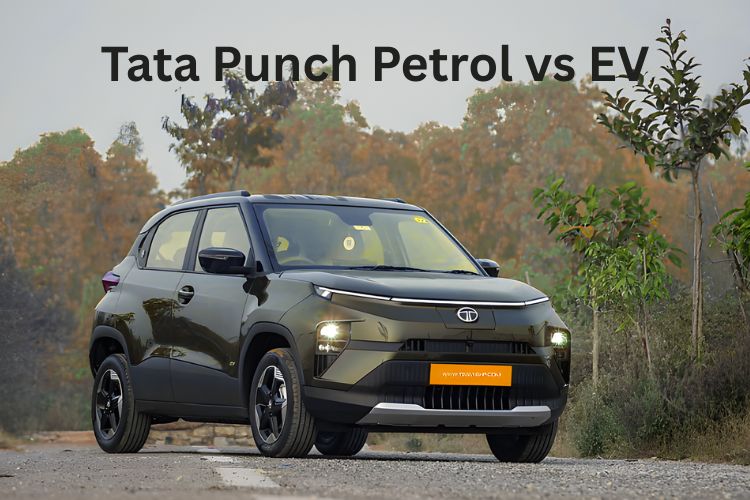
You’re standing in the Tata showroom, staring at two nearly identical red Punches. Your palms are sweating. Your wallet feels heavy.
One looks safe. Familiar. You know how petrol works. Your dad drove petrol. Your uncle still swears by it. The other one whispers promises of never visiting a fuel pump again, of silent mornings, of watching your neighbor’s face when you tell them your fuel bill is ₹200 a month.
But the internet isn’t helping. One forum says the EV will save you lakhs. Another says the battery will die in three years and cost you a kidney to replace. Your brain is melting.
Here’s the truth nobody’s saying clearly enough: this isn’t about picking the “good” car versus the “bad” car. You’re choosing between two completely different lives. And we’re going to use real numbers, real break-even timelines, and real-world honesty to figure out which life fits yours.
Keynote: Tata Punch Petrol vs EV
The Tata Punch petrol and EV represent two fundamentally different ownership experiences built on separate platforms. The petrol offers lower upfront cost, universal refueling convenience, and stable resale value. The EV delivers 90% lower running costs, superior refinement, and advanced safety features. Neither is universally better. Your choice depends entirely on charging access, daily driving patterns, and ownership timeline. For city-focused buyers with home charging keeping the car 5+ years, the EV wins financially. For budget-conscious buyers or those without charging infrastructure, petrol remains the pragmatic choice.
What This Choice Actually Means: Two Different Mornings
The Hidden Question You’re Really Asking
Strip away the brochures and the YouTube reviews. This decision isn’t really about horsepower or boot space or even the badge on the steering wheel.
It’s about daily peace of mind.
The petrol Punch is your favorite old jeans. Comfortable. Proven. You can fill it anywhere, anytime, in five minutes flat. It hums and vibrates in that honest, mechanical way that some people genuinely love. There’s a connection there, a conversation between you and the engine.
The EV Punch is different. It’s waking up every morning to a full battery, like your phone but for your car. It’s the unnerving silence at red lights where you can actually hear your music. It’s watching your monthly fuel budget drop from ₹4,000 to ₹400 and using that difference for literally anything else.
Neither choice is wrong. But one fits your actual daily reality, and we’re about to figure out which.
The Trade You’re Making
The petrol version trades higher running costs for total freedom. You pay ₹6.31 every single kilometer you drive, but you never plan a refuel. You never think about charging. Any pump, any highway, any time.
The EV trades that spontaneity for financial efficiency. You’ll pay roughly ₹0.66 per kilometer. That’s nearly 90% cheaper to run. But you’ll need to plan. You’ll need a parking spot with a plug. You’ll need to think about where you’re going tomorrow.
And here’s the reassurance you need: both cars earned 5-star safety ratings. The petrol got 5 stars from Global NCAP. The EV got 5 stars from Bharat NCAP with even higher scores. Your family is equally safe in either. That question is off the table.
The Money Reality: Stop Guessing, Start Calculating
The Sticker Shock That Makes You Hesitate
Let’s not dance around this. The EV starts at ₹9.99 lakh ex-showroom. The petrol starts at ₹5.50 lakh. That’s a ₹4.5 lakh chasm staring at you from the price board.
For most people reading this, ₹4.5 lakh isn’t monopoly money. That’s a family vacation. That’s wedding expenses. That’s the down payment on a flat. It’s real.
And here’s the part that changes everything: the price you see today on that showroom sticker isn’t the price you actually pay over the years you’ll own this car.
What Each Kilometer Actually Costs You
Let’s do honest math with real-world numbers, not brochure fairy tales.
Petrol reality: In city traffic, the 1.2-liter Revotron engine delivers about 11 kilometers per liter. Not the ARAI claimed 20.09 kmpl. Real roads, real AC, real you. At ₹100 per liter, that’s ₹9.10 for every kilometer you drive.
EV reality: The long-range 35 kWh battery gives you roughly 280 kilometers on a full charge in mixed city driving. At ₹8 per unit of home electricity, a full charge costs ₹280. That works out to ₹1 per kilometer.
That’s not a typo. One rupee versus nine rupees. Every single kilometer.
| Distance | Petrol Cost | EV Cost | Your Savings |
|---|---|---|---|
| 1,000 km | ₹9,100 | ₹1,000 | ₹8,100 |
| 10,000 km | ₹91,000 | ₹10,000 | ₹81,000 |
| 50,000 km | ₹4,55,000 | ₹50,000 | ₹4,05,000 |
Over 50,000 kilometers, you save more than the entire upfront price difference. But that’s only if you charge at home. Public fast charging erases some of that magic but still beats petrol on most days.
The 5-Year Truth: Total Cost of Ownership
Spreadsheets don’t lie. Let’s talk about the full 5-year, 75,000-kilometer ownership picture.
Service costs tell a quiet story most people miss. The petrol Punch needs oil changes, air filter replacements, spark plugs, exhaust system checks. Over 5 years and 75,000 kilometers, you’re looking at roughly ₹23,500 in scheduled service costs. Add annual service visits at ₹7,000 to ₹8,000 each.
The EV has no engine oil. No spark plugs. No exhaust. Service is checking tires, brakes, and software updates. Estimated annual cost? Around ₹5,000 maximum.
Here’s the complete 5-year picture comparing similar “Adventure” trim levels:
Petrol Adventure AMT: On-road price of ₹8.68 lakh plus ₹4.73 lakh in fuel plus ₹23,500 in service equals ₹13.65 lakh total.
EV Adventure 3.3: On-road price of ₹12.40 lakh (after road tax waiver in most states) plus ₹49,500 in electricity plus ₹12,500 in service equals ₹13.02 lakh total.
After 75,000 kilometers, you’ve saved ₹63,000 by going electric. You’ve broken even and are now driving cheaper than petrol.
But. And this is a massive but. This calculation assumes you keep the car long enough to hit that break-even point of roughly 73,000 kilometers. For someone driving 15,000 km per year, that’s nearly 5 years. If you’re the type who flips cars every 3 years, that upfront cost still stings.
How They Actually Feel: The Vibe Check
The Familiar Hum of Petrol
The 1.2-liter Revotron engine is peppy enough for city errands and highway merges. It’s light. Predictable. You know exactly what you’re getting because it’s the same motor used in the Altroz, Tiago, and Tigor.
The AMT gearbox does its job in traffic without wearing out your left leg. Sure, it can be a bit chatty during gear changes, hunting for the right ratio in stop-and-go traffic. But it’s honest work.
There’s something real about hearing the engine respond when you press the accelerator. Feeling it work. Some people genuinely love that mechanical conversation between foot and motor. It’s not refinement. It’s connection.
The Silent Surprise of Electric
Instant torque feels like the laws of physics took a coffee break. You press the pedal. The car surges. No lag. No revving. No drama. Just smooth, addictive acceleration that makes merging into traffic feel like a video game you’re winning.
The cabin stays eerily calm. At red lights, there’s no vibration humming through the steering wheel. No engine noise fighting with your music or your passenger’s voice. Just silence.
It’s a different kind of premium. Not leather seats and chrome trim. Silence and smoothness. The absence of noise becomes its own luxury.
First-time EV drivers almost always grin. That instant punch of torque paired with zero engine noise creates this absurd, delightful sensation. Like a silent go-kart built for adults. It’s just fun in a way petrol can’t match.
The Range Question: Killing the Fear, Facing the Facts
How Far Does the EV Really Go?
The brochure will tell you 421 kilometers for the long-range version. Beautiful number. Frame it.
Real life delivers 216 to 242 kilometers in mixed city driving with AC, traffic, and your actual right foot. Push it hard in 40-degree summer heat with the AC on full blast? Closer to 200 kilometers. Cruise gently on the highway? You might touch 300.
Context matters here. The average Indian urban commuter drives 30 to 50 kilometers per day. At 200 km of real-world range, that’s 4 to 7 days between charges for most people. You’re not tethered to a charging station every night. You’re topping up twice a week, maybe.
The “Will I Get Stuck?” Gut Check
Let’s be honest. If your life involves unplanned 300-kilometer highway dashes every weekend to visit family or chase business meetings, the EV will stress you out.
Charging at a 50 kW DC fast charger takes 56 minutes to go from 10% to 80%. That’s real time. Not imaginary. You can grab lunch, stretch your legs, make calls. But it’s not the 5-minute pump visit you’re used to.
At home with a 7.2 kW AC charger, expect about 5 hours for a full overnight charge. Think of it like charging your phone while you sleep. You plug in when you park at night. You unplug in the morning with a full battery. It becomes routine, invisible, automatic.
The petrol Punch fills its 37-liter tank in 5 minutes and gives you 600+ kilometers of real-world range. That freedom is tangible. Valuable. Not to be dismissed.
Do the Math for Your Actual Life
Stop guessing. Track your actual driving for one honest week. How many days do you drive over 100 kilometers? Over 200?
If 90% of your driving is city loops under 100 kilometers, the EV becomes absurdly practical. You’ll legitimately never visit a fuel pump again. That mental load just vanishes.
If you take frequent long weekend trips without advance planning, the petrol removes that stress. No judgment. Just fit.
The Daily Life Integration: Plugs vs Pumps
The EV Lifestyle: Home Charging Changes Everything
Imagine never planning a “fuel run” again. You just plug in at night. Like your phone. You wake up full every morning. That’s it. The mental load of watching your fuel gauge and planning pump visits just evaporates.
Here’s the deal-breaker reality: you absolutely need a dedicated parking spot with electrical access. Live in an apartment with shared, rotating parking? This won’t work. Full stop. Home charging isn’t a nice-to-have feature. It’s the entire foundation of EV ownership.
Public fast charging exists. It’s growing. But relying on it daily is expensive and stressful. Finding a working charger, waiting 56 minutes, paying ₹20+ per unit instead of ₹8 at home. That erases most of your savings and all of your convenience.
The Petrol Freedom: The 5-Minute Escape Hatch
Any pump. Any time. Five minutes. You’re good for 600 kilometers. That’s genuine freedom from planning. From apps. From wondering if the charger will be occupied or broken.
But let’s not romanticize watching those rupees spin at the pump, knowing every kilometer just cost you ₹9 and there’s nothing you can do about it except drive less.
The familiarity is real, though. Any roadside mechanic can fix a petrol engine. Parts are everywhere. The used car market understands petrol. Resale is simple. These aren’t small things.
The Features Reality: What You Actually Get
Tech and Creature Comforts
Both versions get the 10.25-inch touchscreen. Both get connected car features, ambient lighting, and all the modern Tata tech. The company hasn’t shortchanged either powertrain on the basics.
The EV adds its own tech layer: regenerative braking modes you control with paddle shifters, detailed battery and range displays, app-based climate pre-conditioning so your cabin is cool before you even walk to the car. These are EV-specific features that actually improve daily life.
The petrol gets traditional gauges and simpler operation. Sometimes less tech means less to troubleshoot. There’s value in that simplicity for buyers who just want a car that works without an app.
The Surprising Parity
Boot space is identical. 366 liters in both. The EV’s battery pack didn’t eat your luggage space because it’s built on a dedicated electric platform from the ground up, not a converted petrol platform. That’s huge. Most EVs sacrifice cargo room. This one doesn’t.
Safety is genuinely equal. The petrol earned 5 stars from Global NCAP with 16.45 out of 17 points. The EV earned 5 stars from Bharat NCAP with 31.46 out of 32 points, the highest score ever recorded by that agency at the time. Both protect you seriously.
Build quality, materials, the overall Punch-ness of the vehicle is the same. You’re not getting a lesser car with either choice. You’re getting two versions of a genuinely well-built product.
The Final Verdict: Your Gut, Your Data, Your Decision
The Questions Only You Can Answer
Can you charge at home overnight? If the answer is no, the EV conversation is basically over. Everything else becomes irrelevant.
What’s your daily drive really like? 40 kilometers in city traffic or 150 kilometers mixed with highway stretches? Be honest. Check your odometer.
How long are you keeping this car? Selling in 2 years or driving it for 7? The math changes completely based on your timeline.
Do you get genuine joy from silent, zippy, tech-forward driving, or do you value the proven, familiar simplicity of what you already know? There’s no wrong answer here. Just your answer.
The Simple Truth Table
| You’ll Love the Petrol Punch If… | You’ll Love the EV Punch If… |
|---|---|
| Your budget is tighter upfront and that ₹4.5 lakh difference matters now | You’re playing the long game and can absorb the higher initial cost |
| You take frequent, unplanned long highway trips | 90% of your driving is predictable city and suburb loops |
| You live somewhere without reliable home charging access | You have dedicated parking with charging capability |
| Familiarity and “any mechanic can fix it” brings you peace | Lower running costs and silent, zippy driving excite you |
| You want the lowest possible entry price, period | You’re optimizing for 5-year total cost, not today’s price tag |
One More Honest Thing
The EV isn’t “better” because it’s newer and electric. The petrol isn’t “worse” because it’s traditional. They’re tools for different lives.
Your neighbor’s choice doesn’t matter. Your colleague’s opinion doesn’t matter. What matters is your actual parking situation, your actual daily commute, and your actual financial horizon.
Conclusion: The Choice That Fits Your Life
We started with a price gap and a showroom panic. We ended up talking about your mornings, your driving patterns, and what actually brings you peace of mind. That’s the real comparison.
The EV wins on daily running costs by a landslide and delivers a driving experience that feels a generation ahead. But it demands home charging, careful planning, and a long ownership timeline to make financial sense. The petrol wins on flexibility and upfront affordability, with predictable resale value and zero range anxiety. But it bleeds ₹9 for every kilometer you drive, forever.
Your single actionable step right now: book test drives of both. Back to back. Same day. Feel the petrol’s familiar hum. Feel the EV’s unsettling silence and instant torque. Your gut will tell you which one smiles back at you.
This isn’t just about buying a car. It’s about choosing the rhythm of your next few years. Make the choice that lets you sleep well, drive happy, and never second-guess yourself at the next red light.
EV vs Tata Punch Petrol (FAQs)
Which is better Tata Punch petrol or EV for daily commute?
Yes, the EV is better for daily city commutes under 100 km. You’ll save ₹8 per kilometer driven and never visit a fuel pump again. But only if you have home charging access. Without that, choose petrol.
How long does Tata Punch EV take to charge at home?
About 5 hours for a full charge using a 7.2 kW home AC charger. Overnight charging is standard practice. At public 50 kW DC fast chargers, expect 56 minutes to go from 10% to 80%.
What is the real mileage of Tata Punch petrol in city?
Around 10 to 11 kilometers per liter in real city traffic with AC. The ARAI claims 20.09 kmpl, but that’s tested in ideal conditions no one actually drives in.
Does Tata Punch EV have enough range for highway trips?
Not comfortably for long, unplanned trips. Real-world range is 200 to 280 km depending on driving style and AC use. Fine for planned highway trips with charging stops. Stressful for spontaneous 400 km dashes.
How much money can I save with Tata Punch EV over petrol?
Roughly ₹8,000 per 1,000 km driven, assuming home charging at ₹8 per unit. Over 75,000 km and 5 years, total savings exceed ₹4 lakh in fuel and service costs combined. Break-even happens around 73,000 km.