You’re scrolling through your feed, and there it is again: another article about an $8,000 Chinese electric car. A whole car. For less than a down payment on the American EV you’ve been eyeing. That knot in your stomach tightens. Am I being ripped off? Is my country falling behind? Should I just wait?
The noise is overwhelming. Tariffs. Tax credits expiring. Charging infrastructure wars. Headlines screaming about tech dominance. Everyone’s picking sides like it’s a sports rivalry, and you’re just trying to figure out if going electric makes sense for your life and your wallet.
Here’s the truth most people miss: this isn’t about waving flags or picking Team USA versus Team China. It’s about understanding what’s actually real versus what’s marketing hype, what you can buy versus what you can’t, and what truly matters when you’re the one making the monthly payment.
We’re going to cut through the feelings with facts. Compare real price versus actual value. Decode the battery technology gap that explains everything. Face the policy reality that’s reshaping your options before you even walk into a showroom. And end with what this competition actually means for you, the person who just wants a great car that doesn’t cost a fortune to fuel.
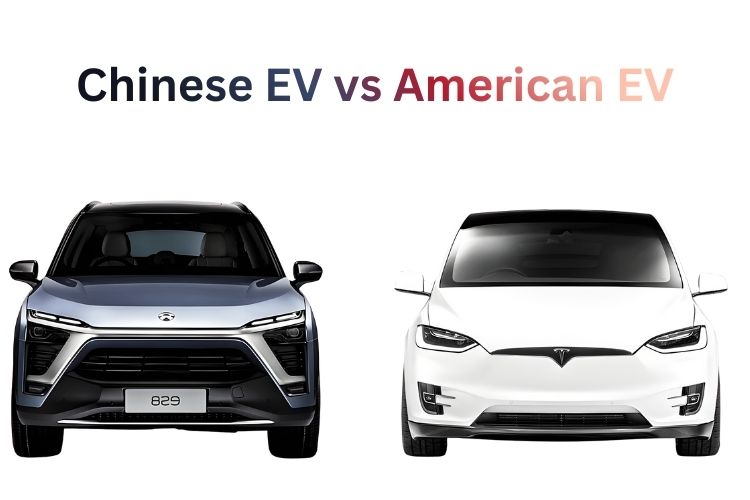
Keynote: Chinese EV vs American EV
Battery chemistry defines the electric vehicle revolution. LFP technology from China delivers unprecedented affordability and safety through iron-based cathodes that eliminate expensive cobalt. These batteries power 76% of global EV sales while lasting over 2,000 cycles. American automakers now adopt Chinese LFP innovations, narrowing the energy density gap to just 5-20% at pack level. The competition drives breakthroughs in solid-state batteries and sodium-ion alternatives. This technological convergence means better, cheaper EVs for everyone, regardless of manufacturing origin.
The Price Shock That Changes Everything
Why Your Wallet Is Having an Identity Crisis
The BYD Seagull resets the entire conversation about EV pricing. In China, it starts under $8,000. Eight thousand dollars. Meanwhile, the average new EV in America costs around $55,000. That’s not a price gap. That’s a different universe.
But here’s the catch that changes everything: those Chinese prices aren’t coming to America. Not even close. The 100% tariff wall erected by the U.S. government, combined with the strict Inflation Reduction Act sourcing rules, keeps that dream firmly offshore. When you add a 100% tariff to a $30,000 BYD, you’re suddenly looking at $60,000 before it even reaches a dealer lot. Some models, like certain BYD variants, face tariffs as high as 247.5%.
Let me show you what this actually means in real numbers:
| Vehicle Model | China Domestic Price | With 100% Tariff (U.S.) | Comparable U.S.-Built EV |
|---|---|---|---|
| BYD Seagull | ~$8,000 | ~$16,000+ | Chevy Bolt: $27,500 |
| BYD Seal | ~$20,000 | ~$40,000+ | Tesla Model 3: $38,990 |
| BYD Atto 3 | ~$18,000 | ~$36,000+ | Ford Mustang Mach-E: $40,000 |
The takeaway for your sanity: you’re not overpaying for patriotism or getting scammed. You’re paying for a completely different market structure, one shaped by decades of policy decisions, labor costs, and supply chain geography. The Chinese EV you see online for $10,000 simply doesn’t exist in any form you can legally buy in the United States.
Why Chinese EVs Cost Less (And Why That Actually Matters)
The Supply Chain Story Nobody’s Telling You Clearly
China doesn’t just make a lot of electric vehicles. In 2024, it manufactured 12.4 million EVs, representing roughly 70% of total global production. Its domestic brands captured 62% of all EVs sold worldwide. Within China itself, plug-in vehicles hit a staggering 47.9% market share in 2024.
But here’s what makes this dominance permanent rather than temporary: China controls approximately 80% of global battery cell production, nearly 85% of cathode materials, and over 90% of anodes. For LFP battery cathodes specifically, China produces over 98% of the world’s supply.
Think of it this way: they’re not just the chef cooking the meal. They own the farm where the ingredients grow, the mill that processes them, the grocery store that sells them, and the kitchen where everything comes together. This is what economists call vertical integration, and it’s the real reason for the price advantage.
UBS took apart a BYD sedan and found something shocking: a sustainable 25% cost advantage that had nothing to do with “cheap labor.” It came from battery chemistry dominance, manufacturing scale, and owning every step of the supply chain. When you don’t have to negotiate with suppliers or pay markup at each stage, your costs collapse.
The uncomfortable truth: this isn’t a temporary market distortion. It’s structural. It’s the result of $231 billion in government subsidies invested between 2009 and 2023, combined with two decades of focused industrial policy. American automakers aren’t just competing against Chinese companies. They’re competing against an entire nation’s strategic economic plan.
The Tech Gap Is Real (But Not What You Think)
China’s “Smartphone on Wheels” Advantage
Chinese EVs treat the car like a software platform from day one. Open a BYD or XPeng, and you’re stepping into an entirely different philosophy. In-car karaoke systems. Wild, customizable infotainment that updates monthly via over-the-air downloads. Facial recognition that adjusts your seat, mirrors, and climate settings the moment you sit down.
Some models come with integrated social media apps, productivity software, and AI assistants that actually feel like characters rather than robotic voice commands. It’s overwhelming at first, then oddly addictive. The car becomes an extension of your digital life, for better or worse.
American EVs? They’re cleaner. More minimalist. They prioritize driving dynamics and intuitive controls over feature explosion. It’s Apple versus Android all over again. Neither approach is objectively better. It depends entirely on whether you want a car that does everything or a car that does driving exceptionally well.
The Battery Innovation That’s Changing the Game
This is where the real divergence happens, and it explains almost everything about price and strategy.
BYD’s Blade Battery uses Lithium Iron Phosphate (LFP) chemistry, cuts costs by eliminating cobalt entirely, and passed the infamous nail-penetration safety test without catching fire. You can literally drive a nail through the battery cell, and it doesn’t explode. That matters when you’re parking 2,000 pounds of lithium in your garage every night.
Here’s what LFP gives Chinese automakers:
Cost: LFP cells run $70-$100 per kilowatt-hour versus $100-$130 for the Nickel Manganese Cobalt (NMC) chemistry most American EVs use.
Safety: LFP is thermally stable. It doesn’t enter thermal runaway nearly as easily as NMC, which means fewer dramatic battery fire headlines.
Longevity: LFP batteries handle over 2,000 full charge cycles compared to 1,000-1,500 for NMC. They last longer, period.
Supply chain: LFP relies on iron and phosphate, which are abundant globally, instead of cobalt, which comes from geopolitically unstable regions with serious ethical concerns.
The trade-off? Energy density. NMC packs more power into less space, giving you longer range from a smaller, lighter battery. But here’s the thing: that gap is closing. The cell-level density difference is about 30%, but advanced packaging techniques like BYD’s cell-to-pack design shrink the real-world difference to just 5-20% at the vehicle level.
And now? Tesla uses LFP in its standard-range Model 3. Ford is putting LFP in cheaper Mach-E variants. The innovation is crossing borders faster than anyone expected.
Where American EVs Still Dominate
Tesla’s Supercharger network remains the gold standard for road-trip confidence. Over 2,000 stations across North America, strategically placed, consistently functional, and now the SAE J3400 standard that every major automaker is adopting. This isn’t just infrastructure. It’s peace of mind.
American EVs win decisively on raw power and capability for specific uses. Rivian’s R1T can tow 11,000 pounds. The Ford F-150 Lightning turns a construction site into a mobile power station. These aren’t just cars. They’re work tools, adventure machines, status symbols wrapped in American truck culture.
The software experience in American EVs feels polished and purposeful. Tesla’s interface is intuitive after five minutes. Ford’s system doesn’t require a YouTube tutorial. Chinese EV software can sometimes feel like it was designed by a committee that couldn’t agree, then translated by someone who speaks English as a fourth language. Powerful but occasionally baffling.
The Policy Reality Check: What You Can Actually Buy
The Tariff Wall Keeping Chinese EVs Out
President Biden’s 100% tariff on Chinese-made EVs, implemented in 2024, isn’t a negotiating position. It’s a wall. A $25,000 Chinese EV becomes $50,000 before shipping costs, dealer markup, and compliance modifications for U.S. safety and emissions standards.
But it gets more complex. The Inflation Reduction Act includes “foreign entity of concern” provisions that restrict battery sourcing from China, even for vehicles assembled in North America. If your battery or its critical minerals come from Chinese companies, your vehicle doesn’t qualify for the $7,500 federal tax credit. This isn’t just about finished cars. It’s about strangling the supply chain at every level.
The 2025 Credit Sunset Buyers Are Feeling
Here’s the deadline pressure: federal EV purchase credits are scheduled to expire entirely on September 30, 2025. That means if you’re shopping today, you’re watching the clock tick down on $7,500 in instant savings.
This isn’t just inconvenient. It’s reshaping the entire market. General Motors took a $1.6 billion charge in early 2025, realigning production capacity because they know demand will crater the moment those credits vanish. Buyers who were on the fence are either rushing to purchase before the deadline or deciding to wait and see what happens to prices after the credits disappear.
The lesson: U.S. EV policy is short-term and reactive, changing with every election cycle. Chinese EV policy has been consistent for 20 years.
What This Means for Your Shopping List
Your actual choices at a U.S. dealership are filtered through these policy layers before you even start comparing cupholders.
| Vehicle Origin | Tariff Status | IRA Credit Eligible? | Estimated Out-the-Door Price |
|---|---|---|---|
| China-Built (BYD, NIO) | 100-247.5% tariff | No | Not available in U.S. |
| Mexico/NA-Built (Tesla, others) | No tariff (USMCA) | Depends on battery sourcing | $35,000-$65,000 |
| U.S.-Built (Ford, GM, Rivian) | No tariff | Often yes (if MSRP <$80K) | $27,500-$75,000 |
The bottom line: policy decides what you see on the lot. The market competition you’re reading about online doesn’t exist in the showroom you can actually walk into.
The Charging Anxiety Nobody’s Solving Correctly
The American Charging Landscape
44% of Americans say public charging infrastructure is insufficient. They’re not wrong. Outside of Tesla’s network, public charging in the U.S. is a fragmented mess of competing apps, broken chargers, and wildly inconsistent pricing.
But here’s the shift that’s happening right now: the North American Charging Standard (NACS), Tesla’s connector, became the official SAE J3400 standard. Ford, GM, Rivian, Hyundai, Mercedes, and virtually every major automaker have announced they’re switching to NACS on future models. Tesla is opening its Supercharger network to all brands.
This is the infrastructure equivalent of everyone finally agreeing to use the same phone charger. The fragmentation is slowly ending. By 2026, the charging experience in America should be dramatically better than it is today.
China’s Urban Planning Advantage
While Americans stress about finding a working charger, China integrated charging infrastructure into urban planning from day one. As of 2022, China had built over 1 million public chargers, representing 51% of the global total. The government’s current three-year action plan targets 28 million charging facilities by the end of 2027.
This isn’t just more chargers. It’s treating charging like a utility, like street lights or sewer systems. State-owned power companies build and operate much of the network, removing the profit-margin pressure that makes U.S. charging companies cherry-pick only the most lucrative locations.
The result: charging becomes so convenient you stop thinking about it, the same way you don’t think about where you’ll find a gas station.
| Standard | Region | Max Power | Connector Type | U.S. Availability |
|---|---|---|---|---|
| SAE J3400 (NACS) | North America | 250 kW+ | Tesla connector | Widespread & growing |
| CCS1 | North America | 150-350 kW | Combined | Widespread |
| GB/T | China | 250 kW+ | Chinese standard | Not compatible |
| ChaoJi | China (emerging) | 900 kW | Next-gen Chinese | Not available |
The Hidden Cost Bomb Nobody Discusses
In Germany, compact EVs now cost over 50% more than comparable gas cars. DC fast charging in both Europe and the United States has reached a price per mile that exceeds gasoline in many markets, especially when you’re paying commercial charging rates instead of home electricity.
This undermines the fundamental economic case for EVs unless you can charge at home. That’s the real divide in EV adoption: homeowners with garages versus everyone else. If you’re renting an apartment or parking on the street, the EV value proposition collapses. You’re paying luxury car prices to fuel at commercial rates.
Nobody wants to say this out loud, but it’s the truth: EVs, as currently structured, are a middle-class homeowner’s technology. Until that changes, mass adoption stays stuck.
The Safety and Quality Question Everyone’s Whispering
The Perception vs. Reality Gap
Let’s address the elephant: many Americans assume “cheap Chinese EV” equals “unsafe deathtrap.” It’s the same assumption people made about Japanese cars in the 1970s, then Korean cars in the 1990s. It was wrong then. It’s wrong now.
BYD and NIO models have earned high safety ratings in rigorous European crash tests, meeting or exceeding the standards set by Volkswagen, BMW, and Mercedes. The Euro NCAP, which doesn’t pull punches, has given Chinese EVs four and five-star ratings. The vehicles are structurally sound, the engineering is legitimate, and the safety systems work.
Where Concerns Are Actually Valid
Data privacy is a legitimate question with no easy answer. Your car collects data on where you drive, how you drive, and potentially what you say inside the cabin. Who controls that data? Where is it stored? Can a foreign government access it? These aren’t paranoid questions. They’re reasonable concerns about a connected vehicle sending information across the Pacific.
Parts availability and service networks remain a real risk for early adopters. If you buy a NIO in Europe today and need a replacement part in two years, will it arrive in a week or six months? Established brands have century-old dealer and parts networks. New Chinese entrants are building theirs from scratch.
American EVs’ Trust Advantage
This is where the American EV advantage becomes intangible but powerful. It’s not just the car. It’s the ecosystem.
You know there’s a Ford dealer 20 minutes away. You’ve heard of Tesla, seen their service centers, and read owner reviews from people in your city. There’s familiarity, which translates to trust, which translates to willingness to spend $50,000 on a seven-year loan.
That trust is worth real money. It’s why Tesla can charge a premium despite Chinese competitors offering similar specs at lower prices in markets where both are available. Brand equity isn’t irrational. It’s the rational response to uncertainty.
Why This “Battle” Is Actually Great News for You
The Innovation Pressure Cooker
U.S. EV prices have dropped significantly in the past two years. Tesla cut Model 3 prices by over $10,000. Ford slashed Mach-E prices. GM is launching the Equinox EV at $35,000. This isn’t charity. It’s a direct response to the looming threat of Chinese competition.
Think of it like the smartphone wars. When Apple and Android competed fiercely, we all won with better phones, more features, and lower prices every single year. The same dynamic is playing out in EVs. Competition forces faster innovation, better value, and more choices.
The alternative, a U.S. market with no foreign competition, would give you three overpriced options from legacy automakers who have no incentive to improve. That’s not speculation. That’s what the American auto industry looked like in the 1970s before Japanese imports forced change.
Technology Crossing Borders
LFP batteries, pioneered and perfected in China, are now in Tesla Model 3s sold in California and Ford Mach-Es built in Mexico. Chinese supply chain innovation is making cheaper American EVs possible. This isn’t defeat. It’s the global economy working exactly as it should.
The expiration of federal tax credits might be painful in the short term, but it forces a crucial question: can automakers build EVs that people want to buy without $7,500 in government bribes? If the answer is no, the industry was never sustainable. If the answer is yes, we’re about to see real innovation in cost reduction and value delivery.
The Three Painful Truths U.S. Automakers Must Face
First truth: Stop playing feature catch-up and redefine what a great digital driving experience means for Western consumers. Chinese infotainment systems are impressive but often overwhelming. There’s an opportunity to build software that feels intuitive, not like a smartphone exploded inside your dashboard.
Second truth: As one industry expert bluntly stated, competing with China requires “disrupting themselves, on a department-by-department level.” You can’t innovate by committee. You can’t build the future while protecting the past. Legacy automakers need to burn their organizational charts and rebuild from first principles.
Third truth: Stop treating EVs as luxury items. The mass market demands affordable options under $30,000, and Chinese automakers have proven it’s possible right now. If American companies can’t or won’t build at that price point, they’re ceding 60% of the market before the race even starts.
Conclusion: The Road Ahead Isn’t What You Expect
We started with that sinking feeling of being left behind, watching $8,000 Chinese EVs and wondering if your $55,000 American option is a ripoff. But the reality is more nuanced, more interesting, and ultimately more hopeful than the headlines suggest.
China didn’t just build better cars. It built an unbeatable ecosystem through two decades of consistent policy, massive subsidies totaling $231 billion, and ruthless focus on owning the entire supply chain from lithium mine to finished vehicle. That’s not something you replicate in a single product cycle.
America faces a choice: business as usual, which means slow decline, or painful but necessary transformation. The infrastructure is being built. The technology is advancing. The competition is forcing change. But the window is closing.
The next time you see any EV, ask yourself this: “Does this feel like a computer with wheels or a car with computers?” That distinction tells you everything about who’s winning the innovation race and what kind of future we’re driving toward.
Remember, American innovation has faced existential threats before. Sputnik terrified a generation, then we landed on the moon. Japanese auto imports nearly destroyed Detroit, then forced the quality revolution that saved it. What feels insurmountable today could become the catalyst for America’s next great industrial renaissance.
The question isn’t whether China is ahead right now. The question is whether we have the courage, the political will, and the strategic focus to respond with the same boldness that built the automotive industry in the first place. That answer isn’t written yet. It’s being written right now, in boardrooms, in Congress, and in the choices you make at the dealership.
American EV vs Chinese EV (FAQs)
Are Chinese EVs better quality than American EVs?
No, they’re different. Chinese EVs excel at features, affordability, and innovative battery tech like LFP chemistry. American EVs lead in software polish, charging infrastructure (Tesla), and capability for towing and off-road use. European crash tests show Chinese EVs meet Western safety standards, debunking the “cheap equals unsafe” stereotype. Quality depends on the specific model and what matters most to you.
Why are Chinese electric cars so cheap compared to American?
China controls 80% of battery production and 98% of LFP cathode materials, creating massive supply chain cost advantages. The government invested $231 billion in subsidies from 2009-2023, allowing companies like BYD to achieve manufacturing scale American brands can’t match. Labor costs play a smaller role than battery dominance and vertical integration. A UBS teardown found a sustainable 25% structural cost advantage.
What battery technology do Chinese EVs use vs American?
Chinese EVs primarily use Lithium Iron Phosphate (LFP) batteries, which cost $70-$100 per kWh, last over 2,000 charge cycles, and offer superior safety. American EVs traditionally used Nickel Manganese Cobalt (NMC) batteries at $100-$130 per kWh with higher energy density but shorter lifespan. The gap is closing as Tesla and Ford now use Chinese LFP in standard-range models.
Can you buy Chinese EVs in the United States?
No. President Biden’s 100% tariff on Chinese-made EVs makes them economically impossible to import. A $30,000 BYD becomes $60,000 before shipping and compliance costs.
Additionally, Inflation Reduction Act rules exclude vehicles with Chinese battery components from federal tax credits. Chinese brands like BYD and NIO have no official U.S. presence and no plans announced.
How do Chinese EV subsidies compare to American tax credits?
China invested $231 billion in direct EV subsidies, infrastructure, and supply chain support from 2009-2023, creating a complete ecosystem. The U.S. offers a $7,500 consumer tax credit for new EVs and $4,000 for used, focused on demand rather than supply chain.
However, U.S. credits expire September 30, 2025, creating market uncertainty Chinese policy doesn’t have.